Thursday 19th September 2024

Over fifty keen, energetic, enthusiastic young bus professionals working in the bus industry met up for just over 24 hours in Cambridge on Thursday and Friday last week for the network’s latest conference.
Over the the last 13 years I’ve had the pleasure of jointly hosting these proceedings and, as always, came away enthused and reassured the industry has some excellent up and coming young people with passion and determination to deliver excellent bus services whatever the regulatory framework.
Here’a snapshot of last week’s proceedings.
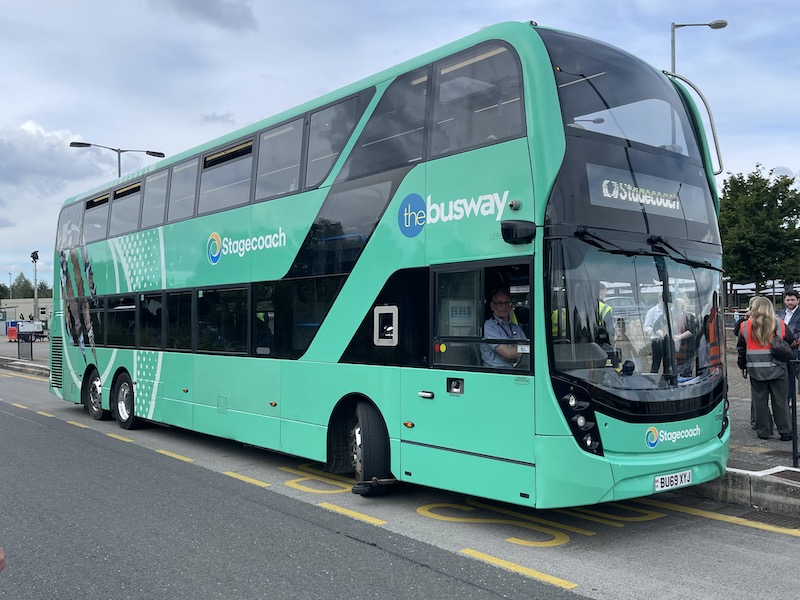
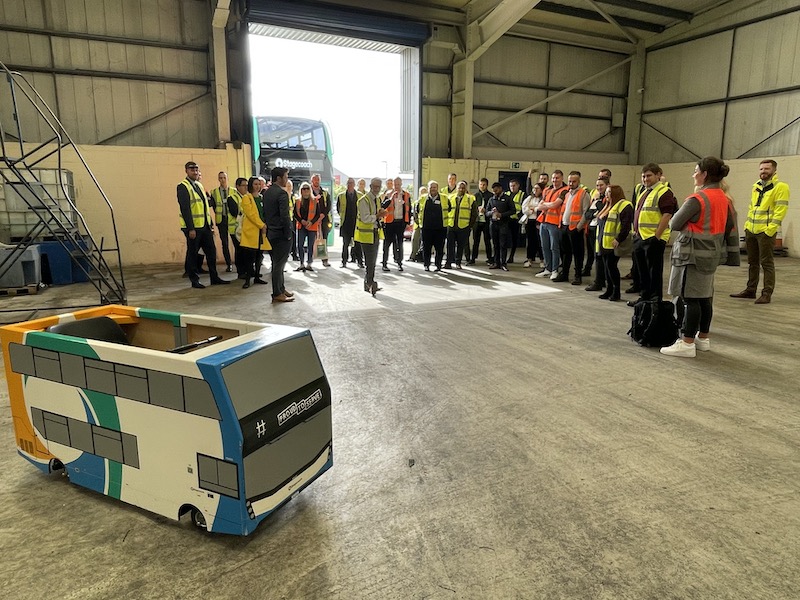
We kicked off with an afternoon visit to Stagecoach’s Cambridge depot as well as a trip up to St Ives and back on Cambridgeshire’s well established Busway. Stagecoach East Managing Director, Darren Roe, welcomed us to the garage which was the first to receive ZEBRA funding for 30 EV double deck buses introduced in May last year on the city’s Park & Ride routes and Citi route 2.
Fun fact is each bus uses 1.2 kWhr of electricity per kilometre which is equivalent to cooking a chicken in an oven for an hour. Serious fact is the buses cost around £500,000 each and, in addition to Stagecoach’s investment, the project has been part funded by the Cambridgeshire and Peterborough Combined Authority (CPCA), the Greater Cambridge Partnership (GCP) and the DfT. CPCA Mayor Johnson aims to have all buses and taxis zero emission by 2030. Quite a target.

The Busway opened in 2011, two years after the original plan due to high profile issues with the construction but that’s now all in the past and following the opening of Cambridge North railway station in 2017 and a new section of Busway to serve it (also on the old tracked alignment of the St Ives branch line as the original Busway is) numbers of passengers have continued to increase.
Our trip to St Ives and back on Thursday afternoon saw double deck triaxle buses on route B, with a capacity of 130, well loaded with one even showing Bus Full in the destination, because it was.

Busway buses, each equipped with an guide wheels, are based at Stagecoach East’s Fenstanton depot. Operations Manager Dan, who is based there, and an expert on all things Busway (having been involved since construction started in 2007) and Company Operations Director Ross gave an insight into the history and operational background to the Busway as we sped along with driver Simon demonstrating the no hands technique of driving.

Back at the garage Darren pointed out the first of what will be three autonomous driven buses for a trial linking a Park & Ride site with the Biomedical campus next year as well as telling us about the company (800 staff, 300 buses, four garages and an outstation) operating in the Combined Authority area as well as Bedford and surrounding areas including into Suffolk.

Thursday evening’s after dinner speaker was Bill Hiron, owner and managing director of the much respected Rochford based Stephenson’s of Essex and associated companies (eg NIBS Buses and Galloway Coach Travel). Bill has vast experience having worked for both large Group companies as well as smaller independents and has been the chair of ALBUM (the Association of Local Bus Managers) representing the SME sector since 2018. Bill received a well deserved MBE for his services to the industry earlier this year.

Bill passed on his key learning tips from his long and varied career: try and learn something about everything (eg schedules, finance, engineering); network among colleagues in the industry and make contacts; attention to detail is crucial; learn from great bosses; data is useful but riding buses and talking to colleagues and trade union reps with experience on the ground is vital too; keep it simple; always tell the truth; set a realistic budget; cost cutting is not a long term strategy; treat staff as real people; don’t rule out running your own business if the opportunity arises; watch out for occasional ‘game-changing’ opportunities; ‘turnover is vanity, profit is sanity’; “bus franchising” is not “franchising” it’s “contracting” and will only work if there’s a “shed load of money”.

Friday morning’s programme kicked off with Adam Leishman and Jonathan ZIebart from Ascendal Group. Ascendal may not be a familiar name in the British bus industry but company owner and founder Adam gave a very engaging and informative presentation explaining its origins and involvement across Australia, Hong Kong, Singapore and the USA as well as here in Britain where its Tower Transit operation became involved in the London bus scene in 2013 buying out First’s operations in east London and Westbourne Park.

These have now been sold on and Ascendal’s current bus industry involvement in Britain is through its ownership of Cambridge based Whippet. It also runs buses in the US and Chile and is the main operator in Hong Kong where its vision is to “inspire people to love public transport”.
Adam is a great advocate of the role of buses, particularly in our cities where he pointed out they are the ‘silver bullet’ solution to the problems of traffic congestion, emissions and air quality, income inequality, poor livability and road injuries/deaths.

Inevitably references to franchising were a common theme during the conference with both Adam and Jonathan being advocates of this model of bus provision so it was interesting to hear Adam comment he saw a real danger the current arrangements in Britain may lead to a “race to the bottom” of companies seeking to gain market share by under pricing their bids. Although this gives franchising authorities financial gain in the short term, in the medium to long term it’s not good news at all. Ascendal’s exit from the London market was timely with all major players currently reporting poor returns or even losses on their bus contracts and expectations TfL will have to fund significant increases in contract prices in future months.
Jonathan is the managing director at Whippet having had previous experience with TransPennine Express and working with First Group on rail bids and more recently working with Ascendal in Texas, Panama, Singapore and Chile and interestingly he also was conditional about his support of franchising as a model: “it has to be the right regime in the right circumstances”.
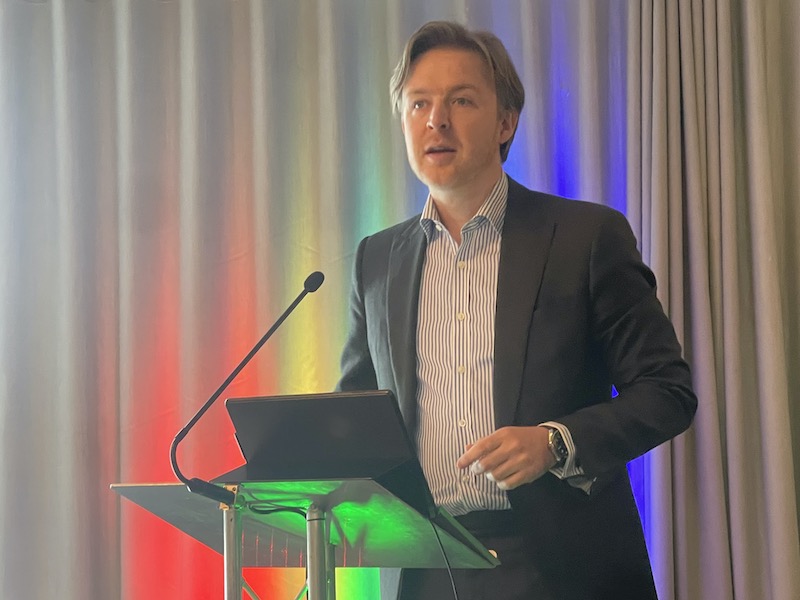
Next up was Claire Miles, Chief Executive of Stagecoach since last October. Claire gave a very personal account of her career path (financial services, Centrica, and Yell) which is always of interest to our young aspirational audience of delegates as well as explaining how she deals with the demands of a high powered job and looking after a family with two teenagers and two spaniels. Claire noted how Stagecoach has recently returned to its roots (routes?) as a British bus and coach operator and now has 24,000 employees, 8,500 vehicles and 120 depots. As someone who is passionate about customer insights and experiences she has been suprised just how little we know about our customers in the bus industry but she see’s this as an opportunity for the future with more digital ticketing and marketing but that we must ensure the product is down to earth and real notwithstanding the current uncertainties (eg future of the £2 fare cap and franchising).
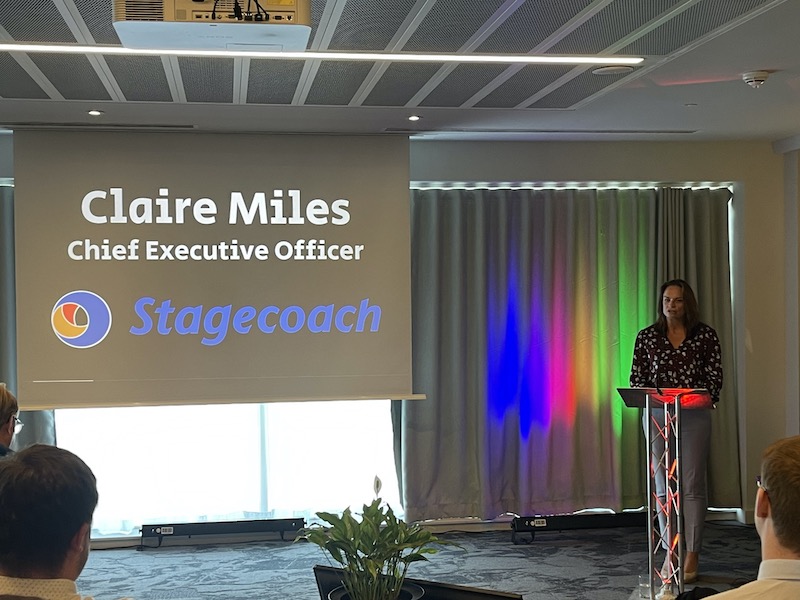
Her top tips for young professionals included: work hard; play your part – take ownership and accountability; put your hand up; take stretch assignments that are outside your comfort zone; be prepared to move sideways to ‘go up’ on a career path; welcome feedback and respond to it; look for a mentor, even from outside the industry; enjoy yourselves.
We always give the opportunity to delegates attending to make a short presentation and gain experience of speaking in public and this time we were delighted to welcome Nathan Burge of McGills Buses who gave a first class presentation highlighting the importance of Health & Safety.

Another popular and regular feature of these conferences is the workshop session where delegates break off into groups to discuss a given theme and come up with their recommended solutions and ideas.
This time we set the task of compiling a two-minute video suitable for TikTok/YouTube/social media highlighting the Cambridgeshire Busway, and to set the bar high on professional presentation, showed the full length video of ‘Britain’s buses at their best’ compiled by transport filmmaker Geoff Marshall which was released on YouTube the previous week and has already amassed over 115,000 views.

And just to make it harder the teams only had 40 minutes to discuss the task, shoot the footage and edit it for showing at the end of the conference.
After a lunch break we moved into the afternoon session with our two speakers from the supplier side of the industry.
These were Kelly Hanna from Ticketer and Oli Knights from Equipmake.

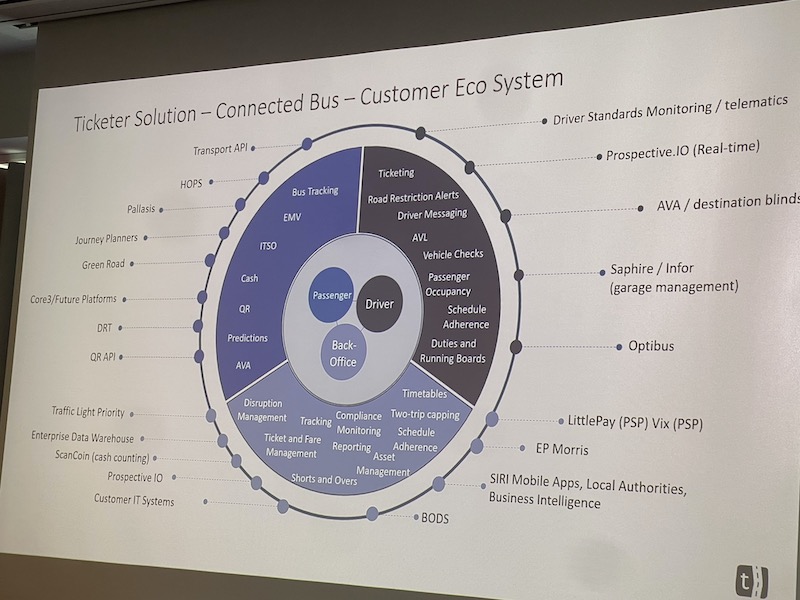
Kelly explained the background to the phenomenal success that Ticketer has become from the leadership of its founder, and now retired, John Carfelt. The company now has an 85% market share with around 500 bus and coach companies using its products with 7.2 billion tickets sold since its formation in 2009.

The company’s success has come about through quickly adapting to the changing use of technology, not least, contactless payments but also vehicle location systems and linking with a whole welter of other software systems.
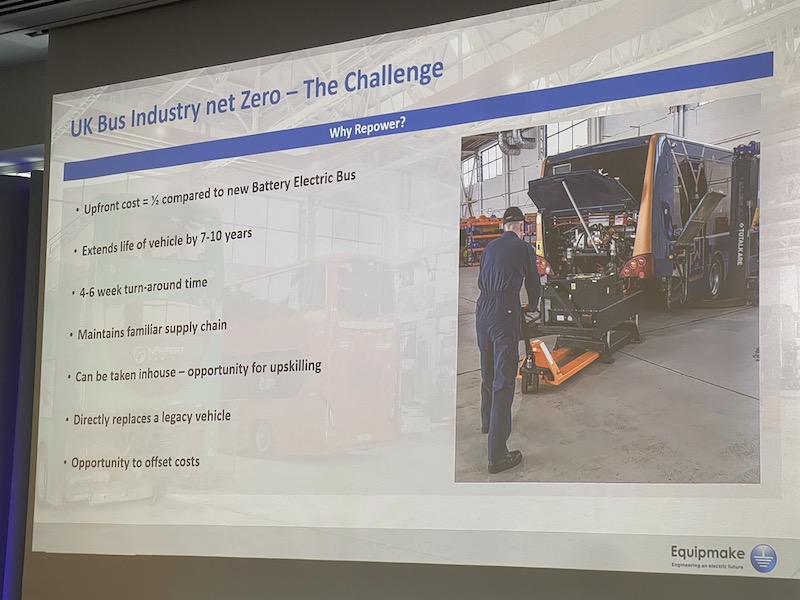
Oli from Equipmake…
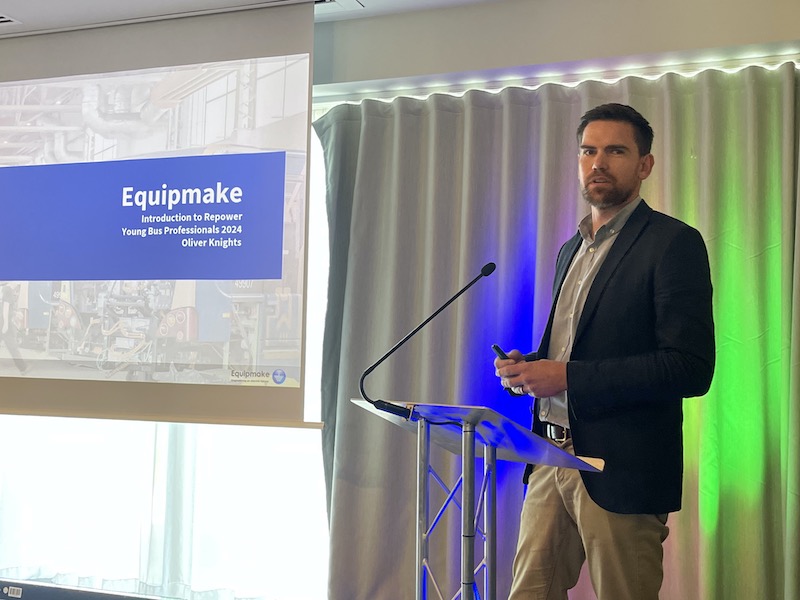
… explained how it’s another founder led company which has built up capacity to repower 200 vehicles per annum to battery/electric propulsion and is proving a success in this growing market.

Then as the conference drew to a close it was time to play the two minute videos made by the five different groups and wow, they were just brilliant. In such a short timescale each group had come up with an engaging, amusing, eye-catching presentation – some even involving interviews and endorsements about the Busway by passengers. Each group proudly presented their video to the rest of the attendees.


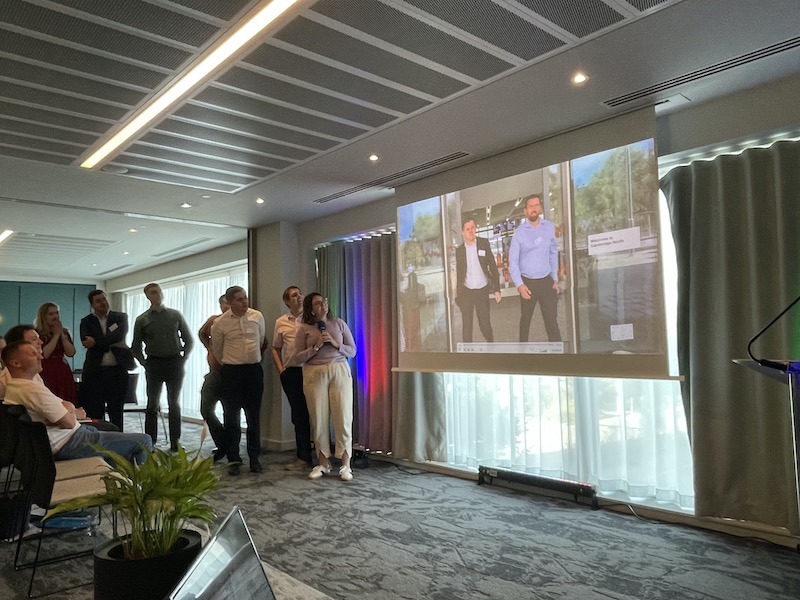


Together with colleague conference hosts, Martijn Gilbert and Alex Hornby, we were blown away by the quality of the videos as we had been by the engagement of these young professionals throughout the 24 hours of the conference. Our next one will be held in Newcastle in early Spring 2025 and everyone went away from Cambridge looking forward to it, including myself.

Roger French
Blogging timetable: 06:00 TThS.
Comments on today’s blog are welcome but please keep them relevant to the blog topic, avoid personal insults and add your name (or an identifier). Thank you.


I do not get why the bus industry has gone head over heels for these awful Ticketer machines. They are just so slow! Not only do they need numerous prods at the screen to set up even the simplest transaction, they are desperately fussy about reading cards/phones, often requiring several goes before the green tick appears on the screen and the ticket appears. I really feel for the drivers having to wrestle with these things, especially on late running and busy buses.
They may well do all that back room stuff shown on the slide, but from a passenger (and probably driver) point of view they are a disaster. Maybe the slowness is down to the sheer complexity of what they are trying to do. Whatever, it all needs to be re-thought.
LikeLiked by 1 person
Contactless payments. For a significant period Ticketer was the only supplier doing a fully managed contactless payment system, other suppliers could offer a machine that read contactless payment cards but couldn’t (or wouldn’t) offer the back office payment processing structure which had to be arranged separately with banks (such as Stagecoach must have done with their VIX machines) which is feasible for the mega groups but beyond small & medium sized operators and even most medium sized groups.
I’ve never had an issue getting a Ticketer to read my contactless card first time, it isn’t particularly fast but not noticeably slower than other machines when making such payments, and whilst you do see some struggle with phone payments it isn’t clear to me as a non-user of such technology whether it is the machine or the user not setting up the payment method promptly (allied to the size of many smart phones making them a little unwieldy when trying to get onto the reader). QR codes can be a little more of an issue though I have worked out the correct method of holding paper tickets, again on phone tickets have the size issue to make it harder, but that is a security measure to use what is a much higher level of fraud from copied or fake tickets than I think the average person may realise is out there.
The number of presses to find/issue tickets will be more an operator set-up question than specific to the machine, you could have a very quick to use set up but it would need a very course fare structure and a very simple ticket range to do it. The more tickets you have the more sales will require multiple screen presses. Ticketer do have some issues due to their rapid growth and market dominance but a lot of the criticism of the product they get is simply because they are ubiquitous so the inherent issues of the requirements (technological & product) that all suppliers have but most only experience Ticketer.
Dwarfer
LikeLike
They are not the best but there is little competition in the market
LikeLiked by 1 person
I am frequently amazed by the number of people who only start prodding their smartphones to bring up the relevant app once they are actually on the bus! That certainly slows things down. From my experience here in Cardiff I’d say that the quickest boarding is by folk who have preloaded a ticket ‘bundle’ onto their phones and only have to zap the QR code, followed by cash payments into the farebox.
LikeLiked by 1 person
“…Stagecoach has recently rerturned to its routes as a British bus and coach operator…”
I think that, in this case, you mean “roots” rather than “routes” – or was the pun intentional? There is also an extra “r” in “returned”.
RC169 (in pedant mode)
LikeLiked by 2 people
Many thanks; corrected but now made a pun out of it, so thanks 👍
LikeLike
Why are they not looking at making the guided busway driverless, It is guided and it is largely segregated from other traffic so is a pretty well controlled environment
Why the focus on driverless busses that operate in a very uncontrolled environment. Focusing on driverless trains would be more sensible particularly as train drivers in the UK are on almost double the average drivers pay in Europe
LikeLike
Probably because many of the buses spend as much time on normal roads as guided busways and those roads are busier and, to get through Cambridge City Centre, more complicated than running round what is effectively a quiet business park and a couple of suburban roads to get to/from the park & ride so is less complicated than the busway routes. At this stage of development I’m not sure I would be comfortable on one of those big deckers trying to get round Cambridge City Centre without a driver in the cab.
Dwarfer
LikeLike
| busses
Unless you’re American, the plural of bus is buses.
| Focusing on driverless trains would be more sensible
Driverless trains are a matter of serious research across the world and it’s consistently being realised that it’s not as simple to make main-line trains driverless on existing networks as it is to make metros driverless or brand new main-lines driverless. HS2 could potentially have been driverless, but would all know what’s happened to that. Driverless main-line trains will happen, to be sure, but it won’t be any time soon.
| train drivers in the UK are on almost double the average drivers pay in Europe
It’s called market forces* and a consequence of the immediate post-privatisation closure of training facilities by the TOCs in favour of poaching qualified drivers from each other with pay and benefits packages, leading to an inevitable, spiralling increase in those packages as companies kept offering better pay packages to retain or recruit staff. Ironically at privatisation the railway unions had approached the TOCs with a request to retain national pay bargaining (as happens in the NHS), which would have kept pay packages fairly low, but had been turned down because those TPCs felt they could reduce costs by not being part of a national pay bargaining set up.
In summary, short-term cost cutting by privately-owned companies led to long-term cost increases for the entire industry, which is hardly unusual in the UK.
That sort of stupidity doesn’t generally happen in the rest of Europe. Don’t blame the staff for corporate greed.
* As an aside, it always strikes me as strange that market forces are seen as acceptable reasons for CEOs and Directors pay packages to hit seven figures with massive bonuses on top, but when it’s low-level oiks benefitting those same market forces are no longer seen as valid. Perhaps it’s just sheer envy, I don’t know.
LikeLiked by 1 person
| HS2 could potentially have been driverless, but would all know …
…but we all know…
Karma strikes again: pedant someone else’s spelling and that guarantees you’ll make an even bigger mistake yourself!
LikeLike
From my use of the Luton – Dunstable busway the buses have guide wheels both sides of the vehicle. How can this work with only one guidewheel on the offside? Those buses I rode on certainly had a guidewheel on the nearside!
LikeLike
The Cambridge buses (and the Crawley ones and the Leigh ones) all have guide wheels on both sides. It would indeed be impossible without.
LikeLiked by 1 person
Zeelo bus UK seems to be caring out a market the big players largely ignore. They are focussed on Home to School transport, Corporate transport. Office shuttles , Warehouse Shuttles and business park shuttles
LikeLike
Think its part of GoAhead’s strategy and the reason they’ve been snaffling up coach operators.
LikeLike
Don’t know about that. First has been very active with First Travel Solutions – whilst that spans stuff like Rail Replacement, it also involves major operations for Amazon and several large educational contracts.
BW2
LikeLike
One such Amazon contract brings First Leicester’s electric deckers into Coventry daily. Was a bit of a distraction the first time I saw one heading down the M69!
LikeLike
Zeelo are not actually a bus operator, they are basically a middleman with an app and a flashy sales pitch who tries to win the sort of contracts you describe and then subcontract the operation of the services to local operators.
LikeLike
A little observation. Don’t know if Claire Miles’ statement of returning to their roots is being pushed subconsciously or overtly by the use of the former logo, not the current one, in her powerpoint?
LikeLiked by 1 person
Good spot!
LikeLike
If the Stagecoach boss, Claire Miles, is passionate about the customer experience then she’s got a lot of work to do.. from my “discovery”experience in Kent just this Tuesday, the “experience” has now become truly awful.
Of the 5 stagecoach services I took, all 5 arrived 10 mins or more late at their respective terminuses from previous trips, and for 4 of the 5 this was so late it was after they were supposed to have departed on the next trip. Drivers taking over weren’t sure which bus was theirs and all the ticket machine setting up nonsense, which seemingly has to be done having slammed the doors shut in passengers faces doesn’t help get loaded and get going.
I suffered 2 trainee drivers with chaperones, one of which was so slow they added a further 10 mins delay just between Maidstone and Sittingbourne on my X3, which eventually arrived in Canterbury 25 minutes late! Should they really be out on scheduled trips when they clearly need more experience and should the chaperone really be telling me “well get the train next time then” by way of apology for this unacceptable delay?
Canterbury and Folkestone customer assistance has of course been abandoned and all the drivers look totally fed up with the ridiculously tight scheduling and customers grumbling about late running ….It comes to something when Arriva operated the most pleasant and “on-time” journey of the day!
Mackay
LikeLiked by 1 person
Agreed. This business of very slow trainees barely able to handle the bus except at very slow speed is industry-wide, especially with the big groups. I had more or less the same rude response from the chaperone on a Go-Ahead Metrobus service, having missed an (on paper) 15 minute connection to another operator’s route, leaving over an hour’s wait in pouring rain. The chaperone should take over if the bus gets very late.
LikeLike
Cambridge sounds like an interesting place to visit, let’s Google “Cambridge buses”.
That’s when you realise the challenge that faces potential bus users in this world famous city.
Impenetrable websites that require multiple clicks, maps that claim to be smart or are out of date (Moovit)
Its like walking into a supermarket where all the aisle names are at the entrance with no arrows.
My instincts tell me when you do find the correct aisle you will find your Nector card isn’t always valid!
During my cambriage cyber travels when selecting “bus” I came across this article about withdrawl of buses in October…2 years ago!
Goodbye Cambridge buses you’ve lost me with much more potential revenue thrown away than the £2 I suggested a driver put in his “tea fund” after saying his Ticketer machine wasn’t working on an award winning service recently!
John Nicholas
LikeLiked by 1 person
That’s not just an issue facing potential users of buses in Cambridge, though; you get the same poor information when you search Google for buses in any city. Their algorithms are broken.
If you think Google searches are bad, try some of the others. They’re come up with even more dross!
That said, given the huge amount of questions I see on social media which could have been answered with a basic search for a company website (such as “Does anyone know what time Tesco in town is open to tonight?” posted to five different local Facebook groups, the posting of which must have taken longer then using the store locator on the Tesco website!), I doubt that a huge percentage of potential users would even make such searches in the first place.
LikeLike
It’s usually easier to Google any European city and quickly find the public transport operator’s website, many with English language versions. GVB Amsterdam is good for example.
Peter Brown
LikeLike
Away from the white hot vortex of technology which has by necessity engulfed the humble bus industry, why on earth does the busway need to be “guided”? What is wrong with a simple tarmac road (with necessity traps at entry and exit points) to deter idiot Motorists.
Terence Uden
LikeLike
It’s a former railway alignment and therefore narrower than a standard road. Guideway allows buses to pass each other at speed.
-blue
LikeLike
A reasonable point except that the Cambridge busway isn’t narrow on the main section, and this all the fuss and delay that went on when under construction could for the most part have been avoided. Surely professional Drivers can pass each other at speed without problem
TU
LikeLike
You are correct about the railway alignment playing a part but it isn’t simply that as I think the Fareham-Gosport one is also a railway alignment but isn’t guided. The other factor is how much room is available to the route to expand, as you say the guideway prevents the tendency to drift slightly around the lane that happens with driver controlled vehicles so vehicles can pass safely with a closer margin. The the case of the Cambridgeshire one the line runs across the marshy fenland so it is effectively running for much of the time on a small embankment so there is no room to widen whilst in Luton the line was squeezed between a road & houses so again there was no space to widen the road used. Bradford & Leeds didn’t use railway alignments but ran up the central reservation of dual carriageways which again would have a limited width.
Dwarfer
LikeLike
Correct, ‘Dwarfer’. Gosport – Fareham, and the two Cambridgeshire busway sections Cambridge North – St Ives and Cambridge station – Trumpington P&R are all repurposed railway tracks.
The Hants busway, however, is buses only the Cambs variety incorporates an adjacent bridleway which doubles as a maintenance and emergency (fire, ambulance, rescue) track. The incorporation of active travel facilities was planned in from the start, meaning that the space for 56mph buses was dependent upon a guideway.
In the Gosport peninsula, the busway runs over an alluvial plain with just a few embankments. Drainage is to either side, as on a conventional road. In Cambridgeshire the water table is very high – see the scenic section around Fen Drayton Lakes (former aggregate pits) – much of the drainage is through the void in the middle of each guideway track to save space and provide width for the bridleway.
LikeLike
The first guided busway in this country was no later than 1985 (WMPTE Tracline in Birmingham), so it’s hardly white hot tech!
LikeLike
The technology wasn’t even new to Birmingham (it was 1984 btw) as it was originally employed in Germany
Guided bus is good for use on old rail alignments especially where bridge parapets, bridge spans or embankments feature. Otherwise, as in Gosport, you can simply have a bus only road, controlled by physical and/or electronic means to keep ne’er do wells out
BW2
LikeLike
The “white hot tech” comment was referring to the proceedings in the Conference Hall and not the Busway.
Terence Uden
LikeLike
Maybe a reasonable question; there are some informed answers to it amongst other comments. However the “vehicle traps” don’t necessarily work either. This is certainly not high-tech technology, but we don’t need to use High technology where low tech and usually less expensive does the trick.
Compared to constructing in new railway this guidy busway was delivered very cheaply and I would argue has more benefits. And of course the railway would end up being heavily subsidised, unlike the bus operations.
LikeLike
There are better ways to guide buses then two chunks of concrete
LikeLike
What I never understand is why more is not made of bus tracking. Even technologically proficient folk often don’t realise it exists. In modern times, where many have more flexible working arrangements, then in times of congestion and delay, it’s not a big deal if broadly speaking, the bus you want you know is on its way. Please, no more “delays all routes” on websites. Instead “Sorry many delays today but bus tracking is operational and generally accurate”. CH, Oxford
LikeLike
I always use Bustimes dot org for the real-time map. It really solves the uncertainty at the bus stop. It would be great if bus stops had publicity for this.
Peter Brown
LikeLike
The Kent Fast track network is due too switch to GoAhead in November using tram type buses although initially standard buses may be used until all the new buses are delivered
The contract requires they open a garage in Kent so that may put Arrivas remaining Kent operations at risk
LikeLike
it will indeed start with diesel buses until the infrastructure is ready. Opportunity chargers are needed at Gravesend and Dartford.
GoAhead have already acquired premises in Dartford.
LikeLike
An interesting and informative blog. It’s particularly pleasing to read the top tips given by some of the presenters but it’s a shame that in most areas of the UK, the general public see little evidence of them in practice.
There are many opportunities for all the delegates who attended to forge improvements and preserve the few good things that already exist across the bus industry. The problems, of course, are huge: pitiful passenger numbers, the lack of effective priority measures for buses and coaches, appallingly filthy and broken infrastructure, and far too many managers who have no idea what a customer is.
I hope none of the 50 or so who you met, Roger, go on and take easy options that only increase the prevalence of these, but wish them every success in making positive differences for the passengers and customers who depend on them every day of their lives.
LikeLiked by 1 person
The only real way to improve bus reliability is vert strict controls on on road parking bus routes but I cannot see that happening
LikeLike
Sadly another conference of young professionals being taught how to all think the same and conform to the same narrative.
Taught that everything the big groups do is amazing, don’t use anyone other than Best Impressions etc etc.
Stay close to the clique but under no circumstances try yo join it. The 10% club is the ultimate in narcism and arrogance – try to be like us but don’t ask to join our little group.
Really sad that so many talented, creative, innovative people will never achieve amazing thins because they don’t follow the narrative.
LikeLike
The busway seems sadly unloved. Journey planners state that at present a long section isn’t being used between Histon and Longstanton. I hope that is temporary. But in addition travel times are far too long to be attractive because the buses are routed around housing estates in both St Ives and Huntingdon. I thought the busway was an innovative way to beat traffic congestion on the Cambridge St Ives Huntingdon corridor but in fact the quickest way by public transport between the two end points is the Whippet X3 which doesn’t use the busway at all. Infrastructure like the busway is useless if it isn’t utilised to its full potential to encourage modal shift. Public transport in the U.K. is the mode of last resort except perhaps for the tube and some London commuter lines where the car would fail badly. What is the point of the busway if it isn’t sweated? Same problem with the channel tunnel which is only used to something like 58% of its capacity while people still fly from London to Paris.
LikeLike
The point of most bus services is to get people from where they live to where they want to go rather than just from Town Centre to Town Centre. The Busway route may be slower between Huntingdon Bus Station & Cambridge City Centre but that isn’t where passengers live and it is faster from most of the areas of housing in Huntingdon (largely to the north of the town centre away from the X3 which comes from the south) which the services go round on their way to Cambridge. The fact that the Whippet X3 is, still I think, an hourly council supported service whereas the Busway service is a commercial bus every 20-mins from Huntingdon mostly using double-deckers (big 3-axle ones at that mostly) with another 20-min frequency service from St Ives on top (plus 20-min shorts from Longstanton) indicate that there is more demand for a service from the areas of housing to the respective centres than a faster service centre to centre.
It is something of a shame that the opportunity wasn’t taken to link more of the villages served by largely council supported services into St Ives onwards via the Busway, particularly when they were operated by the same operator (Whippet) at one time though no longer.
The point of the Cambridge Busway was always more about reliability, by avoiding the congested A14 at the Cambridge end but compromised by not being able to run closer to the city centre via a separated route, than outright speed since it was paralleling a dual-carriageway where high speeds could be achieved by the buses when traffic allowed anyway.
Dwarfer
LikeLike
Dear Dwarfer the trouble is we use current service patterns to assume that’s where the demand is. We follow demand instead of leading it and therefore we end up with ridiculous 38 minute journey times from St Ives to Huntingdon for example when it’s 12 minutes by car. Of course in this country it’s all down to the lack of investment in our infrastructure but it’s a crying shame that the 20 minute headway service which currently stops at St Ives from Cambridge cannot be extended by the fastest route to Huntingdon. Another example is the tedious meander around Addenbrookes hospital at the southern end of the Busway on the route from the City to Trumpington. The busway is only useful if it gives significant reduced journey times otherwise its potential is wasted.
LikeLike
It isn’t about using the current pattern to assume demand but using basic logic of linking where people live to where they want to go & neither Huntingdon or St Ives are significant town centres to generate a large flow between each other alone rather than the flows coming from their estates to them as well at a much higher scale Cambridge. The large housing estates are to the north of Huntingdon & St Ives town centres so running the buses through these makes more logical sense and means more people have more convenient links.
Given the suggested running times, and it is only 12-mins non-stop via the dual-carriageway but closer to 20-mins via the normal roads that may have some intermediate traffic, would mean at least 2 extra buses for anything better than an hourly extension and I just cannot see anything resembling that demand being created (something like £800 per day extra to pay for the resource) just by being a little faster between these two relatively small town centres. There were faster buses between St Ives & Huntingdon, run by Whippet, but they have all faded away as the demand between the two was never significant enough to support a service without other wider flows propping it up.
The Busway isn’t supposed to be the direct link from the City Centre to Trumpington, that is done by the Park & Ride deckers running down the normal roads (due to the constraints of the old railway gauge only single-deckers can run on the southern stretch due to a low bridge which is unsuitable for the demand for the main Park & Ride flow) with the Busway providing a Park & Ride from Trumpington to Addenbrookes plus the fastest link from the City Centre to Addenbrookes.
The Busway isn’t the only part of the bus market and you have to look at the wider network and sometimes there isn’t a need for a solution as it is covered elsewhere. Huntington to Cambridge is faster via the X3 running via Cambourne, looking at the timetables you couldn’t get a faster run using the Busway in any case (if you extended the shorts to Huntington via the dual-carriageway it would still be the same 55-min time as the X3 is – 43-mins Cambridge City Centre to St Ives Bus Station via the Busway + your 12-min drive time via the dual-carriageway) so it makes more sense to use resources more viably on flows that can’t be served better elsewhere. Likewise Trumpington to Cambridge has a link using a more suitable route for the demand so why try duplicating via a route that is less suitable just to use a specific piece of infrastructure.
You could say the Busway hasn’t achieved it’s full potential, if they ever manage to complete the large Northstowe development which it was assumed would be completed soon after the Busway opened and wasn’t started until a decade later then it may get closer, or that there are unserved links that the Busway could effectively offer(more frequent buses linking places like Ramsey & Warboys via the Busway to Cambridge should be possible) with a bit of effort & thought but what is currently offered is logical and clearly successful and meets the core demand flows well.
Dwarfer
LikeLike