Saturday 14th Septmber 2024
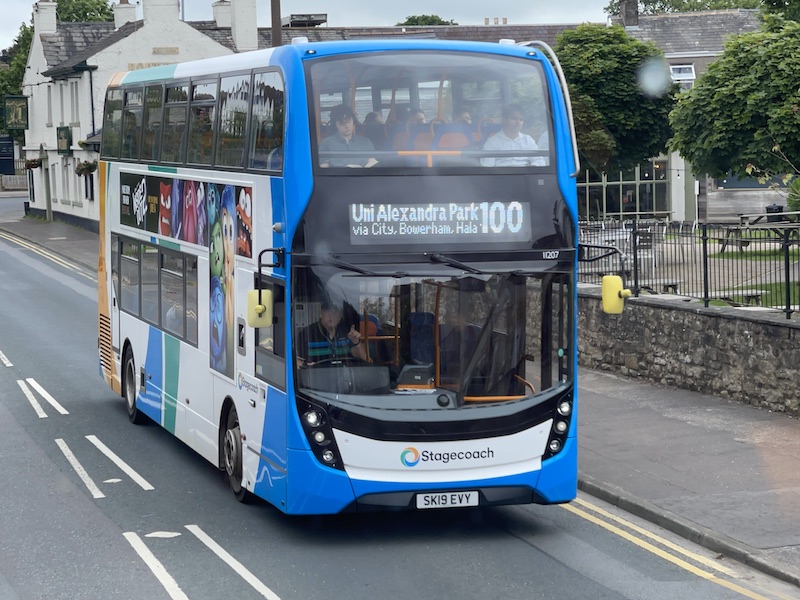
I featured an early morning journey on Preston’s bus route numbered 100 last month and it made sense on the same visit to head on northwards to explore Lancashire’s other route 100 in the lovely city of Lancaster.

Operated by Stagecoach this busy double deck route is part of a mini network linking the city with the large university campus three miles south as well as providing a cross city service continuing north westwards from the city over to Morecambe.
Buses run every 15 minutes with alternate journeys operationally linked in Morecambe to route 2X providing another link to the city centre every half hour – a facility which is promoted on the destination blinds.

Here’s an extract from the Stagecoach timetable highlighting it is a route in two halves with the first section between the University and Lancaster Bus Station taking about 30 minutes and more or less the same again from there to Morecambe Bus Station – which is a lay-by.
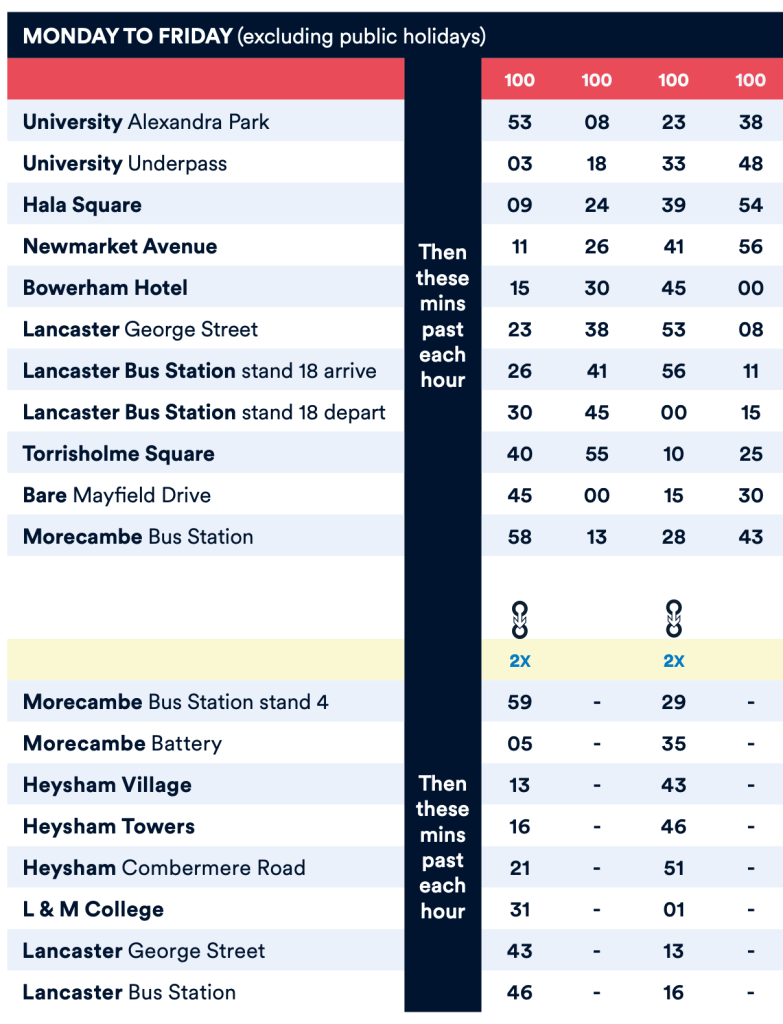
You can see from these extracts how alternate buses continue onwards in Morecambe as a 2X back to Lancaster via Heysham and vice versa.

I planned to catch the 09:33 departure from the bus station to the University campus and as I arrived in the bus station noted there was already quite a queue of students waiting at stand 9.
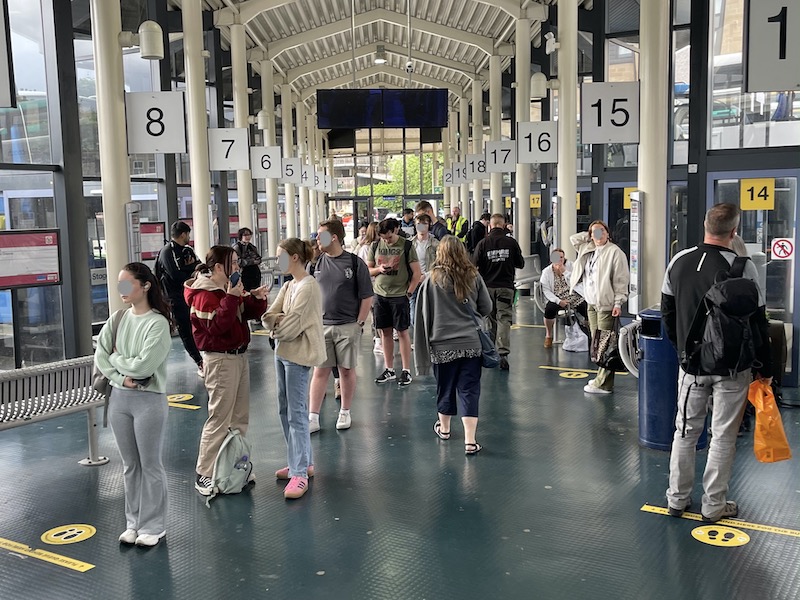
Except it turned out they were catching the more frequent and more direct bus between the city centre and the University – routes 1 and 1A which run every ten minutes and operate direct via the A6 taking 23 minutes to the University. That normally departs from stand 8 but as I’ve found in previous visits, Lancaster’s bus station gets very crowded – both the deoparture bays and the small concourse so it’s not unusual for buses to depart from a nearby stand.
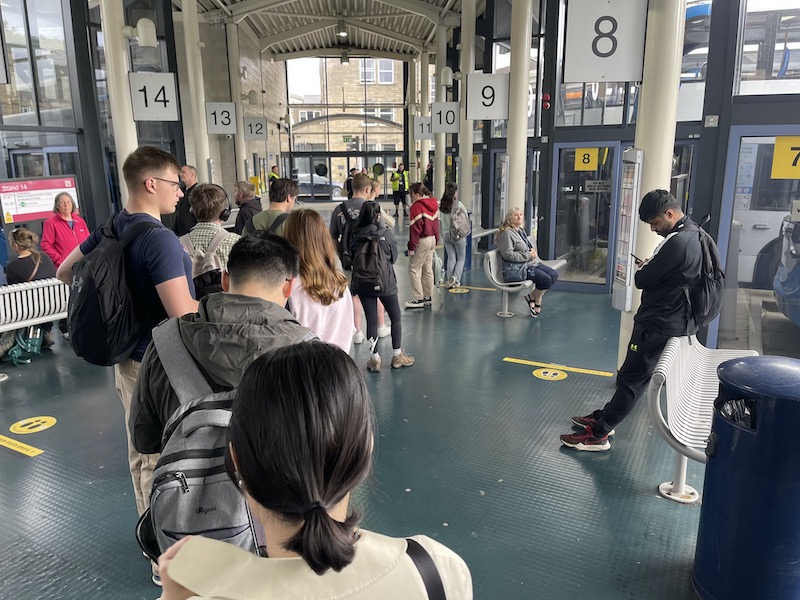
We left with about a dozen passengers and picked up another dozen as we headed south via Scotforth to the University.
It’s a big campus – 560 acres of delightful parkland.
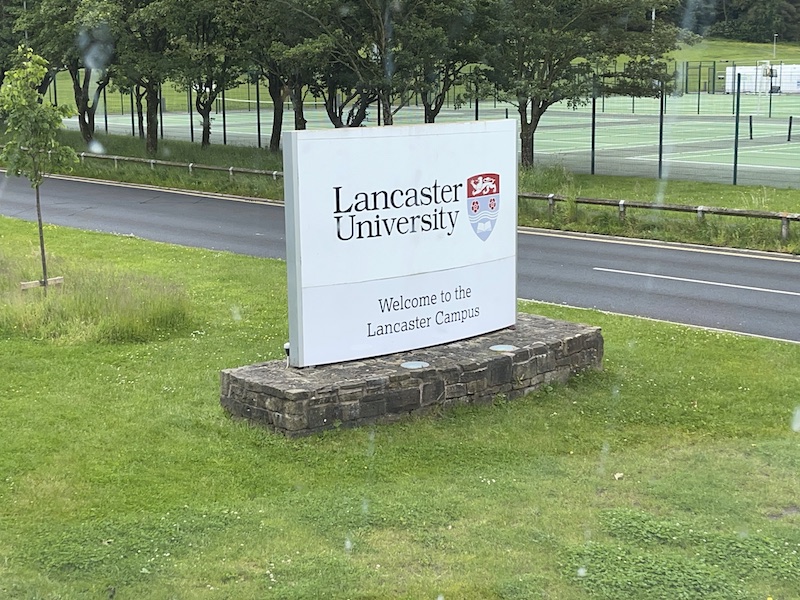
Buses take a direct route inside the campus…
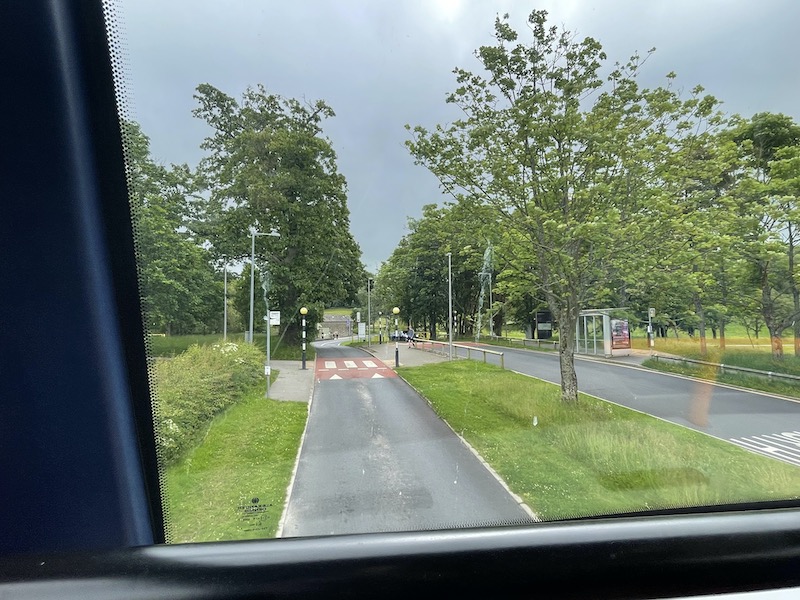
… to the main interchange for most bus services called the Underpass….
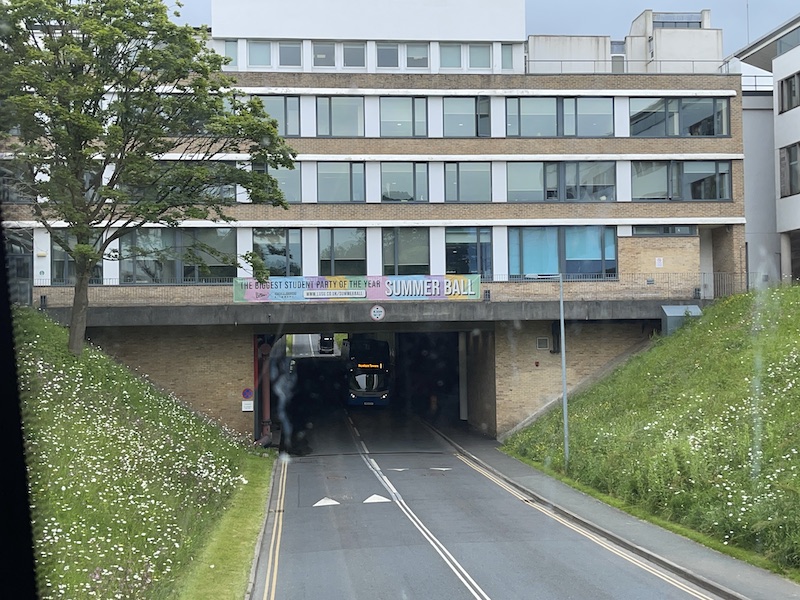
… because it is an Underpass beneath University buildings.
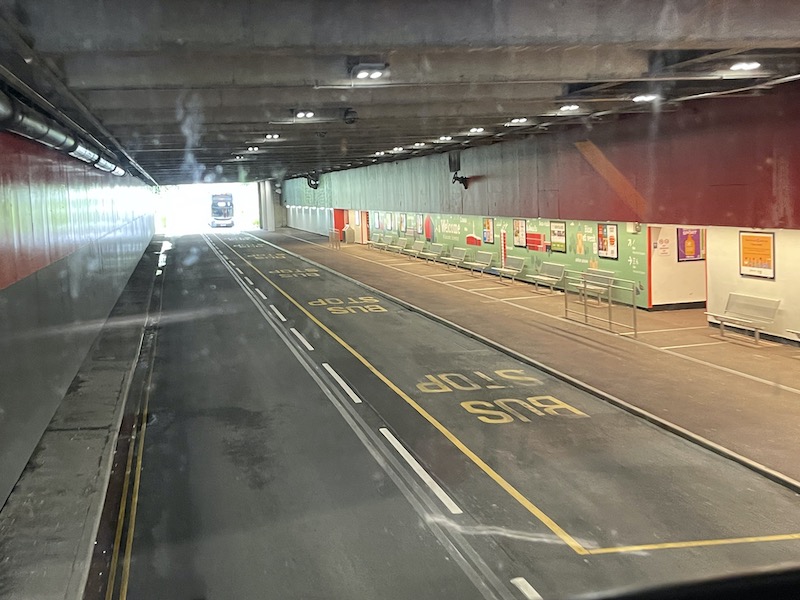
Here buses depart on routes 4/X4 (to the railway station) and 41 (Preston to Morecambe) as well as the aforementioned route 1/1A (which continues to Heysham). After the Underpass route 100 continues to Alexandra Park doing a circuit of the campus, where it pauses before returning to the Underpass.
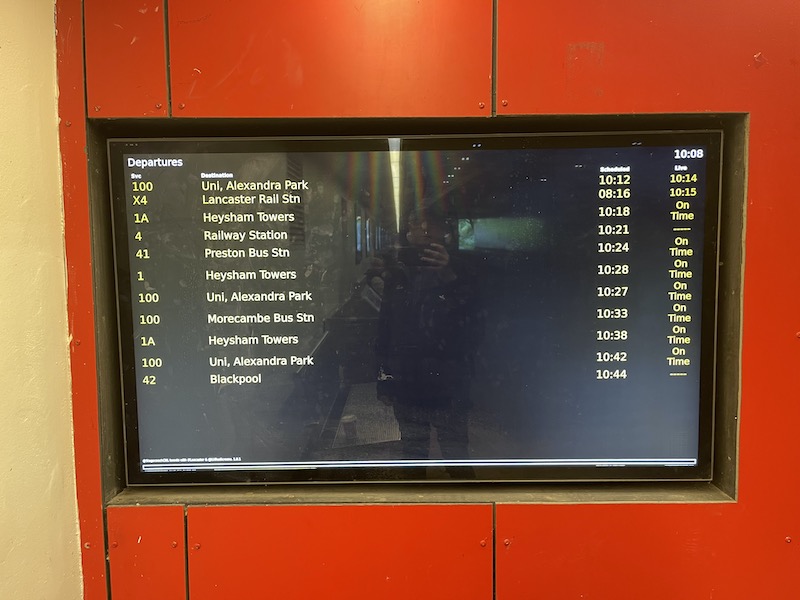
I took a brief break at the Underpass before catching the next bus on route 100 and then stayed on this…
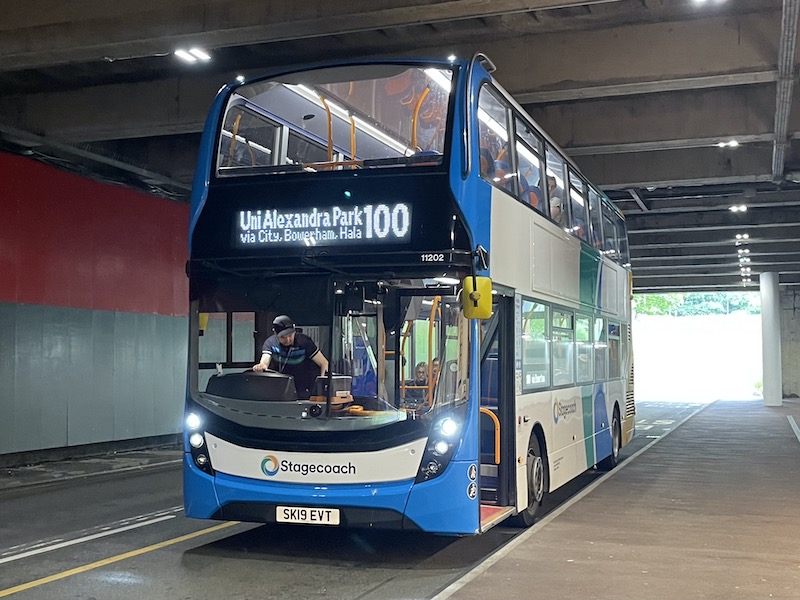
… as it returned to Lancaster and headed on to Morecambe.
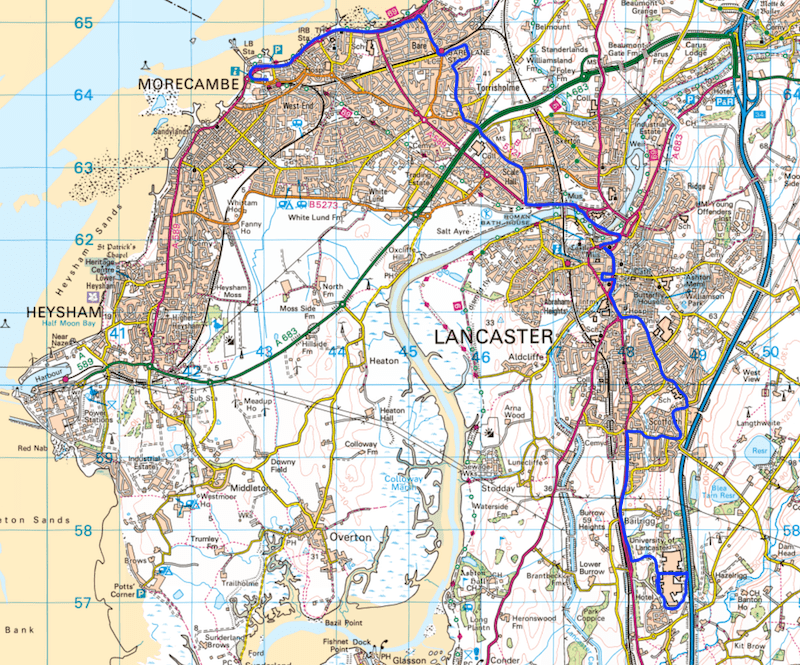
The northern half of the route to Morecambe is in complete contrast to the southern half to the University which is dominated by students and residents living in the Scotforth area.
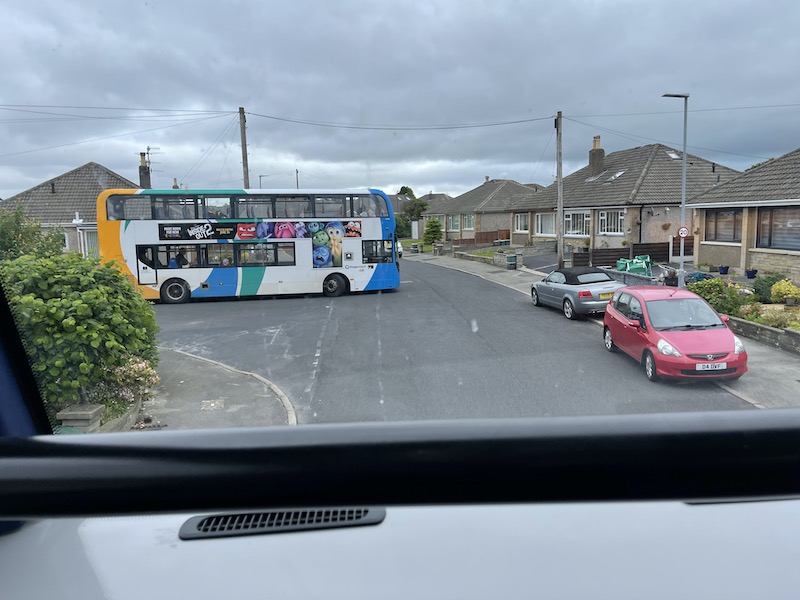
The roads used by the bus on its way trhrough Torrisholme and Bare Lane station are quite tortuous, as you can see in the photo above, but after Bare the bus suddenly hits the seafront road at Morecambe and some great views of the coast are on offer…

… until the bus arrives at the terminus bus stops in Morecambe close to the railway station.
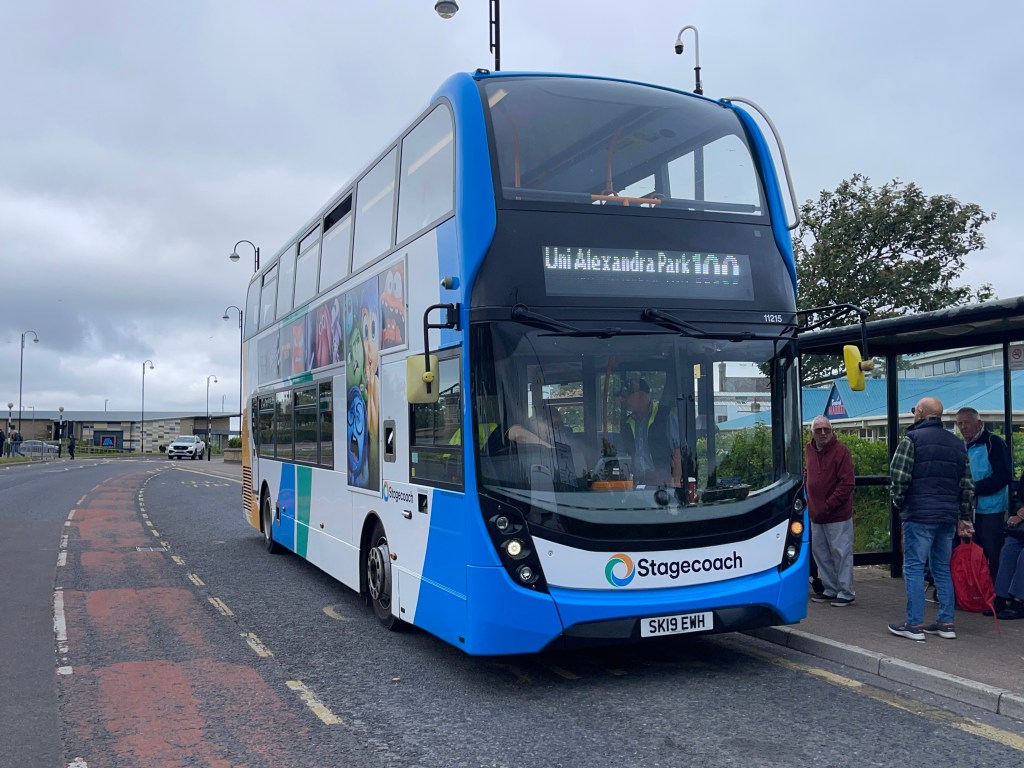
It’s a busy route serving both Morecambe seafront, residential areas, Lancaster city centre and the University. As you can see double deck Enviro400 buses are used on the route including the occasional luxury element with one of the vehicles perviously used on the 555.

Roger French
Did you catch the other eighteen ‘Every route 100’ blogs so far? Here’s 1 of 26 (Stevenage-Hitchin) 2 of 26 (Crawley-Redhill), 3 of 26 (Lincoln-Scunthorpe), 4 of 26 (Glasgow-Riverside Museum), 5 of 26 (Campbeltown local), 6 of 26 (Guildford’s Onslow Park & Ride), 7 of 26 (Warrington-Manchester), 8 of 26 Chatham-St Mary’s Island, 9 of 26 St Paul’s-Wapping, 10 of 26 Syston-Melton Mowbray, 11 of 26 Wellington-Telford Sutton Hill, 12 of 26 Hanley-Stone, 13 of 26 Burgess Hill-Horsham, 14 of 26 Aylesbury-Milton Keynes, 15 Pontypridd-Royal Glamorgan Hospital, 16 Barry circular, 17 Farringdon Park-Larches (Preston), 18 Hastings Conquest Hospital-New Romney.
Blogging timetable: 06:00 TThS.
Comments on today’s blog are welcome but please keep them relevant to the blog topic, avoid personal insults and add your name (or an identifier). Thank you.


Not sure what happened to the X4 there on the real time indicator – seems to be two hours late!
LikeLiked by 1 person
The driver has probably entered the wrong journey number into the ticket machine.
LikeLiked by 1 person
Following a recent timetable revision, Stagecoach now shows the 100 and 2X as completely separate services, with no indication of buses running through. This makes it easier to follow each individual service but obscures the fact that one can catch a through bus across Morecambe.
The service number 100 is well outside the range of numbers employed in Lancaster (most are within 1 to 18). The link with the 2X was more obvious when the 100 was the 2. It was renumbered in 2019 supposedly to commemorate the 100th anniversary of Ribble, although local opinion is that it was more to do with a switch from single to double-deck operation, a consequential rerouting to avoid a low bridge, two earlier bus decapitations under a different low bridge and a fractious period in industrial relations at Morecambe depot!
Jim Davies
LikeLiked by 1 person
I have never been there, nor likely to go there either: but is there not some sort of underground bus interchange in Seattle where dual-power single beck buses go on to the overhead via trolley poles with the diesel engines switched off?????
LikeLiked by 1 person
There is a transit tunnel under the centre of Seattle that was used by dual power trolleybuses, but I believe it is only LRT now.
Peter Brown
LikeLike
I believe that the Lancaster buses in 555 livery are used on the summer only journeys that run from Lancaster to Kendal via the M6 and double the frequency from Kendal to Keswick to every 30 minutes.
LikeLike
If your look closely, they are in the generic “Lakes” livery, rather than the similar but route-specific 555 version.
They might be intended for the 555 but in practice. . .
LikeLike
The Boston Silver Line system used dual mode diesel/trolley buses, switching to/from the latter in its tunnel section. After experimentation, the buses were replaced by hybrid diesel/battery vehicles last year. These are apparently more reliable and quicker in their mode changeover.
LikeLike