
Saturday 17th August 2024

After my abandoned ride on the Sunday only route 100 around Barry, described last time, I headed up to Preston for an overnight stay before an early Monday morning exploration of that city’s route 100, one of two in the county of Lancashire. And, it turns out just in the nick of time as Preston Bus announced in June it was proposing to withdraw the route from 2nd September, albeit replacing it with a new route 16 and an extension of another, route 19/20.
But it’ll be the end for the use of the number 100.
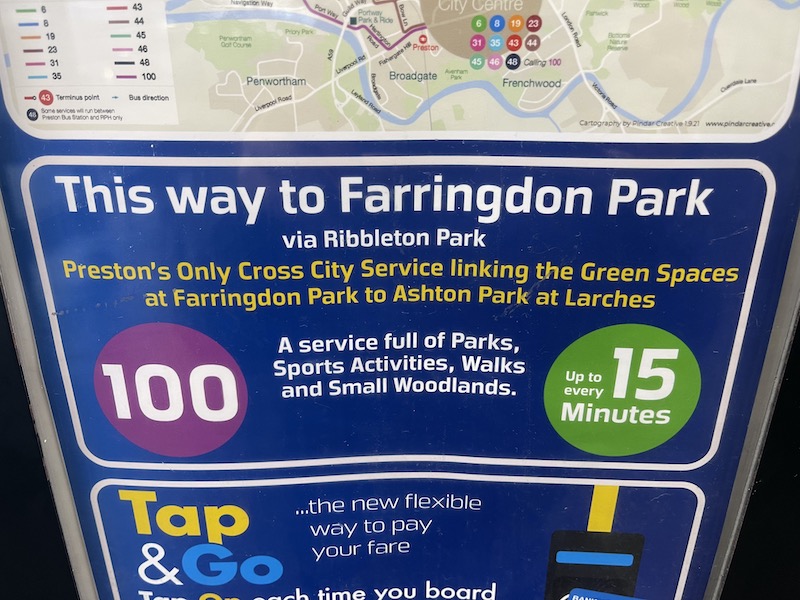
For just two more weeks, therefore, Preston’s route 100 is “Preston’s Only Cross City Service linking the Green Spaces at Farringdon Park to Ashton Park at Larches” as well as serving the Portway Park & Ride site to the west.
The route currently takes six buses providing a 15 minute daytime frequency.
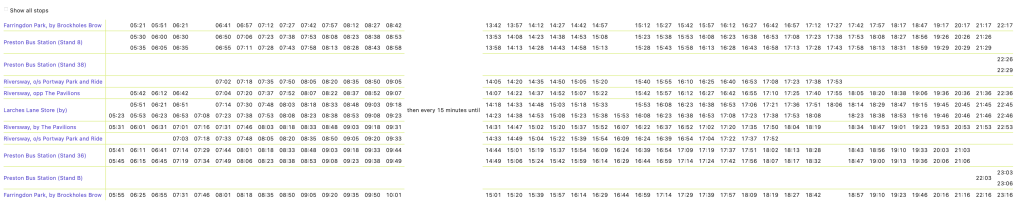
Farringdon Park is a small residential area just before the A59 towards Blackburn meets the M6. Buses do a little turn in a couple of side roads then follow the A59 into the city centre arriving at the city’s bus station 11 minutes later.

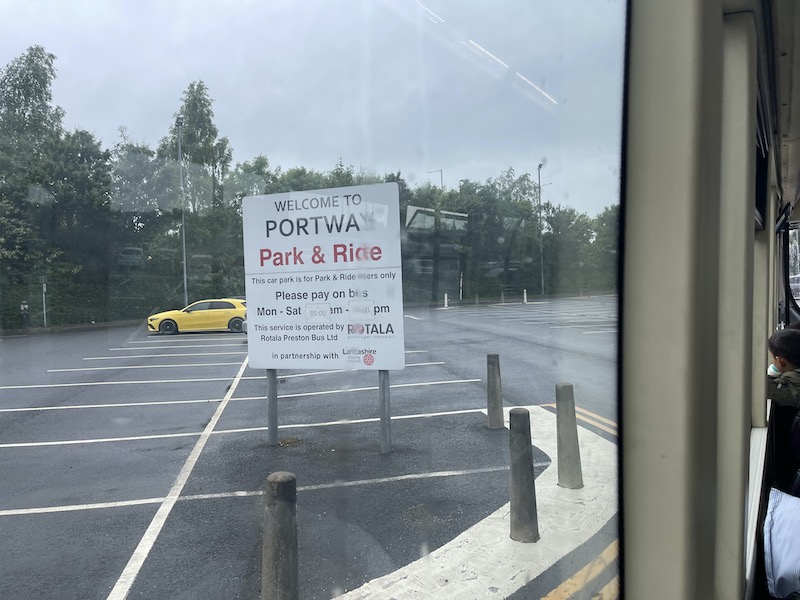
After a five minute stand time in the bus station it’s on towards the railway station then calling into the Portway Park & Ride site which is a conveniently located car park, west of the city centre, which buses on route 100 circumnavigate.
The route then continues westwards alongside the Albert Edward Dock, now called Riversway Docklands…

… before passing the large Ashton Park to reach the Larches residential area 20 minutes after leaving the bus station and where the bus does a one-way loop but pauses for five minutes.
Another five minutes stand time is taken when arriving back at the bus station before continuing to Farringdon Park where there’s another 11 minutes layover before beginning the circuit again.
With layover of 26 minutes on a round trip wheel turning time of 64 minutes it’s almost worthy of a TfL sponsored award for slack timing. In the peaks a seventh bus is added to the schedule enabling extended journey times.

I caught the 06:45 departure from the city’s bus station bay 36 (there’s even more than that) to Farringdon Park which being ‘against the flow’ unsurprisingly only carried one passenger who was already on the bus when it arrived from The Larches and alighted on the east side of the city centre. It was good to see eight passengers alight in the bus station when the bus had arrived.

We arrived at Farringdon Park on time at 06:55 and I was expecting the bus to form the 06:57 departure but no, a bus was already waiting to depart and my arriving bus would have 17 minutes layover and be the next departure at 07:12.

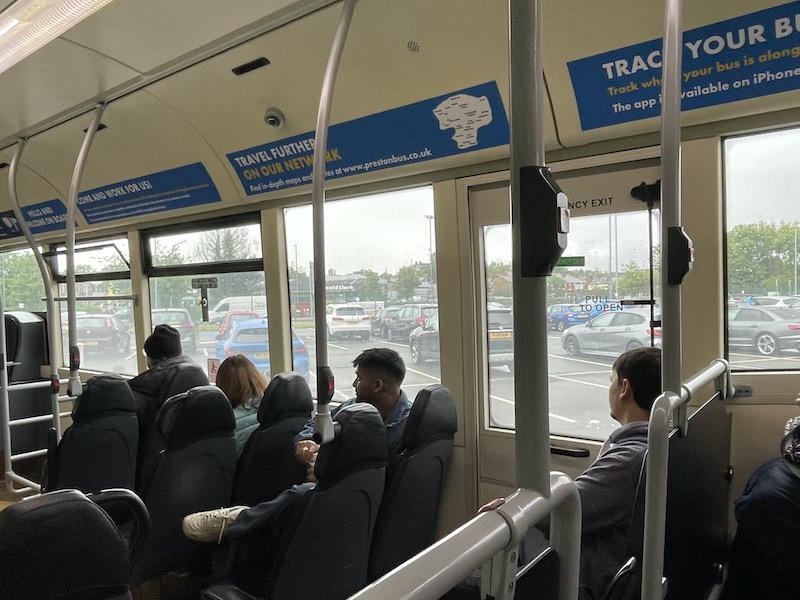
I nipped on to the bus in front…

… and we soon started to pick up passengers as we headed into the city centre with seven on board of whom five alighted at the bus station and, interestingly, two travelled right through to Larches – which they won’t be able to do once the service is replaced by two separate routes.
The journey over to Larches was obviously quieter being against the flow again with just one passenger boarding.

After an eight minute pause at Larches we were on our way again back to the city centre with six already on board, two of who had boarded at the two stops before the layover point.
11 more passengers boarded as we headed into the city centre including two at the Park & Ride site from where it took a few minutes to exit due to the build up of traffic.
I alighted at Preston railway station with one of the passengers, leaving the others to continue towards the bus station.
And that’s Preston’s route 100 as it has been, and perhaps not surprising to see this rather slack timetable coming to an end and instead something, I suspect, that will be rather tighter.
Roger French
Did you catch the other sixteen ‘Every route 100’ blogs so far? Here’s 1 of 26 (Stevenage-Hitchin) 2 of 26 (Crawley-Redhill), 3 of 26 (Lincoln-Scunthorpe), 4 of 26 (Glasgow-Riverside Museum), 5 of 26 (Campbeltown local), 6 of 26 (Guildford’s Onslow Park & Ride), 7 of 26 (Warrington-Manchester), 8 of 26 Chatham-St Mary’s Island, 9 of 26 St Paul’s-Wapping, 10 of 26 Syston-Melton Mowbray, 11 of 26 Wellington-Telford Sutton Hill, 12 of 26 Hanley-Stone, 13 of 26 Burgess Hill-Horsham, 14 of 26 Aylesbury-Milton Keynes, 15 Pontypridd-Royal Glamorgan Hospital, 16 Barry circular.
Blogging timetable: 06:00 TThS with Summer Su extras.
Comments on today’s blog are welcome but please keep them relevant to the blog topic, avoid personal insults and add your name (or an identifier). Thank you.
 BusAndTrainUser
Since getting my ENCTS pass I have needed to direct drivers of buses several times: twice in the Richmond on Thames area. Both incidents were short term road closures directed by the police, RTAs in both instances. I needed to take charge of a 190 at Chalkers Corner, getting into Richmond via the A205 and A305 (Lower Richmond Road). The other occasion was aboard an eastbound 493 which I needed to direct south along Kings Road, east along Marchmont Road and then back to line of route via the B353 (Queens Road). A Falcon Bus driver got lost driving into Kingston aboard a 461 attempting to observe an official diversion but I was seated too far back to take charge at the critical moment when he wrongly turned left in Thames Ditton.
LikeLike
I did that myself one day, because of roadworks, a driver on the then Arriva 84 Crewe-Chester got lost on a diversion route going through Tarporley, i managed to have a Cheshire Road atlas [this in the early 2000s before smartphones wifi & such] so helped the driver get from Tarporley to Tarvin only ended up a couple minutes late on arrival in Chester.
SM
LikeLike
So, from the Larches, around 10% of the passengers got off at the railway station. I expect many bus managers will say ‘so we’ll concentrate on serving the 90%’ – but the industry is looking for a 10% uplift in passenger numbers generally, and far too many buses don’t stop at railway stations. So – make them stop there, and there’s your 10%. Louise Haigh is looking for ‘network integration’ (whatever that is, over and above, or possibly less than, ‘integration’). Passengers want it (all the ones I’ve talked to, anyway). What I don’t understand is what is stopping bus and train managers from talking, as a matter of course, about how to improve connections. The two passengers who got off at Preston station were probably spending much more on their rail journey than on the bus, so rail managers are being exceptionally stupid if they don’t have the £-signs in their eyes when they consider the issue …
LikeLike
The holy grail of bus/rail integration is a tricky thing to achieve. Ignoring the ticketing side for now, and just looking at the service.
The best connections are where at least one of the legs is frequent, so a specific hit is not required. This is not very common. The remainder are compromises between competing demands and lowest cost.
LikeLike
| rail managers are being exceptionally stupid if they don’t have the
| £-signs in their eyes when they consider the issue
What chance is there that the passengers who currently use the bus will stop travelling by train entirely just because the bus company has made a commercial decision to remove a service it clearly considers unnecessary or unprofitable? Realistically they’re more likely to find an alternative way of getting to the railway station, so the only loser is the bus company.
Also, given that any revenue earned by the UK passenger rail industry goes to HM Treasury, what actual benefit would the train operator get from interfering with a bus company’s commercial decisions about its operations, and why would not so interfering mean that rail managers are “exceptionally stupid”?
And finally… Would you call a manager “exceptionally stupid” to their face, or is it just keyboard warrior syndrome?
LikeLike
Because of the history of the development of british towns & cities very few railway stations are actually that convenient for the centres they serve and are often very difficult to serve well. It may be 10% of passengers (on relatively peak time journeys when you have the biggest intermodal transfer) but if it costs 15 or 20% more to serve it (1 extra bus on a 4 bus PVR for instance) due to the extra distance/time required to reach the station it still may not be commercial. Not one of the stations in the major towns of Leicestershire is close to the main centre of activity of the settlement & many in Notts & Derbyshire are similar (Leicester is close but development has moved the city centre north and the road layout means buses can only serve easily on one road south and terminating buses have to travel a significant distance to turn around – Nottingham has a similar issues of the city centre moving away & road layout meaning to actually serve the station means heading away from the centre whilst Derby, Loughborough, Melton Mowbray & Hinckley are all significant distances from their core town centre meaning extension of most services is simply unviable) so diversions or extensions involve significant costs.
You also have the opportunity cost of what you can’t serve by routeing via the station. On part of our network the council introduced a new service merging a number of contracts into a single route and originally routed it via the station but we got a number of complaints (more than we have ever got since about the route) because the route missed out the main hospital (which was on a parallel road out of town and both could not be served without doubling back) so we removed the station and routed via the hospital. Also it is no good serving most stations if you don’t provide convenient connections with trains and that is not always possible, bus operators have many constraints (school & work times for instance) which limits times of trips – and that is before you hit the conundrum of which train at which station, we had a route that passed 4 stations on 3 lines and it was impossible to connect with trains at all stations or all directions (at one station cycle times meant we could connect in one direction but that meant the buses passed just before the equivalent return trains) & the fact that trains change dates don’t line up with sensible dates for bus companies and few train companies have any regard for the needs of bus operators and expect buses to conform to them at all times.
Serving stations may be nice to have but in many cases without additional funding for resources it simply doesn’t have a commercial case and costs more than any potential revenue may cover once you factor it in.
Dwarfer
LikeLiked by 1 person
| Serving stations may be nice to have but in many cases without
| additional funding for resources it simply doesn’t have a commercial
| case and costs more than any potential revenue may cover once you
| factor it in.
Exactly.
And even if a Train Company could convince the DfT (well, HM Treasury really, but they have to deal with the dead hand of DafT) to allow them to fund the shortfall, what financial benefit would that Train Company get out of doing so?
Anyone who uses the bus rather than a car is realistically lost money for the Train Company in these days when car park charges are a significant source of revenue for them, even if it does then all go straight to HM Treasury.
Buses serving railways stations is definitely a nice to have, but it’s something that is in all truth revenue negative for both bus and train operator alike. That’s not how I’d like to see bus and rail integration be dealt with, but unfortunately it’s the way things are.
LikeLiked by 1 person
Very depressing, and – I have to say – frustrating for the many passengers who would like to use public transport but can’t because of the lack of this basic link. I really do feel that part of the problem is in the set-up of the industries, and that the basic economic facts would not be as dismal as you say they are, IF some heads were banged together at the top and the government simply required bus and rail to act in co-ordination as a matter of course.
The rail people have certainly not helped by being so car-fixated but, for instance, GWR are simply being unhelpful when they refuse to talk about a proper revenue sharing mechanism for Bus+Rail journeys where a proper aim would be to grow the market by the right sort of combined service – for which the proper framework would be some kind of joint venture: a perfectly normal commercial proposition, but not apparently one which is part of the world-view of these supposedly enterprising and innovative business-people!
In all of this, the passenger/customer can apparently go to hell – or buy themselves a car and give up on bus and rail for any meaningful part of their travel …
LikeLike
Having looked at the timetables for replacement services 16, 19 and 20 it would seem that one of the main objectives of the changes is to provide new links to the railway station from several areas of Preston, while maintaining existing ones as far as possible. The 16 from Farringdon Park will have some peak hour journeys extended to the station while new 19 provides an all-day link from Larches. The 20 provides a new link with Lea while 19/20 with a combined 10’ frequency will link the station with Deepdale (passing by Preston North End’s ground) and the Royal Preston Hospital – both major traffic objectives.
So in this particular case I think Preston Bus should be applauded for making the effort rather than it being seen as In any way negative.
LikeLike
BSIP was supposed to improve intergration between bus and rail but it never really happened, Ticket inter acceptence between companies was supposed to be happening but again in general it has not
LikeLiked by 1 person
I know it didn’t make it onto your list being a school service, but another 100 that is no more is the Cardinal Griffin School to Handsacre operated by NX West Midlands, which will not be returning next month.
Stu (West Midlands Bus Users)
LikeLike
There seems to be a broken link for 3/26, Lincoln-Scunthorpe which I’d like to read as I keep promising myself a trip to Scunthorpe and Grimsby: just because I’ve never actually been to either!
LikeLike
LikeLike
Thank you Roger.
LikeLike
The A305 is the UPPER Richmond Road!
LikeLike
By coincidence I travelled on this 100 a couple of Wednesday’s ago to get from Preston station to the Ribble Steam Railway and back. The loadings on the two mid-to-late afternoon journeys were about 4 or 5 in each direction.
LikeLike
I note that you took this journey particularly early in the morning. Let
me assure you that congestion is a frequent problem, particularly along
the A59, when there has been a problem on the M6, which is quite a lot
of the time, and with the many roadworks there have been along the route
for pretty much its entire history. Those layover times are not as
generous as you would think. This is proven by the fact that the
replacement routes at the Fulwood end will keep the vast majority of
that layover time.
LikeLike