Sunday 11th August 2024
I’m a child of the mid to late 1950s and early 1960s and as regular blog readers will know, growing up in the fairly affluent north London suburb of Winchmore Hill my early interest in public transport was first kindled by watching and travelling on the soon to be replaced trolleybuses which plied up and down the busy Green Lanes to Wood Green and beyond on routes 625, 629 and 641.
In that pre Internet, social media, online forums and even specialist societies such as the London Omnibus Traction Society era it wasn’t possible to be aware of any transport news and developments relying instead on what you actually saw with your own eyes on the road and one day realising gleaming new Routemaster buses had begun making an appearance.
Perhaps there may have been news in the Evening Standard or Evening News or even the weekly Palmers Green & Southgate Gazette but I was still too young to take an interest in newspapers.
No photographs were possible to record this period of transformation from electric power to motor bus as I didn’t get my first camera until 1963 – a Brownie 127 – which could take just eight black and white exposures on a roll of film that cost a week’s pocket money to buy and get developed.
I’d also yet to come across a magazine called Buses Illustrated.
It’s no surprise that since those formative years, whenever a new book is published about London’s trolleybuses I’ve always keenly leafed through the pages eager to see if it contains memory jerking photographs of familiar local North London street scenes as my fading memory recalls them.
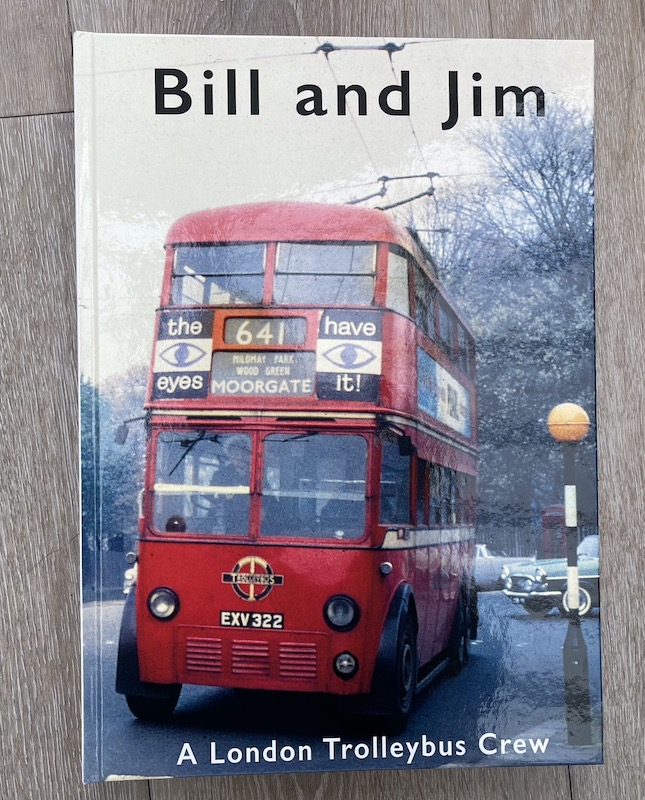
So imagine my delight a few weeks ago on hearing about a new book just published called ‘Bill and Jim – A London Trolleybus Crew’ which not only features a glorious colour photograph on the cover of a trolleybus on route 641 but it’s 208 pages are packed full of photographs, almost exclusively for a greater part of the book, on that route along with its stablemate the 629 as well as the 625.

It’s as though the book has been published just for me.
So, thanks very much to Hugh Taylor for compiling this treasure trove of North London nostalgia and how fortuitous as a 14 year old back in the early 1960s he befriended driver Bill Ryder and conductor Jim Feirghley (hence the book’s title) who were a crew who worked on the trolleybuses out of Wood Green garage and lead to his lifelong interest culminating in the compilation of the 373 superb photographs contained in this book.
Looking back over 60 years it seems incredible to see so many photographs were taken during that pre-digital period, and all in my familiar home territory. I would never have believed so many photographs existed so well done Hugh for tracking so many down to include in the book.
There are photographs showing changes to overhead wiring patterns at road junctions as routes were being gradually converted to RM operation reminding us that even back in those days enthusiasts were obsessed with intricate detail including ensuring they rode under every inch of overhead wire rather like the ‘track bashers’ of today on the railways and tram systems.

There are also photographs of many dewiring incidents that occurred in those days as well as descriptions and illustrations of destination blinds, badges, and extracts from running cards plus engaging and extensive descriptions of the celebrations to mark the last night’s trolleybus operation on each route before conversion to Routemasters.
‘Bill and Jim – A London Trolleybus Crew’ costs £35 which is a bargain for nostalgia loving former residents of North London with an interest in photographs of street scenes from their 1950s/60s childhood and now do blogging as a retirement hobby …. and it’s probably a great book for the many others with an interest in the London trolleybus era too.
Publicised by Adam Gordon, Hugh Taylor’s hardback book is available from all the usual outlets.
Roger French
Blogging timetable: 06:00 TThS with Summer Su extras including tomorrow.
Comments on today’s blog are welcome but please keep them relevant to the blog topic, avoid personal insults and add your name (or an identifier). Thank you.


I have been fortunate in buying several London trolleybus books recently both new (LTM Shop) and reasonably priced second-hand copies at charity shops and the Kingston Antiques Centre. Trolleybuses were part of my childhood, yet I never travelled on them. I only saw them from the family car when I was a child – the 602 terminal at “The Dittons”! I only knew that they were gone forever when I saw from the family car – workmen removing the overhead and traction standards in Kingston one day. I lived in Hersham which has a claim to fame in London trolleybus history. It was in Hersham at the Hackbridge-Hewittic factory that the substations’ equipment (transformers and rectifiers) were built. London Transport was obviously pleased with HH built transformers and rectifiers as HH equipment was used for the power supply when the Victoria Line was built. I did notice the book you reviewed but chose Mick Webber’s book “Served by London’s Trolleybuses” instead – when on a visit to the LTM Shop.
LikeLike
As someone whose bus interest started in 1977 at the age of 11, I can’t relate to trolleybuses, but what is familiar is the added excitement of news and stories which feature places I have a connection with. There are a number including my main childhood residence close to Gants Hill, but also my grandmother’s house at what she called Winchmore Hill (post code was Edmonton). She actually lived on the corner of Church Street and Bury Street West and on our very regular visits, I could see the 29 (RM) W8 (DMS) and 715 (RP) from her front window and it worked out very well that I spend many hours observing them, leaving my mother and grandmother to talk about things which were of very little interest to me.
I was quite proud to be able to make my own way there from not long after, naturally on the 123, which terminated at Green Dragon Lane about a half mile away, at the time.
LikeLiked by 1 person
A bit off topic, but when I first moved to Enfield in 1965 I lived above one of the shops at the end of Village Road. That was Enfield, Church Street (to the left) was postally Edmonton (N9) and Ridge Avenue (straight ahead) was Winchmore Hill (N21).
I remember being fascinated by the Routemasters on the 269 and 275, and if we ever ventured to Winchmore Hill (which was rare) the 141. I had moved from Chelsea, where virtually all the buses were RT family vehicles-the innocence of youth! I didn’t see the RMs as ‘new’, just different.
LikeLiked by 1 person
I visited those shops many times, particularly the sweet shop!
LikeLike
Hi, many thanks for the blog. This book looks like a real gem. I used to travel to school on a 623 or 625 from the terminus at Napier Arms to Palmerston Road Walthamstow. Absolutely smashing things trolleybuses. The low sound of the motors and the smell.
I was sorry to see them go, but the Routemasters were great too.
LikeLiked by 1 person
I was born in 1945 and lived in Palmers Green until my family moved to Amersham in 1961. The 625, 629 and 641 were an important part of my childhood so I will definitely buy the book.
LikeLiked by 1 person
The PSV Circle catered for London Transport route information at the time in their “MET” section, later concentrating on vehicles alone after LOTS arrived on the scene.
Terence Uden
LikeLike
Thanks for the post Roger, it does sound like a good book. I am old enough to just remember the Reading trolleybuses. My great aunt and uncle lived near the water tower in Tilehurst and service 17 was the last trolleybus route. After the trolleys came Dennis Lowlines (which looked like the Bristol Lodekkas of my home turf), then some Bristol VR 33 ft “Jumbos”, later Metro Scania Metropolitans and MCW Metrobuses. I never got to ride the unique standee Bristol REs though, but loved the look of them.
Transport crew reminiscences are always interesting from a social history POV too. I have the following book on LCC tramways that I’d highly recommend.
https://rail-books.co.uk/products/wheels-used-to-talk-to-us-a-london-tramway-man-remembers-9780950545806
Peter Brown
LikeLike
I grew up with Bradford City Transport trolleybuses, which were greatly appreciated as cleaner and quiter than diesel buses. However, the electricity, as with all trolleybus systems in those times, came from dirty coal-fired power-stations.
I wonder if anyone from Bradford/Bournemouth/Brighton/Portsmouth/elsewhere remembers cryptic ‘Pull for frogs’ signs on the columns supporting the overhead wires (and street-lights)?
LikeLike
Another fine blog, Roger – thank you. Just imagine your old home turf with modern trolleybuses (though probably not reversing out of Wood Green Depot!). That should have followed on from the wonderful articulated buses that served on the 29 pre-Boris!
LikeLike
I also lived in North London in the 50s, in Mill Hill. I used to go to a secondary school in Cricklewood. Optionally part of my journey was by trolleybus, although I can’t remember which route. One thing I did learn was that it was pointless trying to jump on to the back platform as the trolleybus was pulling away, because of the phenomenal rate of acceleration!
My last memories was visiting a trolleybus graveyard somewhere in the Edgware Road, and filching various bits, that I still have – some destination blinds for example.
Trolleybuses were a transport of delight!
Richard
LikeLike
I also lived in Mill Hill, however my memory of trolleybuses were on the Edgware Road to Stonegrove. Not much use to us: we had RTs on the 140 and RFs on the 251 past our house (and TDs in the Broadway).
LikeLike
The cover picture of the 641 recalls a most amusing incident one Saturday afternoon when similarly riding the “last days” of these fine vehicles. A Wood Green Conductress of the wartime variety had obviously just been handed a fare chart for the replacement 141 service. It may be recalled that the new or revised (?) 141 was to be extended miles into deepest South London from Winchmore Hill (although virtually no through journeys), in fact barely 600 yards from the Kent boundary just south of Grove Park. We were almost empty, the City of London, dying after 1300 hours on a Saturday at the time, thus she was standing at the front conversing with her Driver. Cannot remember the exact layout, but this was possible on some classes of trolleybus.
North London folk are darkly suspicious of those from the South, and vice-versa, and the River Thames may as well have been the Berlin Wall. She was reading aloud with mounting distaste and derision the various stage name places, clearly most she had never previously thought to exist. As we arrived at Moorgate, she firmly folded said fare chart, and with a grimace, declared to her Driver as if they were to venturing up the Amazon, “well, I certainly hope they have a toilet there!”
Terence Uden
LikeLike
And now all that’s is left are two museums who can just about manage to run the London trolleys .
LikeLike
Nit to many people were aware that Tramway Avenue garage Edmonton had a turntable for turning the trolleybuses
tramway avenue edmonton bus turntable waltham cross monument – YouTube
LikeLike
Growing up in the Bournemouth area I took trolleybuses as a fact of life, notably the 25 route which almost met the then Hampshire/Dorset boundary at County Gates. They were all doubledeckers and dual staircase, with open platform entry at the rear and a front exit door controlled by the driver. The operator was Bournemouth Corporation Transport which also ran a smaller fleet of buses with similar layout, as well as some single deck buses, and the whole lot were painted yellow – hence the later Yellow Buses fleetname.
I recall also seeing trolleys at work in Reading, Portsmouth, Walsall, Wolverhampton, Nottingham, Rotherham, Newcastle and Glasgow – but all the London ones had retired before I got there.
Ian McNeil
LikeLike
In response to commenters at August 11, 2024 at 2:51 pm and August 11, 2024 at 4:42 pm, this may be of interest The Bournemouth trolleybus turntable at Dolphin Inn, Christchurch, 1965.
Manually operated, until closure, the Christchurch turntable is said to be one of only five trolleybus turntables ever to have been constructed worldwide. More on Wikipedia.
LikeLike
As a country boy from Surrey my trolleybus experiences were fleeting and second-hand. My mum would occasionally take a Green Line bus to Kingston for the shops and I’d see them there. I think my first ever ride on a trolleybus might have been in Philadelphia (known there as a “trackless trolley”) or, if that memory is false, in Vancouver. Then the next in Zurich! Such a shame that a great form of public transport is now so rare and not even considered as a realistic carbon-free transport alternative
LikeLike
There’s a whole load of etymology here, if you’re so inclined.
Some English Language speech communities called a Streetcar a Trolley, some called it a Tram.
When a bus (short for omnibus ‘for everyone’ (spelt ‘bus in some municipalities when I were a little lad) was adapted to run on overhead electrical wires it – having features of a tram or trolley – was named either a trolleybus or a trackless tram.
Depending where you lived these terms were shortened to a trolley or a trackless.
Meanwhile, these clean, quiet vehicles hid a dirty secret – coal-fired electricity generation.
There are plenty of trolleybus systems around the world. And plenty in mainland Europe. Battery trolleybuses are now coming into operation in various locations. We’d love to see a trial in Cambridge!
What goes around, comes around. Plus ça change…
LikeLike
Turntables existed in most London trolleybus depots, integrated with a traverser, to turn vehicles in “dead end” layouts and shunt them from what were commonly arrival wires to departure wires.
Andrew Braddock
LikeLike
Many thanks – I’ll get this! My only memory of London trolleybuses was in Uxbridge, where I believe there was just one route – but I remember quite complex wiring, so perhaps there were plans to expand.
LikeLike
That would have been the 607 which become the 207 on conversion to route master operation
LikeLike
Oh! I’ve just remembered, in more recent times I attended an illustrated talk from a guy who had something to do with a trolleybus museum in East Anglia. I don’t know if he was joking, but he said that he had cut it down from five hours to just over an hour!
And – I sometimes catch the 141 from Old Street towards London Bridge. I’ll muse about the 641 the next time I’m on one 🙂
Richard
LikeLike
Dont kknow about the talk but the museum, near Lowestoft, is brilliant.
LikeLike
15/09/1990. Before watching football at Millwall FC on an exhausting and exhaustive Travelcard jaunt, I used a 141 from Albany Road to New Cross Garage – WN194, M773. After the match I was on another 141 – NX107, T1042. The WN Metrobus did look out of place amongst its Titan brothers.
LikeLike
My abiding memory of trolleybuses, in Manchester in the 50s, was the sound of them from outside at speed. Only the swish of the tyres on the road, particularly if wet – not unusual.
Garry Brown
LikeLike
Used to beg my mother to take a ride on the 662 trolleybus at Wembley High Road. Remember the amazing green swirly moquette seats, so different from the boring bus one. and the ceiling of the downstairs saloon was almost white instead of the (boring) cream of the buses. The 662 went from Sudbury to, I think, Paddington.
And sitting upstairs in the High Road Lyons cafe, by the window, watching the trolley pickups go past on the overhead wires, while drinking a “milk and a dash”. Memories!
LikeLike
The interesting bit was watching the conductor jump off to change the points or to wrestle with a large pole to get the trolly reconnected to the overhead lines
LikeLike
For the first eight years of my life Trolleybuses passed my house in Swinton Street, King’s Cross, the start of the Holborn loop, yet I have hardly any memory of them! I do remember seeing a yellow poster on the pole saying that trolley buses will be replaced by buses, and running into my parents bedroom at the front of the house to see gleaming Routemasters passing on the new route 143. I call that day the day my enthusiasm of buses began.
I shall certainly be buying this book.
LikeLike