Saturday 27th July 2024
Norfolk is typical of a number of ‘shire counties’ embracing the opportunities presented by Bus Service Improvement Plan (BSIP) funding in England.

It doesn’t have a high profile directly elected Mayor continually courting media coverage to spout the mantra about “taking back control”. Instead, experienced and dedicated staff at the Council and bus operators deploy their respective skills to quietly and effectively work together to improve the County’s bus provision.

Surprisingly for what one may think of as a largely rural county, Norfolk has enjoyed a very stable bus network with 89% of bus mileage provided commercially. The Council spends £3.5 million funding the remaining 11% of services and commendably this budget hasn’t been cut for at least the last 10 years despite severe financial pressures on councillors.
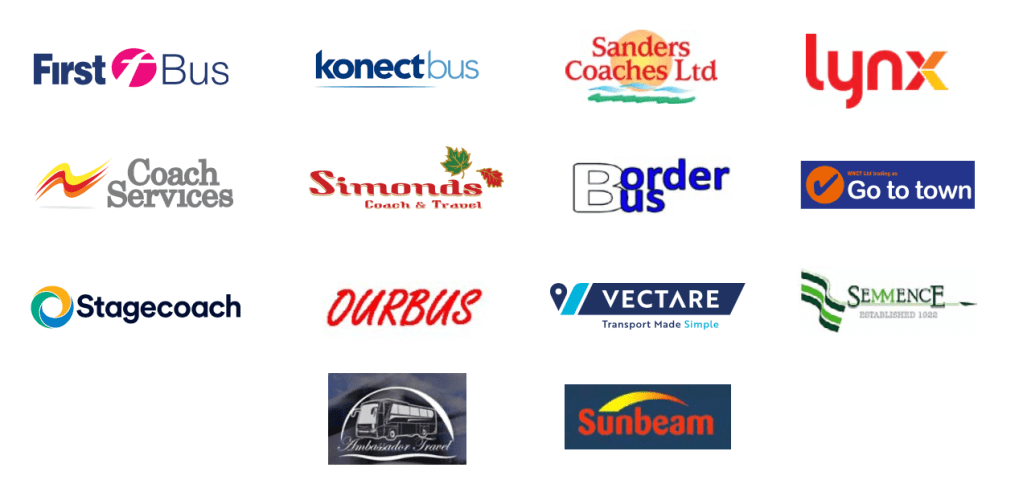
14 bus companies operate local bus services in Norfolk with First Bus the largest followed by Sanders Coaches, KonnectBus and Lynx. All are signed up to the Norfolk Enhanced Partnership with a positive commitment enshrined in the County’s Bus Service Improvement Plan (BSIP).
“We want to see passenger numbers grow so we can continue to invest and improve services in Norfolk and commit to undertaking all that we can to make these aspirations a reality. It is encouraging to see the support of Members and Officers at Norfolk County Council and believe that together we can further improve outcomes for Norfolk’s residents and visitors.” – the bus operators commitment.
Together with bus industry colleagues, I attended a briefing at the beginning of the month when council officers explained the background to the County’s Bus Service Improvement Plan (BSIP) including what’s been implemented so far and future plans.
I followed that up spending a couple of days travelling around the network last week to see whether operations on the road lived up to these expectations.
Spoiler alert: they did.
Norfolk makes for an excellent example of improvements that can be achieved in a short timescale with relatively small amounts of funding without getting bogged down in costly legal matters, bus garage acquisitions, the turmoil of awarding contracts and a myriad of other things involved in franchising and “taking back control”.
The Norfolk approach is the tried and tested successful formula of using bus operators’ expertise and commercial prowess to grow the market with the local authority introducing complimentary infrastructure enhancements, kick starting frequency enhancements, promoting fare offers and other supportive measures. Crucially there’s total buy-in to Norfolk’s plans from the controlling Conservative led Council. Councillor Graham Plant, cabinet member for highways, infrastructure and transport is fully supportive commenting results so far “are better than we ever thought they could be”.

Last November – just over a year since the County Council received is £49.55 million of BSIP funding from the Department for Transport (the sixth highest pay out in England) – passenger numbers increased by 18% with fare paying passengers at 107% compared to pre Covid baseline figures.
So, what does Norfolk’s Bus Service Improvement Plan involve?
Obviously the £49.55 million funding the County was awarded over a three year period from April 2022 to March 2025 has been a huge and welcome boost.
£30.9 million has been allocated to capital projects (of which 70% is going on bus priority measures – bus lanes and traffic light priority) with the balance of £18.6 million going towards revenue funded projects of which £11 million is being spent on enhancing frequencies, for example, kick starting extra daytime journeys on routes identified as having growth potential as well as improved evening and Sunday timetables, while £7.6 million is paying for capped and flat fares (£1.50 in some towns, including Great Yarmouth).
Interestingly and encouragingly, the passenger growth seen in Norfolk is mostly coming from fare paying passengers with concessionary passenger numbers languishing as is the experience all over England following changed travel habits during Covid.
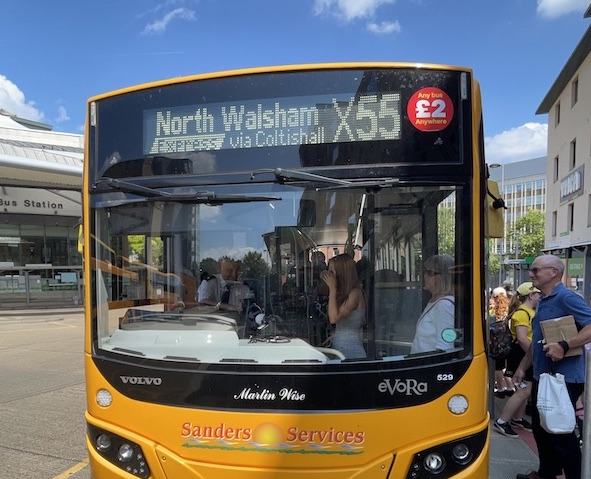
Bearing in mind the three year BSIP funding ends in March 2025, the Council has been canny in front loading many of the projects to get the maximum use of the money – an example of this is backing the frequency enhancement on Sanders Coaches’ route X55 between North Walsham and Norwich from hourly to half-hourly along with investment by the operator in new single deck buses for the route…

… and very smart they are to ride in too, as I found when I took a ride, with the service obviously proving popular with passengers.

This is no doubt helped by the £2 fare cap. I travelled from Norwich out to North Walsham at 07:58 one morning – before concessionary travel kicked in at 09:30 – and was impressed that 19 passengers travelled, bearing in mind it’s an ‘against the peak hour flow’ journey, and I was even more impressed I only had to pay £2 for the 48 minute journey.
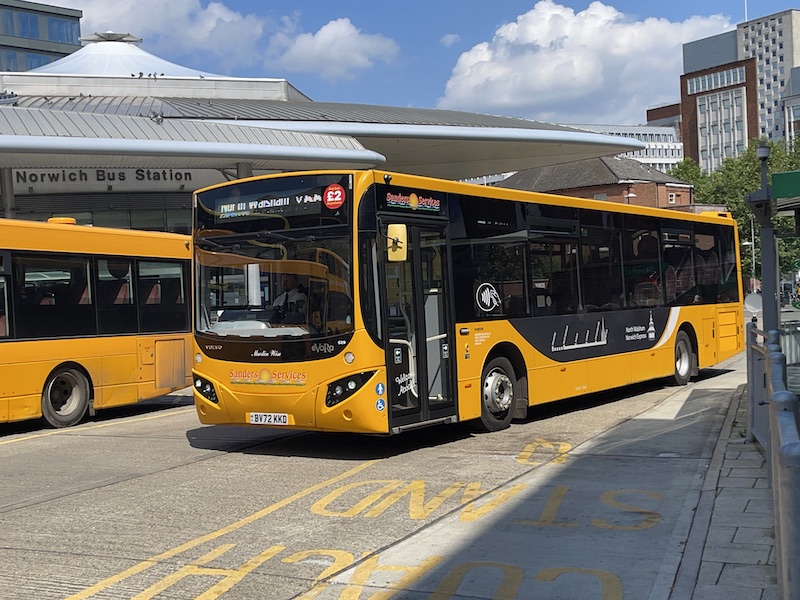
Previously the route had an hourly frequency with double deck buses but they could only fit under one of the three railway bridges in North Walsham necessitating a 20 minute indirect tour of the town before the journey to Norwich got underway. Single deck buses can travel straight up the main road under one of the alternative bridges saving that 20 minute time penalty making for a much more attractive end to end journey time of 46 minutes.

The refreshed service launched in January 2023 and experienced a 38.5% increase in passengers that year – far exceeding expectations.
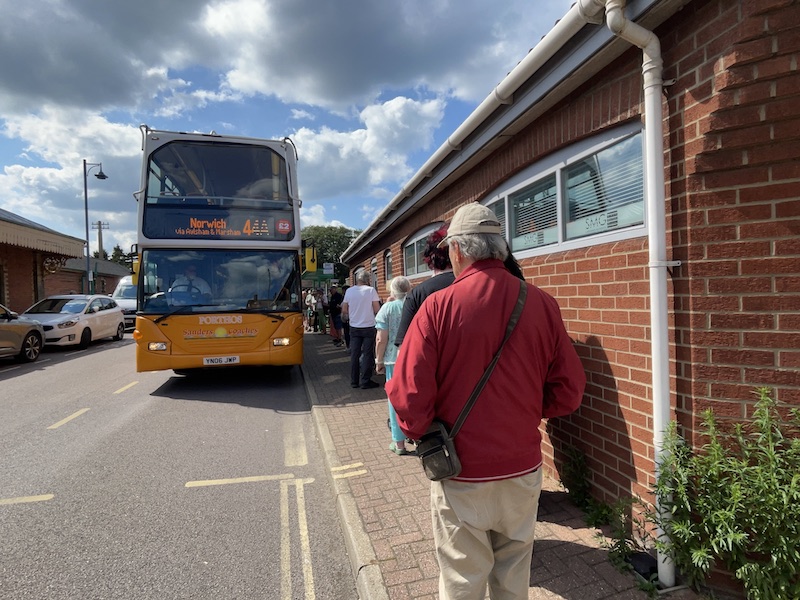
Sanders Coaches won the coveted ‘Independent Bus Operator of the Year’ title at last year’s UK Bus Awards and operates an extensive route network across North Norfolk including deep rural routes as well as popular trunk routes connecting market towns and villages with Norwich.
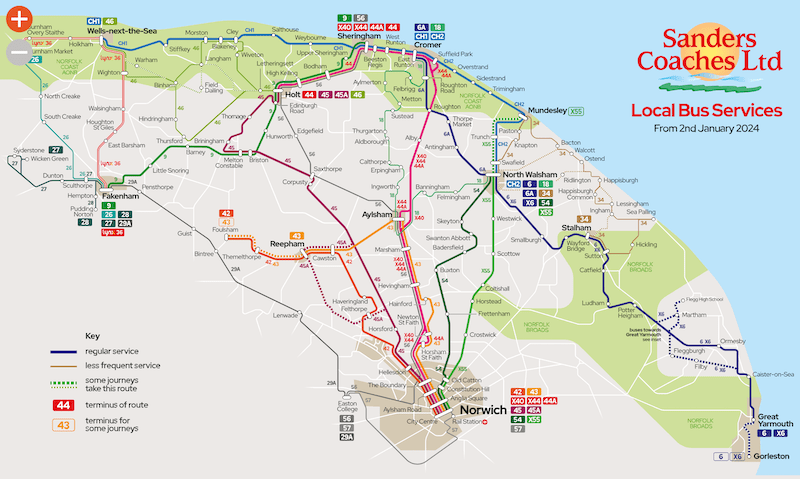
As I travelled around I saw impressive numbers travelling especially on the Holt – Sheringham – Cromer – Aylsham – Norwich corridor where the company runs up to three buses an hour on the southern part.

Granted many of these were holiday makers but nevertheless it was encouraging to see such good use being made of a network characterised by rural landscape in between the small town settlements and Norwich.

Its CoastHopper routes (CH1 from Wells-next-the-Sea to Cromer and CH2 Cromer – North Walsham) are hugely popular, again as I found out on my travels.
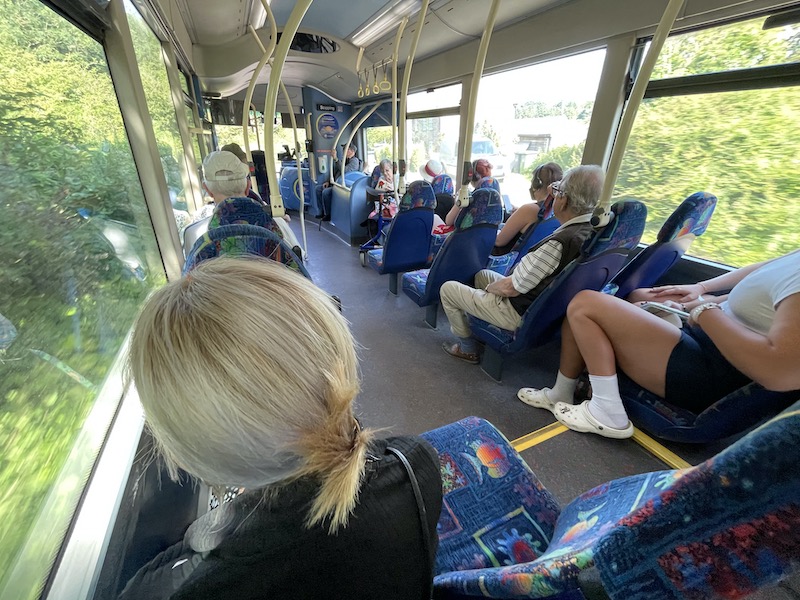
It was also good to see plentiful supplies of timetable leaflets on every bus I travelled on.

Meanwhile over in North West Norfolk, as I’ve previously blogged, the excellent Lynx bus company…

… has continued to invest in new double deck buses to transform the Fakenham – Wells – Hunstanton – Kings Lynn corridors…

… while in Norwich itself there’s been a transformation of vehicle quality with £14.7 million investment in a fleet of 70 electric powered buses thanks to successful bids under the last Government’s ZEBRA scheme matched by investment from First Bus.

Stand in Norwich bus station or the nearby St Stephen’s Street for just a short time and you’ll see high profile attractive branding for First’s excel route across to Peterborough…

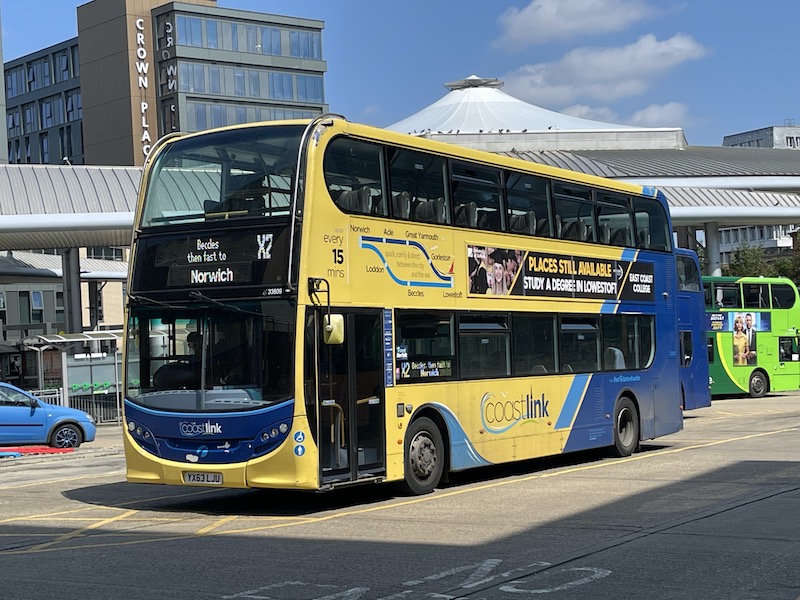
…its two routes to Lowestoft (one via Great Yarmouth and Gorleston, the other via Lodden and Beccles)…
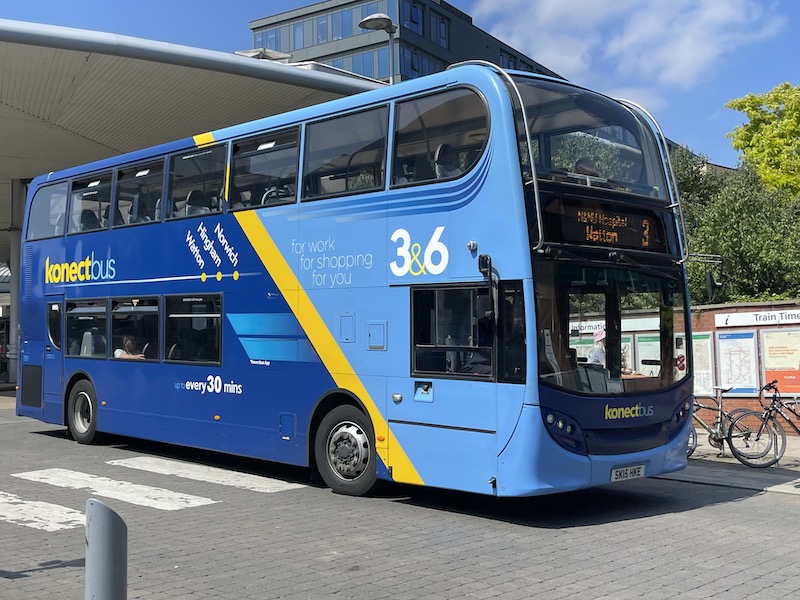
… KonectBus’s network…
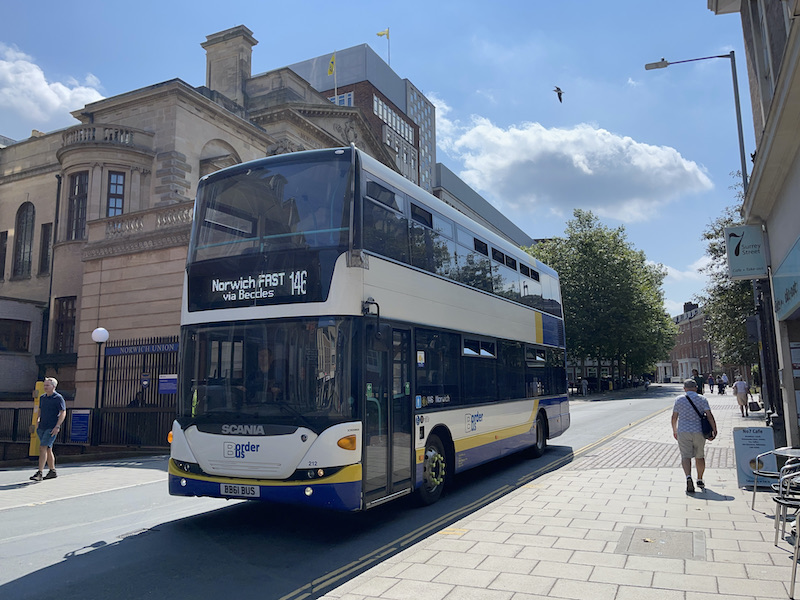
and Border Bus…
… OurBus …

… and Coach Services.

The Bus Station waiting area provides some excellent information provision…
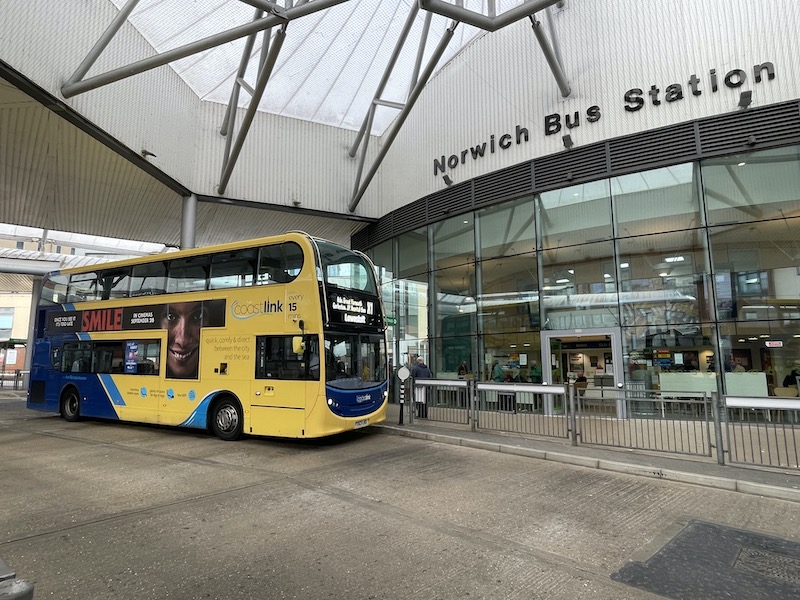


… albeit no printed timetables from First Busses (sic)…

… although First Bus still has its own Travel Centre in the city…

…where there are attractive brochures and leaflets to encourage leisure travel …
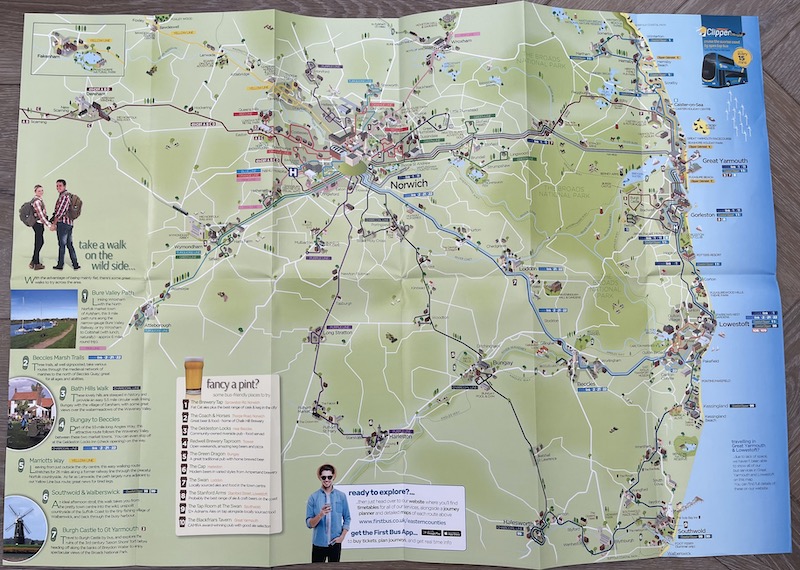

… and, back at the Bus Station, for KonectBus too.


Meanwhile, using its BSIP funding, the County Council has introduced some key pieces of bus priority measures including a short but effective section of bus only lane to assist with access to the bus station…

… which joins twelve existing bus lanes in the city…

… as well as bus only roads in Castle Meadow and St Stephen’s Street and eight bus gates. Other bus lanes are in King’s Lynn, Great Yarmouth, Diss and Wymondham with three bus gates in Great Yarmouth.
The BSIP includes plans for more bus lanes with next on the list, following a public consultation which ended last month, modifications to Great Yarmouth’s Market Gates bus interchange enabling two way bus movements generating up to five minutes time saving per journey.
The County is also proud of its Travel Norfolk website and journey planning software together with its policy of installing a QR code at every bus stop, which takes you direct to ‘live’ departures for that stop…


… as well as installing new bus stop plates to a consistent format throughout the County.

Upgrades to what are called a Gold stop standard will be implemented at 20 key bus stops – including a covered waiting area, lighting, real-time information, additional seating, cycle parking and printed timetable information and 50 more stops will receive real-time information – although I found on my travels that sadly it’s not always real time.

Enhanced waiting areas have also been introduced with central Norwich now providing excellent facilities in St Stephen’s Street and Castle Meadow…


… while over at North Walsham there’s a Travel Hub (!)…

… although sadly one of the three bus shelters has come to grief in a recent incident and is awaiting replacement…
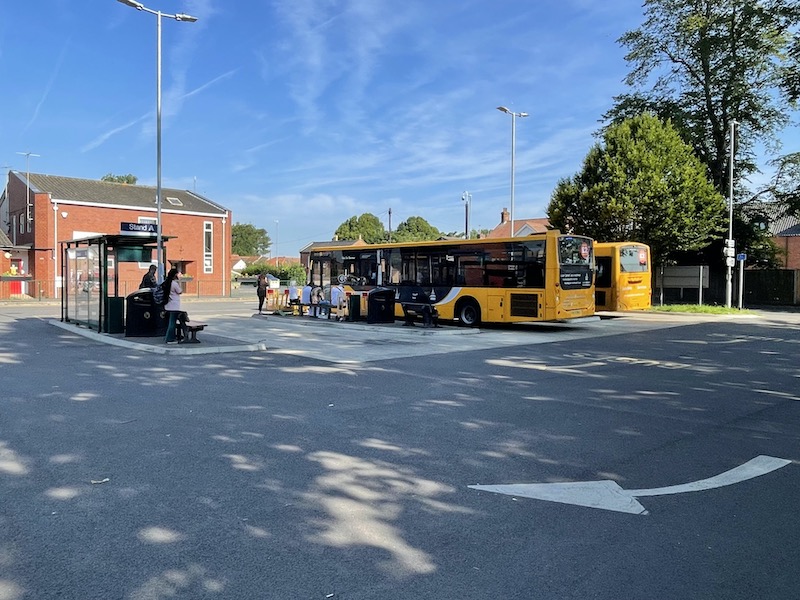
… and it’s impossible for buses to turn into the Hub and pull on to Stand C (on the left hand side in the photo below)…
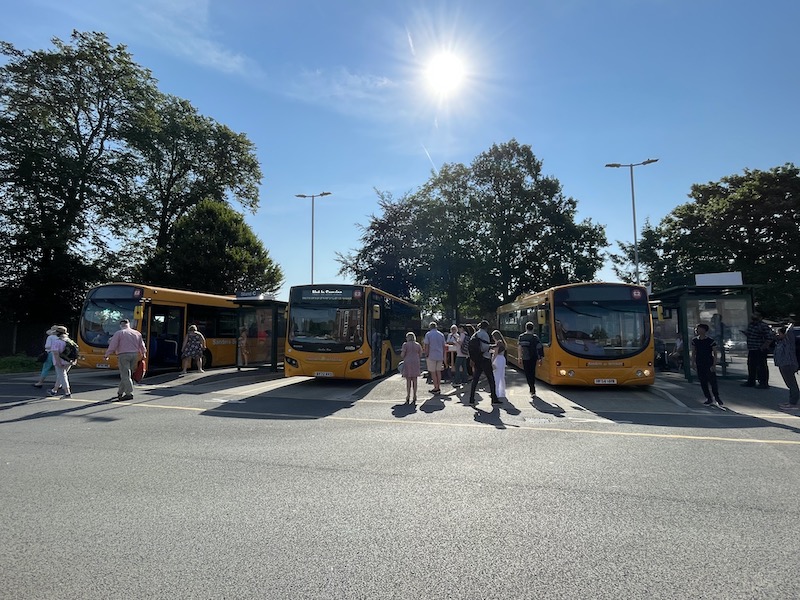
…due to the tight turn.

But the toilets are the best I’ve ever seen in a market town bus terminus of this kind.
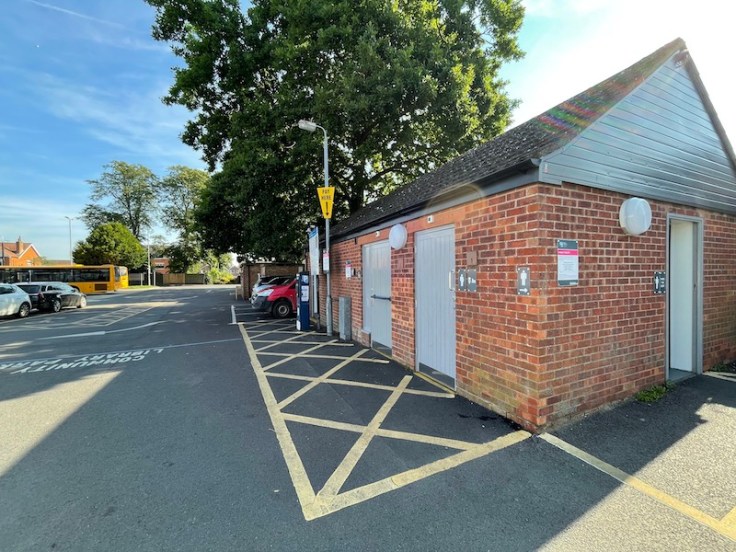

The BSIP includes plans for further “Hub” style improvements in Cromer…

… Hunstanton…

… Sheringham…
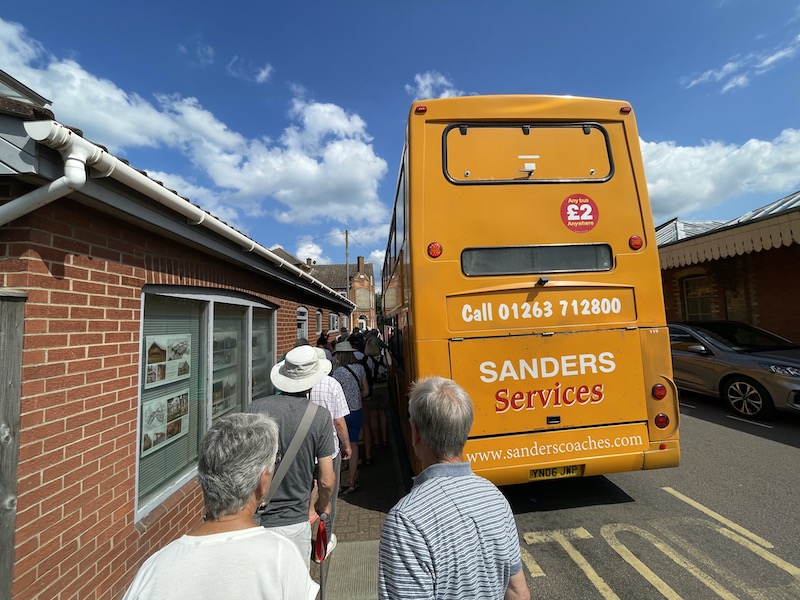
… and Diss.

And not before time in some of these locations.
So well done to staff at the County Council and bus companies in Norfolk. As well as Councillor Graham Plant for letting them quietly get on with but providing crucial backing and support.
Roger French
Blogging timetable: 06:00 TThS with Summer Su extras.
Comments on today’s blog are welcome but please keep them relevant to the blog topic, avoid personal insults and add your name (or an identifier). Thank you.
 BusAndTrainUser
Sounds like great stuff! – It’s really nice to have to good news on the bus scene. Perhaps the next stage should be some co-ordination – these schemes (apart from the Excel ABC – and that notably ends in Norwich a 15 minute walk from the rail station) mostly seem to be for ]’One-seat’ journeys. To really break into the wider travel desire that the car has created, a real network is needed, and that will involve through-ticketing and awareness by staff of connections, as well as timetable and interchange facility improvements. Perhaps an aim of any continuing BSIP should be to have some means whereby the independent bus companies are encouraged to come into joint talks for extending the nature of public transport travel – and the rail operator local management too.
LikeLiked by 1 person
Hugely encouraging,next stop for Louise Haigh? Except of course it’s a Conservative Authority
LikeLiked by 1 person
The absence of an all-operator network map similar to Hertfordshire is a surprising ommission; I wouldn’t want to mess around trying to splice together my trip from half a dozen individual operator maps. Also the continued failure of (most) operators to publicise on their buses the £2 fare just mystifies me. Nit-picks aside, this looks like county using its BSIP money wisely.
Buying buses which are actually fit for purpose is an interesting contrast to the situtation in Wales covered (yet again) in Buses this month where TfW has wasted millions buying kit which can’t even complete a day’s shift on its TrawsCymru network. This seems a good example of what that article was talking about, electric buses need to be introduced at scale in urban centres where they can actually affect the air quality and not frittered away in penny packets.
LikeLike
Everything that involved the dead hand of TfW is mess – buses, trains you name it. It has recently been quoted as a money, for which it is with bad and unscrutinised excision making.
LikeLike
*decision making
LikeLike
Every Sanders bus, bar one, is clearly marked with the £2.00 fare. The one that isn’t is a minibus that does other things before weekday wiggles around a variety of villages – with a different route each day. We get it on Fridays.
LikeLike
Indeed Sanders are one of the exceptions, although I’d still argue it’s pretty low key. Just imagine if the entire industry had used every piece of unused external advertising space they had, and replaced all the adverts for local car dealers for the duration.
LikeLike
Possibly but as Sanders don’t carry advertising for anything other than their own services the large red disc, advertising the £2.00 fare, does stand out.
LikeLike
Part of the problem was that when the £2 scheme was introduced the operators got almost no notice (2 weeks over Christmas to run for only a few months) and then it kept rolling on with finish dates only a few months in the future meaning by the time any meaningful marketing was rolled out it would have been ended. It was only the last extension that was for a truly meaningful period and by that time it had been running for a year and many operators probably, though possibly mistakenly, felt it was pretty well known (though I have seen external adverts on a number of operators including Stagecoach and a number have programmed their blinds to display adverts it just isn’t as widely applied as Sanders have done) so going big on it was not going to have a major impact.
There is also that concern held by many in the industry that we just don’t know how the scheme is going to be exited, probably a slightly overblown concern but it is a worry, you don’t want to push the £2 fare if the fare is just going to jump back to full fares at the end and you create a lot of upset over fare increases and lose all the new business. Plus, since the reimbursement is a fixed pot and not variable managing extra demand is important as there is no way to support extra resource if numbers begin to fill buses, £2 is not enough to pay for extra buses and no one else is funding such for the scheme. The whole scheme has been badly implemented by the government and operators haven’t been able to really maximise its benefits
Dwarfer
LikeLike
And, of course, in this area there is a lot of bus pass people so the £2.00 does not apply! However, if it raises the profile then all well and good. I think that Lynx may have noted the prevalence of bus passes.
LikeLike
It would be a good idea for officers of some our lack lustre authorities to take their elected members for a day out in Norfolk to meet their opposite numbers. It would be particularly useful for Tory councillors to meet with Councillor Plant, the cabinet member, to see what can be achieved, in partnership with good operators (without needing to think about stupid DRT schemes).
We might see other authorities aiming higher, to match Norfolk’s standard.
Petras409
LikeLike
It’s great to hear of the good work that the council and the bus companies are doing in Norfolk! But when you laud the council for its light-touch approach and by inference decry those authorities going for a more centralised model, it seems like you’re missing a key point, which is that Norwich isn’t going down that route because it doesn’t need to.
With a number of strong independent operators, a division of Go-ahead and one of the few First networks that still seems to be run in the interests of passengers and not bean counters (you can tell because their timetables still feature magical phrases like “then every 30 minutes” rather than being derived from random number generators like most of us have to suffer), there was already a good base to build on.
If Manchester or West Yorkshire had been starting from there and had already got high customer satisfaction from their existing network then there would have been far less interest in taking control of it – but when the network was run down, the service patchy, the fleet tired and the operators showing no interest in improving things without being given vast piles of cash there’s not much point in tinkering at the edges and hoping for the best.
LikeLiked by 1 person
It’s been some time since I was in Norwich, but that bus priority exit from the bus station was badly needed. It was very difficult to get out before, with buses queueing in the station.
Andrew Kleissner.
LikeLike
I wonder who spells the plural of bus busses? Was always buses in my youth!
LikeLike
It’s the US spelling and US English seems to be ‘in’ nowadays, partly because a surprising amount of large UK companies’ IT departments leave their software in the default setting of “US English” rather than switching it to “UK English”.
Yes, Stagecoach Group, I’m talking about you!
LikeLiked by 1 person
What a great success story. Well done Norfolk – council staff and operators. Excellent vision. Enjoyed the bus service when I was in Aylsham recently. I do wonder what will happen here and elsewhere after the BSIP runs out. Less positively (sorry) North Walsham bus stands look an absolute nightmare. Narrow with little passenger space. I can understand how a shelter was “taken out”. An original floating bus stop but with traffic both sides.
LikeLiked by 1 person
Nice to see leaflets snd staffed travel centres and therefore visitors travelling in substantial numbers in a popular holiday area.
I doubt many shire authorities will adopt franchising, because they never had municipal operators and thus never “lost control”. If any shire LTA did have ambitions to take control if they are afflicted by indifferent big groups, then I would recommend they visit Jersey and Guernsey and study their operating models.
Peter Brown
LikeLike
Norfolk does seem to be making a good fist of improving things with its BSIP money. But would it be THAT difficult for Konectbus to carry First service info, and vice versa? I seem to remember a bus operator somewhere on the south coast producing very good timetable books with everyone else’s timetables included… But great that both operators have public offices in Norwich.
LikeLiked by 1 person
Perhaps an opportunity to plug ‘Bus Atlas’ which has a very good all operator map of Norfolk, and most of the rest of the Country as well.
Interesting that Lynx has ignored the £2 fare and does not appear to have suffered as a result. And First, whilst producing excellent timetables on line , produces no printed leaflets unless there has been a recent change
There is also a Countywide All Operator Day Ticket useful if Lynx is part of your itinerary
And hopefully m like others M the BSIP funding for new services extends to March 2026
LikeLiked by 2 people
| There is also a Countywide All Operator Day Ticket useful if Lynx is
| part of your itinerary
The Norfolk Fusion ticket.
At £12 adult it’s the same price as the joint Lynx/Sanders ‘Coast Day’ ticket (and cheaper for 16-19 year olds), covers all operators instead of just the two, and even more impressively it’s also valid for any journey starting or ending in Norfolk, which means you can buy one in Peterborough on First’s Excel, switch to Lynx at King’s Lynn round the coast to Wells, continue with Sanders to Norwich or Great Yarmouth and then back onto First to end up in Lowestoft in Suffolk. Or from Norwich back through to Peterborough as I did it back before £2 fares.
LikeLiked by 1 person
Roger writes: …”while £7.6 million is paying for capped and flat fares (£1.50 in some towns, including Great Yarmouth).”
One wonders why the Norfolk LTA cannot agree a £2.00 single capped fare with Lynx.
If you’re a fare-paying adult, setting off from King’s Lynn Bus station a day in ‘Sunny Hunny’ (aka ‘Hunstanton, the last resort’) will cost you £6.30 (two-trip ticket) whilst a day in Norwich (for the castle and cathedral), Peterborough (for the cathedral and moot hall) or Spalding (for the flowers) will set your back a mere £4.00 (2x £2 single.
This is one of the downsides of Enhanced Partnerships; passengers get inter-operator ticketing and capped fares if the operators agree. With Franchising (more correctly competition for contracts, rather than on-road) all aspects of the passenger experience can be specified.
However, where the LTA is not the same body as the Highway Authority, tackling the major issue which affects bus reliability – traffic congestion – has additional hurdles to mount. No doubt there will be interesting negotiations to come between Cambridgeshire and Peterborough Combined Authority and Cambridgeshire County Council.
LikeLiked by 1 person
Spiralling costs lead to rural bus service closure
A rural bus and taxi service has announced it has shut with immediate effect due to falling passenger numbers and spiralling costs.
Essex and Suffolk Demand Responsive Transport (DaRT) bus services and Arrow Taxis announced the closure “with great regret” on social media, external.
LikeLike
The closure of Arrow Taxis (Essex) Ltd and, the associated, Essex and Suffolk Dart C. I. C. on 26 July is causing complications as it coincides with a major Essex re-tendering programme which involves both operators. The results of this come into effect on 28 July. Essex C. C. is trying to arrange operators for six services.
I believe that Sanders service X55 is taking passengers between North Walsham and Norwich away from the railway. The more frequent bus takes passengers into the city centre at a much lower fare.
Peter Clark
LikeLike
Unlike Roger, I am not impressed with the replacement of at-stop timetables & departure lists with scannable bar codes (as seen all over Kings Lynn yesterday).
Paul B
LikeLiked by 1 person
Quite wonderful for me to see Route 90, Norwich-Thetford, bearing the same number as the modest 90 I travelled to school on in 1944-5. It ran out only as far as Cringleford, but started my fascination with buses.
Bruce Perkins
LikeLike
Roger
Excellent article thank you. The Norwich Electric fleet are a joy to travel on. The only niggle is that the audio next stop announcements and Hannover information screens are sometimes not working
First have just introduced an open top Clipper tour of Norwich for the school holidays and a printed leaflet is available from the travel shop.
While there are no printed First timetables ,the Travel Shop can provide printed individual or sets of the timetables from the web site . I collected a set this week.
The only disappointment locally is that Lynx have not joined the £2 fare offer. However their fleet is always clean and tidy and they have a printed timetable booklet.
Best wishes
Rod Gilchrist
LikeLike
Dear busandtrainuser, why so many different bus companies ? South of Sleaford, Lincolnshire we have three partial bus services between the town and Bourne by three different bus companies and, since the cessation of the NatEx coach service, no bus service linking Sleaford and Bourne !!! The chaos has to stop !!! Graham Lilley, transport campaigner
LikeLiked by 1 person
Did you answer Lincolnshire County Council’s recent consultation and ask for connecting links such as Sleaford – Bourne to be introduced using BSIP funds?
Lincs CC is wedded to their Call Connect scheme and needs to be pushed a bit to think about scheduled links!
LikeLike
Maybe the “chaos” lies mainly.in your head! These are rather vague objections, and I’m pretty suspicious of the extremely expensive, producer dominated “solutions” often promoted by transport campaigners.
Is the new Labour government going to, say, double the subsidies available for bus services? I rather doubt this.
LikeLike
Interesting to note that the travel Norfolk website was delivered by a local Brighton Web Agency that I recommended along with GRM mapping. Very glad they seem to like it. Apologies if some of the real-time wasn’t real-time. We are adding the ability to see the actual buses live locations moving on the maps to give further reassurance that your bus is on its way!
all the best, Lee D 🙂
LikeLiked by 1 person
Although Lynx are not part of the 2 quid fare scheme there fares are still very good value . Fakenham to Wells Next the Sea is just £4.50 return .
LikeLike
All well and good except there are some very annoying service gaps on the Holt to Sheringham leg of the Sander’s run Holt/Sheringham/Cromer/Aylsham/Norwich corridor.
Especially in evenings where buses tend to start from or finish at Sheringham instead of Holt (where Sanders is based, for *** sake).
For example, the last possible time to leave Holt for Norwich (for onward connections to London) is 17:24, and similarly there is a big gap in the evening leaving Norwich until the last bus at 22:49. (There is one later bus to Sheringham with a 2.5 hour wait for onward connection to Norwich, and that arrives too late to Norwich for last train to London).
And also the late evening service from Norwich to Holt nicely connects with trains at Sheringham Sun-Thurs for onward travel to Holt, but not on Friday/Sat when the train arrives about 10 minutes later than the bus due to extra stops. Would not cost that much more operationally to delay the last bus from Norwich on Fri/Sat to meet the last train at Sheringham.
Having one extra rotation to Norwich following from the 18:34 from Holt (without the wait at Sheringham) would be a huge improvement for travelers wanting to visit Holt for an extended stay to arrive at a more reasonable hour and make the most of their time in the area.
The 7-8 miles between Sheringham to Holt is not safely walkable by any route (especially at night), and a taxi between the two generally costs around £30, which is usually more than the return train ticket from London for a single person, and sometimes even for a family. The only other way to fill the gap would be to bring a bicycle (potentially folding if an underground train is needed) and that’s not an option open to many.
Pleas have been made in local media many times to have fewer gaps and better connectivity, but have fallen on deaf ears.
When I want to do such journeys I plan around the timetable restrictions, with gritted teeth. The BSIP (which I have read) has come up short on multi-modal connectivity and frequency infill in terms of priorities, and the use of BSIP funds on some of the other points described in this article annoys me further.
I haven’t yet sat down to make the “string diagrams” to argue the very incremental cost case for filling the gaps (agreed the extra rotation which would extend the duration of the PVR hours and needing another driver so would need significantly more funds)
MilesT
LikeLike
Not quite everything to BSIP plan
https://www.northnorfolknews.co.uk/news/24486326.cromers-overstrand-road-bus-gate-slammed-farce/
LikeLike
The £2 fare is a game changer for car free Londoners like us who travel as a family of three. Lynx should be made to accept it. And as much as some positives are coming out of Norfolk wouldn’t a coordinating travel authority with real power create a public transport service greater than the sum of its parts? Norfolk have always tried hard. They did a great job with Norfolk Green and the Coasthopper until the money was cut in the 2010’s. I think the evidence is there that if they had the resources and the power they could do a great job again. You shouldn’t need a car in Norwich. Outside Norwich public transport should be good enough to enable families to give up the second or third car. If only railways were part of the package. Think of the potential if Norfolk was to be a new shire county pilot for coordinated public transport. Why should the U.K. be the only country in Europe not to see this?
MikeC
LikeLike
The other big miss in the BSIP is not enabling single seat/single fare travel from North Norfolk to the main hospital in Norwich (which is on the south side of the city). Presumably to prevent fare abstraction from First Bus who run the majority of the routes to UEA and hospitals (there is also the Bupa Spire hospital nearby to the Norfolk & Norwich)
The lack of direct service adds to the pressure for residents of North Norfolk to use the volunteer run hospital car service, but visitors are not really supposed to use that service.
The Sander’s routes to Norwich (the trunk 44, but also commuter direct and express routes) terminate at Castle Meadow/Bus station, where it is possible to change buses to the hospital, with varying amounts of wait time and (I think) walking between stops.
Extending Sander’s buses to the hospital (via UEA) would add 20 minutes to the route (and the 44 trunks are already quite long), and I appreciate this would increase the PVR and drivers hours and likely would need to be subsidise even though the main trunk buses are already well used.
The tunk 44 already provides reasonable access to the subsidiary hospital in Cromer, but the other smaller health facilities in the district are not well served I think
MilesT
LikeLike
Having the chance to travel in Norfolk in the sunshine on Saturday, I was surprised with how well the loadingis across various bus routes. Among the services I have sampled today is the Excel DD, with all seats being taken in the morning. The Lynx buses were less crowded, possibly due to it did not join the 2 pounds scheme. The condition of the Optare Tempo and the new E400MMC on 36 Coastliners were superb, especially the 36 Coastliners; they are really comfortable and stylish for along journey, especially compared to the similar E400MMC deployed by Sanders on the X41. It is a bit strange that the coastal route was not operated as a through route, with a bus change needed in Well-Next-the Seabetween the CH1 and the 36. If any joint operations can be done between Lynx and Sander, it would be good, or at least there should be better signposts or instructions for interchanging. There were puzzled tourists seeking directions, but it seems even the Sander driver didn’t have any idea about the Lynx to King’s Lynn. Timekeeping is challenging; there are many late running on Sander’s part today, possibly due to the Sheringham’s 1940 Day in town. The current allocation of the CH1 is a mid-size B8RLE, which is hard to cope with the demand, but I wonder if it is due to the restriction of the low bridge that a DD could not be deployed. A very limited number of passengers can be taken by our CH1, and a hundred were left behind, which could be sorry for them given the frequency. Sander invested in tri-axle buses, but it seems two of the three were deployed to the football route today, which could not help to alleviate the seafront pressure. Compared with Lynx with bus stop flag installed all along the route, not all bus stops of CH1 was with a bus stop pole, and sometimes passengers were really confused. My final leg of X41 to Norwich was a full-loading X41. The Norwich to Cromer / Sheringham corridor had promising loading, but the timetable was a bit strange with an uneven service pattern. The bus leaving Sheringham to Norwich before dark at 17:42, and there is no bus scheduled until the last one at 21:10. The taking of bus usage in Norfolk is quite significant. Hopefully, there will bemore service enhancements there.
LikeLike