
Sunday 7th July 2024

Ian Budd, the enthusiastic knowledgable convenor of the Friends of the Far North Line (FoFNL) kindly invited me to speak at the organisation’s Annual Conference last month in Inverness.
It was wonderful to see and hear the passion and enthusiasm of everyone attending; all committed to making the Far North Line – which runs between Inverness and Thurso/Wick – as attractive as possible thereby encouraging more passengers to travel by train for business and leisure and enjoy the delights offered by this special railway line.

Other speakers at the Conference included Anthony Smith (recently retired Chief Executive of Transport Focus) and Robert Gardner (a Chartered Engineer working on high speed broadband using low orbit satellites for the line) as well as Mark Ilderton (Interim Service Delivery Director at ScotRail) and Frank Roach of HITRANS.

Frank has been a key player, not only being one of the founding members of FoFNL, but also through his work instigating and seeing through many of the positive developments on the line over the last couple of decades, including, for example, the recent introduction of ‘request to stop’ devices at the small request stations on the line.

The Conference was preceded by the FoFNL AGM when, as well as the usual administrative business to transact, Ian gave an interesting update of current issues impacting the line including the latest on the Delmore Loop (see below) and the unique circumstances surrounding the temporary closure of Altnabreac station, but also, hopefully, its imminent reopening,
This month is a very special one for the Far North Line as it was 150 years ago, on 28th July 1874, that the final stretch of track, from Helmsdale to Thurso and Wick, opened and the line began operating as it still does today. The Friends together with the Highland Railway Society and the Scottish Association for Public Transport are mounting an exhibition in Wick station to commemorate the anniversary.

This year also marks the 30th anniversary of the formation of the FoFNL itself and it’s interesting to see how the organisation has developed and adapted over that time, changing from a group intent on saving the line from possible threats of closure – which were still around in 1994 with new bridges cutting comparable journey times by road, the loss of freight traffic, falling passenger numbers and the uncertainty of looming rail privatisation.
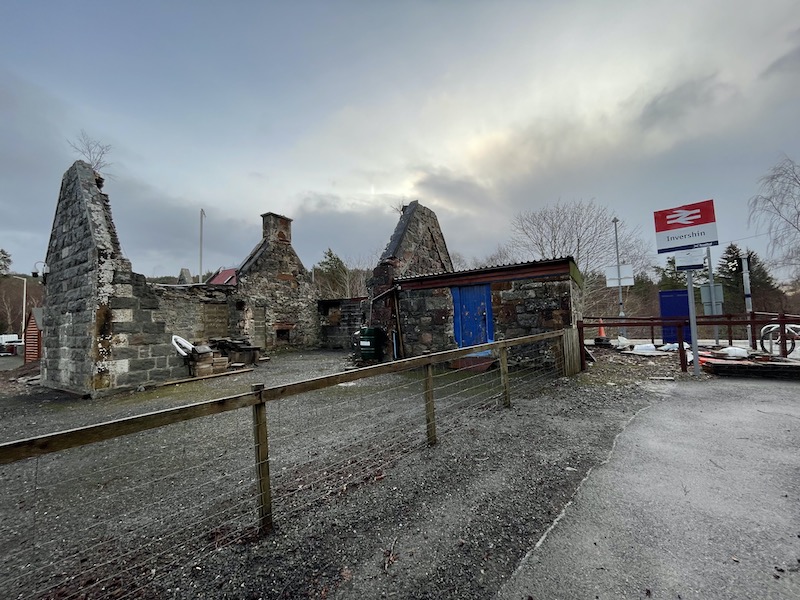
The organisation quickly gained respect in the rail industry thanks to its professional and positive approach; being treated as a serious stakeholder and a critical friend. There’s no doubt its lobbying has been instrumental in achieving many initiatives including improvements to the timetable (increasing the number of end-to-end journeys from three to four a day, as well as additional commuter journeys at the southern end of the line); improving the interiors of Class 158s (all seats lining up with windows and installing retention toilets, before they became mandatory) and reopening the one platform stations at Beauly and Conon Bridge located between Dingwall and Inverness.
Incidentally, at just 15 metres, Beauly’s claim to fame is being Britain’s shortest platform with Conon Bridge said to be just 1 centimetre longer. Both platforms are less than one carriage long necessitating just a single door opening when trains stop.
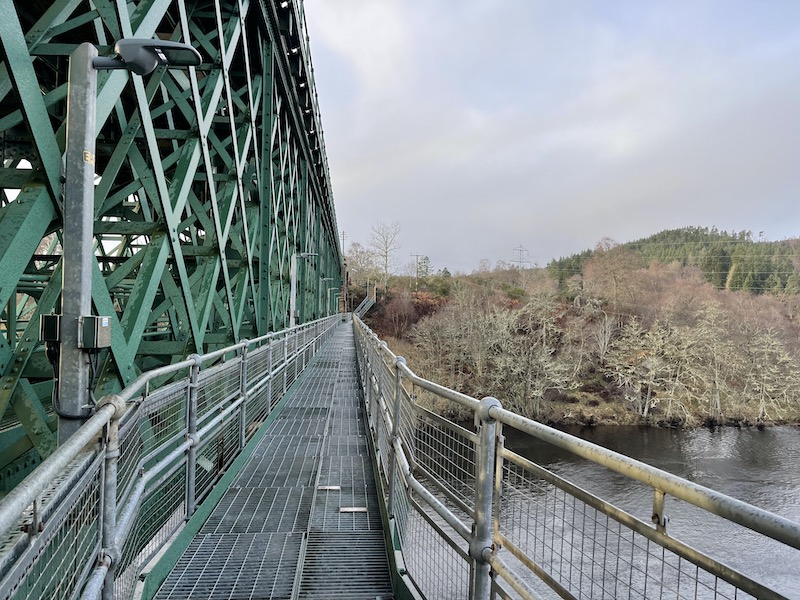
Another of the Line’s claims to fame is the footbridge connecting Culrain and Invershin stations (both request stops) located either side of the Kyle of Sutherland…

… and, at 748 yards, said to be the shortest distance between two railway stations in Britain. Geoff Marshall and I paid a visit to them back in February last year.

One of the projects the FoFNL would like to see come to fruition is the installation of a passing loop at Delmore between Inverness and Beauly so in the event the first southbound journey from Wick at 06:18, due to arrive into Inverness at 10:39, is running more than five minutes late at Muir of Ord (at 10:15) it doesn’t have to frustratingly be held there for more than an hour to allow the 10:41 Inverness to Wick and 10:56 Inverness to Kyle of Lochalsh trains to clear the long section of single track between Inverness and Muir of Ord – the Kyle train doesn’t reach Muir of Ord until 11:19.
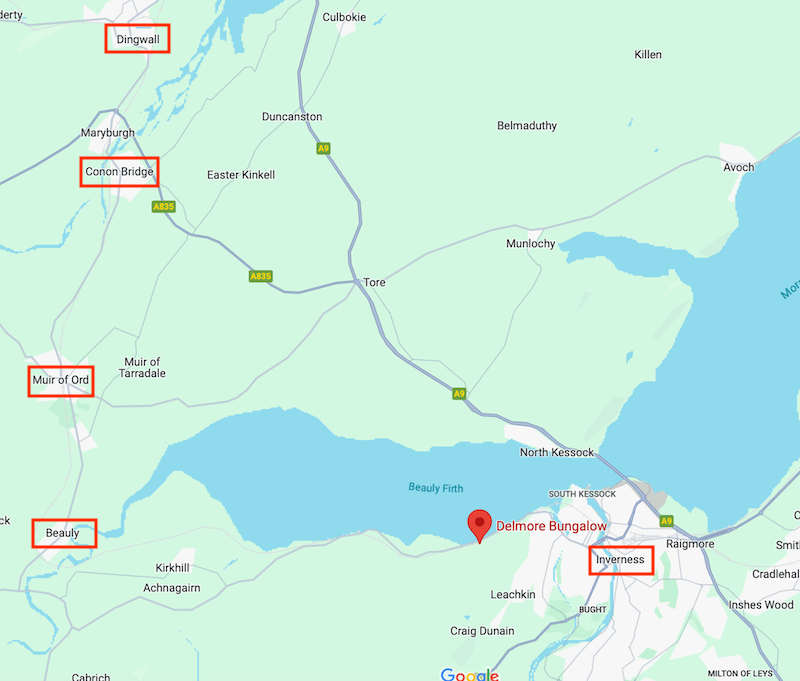
Sadly, despite FoFNL campaigning for this relative small piece of infrastructure for the last 20 years and acknowledgement from Transport Scotland, ScotRail and Network Rail of its undoubted benefit, due to lack of funding it still remains in the implementation sidings, so to speak. When you see the funding going into the dualling of the A9 south of Inverness it does make you wonder about relative spending priorities.
Ian also points out the benefits from installing more passing loops further north on the line – between Dingwall and Invergordon and between Helmsdale and Forsinard – which would minimise the impact of a late running train on journeys in the opposite direction, helping to maintain a reputation for good timekeeping and reliability on the line.
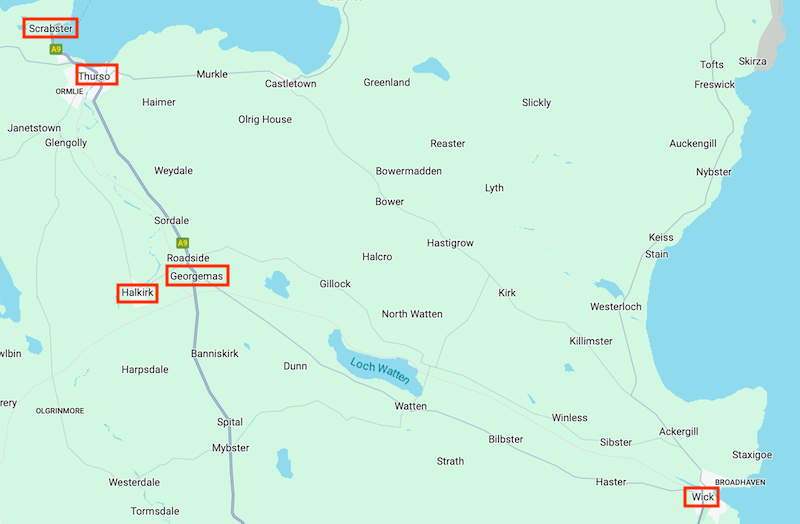
Other improvements the FoFNL suggest include a curve at Georgemas Junction to overcome the need for trains to reverse on the way to Thurso as well as reopening the station at nearby Halkirk and, further south, reopen the station at Evanton between Dingwall and Alness.
I always enjoy a ride on the Far North Line. It may not be as renowned as the West Highland, Kyle of Lochalsh or the Highland main lines but, as I said at the Conference, in many ways that makes it all the more special, as you feel you’re travelling on a line that’s just as magical as the others but not so mainstream touristy.
Travelling on the line has also featured in some of my most memorable adventures including visiting Cape Wrath, travelling on one of Britain’s last post buses (Tongue to Lairg), and completing the Lands End to John O’Groats 24-hour challenge, albeit for the journey home afterwards (the bus is quicker).
It’s a shame the Far North Bus no longer connects with the lunch time northbound train arrival in Lairg, as that was a convenient way to reach Durness and the north western tip of Britain, but more positively, there’s now a bus on route 805 every day, Monday to Saturday, from Inverness to Durness leaving at 15:00 (16:00 Saturdays).

There’s also an 803 on TThS from Thurso to Tongue (continuing to Durness on Saturdays) leaving at 14:30 but that’s a little tight for a connection from the train arriving at 14:24, and I’m not sure I’d risk it.
The FoFNL suggests there’s scope for improvements to bus connections between Thurso station and Scrabster Harbour for the ferry to Orkney as well as from seaboard villages to Fearn station and the Dornoch to Tain bus service.
Members of FoFNL live all over Britain and as well as supporting the development of the line receive a thrice a year magazine called the Far North Express. Put together by Ian Budd, this really is a magnificent read and well worth the annual membership alone.

FoFNL Membership costs £18 a year, £15 per annum for continuous membership or £120 for life membership. You can easily sign up online. Your support will be much appreciated and I can vouch for the fact you’ll definitely be among friends.
Roger French
Blogging timetable: 06:00 TThS with Summer Su extras including today.
Comments on today’s blog are welcome but please keep them relevant to the blog topic, avoid personal insults and add your name (or an identifier). Thank you.
 BusAndTrainUser
A good read – but it is Conon Bridge, not Canon Bridge.
MW
LikeLike
Many thanks; now corrected.
LikeLike
Don’t think Culrain and Invershin are the closest two stations. Assuming both stations have to be on the same line with trains running between them then I think City Thameslink to Blackfriars would be closer. There seem to be several other contenders as well, although it all gets very messy if you start counting entrance to entrance or platform to platform (especially for Blackfriars).
LikeLike
Covent Garden & Leicester Square are probably the closest only about 200 yards
LikeLike
Morning Roger, lovely line, Partly saved from closure in the Beeching era by arguing the case for military use – speak to Lord Thurso for details.
In terms of the shortest gap between stations, I’d assumed this was Newhaven Town to Newhaven Harbour, and certainly would have been Newhaven Harbour to Newhaven Marine.
Norman Baker
LikeLiked by 1 person
Lovely line, though alas I’ve never done it myself. BTW, couple of wee typos just above the photo of the footbridge linking Invershin & Culrain – it’s Conon Bridge, not Canon Bridge. Graham L.
LikeLike
How do you run that line cost effectively ?
With no freight and a very sparse population it must be very expensive to operate that line
LikeLike
| How do you run that line cost effectively ?
You don’t. It’s the social railway at it’s most extreme.
LikeLike
You don’t! There is already perfectly good commercial coach service operating from Inverness to Wick and Thurso. This serves centres such as Dornoch that the railway bypasses – and which does not require big subsidies to operate!
LikeLike
Maybe the 0618 from Wick could be re-timed to leave a few minutes earlier to minimise the chances of that awful hour’s wait at Muir of Ord? The 0700 from Inverness would have to be adjusted too to ensure they still pass at Lairg, but maybe there are other implications?
Mike Best
LikeLike
At risk of being dragged to the stake and burnt alive, I really have to question the actual effectiveness and economics of a what is actually a single track railway longer than the distance from Doncaster to London. Railways can only remotely be effective if the track is used intensively, by both passenger and freight.
The daily operational issues, difficult terrain and the stark fact that buses and coaches can more effectively cover (with far better passenger vision than stuck in a crowded train with high back seats!) these days with an improved road network, leads me to think perhaps we should let this one go. Fear not, as of course it would never happen, as to question “the Romance of the Railways” is sheer heresy, and I am sure my comments will be met with an avalanche of wonderfully valid reasons why this line must stay at any cost.
And that cost will be great indeed, rising inexorably as the years roll on.
Terence Uden
LikeLike
The population of most of the towns the line service only runs to a few thousand
The cost of the line relive to the passenger numbers cannot be good. Most of the stations will be lucky to get a handful of passengers a day
Is it the best use of scarce funds ? For many journeys the bus is quicker as well
LikeLike
|Fear not, as of course it would never happen, as to question “the Romance of
| the Railways” is sheer heresy
There has to be some explanation for the way the world turns into raging ogres if there’s a mere suggestion of closing an almost unused station, let alone an entire line.
A former colleague of mine worked for BR as a supervisor on the Cambrian Coast Line (Machynlleth – Pwllheli) before privatisation. He told me that in early 1990s BR tried to close Tonfanau station as it had been used by two passengers a month for years (along with three others which weren’t quite so ridiculously underused).
There were thousands of objections to the closure from all over the UK and beyond, clearly not from people who’d ever use the station, but permission to close was duly refused and so the station is still there.
It’s apparently far more successful now, being used by all of about half-a-dozen people each day, although I believe daily use of the other three stations can still be counted on the fingers of one hand.
LikeLike
Your arguments are of course entirely reasonable – but maintaining this type of rural railway is now almost a national religion!
LikeLike
On an (almost) parallel topic, sad to note the loss earlier this year of the bus link on the west coast between Lochinver and Kinlochbervie. Thus it is no longer possible to reach Durness and Cape Wrath travelling by bus north from Ullapool. Most recently this had been operating six days a week, up from twice a month previously. A sad loss to us bus route explorers.
Robin Bence
LikeLiked by 1 person
And so the question arises as to why we don’t employ a tiny fraction of the funds the trainspotter politicians splurge on rail to maintain these very cost efficient bus and coach links?
Megabus used to run an excellent sleeper coach service, which cost a fraction of the hugely subsidised AND very expensive Caledonian Sleeper services (I’m alright though – I get Priv rates!) beloved by UK and Scottish politicians. It’s a shame these innovative services could not quite be made to work commercially, but with some modest support they might have been.
LikeLike
So pleased to see this, Roger! It’s my favourite British line by far, which I’ve travelled on many times over the years, usually en route to Orkney. After a gap of some thirteen years I did it again last September, staying in Wick for a few nights. I planned to get a day return to Thurso from Wick one day, setting out on the mid-day train, but the helpful lady in the ticket office told me that the previous train down to Inverness, which would have formed my return train from Thurso, had struck a deer on its way south near Helmsdale and been incapacitated, so I would have been stranded in Thurso.
There is of course still a little freight on the line on an ‘as required’ basis to/from Georgemas – nuclear decommissioning trains (Dounreay), oil pipelines for the North Sea and some timber traffic and indeed there may be a loading facility installed at Altnabreac.
The Friends of the Far North Line do a fantastic job and I follow them online.
This is my first posting here, but I have been reading your blog regularly for some time, having originally had it drawn to my attention by Barry Doe in Rail. Suffice it to say it’s a ‘must read’ now!
Brian Musgrave.
LikeLiked by 2 people
Ah; thanks very much Brian. Welcome on board.
LikeLike
Hi Roger,
A very timely report as we approach the 150th anniversary of the Far North Line – and I really enjoyed your presentation at the FoFNL conference in Inverness.
You note that bus connections between Thurso station and Scrabster Ferry Terminal could be improved. The former infrequent direct bus links have all been withdrawn.
ScotRail recommend that passengers travel between the two by TAXI! See notes on ScotRail’s timetable explaining that this taxi connection should be booked in advance – and is included for those holding Rail and Sail tickets. However these tickets are something of a closely guarded secret as they can’t be booked on ScotRail’s website.
The cost of these may or may not compare well with any separate discounts available.
On my most recent trip north to Thurso by train, some of the remaining passengers were heading for Orkney via the NorthLink ferry, but none seemed to have a taxi waiting.
I met a Canadian couple outside the station who were looking in vain for a taxi rank. No joy, and with the station being unstaffed at that time, there was no one to assist. As they had bulky luggage, they did not wish to walk any distance, so I suggested that they phone for a taxi from a nearby hotel. It’s about 2 miles to the ferry terminal for those who wish to walk, and this seemed to be the preferred choice for backpackers. Another alternative is Stagecoach’s X99 service from Inverness which does continue to Scrabster to connect with some Orkney sailings – but it does not connect with any trains at Thurso station!
Neil Wallace
LikeLike
I am not sure that I would trust the ‘request to stop’ devices at these remote stations. Does anybody go to check regularly that they are still functioning? The old arm wave method sounds more reliable. It works on the Central Wales line, although the last time I travelled on the Far North Line (2018 before these devices were installed) I noticed trains seemed to approach the request stops at far higher speeds than they do on the Central Wales line.
Indeed, the economics of this line do not bear thinking about!
A. Henthorn Stott
LikeLike
Nice to see a daylight picture of Wick Station! On a Rail Rover tour of the BR Network I arrived on the last down train, hearing the engine of the locomotive switched off and needed to leave on the first up train the following morning – both in the dark of the night. I saw nothing of Wick apart from the inside of my hotel. Rail Rover then £27 for the week.
LikeLike
I was on this line last week for the second time in my life (first time was 26 years ago when I made my way up to the Orkneys as a young backpacker; this time with my wife of 21 years). She was a bit skeptical of the eight hour ride from Edinburgh to Thurso, but she truly enjoyed the scenery as we made our north. The scenery from Inverness to Thurso is truly special. Thank you so much for this informative and entertaining blog, Mr. French–Signed, An American obsessed with train and bus travel in the UK!
LikeLike