
Saturday 6th July 2024

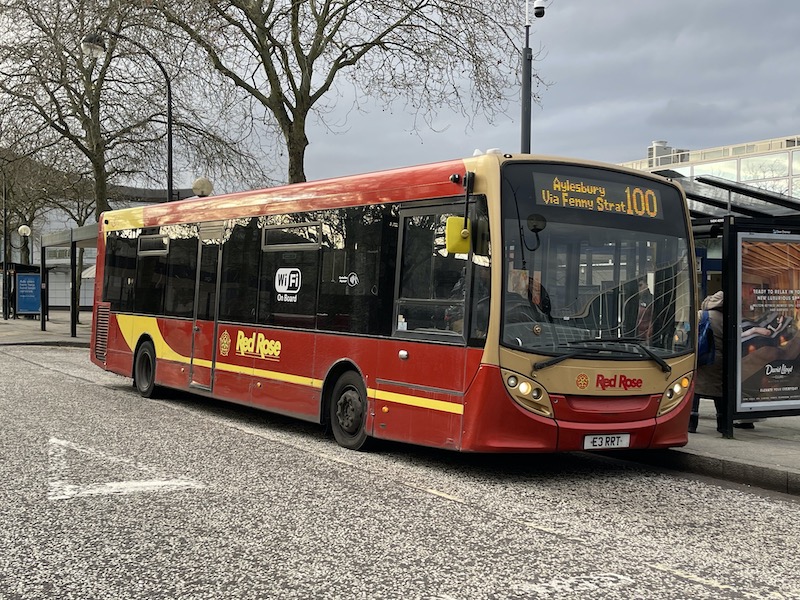
Time for another exploration of one of Britain’s 26 bus routes numbered 100. And this time I’m back in the Home Counties taking a ride on Red Rose Travel’s route between Aylesbury and Milton Keynes.
In what is a topical piece of history, the route was introduced as recently as 2020 being a close replica of one operated by Arriva using the same route number until withdrawal in 2013.
It’s a simple timetable operating Mondays to Saturdays with hourly departures on the hour from both ends of the route during the off-peak and extra journeys in the peaks.

It’s a route in three thirds.
Heading north from Aylesbury through the town’s north eastern suburb it soon takes on an inter-urban feel after leaving Bierton along the A418 until it reaches the village of Wing.
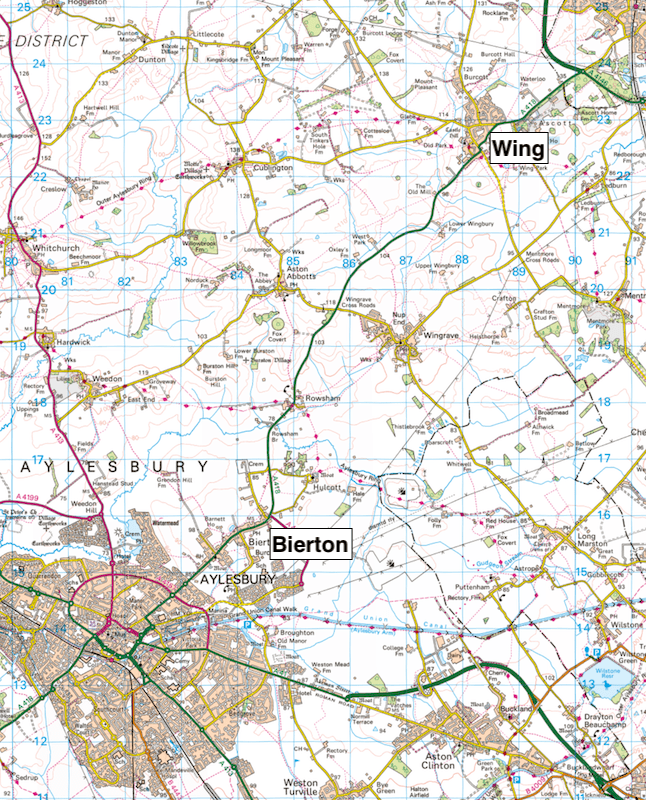
Rather than head into Leighton Buzzard the bus turns left on to the fast flowing A4146 dual carriageway running non-stop until it reaches the southern outskirts of the Metropolis of Milton Keynes at Water Eaton.

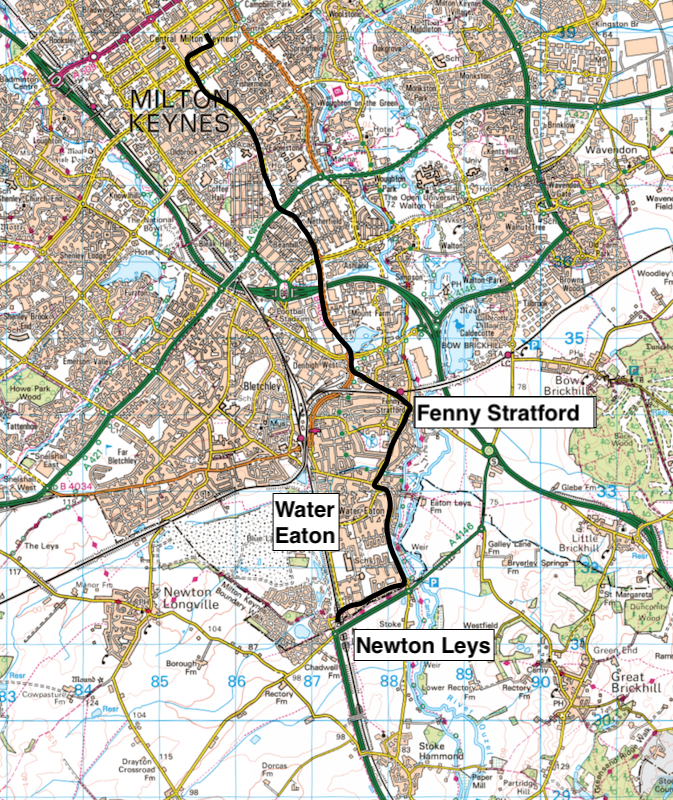
From Newton Leys and Water Eaton the bus passes through Fenny Stratford, avoiding the centre of Bletchley, continuing north to reach Milton Keynes terminating at “The Point” which is the main bus stop by the town’s huge Midsummer Place shopping mall.
End to end journey time is 52 minutes which is good going for a very handy cross Buckinghamshire inter-urban link. Although such a journey would be very tedious by rail (necessitating travelling via London), there are two other bus route options provided by Arriva as part of its rebranded ‘connexions’ inter-urban network launched in January but being abandoned at the end of this month.
As reported Arriva are closing its Aylesbury and High Wycombe bases at the end of next month, but for now its hourly (recently renumbered) X4 also operates via Bierton and Wing but then serves Leighton Buzzard before reaching Milton Keynes Central station taking 85 minutes for the overall journey while its hourly X6 takes 86 minutes and is routed via Winslow, Buckingham and Stony Stratford as well as Milton Keynes Central station to terminate at The Point.

None of routes 100, X4 or X6 run on a Sunday and evening journeys after around 20:00 are best avoided, as there aren’t any.

I took a ride on the 13:00 departure from Aylesbury’s bus station on route 100 and was intrigued to see how many other passengers there’d be, bearing in mind the route doesn’t really serve any other large catchment areas (such as Leighton Buzzard and Buckingham as the X4/X6 do).
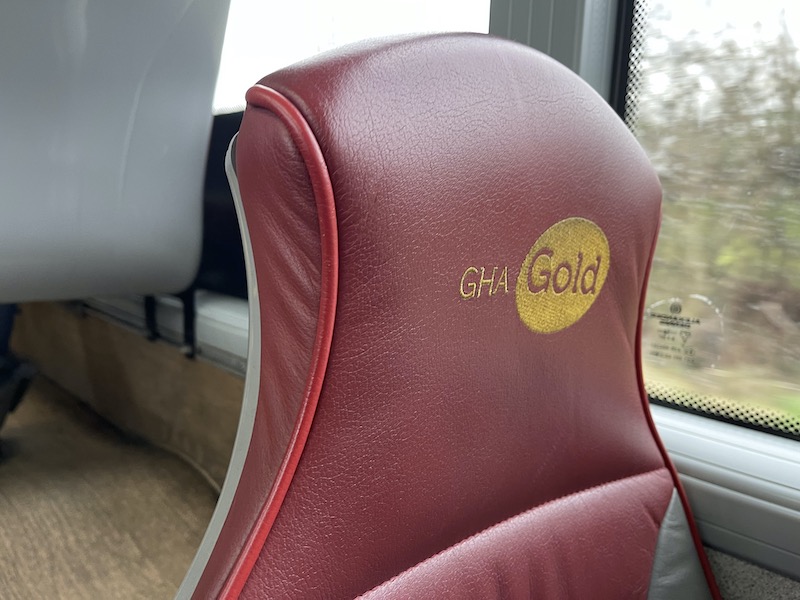
The bus was a former GHA Enviro200 with the branded seats being a bit of a giveaway of its past history. While perfectly comfortable to travel in I don’t particularly like the seat layout with the rearward facing seats in prime position in the raised section where it’s always nice to sit and enjoy a forward facing view of the road ahead.

We left the bus station six minutes down at 13:06 with seven on board and picked up another passenger at the first stop in Aylesbury town centre. No further stops until Bierton where one more joined us while one of the Aylesbury boarders alighted in Wing which we left at 13:23 just three minutes late.
It was then non-stop along the A4146 until we got to Water Eaton where we picked up two new passengers, dropped our Bierton boarder off and another from Aylesbury. Nothing else until Milton Keynes Football Stadium where one boarded and one alighted with another boarding and alighting at the next couple of stops bringing us into Midsummer Place, Milton Keynes with eight on, four from Aylesbury and four having boarded in Milton Keynes.
That makes for 12 passengers in total and we’d arrived pretty much on time with half a dozen passengers boarding for the return journey at 14:00. We’d passed the second bus on the route as we bombed along the A4146 and that also had around half a dozen on board. I suspect the route does better in the peak hours – I’d certainly hope so otherwise it’s commerciality is somewhat questionable.
It was noteworthy there was a hand sanitiser dispenser available, but inevitably it was empty.

It’s a convenient quick connection between Aylesbury and Milton Keynes, but unless there’s enough end to end traffic, viability maybe in doubt especially as Arriva are set to continue its routes X4 and X6, as these operate from its Milton Keynes base rather than Aylesbury.
Roger French
Did you catch the other thirteen ‘Every route 100’ blogs so far? Here’s 1 of 26 (Stevenage-Hitchin) 2 of 26 (Crawley-Redhill), 3 of 26 (Lincoln-Scunthorpe), 4 of 26 (Glasgow-Riverside Museum), 5 of 26 (Campbeltown local), 6 of 26 (Guildford’s Onslow Park & Ride), 7 of 26 (Warrington-Manchester), 8 of 26 Chatham-St Mary’s Island, 9 of 26 St Paul’s-Wapping, 10 of 26 Syston-Melton Mowbray, 11 of 26 Wellington-Telford Sutton Hill, 12 of 26 Hanley-Stone, 13 of 26 Burgess Hill-Horsham.
Blogging timetable: 06:00 TThS with Summer Su extras.
Comments on today’s blog are welcome but please keep them relevant to the blog topic, avoid personal insults and add your name (or an identifier). Thank you.
 BusAndTrainUser
Relevant to Red Rose Travel & of course all other operation in England I wonder what Rogers & everyone’s thoughts are with regard to our industry in respect of the change of administration yesterday especially given the £2 maximum fare& BSIP were products of the erstwhile administration. Red Rose Travel & others I am sure were keeping an eye on what was happening in England on Independence Day.
LikeLike
Unless I’m wrong, there is very little evidence that it’s generated additional traffic, which would be consistent with the results from the TfL and ScotRail off-peak trials both of which seem to have to failed. Indeed, the worst-case scenario is that the £2 fare attracts little additional traffic, but the potentially significant fare increase when it’s withdrawn drives away people and the net impact is actually negative.
I would much prefer the available subsidy pot to be directed at making the public transport offer more attractive via seed funding frequency enhancements, investment in bus priority and improved infrastructure. The ideal to me is public funding which increases a network’s revenue generating ability, so it’s actually improving the finances in the long term not creating an open-ended need for subsidy. BSIP should have been used for this, but in reality great chunks of it have been spaffed on useless DRT schemes, and plugging the funding gaps to keep the existing network going.
LikeLike
There seems to be little indication that the £2 Fare has increased bus usage
The main problem I see with bus services is lack of them with services being very limited so are of little use to most people. So service need to be improved
Replacing the £2 fare with a simple three zone system might be more sensible and will raise more revenues which may help improve services
The reality is though that without subsidies we will never get a decent bus network. It is simple impossible to try to run as reasonable level of service on a fully commercial basis
In the smaller towns as well competition simply does not work it creates a fragile constantly changing network and fragments it making it largely non viable an the poor services drive people away
LikeLiked by 1 person
| Indeed, the worst-case scenario is that the £2 fare attracts little additional
| traffic, but the potentially significant fare increase when it’s withdrawn
| drives away people and the net impact is actually negative.
This is definitely my concern. As far as I can tell the £2 fare hasn’t attracted extra users on any of the routes I use, but it has allowed existing users to reduce their spend on bus fares and use the savings on other things.
We all know that many people are struggling at the moment, and I think it’s reasonable to say that bus users are in the socio-economic groups who are struggling the most.
When this scheme ends, especially if fares jump straight back to previous levels (plus whatever %age increases have been hidden by the £2 fare), those people are going to struggle and will inevitably have to make cuts. As the 1960s & 70s showed where fares rises reduced ridership which resulted in another fares rise which reduced ridership even more, a vicious circle ensues and we’ll see the bus industry struggling far more than it already is.
And, as the annual media outrage at rail fares shows, the industry will get a heck of a lot of bad press for putting fares up even though it’ll be at the behest of government.
I know Roger is very much against the loss of commercial freedom inherent in franchising but I think he’ll accept that, for much of the English bus industry, it’s either that or the end of many local bus services as we know them.
LikeLiked by 2 people
A route which typifies the problem of speeding up routes to compete with the car, which sounds so simple to do in theory. In most cases the only way to do it is to by-pass major traffic generators, in this case Bletchley and Leighton Buzzard. The problem then is that you’re dependent on end-to-end traffic and whatever is generated by the much smaller intermediate locations.
In this case, even a combined timetable and ticketing with the two Arriva routes seems unlikely to make such difference, since the Arriva routes are so much slower that catching one isn’t much quicker than waiting for the next 100. I guess a combined timetable might generate a little more traffic at the ends of the route (e.g. between Wing and Aylesbury).
More generally this shows how marginal parts of the network are; we’d all like to see investment in newer buses and drivers paid more, but if there are only half a dozen passengers on each bus where does that money come from? Equally, how much public subsidy can that level of passenger flow justify given all the competiting demands for expenditure.
LikeLiked by 1 person
When I have travelled on the 100 some journeys are quiet like you describe but other journeys I have made have been in a nearly full bus. The full journeys have tended to be towards MK in the morning before 11 and back from MK after 3pm. There is also quite significant traffic from Wing into Aylesbury in the mornings -this I think depends on how the Arriva service is running.
LikeLike
I think the birth of the 100, December 2019, was actually for two reasons. One, the continuing desire of the “Red” group of companies to chip away at Arriva (with some success it appears), and two, to feed vehicles/Drivers into the 21 (MK-Olney/Lavendon) which would otherwise have operated “dead” from/to Aylesbury. Four vehicles did a neat four-hour cycle until recent times, but for operational reasons unknown, the vehicles are now separated, but Drivers may still work 100s to get to/from MK.
Clearly, almost five years on, and with reasonable loadings at times, the 100 must still be worthwhile.
Terence Uden
LikeLiked by 2 people
What we need from the new Government is more money to county councils to keep bus routes going. WE stand to lose our route next April thanks to Hants CC cutting all subsidies. BUt I have little hope as buses are never a priority
malcolm chase, Fleet, Hants
LikeLike
At the moment at best the £2 fare and BSIP has slowed down the decline of bus services but that’s all
What happens when the £2 fare finishes and the BSIP money runs out who knows ?
LikeLike
Milton Keynes Council is not very bus friendly. I remember the owner of Meridian Bus(Britannia Bus). Stating they had delayed services due to the Council
LikeLike