Thursday 18th April 2024
This month has seen four developments in the burgeoning world of DRT operations.
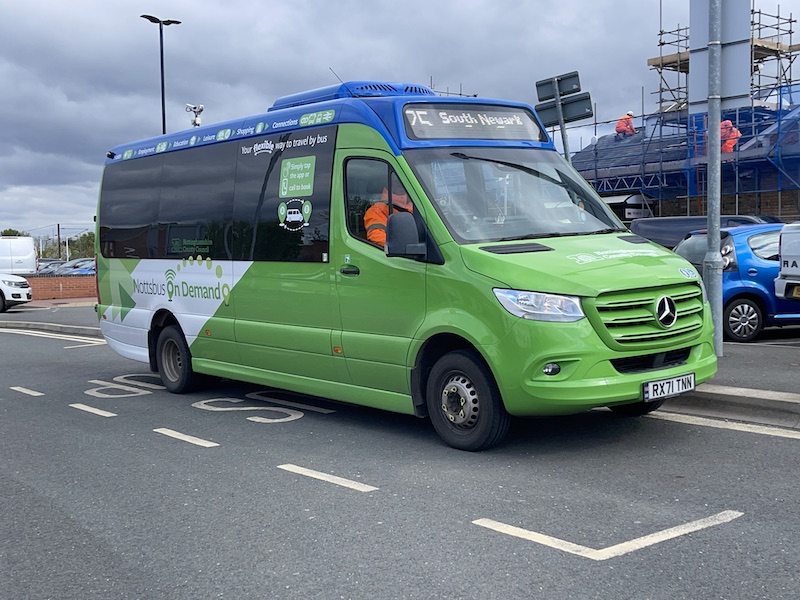
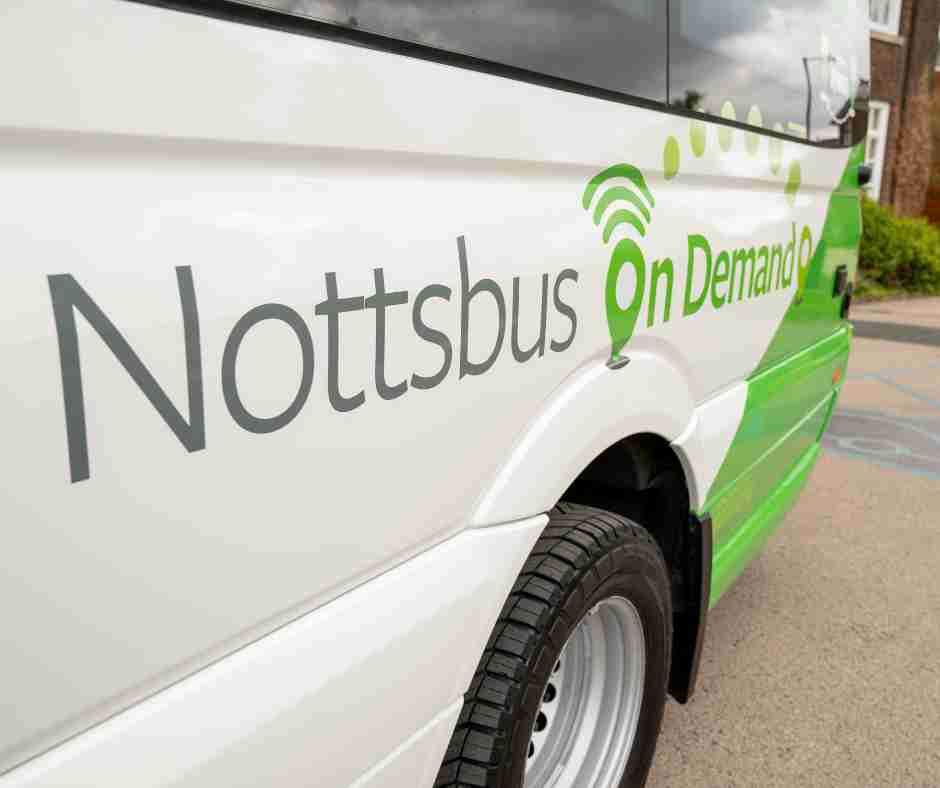
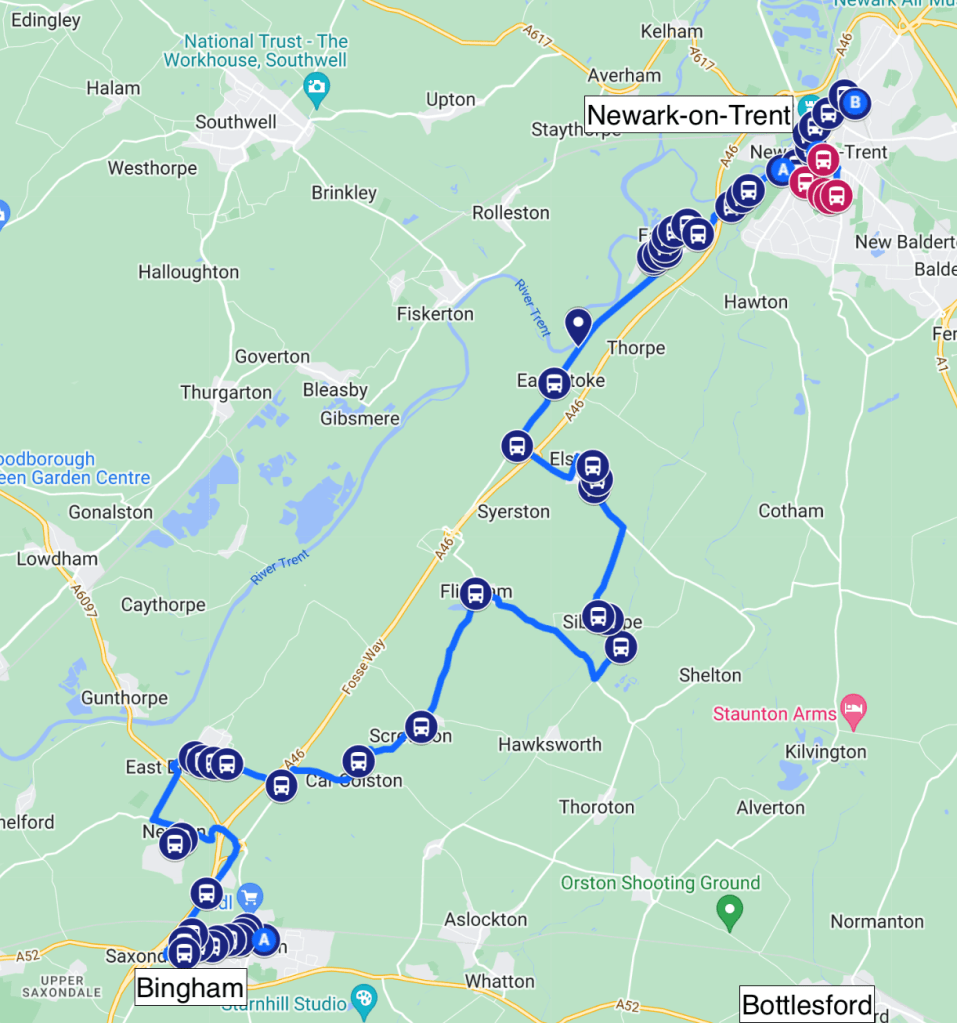
Firstly, Nottinghamshire County Council expanded its Nottsbus On Demand offering last week adding a fifth area south of Newark. To kick start the new arrangements it withdrew “your friendly local link through the Rushcliffe Villages” represented by Marshalls of Sutton in Trent operated hourly tendered route 91 …
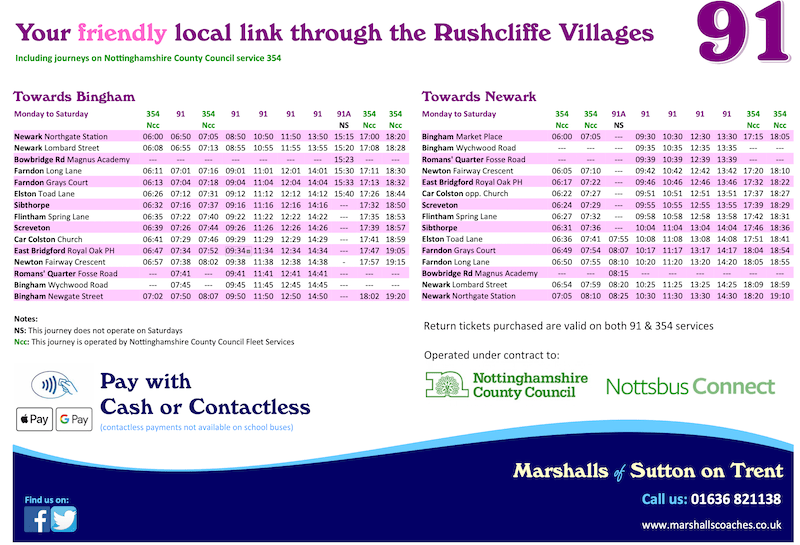
… providing a straightforward route taking an hour to link Newark with Bingham via Sibthorpe and Flintham…
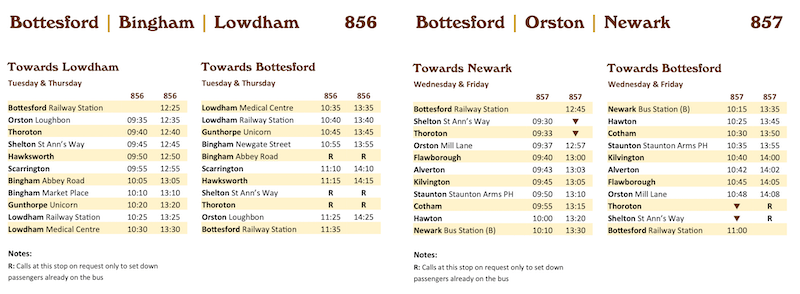
.. as well as also withdrawing a couple of rural, shopper, two return twice-a-week type journeys linking villages between Bottesford and Newark with Newark.
I’d intended to give the new service a try out on Wednesday or Thursday last week and booked a journey from Newark to Bottesford using the Nottsbus On Demand app but sadly circumstances prevented me from travelling on both days so cancelled the bookings.
However, while I was playing around with the app I also tried to book a journey from Newark to Bingham and, as you can see from the screen shots below, it was directing me to use bus route 91, departing at the old times from Newark Northgate station.

This seemed most odd so I gave Marshalls a ring to check they’d ceased running the service, which they confirmed, so rang the Nottsbus On Demand telephone number to see what was happening.
This turned out to be Nottinghamshire County Council’s Customer Service number dealing with a whole host of local authority type queries but the very polite woman answering did her best to try and find out any information to help. It turned out I knew more than she did and her only advice was to ring Traveline.
After that experience I was pleased I didn’t make it to Newark last week and wait for a bus which I knew was withdrawn.
Undeterred I tried again this week and easily rebooked my Newark to Bottesford journey but any journey requests to Bingham were still directing me to the withdrawn route 91.
Nottinghamshire uses Via software so I know to always state a desired pick up time 15 minutes after you actually want it as, if you’re in luck, back comes confirmation in the form of a half hour window for the departure with your chosen time in the middle.
With a train arrival at Newark Northgate on Tuesday at 10:31, I requested a pick up, using the app on Monday morning, for 10:50 and sure enough got offered a departure between 10:35 and 11:05…
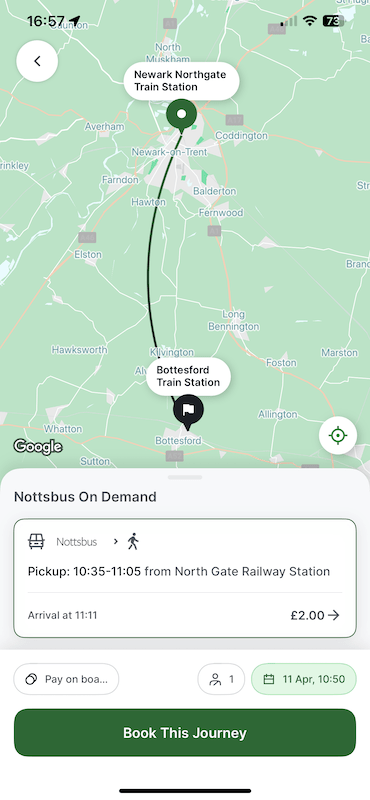
… with the actual pick up on Tuesday, advised an hour before, at 10:35.

That always happens in the early days of a new scheme when few people are using DRT and, of course, as soon as a handful of passengers start using it, you get the “sorry, no vehicle is available” reply.
After we’d left Grantham and the train was heading to Newark Northgate another update (at 10:26) let me know the pick up had advanced to 10:32, so just as well I’d booked a pick up at 10:50 with my train due in at 10:31!
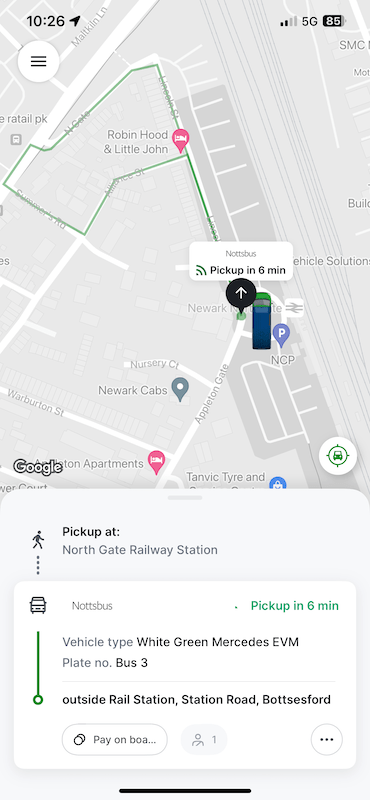
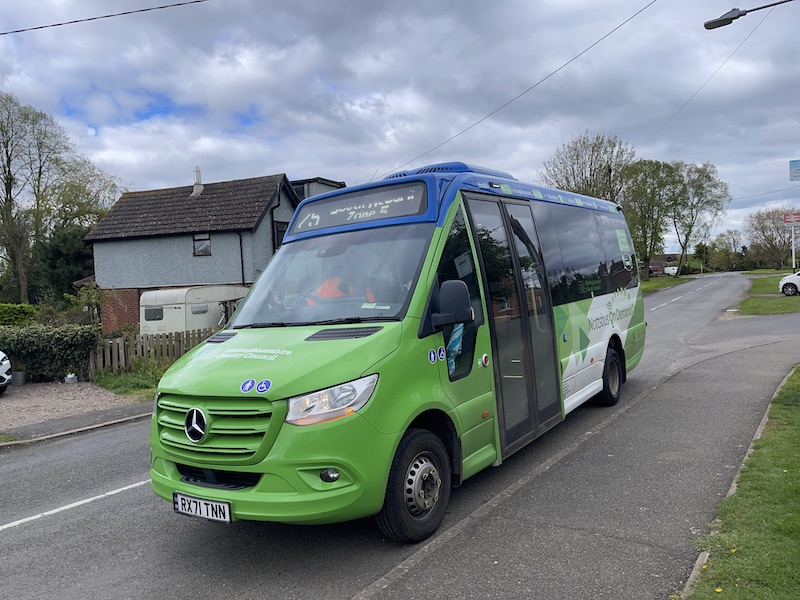
Cheryl was waiting for me outside Newark Northgate in a Mercedes Sprinter in NottsBus On Demand green and white livery…
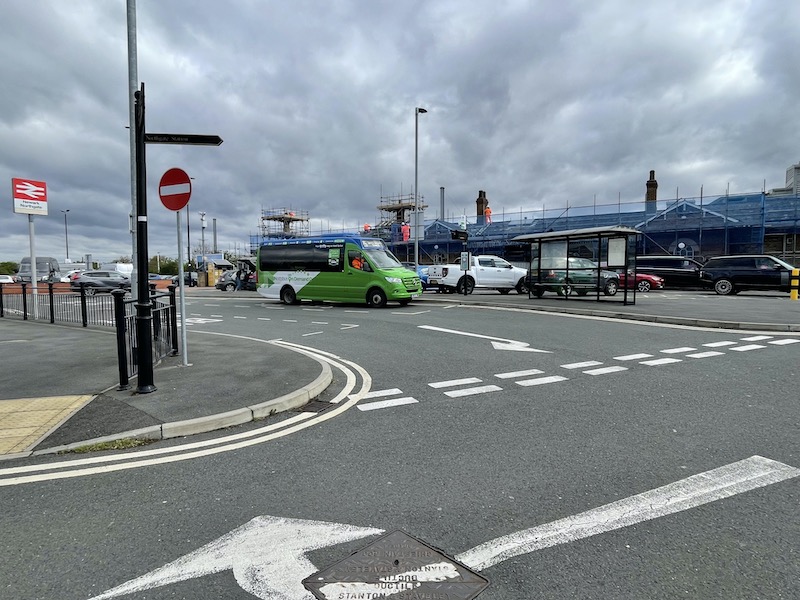
… and the standard Sprinter interior layout and decor.
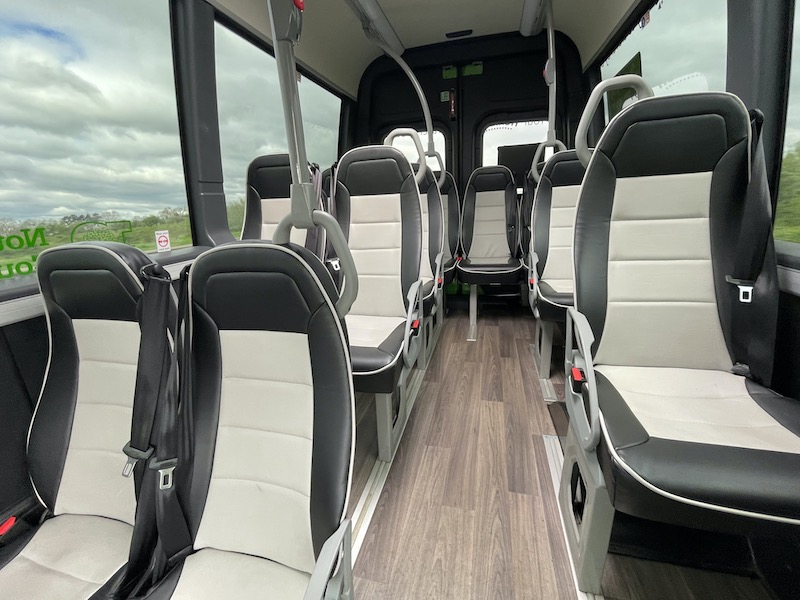
We had a great chat on the 25 minute journey via the A1 down to Bottesford.

Cheryl’s a fantastic ambassador for the service and, following a stint at taxi driving, has been driving for Nottinghamshire County Council for eight years particularly enjoying the rapport with passengers on the County’s rural routes.
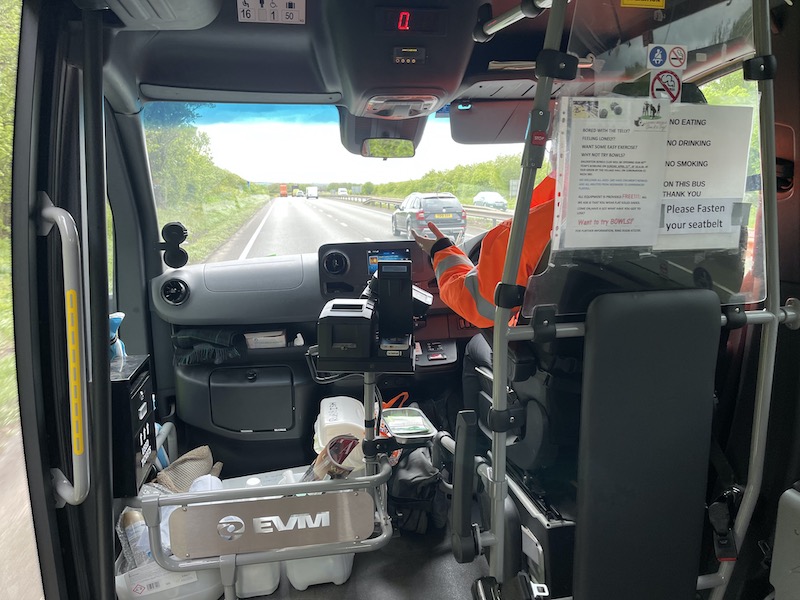
Along with colleague Tim, she’s now assigned to the new Zone 5 for South Newark and reported good passenger feedback so far. It was good to see a leaflet available on board the bus…

… including a map showing the area covered…
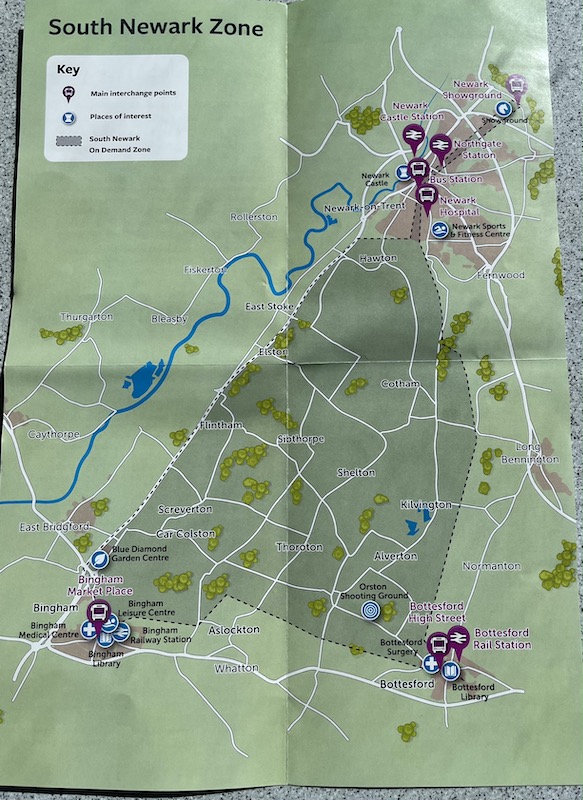
… and I noticed explanatory displays at bus stops.
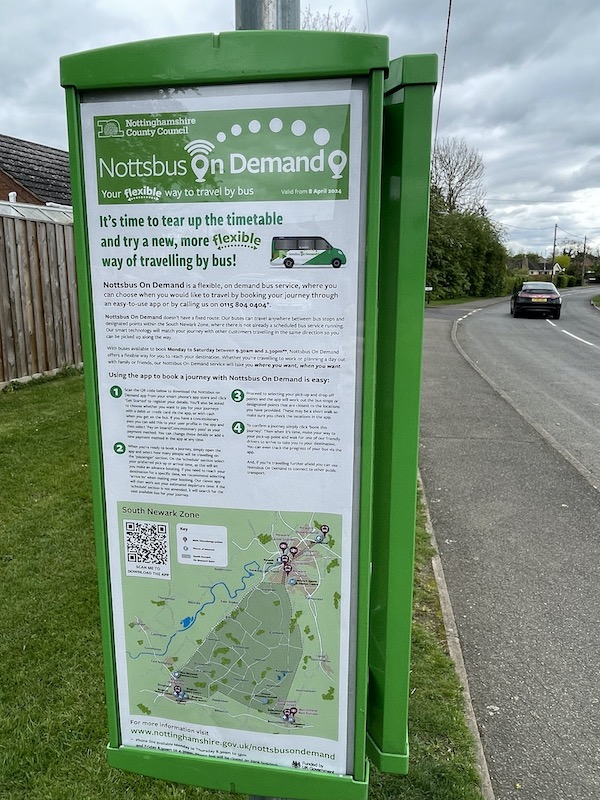
This latest Zone has rather limited operating hours – 09:30 to 14:30 on Monday-Saturday – which reflects the span of day covered by erstwhile route 91.
Before and after those operating hours, Cheryl, and Tim on the opposite shift, use the bus on a fixed timetabled peak time route 354 which mimics former route 91 which rather begs the question in my mind whether withdrawing the 91 to utilise the bus in the off-peak to provide an “on-demand” service to a larger number of hamlets and villages (in the new Zone 5) has been of overall benefit.
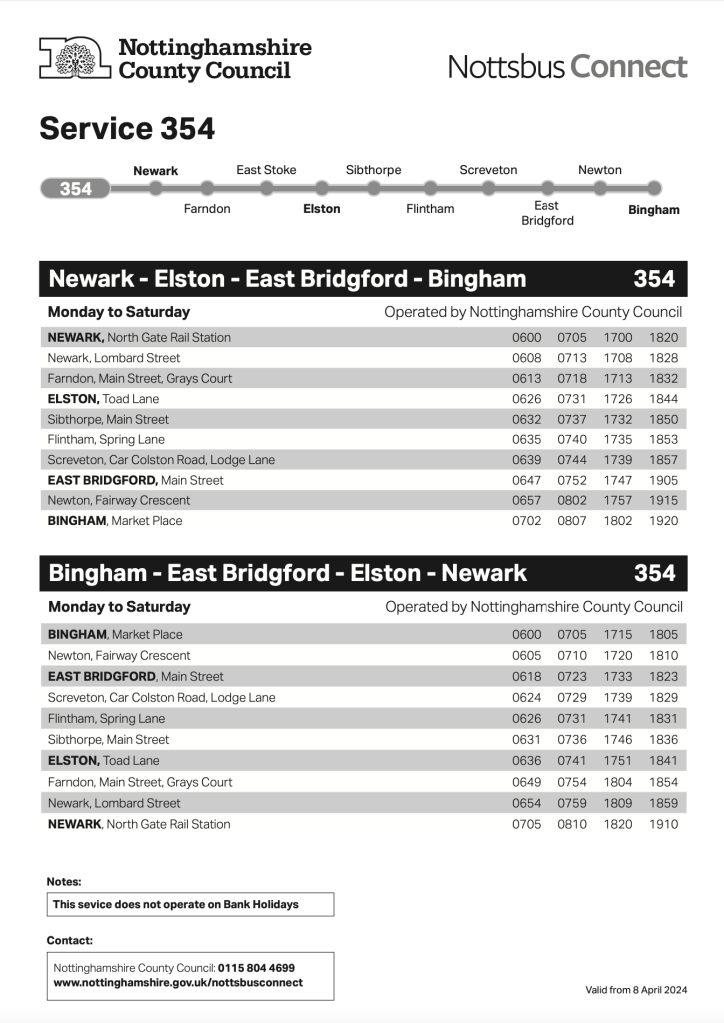
Only time will tell.
Next up, it was all change in Greater Bristol last week as the extensive WESTlink scheme celebrated its first anniversary with a makeover.
It turns out the Traffic Commissioner cottoned on to the fact the previous set up included rather large geographic zones meaning passengers could make a journey of over 31 miles especially from one side of the southern zone (green coloured) to the other which means it should come under EU driving hours and tachograph type arrangements.
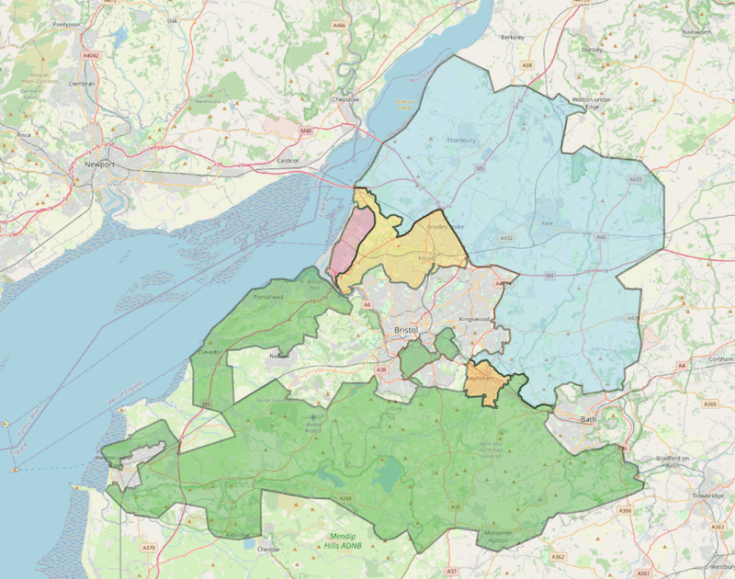
It’s also been established the larger the zone, the harder it is to make DRT effective with buses spending too much time running ‘dead’ between journeys.
WESTlink’s solution is to split the previous three zones (green, light blue and yellow) with two overlaps (pink and orange) into eight smaller “core” zones with a larger number (13) of shared zones (shown in grey on the map below) where journeys are made to popular destinations from more than one direction.
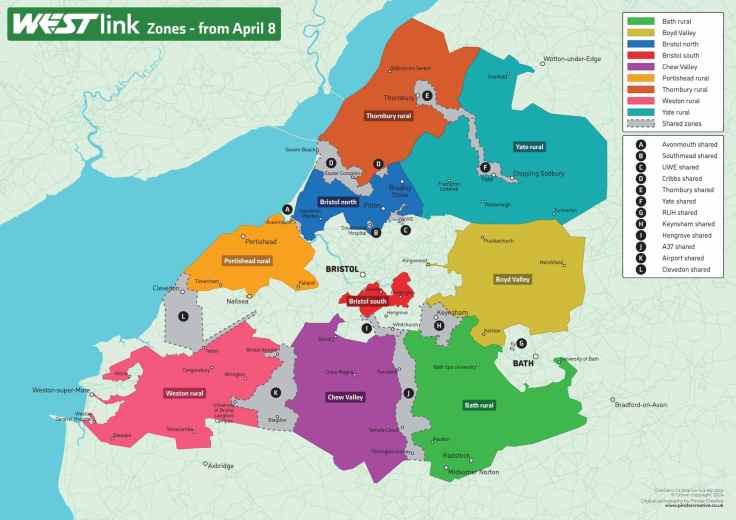
The opportunity has also been taken to add new destinations previously outside the area served including Bath Royal United Hospital, Kingswood High Street, Ashton Vale, Cribbs Causeway and Southmead Hospital.
I played around with the WESTlink app to see if I could book the four journeys I made when trying out the service on its first day in April 2023.
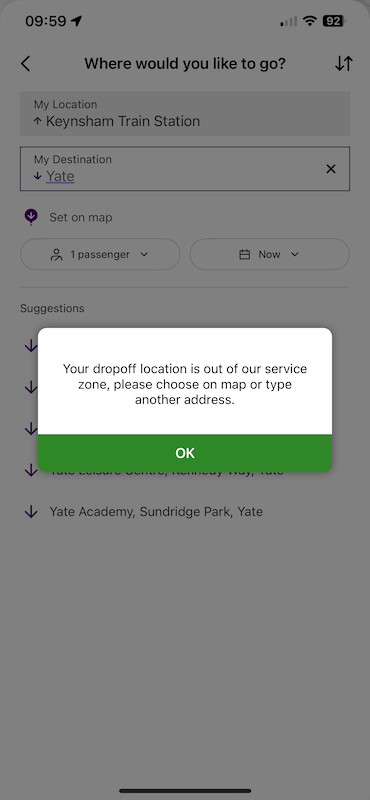
The first journey I made at that time from Keynsham station (now in the H shared zone) to Yate (turquoise zone) is no longer possible as those places fall a zone the other side of the neighbouring zone. The app just gives you an ‘out of our service zone’ message with no suggestions or alternative options of how to make that journey. I reckon I’d now have to go via central Bristol and of course that will entail paying twice – £2 for each single leg rather than having the through journey for that price.
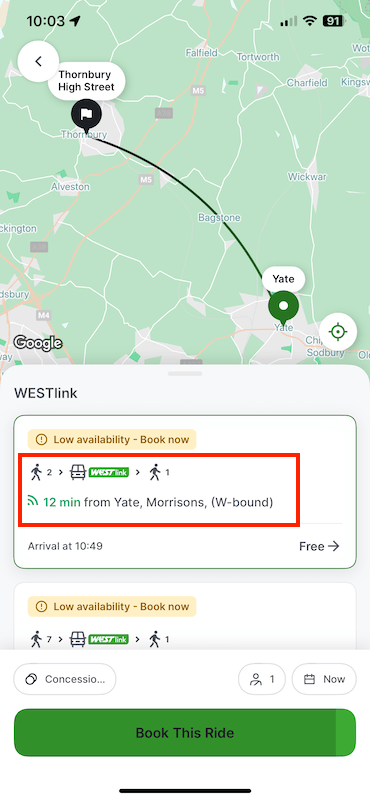
I previously then travelled from Yate (turquoise zone) to Thornbury (orangey-red zone) – with my destination (Thornbury High Street) in the E shared zone linking those two zones, so tried to book that journey and on my Day 1 experience got offered a ride within seven minutes, this time, impressively, I got offered a pick up in 12 minutes showing the benefit of the smaller zones. (The seven minute experience was very much a Day 1 phenomenon – when no-one else is travelling. One year on I’d have expected it to be a lot longer.)
From Thornbury I travelled to Almondsbury and whereas last time the app gave me a pick up in 19 minutes, this time I was directed to bus route T1 which also offers that journey every 20 minutes and quite right too. No point clogging DRT up with journeys which can easily be made by existing bus routes.

My fourth and final journey back in April 2023 was across the huge southern former green coloured zone from Parson Street station over to Freshford (on the eastern boundary) which took a marathon 70 minutes so I knew in the new scheme of things it wouldn’t be possible and indeed it isn’t. When I tried to book I just got the ‘out of service zone’ response.
It’ll be interesting to see how the new multi zone arrangement settles down. The map showing the various zone boundaries could do with being a bit clearer as it’s not easy to see exactly where they are and bizarrely the app doesn’t delineate them, just advising when you’re trying to book a journey that’s not possible,

The same applies to the third of last week’s DRT developments over in Milton Keynes where the area covered by MK Connect has also been split into smaller zones, in this case, three, with a rural zone to the north, a main zone surrounding Milton Keynes itself and a small (green coloured) shared zone based on Newport Pagnell.
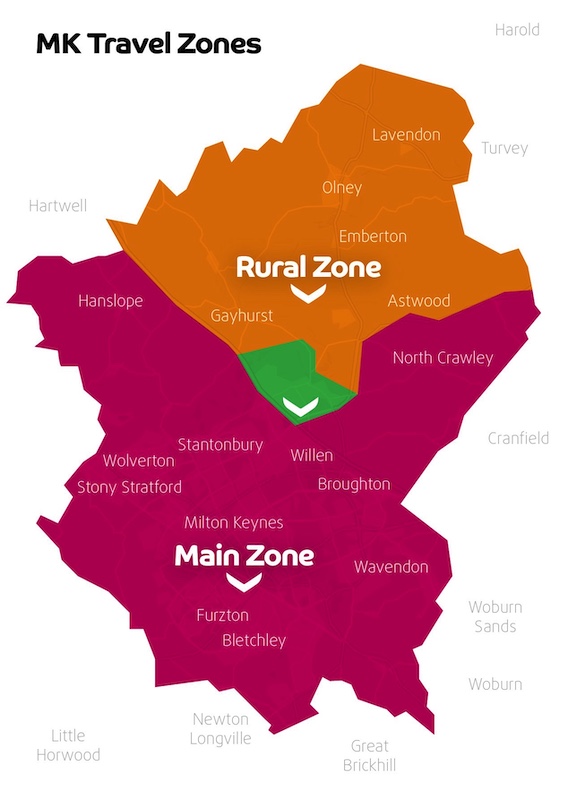
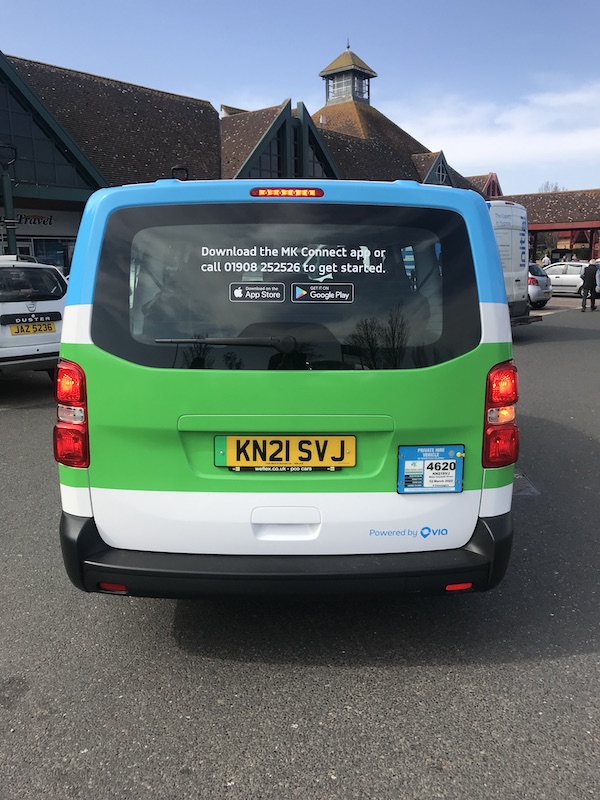
Team MK Connect explain in the email sent out to all existing passengers “some people who use MK Connect to travel from the rural areas of Northern Milton Keynes (such as Olney) tell us they can wait up to 70 minutes to be collected. We hope to bring that wait time down. For the next six months we will be running a pilot scheme where Milton Keynes is split into three zones for MK Connect journeys: a rural zone, a zone for Newport Pagnell, and the main zone for the rest of the city. Instead of covering the whole of Milton Keynes, MK Connect drivers will serve one or two zones, which means they can collect passengers far more quickly. We hope to cut the wait time in rural areas from up to 70 minutes to up to 15 minutes.”

So far so good, and a wait of 15 minutes certainly sounds more desireable than kickng your heels for over an hour to wait for a pick up, but the crunch is in the next paragraph.
“This means that some passengers traveling to or from rural areas will have their journey broken into two parts. Both parts might be in an MK Connect vehicle, or it might mean transferring to a bus. The pilot aims to determine whether people prefer a faster journey where they change vehicles, or a slower journey where they don’t need to, so we can make informed decisions for the future.”
I can’t conceive passengers will prefer to change buses especially on the return journey when it’ll be hit and miss whether a booked MK Connect vehicle will conveniently connect with a fixed bus time or another MK Connect vehicle. As opposed to Bristol, at least in Milton Keynes “anyone asked to change vehicles to complete their journey will only pay for one part of their trip (for up to two journeys per day).”
It’ll be interesting to see how the six months pilot plays out.
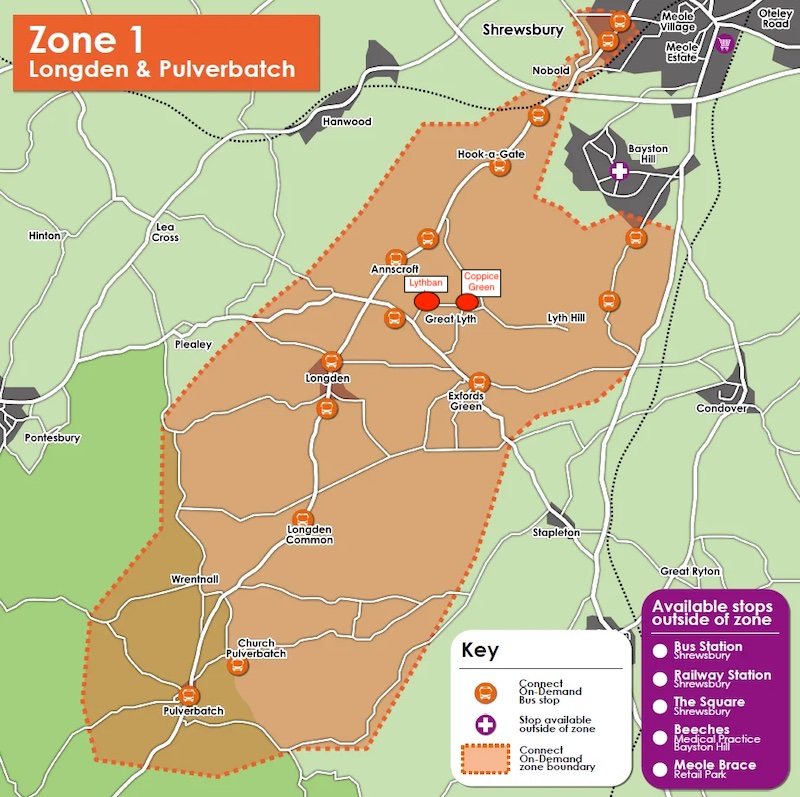
This month’s fourth DRT development began on 2nd April in Shropshire where that county’s CONNECT ON-DEMAND scheme based on Shrewsbury had two bus stops added for the communities of Old Coppice and Lythbank. Frankly I’d been surprised they’d been left out when the service began last November.

They’re just minuscule hamlets adjacent to Great Lyth as I’ve shown on the map below. So it’s no big deal to include them but an email went out to the customer base last week explaining the improvement.
The email also advised booking arrangements have been amended with “a three-hour restriction on making a booking later the same day is being reduced to two hours, so that customers can receive more options of travel when using the service and have less time to wait if choosing to book on the day.”
I hadn’t realised there was a three hour restiction and can’t understand even why a two-hour one should apply. Why not let passengers book an immediate return if that’s what they want to do?
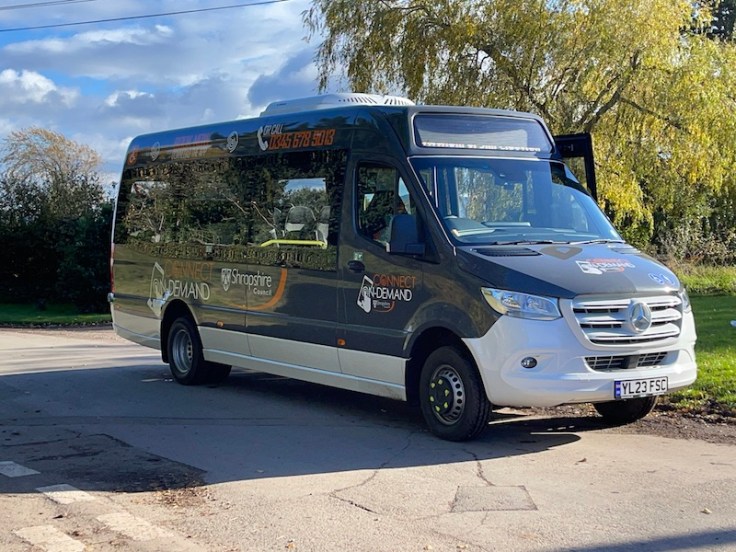
The email encouraging goes on to say “since its launch the service has seen a steady increase in passenger numbers – and received helpful feedback, which is now being used to improve the service.” Obviously no statistics are provided so “a steady increase in passenger numbers” could mean anything from single figures a day to double figures or something more sustainable.
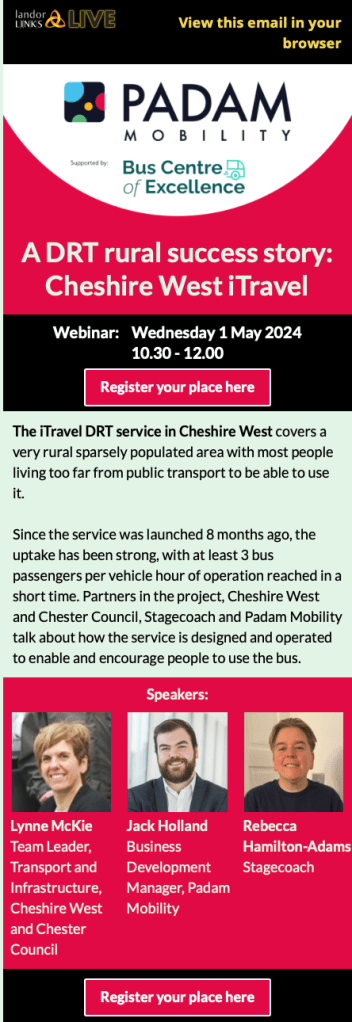
And while on the subject of numbers travelling we really have gone through the Alice in DRTland Looking Glass when a “DRT rural success story” is defined as achieving “3 bus passengers per vehicle hour of operation” warranting its very own online webinar to tell everyone about it. Ironically Hertfordshire has just withdrawn rural routes 29/30/31, as previously explained, which were achieving that level of patronage.
But that’s DRT for you.
I see the webinar is being promoted by the Bus Centre of Excellence and is sponsored/funded by PADAM Mobility – purveyors of the finest DRT software and algorithms.
Roger French
Blogging timetable: 06:00 TThS
Comments on today’s blog are welcome but please keep them relevant to the blog topic, avoid personal insults and add your name (or an identifier). Thank you.


How often are people’s journey requests not possible? For me, that is an important piece of data that shows how convenient DRT is (the DR part).
Compared to a proper bus, DRT sounds great, running when and where it is wanted. In reality people have to plan their lives around when buses are available but without the chance to plan that a conventional service provides. A half hour window for a bus arrival for Dial a Ride would not be tolerated for a service bus.
Gareth Cheeseman
LikeLiked by 2 people
There seems to be a great reluctance by LA’s to actually publish any meaningful data on DRT usage
What limited data there is suggests that costs are very high and usage is very low typically less than 2 passengers per journey there is also a lot of dead time with the vehicles just parked up for significant periods of time
LikeLike
Yes, few are coming clean on the cost of DRT. Shropshire made a presentation on a DfT forum, and repeatedly ignored any question about costs, or what criteria would be used to judge financial success.
KCC
LikeLike
Hopefully of interest to those following the DRT saga is the news that Newport Transport’s DRT31 which served the rural western area of the city reverted to a scheduled, fixed route basis running seven times a day M-F and five on Saturdays at the beginning of this month. It was a traditional ‘phone the depot the day before’ one, even during the app and call centre driven Fflecsi experiment in the urban area of the city.
As a tendered service, the decision was a political rather than a commercial one. The brand new Yutong E9L I caught last week was quite well loaded, especially after picking up passengers in tne urban area which the DRT didn’t, of course. Villagers liked the upgrade from a minibus and wider range of journey opportunities but were less keen on the longer journey time to the city centre.
The traditional DRT services in the east of the city remain unchanged.
Chris B
LikeLike
Introducing two zones in Milton Keynes means that journeys such as Astwood to North Crawley and Gayhurst to Hanslope are no longer possible. Would it have been better to introduce an overlapping zone to enable such journeys to continue?
MotCO
LikeLike
If and it is a big if all the travel on a DRT service was logged and recorded over a period of time you could establish detailed travel patterns and develop a fixed or semi fixed route to provide the service as the log would show when and from where and to where people wanted to travel
LikeLike
Not just actual travel but unfulfilled journey requests to get the whole picture.
I’d imagine it’s very easy to extract such data from the online booking systems.
LikeLike
https://www.bbc.co.uk/news/uk-england-nottinghamshire-68782732
The above link shows that customers actually do want DRT and are questioning the slow roll out of Nottsbus on demand. Personally I prefer the semi fixed routes used by Lincolnshire and Wiltshire amongst others. This latest Notts scheme is in an area previously served by W Gash and Sons.
Richard Warwick
LikeLike
“Under the Nottsbus On Demand scheme, people should be able to travel anywhere between bus stops or other designated points with each service zone at a convenient time, using an app or making a phone call to book a seat.”
I suspect that there is a simple explanation for this comment from the BBC report, to the effect that the residents “do want DRT”. As yet, they haven’t experienced the reality, so they presumably believe the promises contained in the promotional material, and in the public statements from the local authority and their various “partners”. I guess it would be interesting for Roger to visit this scheme once it has been running for three or four months, and see if the residents are still so enthusiastic about it!
Nigel Frampton
LikeLike
I think it is more case of the have no service at present and DRT is better than nothing
Mind you the failure rate of DRT in the UK appears to be running at about 70% plus. The other slight issue is if by some remote chance a DRT service is saucerful it automatically fails as it cannot cope with the passenger numbers
LikeLike
Saucerful?
Those few schemes that justify their funding likely still have their plate full in doing so.
LikeLike
If you read the article on the BBC website, you will see that there are currently services in the area – for example, this quote from a resident:-
“One resident I spoke to wants to stop driving because he previously had a stroke, but the bus service isn’t good enough as it is.”
This paragraph also provides some further clarity:-
“According to the LDRS, the new zones launching this year will replace some scheduled services, and the council also plans to take over other routes no longer deemed commercially viable to operators at a cost of £1.4m.”
So, no, it is not a case of “no service at present”.
Nigel Frampton
LikeLike
And so the DRT bandwagon rolls on……Clearly Nobody learnt lessons from or even remembers the disastrous Shropshire “experiment” some fifteen plus years ago. In this particular case, it would have been much more sensible to have made a couple of 91 journeys “flexible” and leave the remainder timetabled as now. I doubt if a single extra passenger will be gained and probably many lost as unable to cope with the technology.
As said many times before, the people dreaming up these schemes, and indeed the Council staff themselves who administer, are rarely, if ever, bus users themselves. Thus fall for the charms of the Snake Oil Salesman who show them the “benefits” and “flexibility” of “tearing up the timetable”, but none of the reality.
Terence Uden
LikeLike
My partner and I were looking at visiting Hardwick Hall in Derbyshire which has always been difficult to get to by public transport. There’s a DRT in the area although it’s not all that easy to find information on, only appearing on the timetable pages of the DerbysBus site, not at all on the Derbyshire County Council website and not showing on any journey planner.
There’s a nice app you can use to book travel for yourself, and that happily offers a trip from Chesterfield station to the Hall. But you can only book for yourself: if there’s two of you travelling together, you have to book via the call centre. Eh? Why?
Anyway, when you come up with these ideas at 10 p.m. the day before, the call centre’s closed. So we drove there instead. Another success for DRT, I guess.
A. Nony Mouse
LikeLiked by 1 person
on the Nottsbus change discussed in the blog, and the Herts change to the 29/30/31 in a previous blog, it would be interesting to compare passenger numbers before and after the change, as resource requirements and span of day similar. A simple FOI request should produce this information in due course.
LikeLike
Slightly off as it has been announced by London Mayoral Candidate Sadiq Khan to create Super Loop 2 (which is not really a loop, and even the “new” routes fail to potentially usefully connect- they just seem to be bus routes – including a Wimbledon – Kingston -(Richmond) one which seems to be adding back the journeys relatively recently cut out of the existing 57 bus route in part, and another route via Romford which seems to in part replicate what used to be a pre-war Green Line route to central london.
As to DRT, is this of no charge (after 930am) for English OAP Bus Pass holders (Over present day pensionable age)?
JBC Prestatyn
LikeLike
Hello Roger, did you also pick up that in the Shropshire scheme they are now asking that concessionary pass holders (who can themselves still travel free) to give their credit/debit card details before making a booking. This is ‘in case’ a fare paying passenger travels with the pass holder. Not sure of the security aspects of giving your card details for this, but more to the point, how much more difficult can Shropshire make the booking process? As many have said before, dreamed up by a, car loving, computer orientated junior manager in Shire Hall who never uses a bus, let alone DRT!
Brian Willson (Orpington and Bucknell in Shropshire.
LikeLike
Yes; I did see that Brian. As you rightly say, a completely unnecessary complication.
LikeLike