Thursday 14th March 2024

The sub title of this ‘hot off the press’ voluminous book, coming in at 420 pages, ‘In shades of brown & cream’ adds ‘South Yorkshire PTE – the bus operating years’ clarifying it’s a comprehensive study of that renowned bus operator in what was dubbed at the time ‘The People’s Republic of South Yorkshire’ encompassing the period between 1974 and 1986.
Written by Neil Hudson, Gary Nolan and Darren Sentance who each have first hand knowledge of that pioneering period at South Yorkshire PTE, the book takes the reader from the company’s birth when local government was reorganised and the new South Yorkshire Metropolitan County Council established, through its radical policies and many innovations to the end of direct public sector control when deregulation was introduced 12 years later.

Neil, Gary and Darren describe the book as a much requested “prequel” to their first book published by the Omnibus Society in 2021 entitled “The Region’s Favourite” in which they set out the history of South Yorkshire Transport and Mainline in the following 12 year period between 1986 and 1998 which took the story from deregulation through to the company’s acquisition by First Bus.
As in that book, the authors enlighten the reader on a journey of discovery explaining developments in the company at a strategic level year by year together with comprehensive details of changes to the fleet, routes, timetables, fares, tickets and marketing.
As well as each year being explored in detail, the book’s 26 chapters also cover topics including the company’s close relationship with the Dennis Dominator bus; bus garages, workshops and bus stations; engineering practices and maintenance; service vehicles; the company’s staff as well as a chapter devoted to Yorkshire Traction which was the dominant bus operator in the Barnsley area. The book concludes with a full fleet listing as at the PTE’s formation.
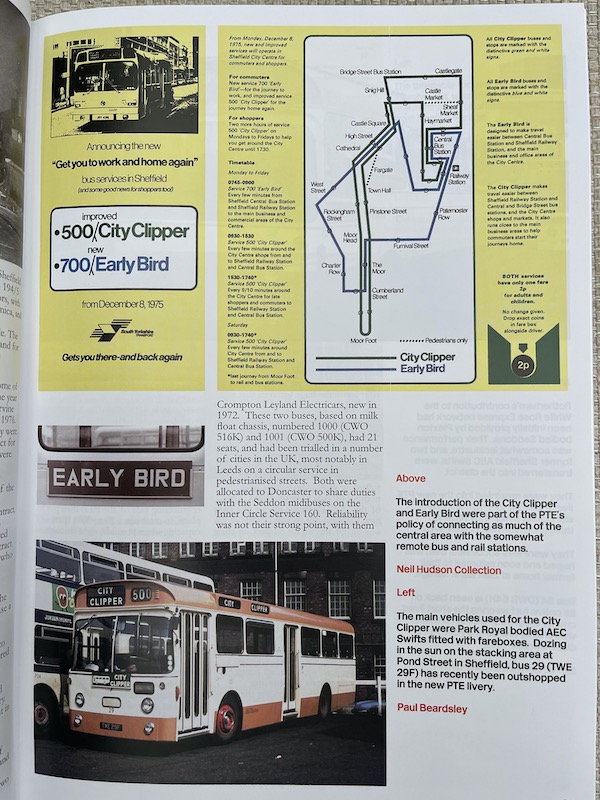
As you can see, as well as informative text, the 420 pages are packed with photographs, mostly colour, as well as images of marketing material and maps…

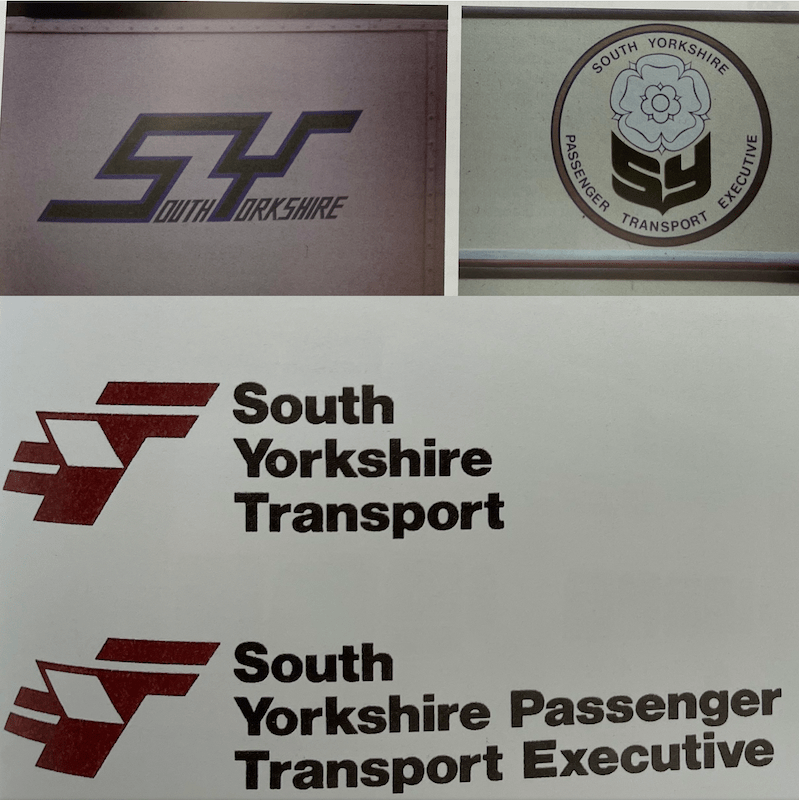
… the evolution of a livery and logo…
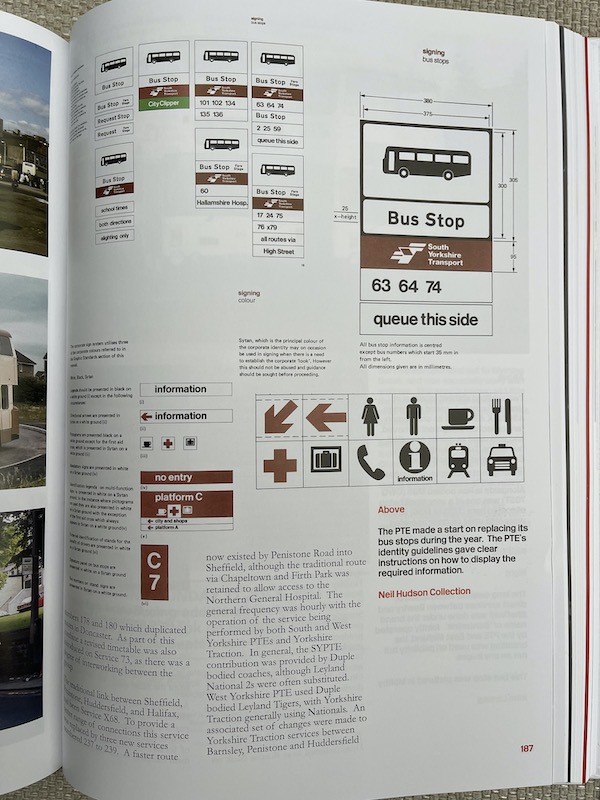
… and bus stop plates (with the complication that control of bus shelters was initially retained by the Borough Councils).
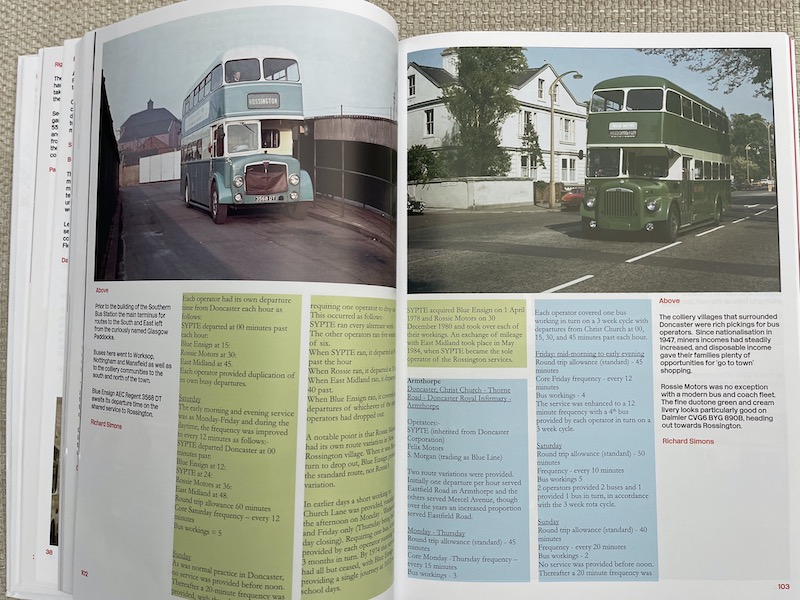
There’s an eight page chapter compiled by Richard Simmons and liberally illustrated with marvellous photographs setting out the complex and unique arrangements found in Doncaster in the early 1970s where the town’s independent bus operators shared bus routes with the NBC subsidiary East Midland and the former Doncaster Transport (subsumed by SYPTE) with different days, weeks or even journeys being operated on a strict rota system.
South Yorkshire is of course renowned during the period for its cheap fares policy which naturally is covered in the book. Fare levels had previously varied in Sheffield, Doncaster and Rotherham due to different policies enacted by those former municipal bus companies but by January 1976 these anomalies had been evened out and fares became frozen for a whole decade, right through until 1986. The difference between the revenue required to operate services and what was actually taken on the bus was added to the rates bill (now Council Tax) of each local authority in the form of a precept. The authors explain “instantly this made South Yorkshire one of the highest rated areas in the UK. However, service levels didn’t suffer and the local populace enjoyed the best bus services for the next twelve years. The maximum fare in the county was 40p, but most people paid less than 10p”.
I was working in West Yorkshire between 1975 and 1977 and well remember paying just 2p for bus rides on my trips to Sheffield, enjoying the bargain travel offered all the more so knowing I wasn’t a resident having to pay the annual increases in council rates.
When fares finally increased in April 1986 passengers faced an average increase of 250% with some facing a 350% rise. Naturally this had a dramatic overnight impact on ridership which was nearly 20% down on some services, making for a tricky start to deregulation in October of that year particularly as the commercial network had had to be registered in the previous February and was frozen by law for the first three months of the new regime.

But it wasn’t just frozen fares that marked out the pioneering South Yorkshire PTE, the company also got involved in many innovations including trialling articulated buses, and, well ahead of its time, an electric battery bus…

… a gas powered bus and city centre circular/shuttle type routes.

Peter Sephton who was Chair & Managing Director of SYT in the period after deregulation has written the forward to the book. He notes “there are several key values to this important and informative book. It demonstrates the determination of South Yorkshire politicians to create a travel network that provided mobility to all parts of the community as a means of furthering opportunity; it outlines the managerial skills that created the mechanisms to run such a comprehensive transport network; and it shows the efforts that were committed by politicians and professional transport operators to enable people who could not afford the cost of a private car to have access to work, education and leisure in a region of relatively low incomes.”
He’s certainly right. You won’t find a more informative book on the subject which is all the more pertinent today with history about to repeat itself as South Yorkshire Elected Mayor Oliver Coppard announces his intention to “take back control” of the County’s bus network by introducing franchising.
Neil (who started his career in the bus industry with the fledging SYT in 1988), Gary (started his career with SYPTE in 1978) and Darren (who joined Mainline in 1997) have therefore produced an excellently timed volume providing a fascinating detailed read for anyone with an interest in South Yorkshire’s public transport. Those with just a general interest in the bus scene will also find the background story behind what were regarded as radical policies in their day an informative read.
The hardback book is priced at £40 and is available through all the usual outlets.
Roger French
Blogging timetable: 06:00 TThS
Comments on today’s blog are welcome but please keep them relevant to the blog topic, avoid personal insults and add your name (or an identifier). Thank you.
 BusAndTrainUser
I remember hearing about the 2p fares in Sheffield.and note how much fares increased on deregulation
This raises the interesting question that, had Ken Livindstone brought “Fares Free and Frequent” into London fundrd by a council tax charge and the scheme be subsequently dropped, what effect this would have had on London Transport. Bus services could have been axed or reduced but the UndergrounD would have been a different proposition. Only pieces of that, as has happened with Aldwych and Ongar, could be cut completely.
John Crowhurst
LikeLike
A wonderful system all destroyed by that hag Thatcher.
Jim B.
LikeLike
This does look like a very comprehensive tome. As someone who does not know South Yorkshire that well, why was Barnsley kept so separate?
In the 70s and early 80s low bus fares were seen as an alternative to major highway schemes and kept buses as a mainstream option for most people. Nowadays we have a national low fare scheme but many areas are now reliant on Dial a Ride services, which are very much not mainstream generally being of little use to people who work.
Gareth Cheeseman
LikeLike
I think because Barnsley never had a municipal bus operation (prehaps oddly for a very socialist area). Instead it became the heartland of Tracky and remained so into SYPTE days.
LikeLike
Although South Yorkshire’s high rates were blamed on the low bus fare policy I wonder how much they were reduced by when it had to come to an end?
Jim Davies
LikeLike
Well Jim, both your points may be true. Artificially low bus fares were a factor in the high rates for the People’s Republic of South Yorkshire – that’s beyond debate.
However, when that changed at d-day, were rates magically lowered? No (as you say) – the funds were then employed elsewhere
BW2
LikeLike
Of course all these new municipal “taking back control” measures still leave the employees and buses farmed out to the privateers.
LikeLike
As an undergraduate I spent a week in West Yorkshire in 1980 looking at the relationship between local councils and the then Metropolitan County Council. Fares in West Yorkshire were then much higher than their neighbouring counterparts and I remember this being discussed. As the book no doubt explains South Yorks took the political decision not to increase fares but with so much copper being collected on buses and presumably change given I remember thinking at the time that it would surely have been cheaper to abolish them altogether. That would have saved costs in depots as well. I think the only European city to offer free fares then was Bologna which was run by the Communists.
As regards the London situation when Ken Livingstone’s Fares Fair policy was challenged in the courts the GLC faced some difficult decisions but was in the end able to agree a ‘balanced plan’ which avoided dramatic fare rises. Then of course came the Capitalcard but that is for another day.
Martin W
LikeLike
London Transport fares doubled overnight in March 1982, as a result of “Fares Fair” being ruled illegal. I would call that a dramatic fare rise!
It was followed later in 1982 by cuts to services – a 13% reduction in scheduled mileage on the bus network. Interestingly, operated mileage only fell by 2% as there was a reduction in lost mileage – London Transport finding itself not capable of delivering 200million bus miles a year. The actual operated mileage on the London bus network in 2022/23 was around 285million bus miles.
Malc M
LikeLike
Increased mileage but what about average journey time?
LikeLike
I was born and raised in South Yorkshire in the early 70’s and didnt know the policies were unusual until we went on holiday to Cleethorpes and got on a bus and the driver said something like 17p instead of our usual 2p. We didnt have the money so had to walk. I’d also never heard it referred to (snobbishly (?)) as the people republic of South Yorkshire until James May called it this on Top Gear years later. The buses were frequent, always seemed to be busy but not very clean. I will get a copy of the book, thanks for the review. Darren
LikeLike
It wasn’t meant snobbishly by myself, Darren.
If you look at the wiki entry for it, it was an epithet that was given to it by a local journo but was readily embraced by those in charge; the same wiki entry has a link to the Morning Star proudly using the term. They were very socialist, even flying the red flag from Sheffield town hall on May Day. Of course, this was all catnip to the Thatcherite papers who loved stories on the “loony left” in those days! By 1997, David Blunkett was a seemingly much more moderate individual. In truth, he probably hadn’t changed much but the world had.
It certainly is a weighty tome, and one for those of all generations – those who remember the times, and those looking to gain lessons for the future.
BW2
LikeLike
Interesting blast from the past and recall Conductors having to cope with heaving bus loads, many paying in the 2p-5p range. I made the comparison with London Transport, where we too had similar loadings after Livingstone had introduced the 2p (short distance) and 3p max for OAPs. This later morphed into the free fare system without any additional resources, thus causing services to simply disintegrated after 0900. At least SYPTE matched passenger demand with vehicle provision.
And Barnsley, as north west of Doncaster, was different as the bulk of services were run by the NBC and not local Councils.
Terence Uden
LikeLike
Thank you Terence.
I was working in a bank at the time and we relied on the coins, from the bus garage, to supply change for supermarkets. There were times when we phoned the supermarkets so that they come and get their weekend change supply. If the garage was late paying in we were stuffed!
LikeLike
@Terence Uden – free travel for OAPs was introduced in 1973. I am guessing the 2p and 3p fares must have been before that.
Livingstone was first elected to the GLC in 1973, and only became leader in 1981, eight years after the 2p and 3p fares had been replaced by free travel.
There was one “pinch point” with the free travel, as there was a restriction for the evening peak. This resulted in many pensioners trying to make their journeys before the 16:00 cut-off, just as schoolkids were also wanting to get home. That pinch point was eased when pensioners’ free travel was extedned to include the evening peak.
Malc M
LikeLike
That’s why the crew of any bus due off the stand at 1558 would delay until 1601. The ruse eventually failed after pensioners (“wombles”) learnt what the running number was.
Kim
LikeLike
I didn’t actually mention dates, but I am certain the free travel period (0900-1530) came in after 1973. And Livingstone was certainly behind it whenever he was elected. I recall working a 94 on the fateful day, a Sunday, and having to explain to disbelieving OAPs they no longer had to pay! Can still recall their expressions.
The shift to abolishing the evening peak for restrictions caused even more chaos. Routes such as the 119 filled up in Bromley High Street, and Commuters, of which there were many in those days, were left standing at Bromley South, a tale presumably repeated at many outer-London locations.
Terence Uden
LikeLike
A number of points.
1. I was lucky enough to receive the book on publication day and can confirm it is absolutlely excellent- very detailed and through, and yet an easy and engaging read.
2. If Roger was paying 2p on his trips to Sheffield, he must have ben a victim of child labour! 2p was the childrens’ fare. The adult minimum was 3p for one stage; a typical city to outer suburb fare was 7p or 8p. In 1975, this was at the lower end of normality, but rapid inflation soon made the fares very cheap.
3. In reply to the comment about ‘would conductors have ben abolished?’ there was some talk in SYCC circles about bringing in free travel when conductors were colecting less than what it cost to employ them, but of cours events after about 1983 moved on, and complete OPO was achieved (from memory) early in 1986. On the other hand Blunkett recently said that he wanted fares (albeit low ones) kept as he felt that people would not respect a ‘something for nothing’ service. There were already concerns about the 2p fares allowing less responsible parents allowing their offspring to ride around all day at minimum cost and creatign trouble!
4. ‘Why was Barnsley different?’ Simply because it was Yorkshire Traction territory, although socially and economically it was (and is) rather different to Sheffield. NBC, after the Midland Red experinece, did not want to sell YTC, and a reasonable working and economic relationship with the PTE was ultimately established – as the book chronicles well.
5. Finally, the comparison with the presnt emaciated state of provision in the County is almost too painful to contemplate, with custom since dereg., the pandemic or just about any other landamrk having fallen faster in SY than in any other of the PTE areas. The County has lost so much and deserves better.
LikeLike
As a follow up to the “Barnsley” question, there may be answers within the book itself.
However, the approach of the National Bus Company might be a clue. With Roger being an NBC manager of the time, he may be able to provide more insight. In 1973, the NBC lost the bedrock of its Midland Red operations to WMPTE (please no comments), exposing the level of cross subsidy and leaving a hole in the accounts. Thus the NBC were inclined to work with PTEs in the future to ensure that no repeat was experienced. That meant negotiating with the PTEs in areas such as shared ticketing, mileage apportionment and route swaps etc.
More visibly, it saw Ribble and Crosville vehicles aligned with Merseyside PTE (and carrying MPTE logos), Yorkshire Traction/Yorkshire Woollen/West Riding/West Yorkshire vehicles wearing West Yorkshire PTE livery and installing Kerching ticket validators.
Most notably, United and Northern vehicles wore full Tyne and Wear livery, and were part of the integrated with TWPTE bus and Metro operations with the Transfare scheme etc.
The surprise is that SYPTE didn’t insist on a standardised livery for Tracky services in Barnsley, Doncaster and the areas between, but perhaps that is covered in the text itself.
BW2
LikeLike
ps Was writing my post whilst anon 09:56 was writing theirs 🙂 Turns out it IS covered in the book (as I thought it might) and the reasoning is as suggested.
BW2
LikeLike
Innovative? Certainly. Not just the bendy-bus city centre (free) link but also early adopters of the ‘Kneeling National’, a front-door near-side lowering which is now standard.
In the early 1980s when SYPTE was very much a thriving entity, I knew a very poor family of five who would frequently have a very cheap day out in the Peak District National Park. Two 5p adult fares and three 2p child fares would take them and their home-made picnic to the city boundary, where they walked, played and pic-nicked in the Peak District National Park. A grand day out for a total expenditure of 32p!
Outside of the Metropolitan County SYT routes ran, at commercial fares, to Castleton and Bakewell, with Chatsworth House served (as I recall) on summer weekends and public holidays, overseen by a team of inspectors making a count of outbound and home-bound passengers, thus ensuring no-one was abandoned at Chatsworth by lack of capacity on the lsat buses back to the city.
LikeLike
Many thanks for the review Roger.
Copies of the book can be obtained post and packing free from https://yorkbookshop.com/
Go to Coming soon ensure you choose the UK not international option. Enjoy!!
LikeLike
Imagine how SYPTE’s fare policy would accord with today’s net zero, air quality, congestion, active travel, reduction in urban car dependency, LTNs etc.
Peter Brown
LikeLike
If the objective is to encourage people to switch from using their cars to use buses (etc.) then I don’t believe that cheap fares alone will have any significant effect. You have to bear in mind just how much people actually pay for having and using a car – whether they pay with their own money, or if it is paid for them, e.g. by an employer. In practice people pay considerable sums to own, maintain and use cars, and the motivation may include convenience, speed, comfort, and/or privacy.
Cheap bus fares may encourage and enable existing users to travel more often, but I doubt that they will encourage many new users. I would suggest that public transport does not need to be cheap, it needs to be good.
Nigel Frampton
LikeLike
Nigel, you are right of course, fares are one part of a jigsaw that put together correctly will contribute to greater bus use. Passengers need to feel they are getting value for money. Maybe SYPTE direct operation, if it had continued, by now would also be benefitting from better operating conditions in terms of infrastructure, and the policies I mentioned above.
This timely article came up on Transportinfo.org.uk which highlights the success of the usual suspects, Brighton & Hove, Nottingham, and Reading. One of the key factor seems to be local people (operator and LTA) working for the mutual benefit of their city.
https://www.route-one.net/features/learning-from-the-success-stories-of-bus-patronage-growth/
Peter Brown
LikeLike