Thursday 22nd February 2024

I’m counting down Britain’s (aka London’s) top ten busiest railway stations according to the Office of Rail and Road (ORR), and after last month’s entry, taking a look at Euston (at No 10), it’s the turn of Farringdon. The station has stormed into the top ten thanks to the Elizabeth line boosting the number of passengers after it began operating through the station in May 2022 with an interchange to the much longer established Thameslink.
Farringdon also sees London Underground’s Metropolitan, Hammersmith & City and Circle lines use parallel tracks and platforms to Thameslink between which there’s also considerable interchange although that’s also been impacted by the Elizabeth line for passengers changing from Thameslink to travel to Moorgate, Liverpool Street or Paddington, for example, for which the Elizabeth line offers an alternative.
The ORR reckons Farringdon saw 31,459,904 National Rail passenger entries, exits and train changing in 2022/23. The previous year (prior to the Elizabeth line opening) saw it languish at No 29 in the Busiest Railway Station chart so it’s now very much in the ascendency and you only have to stand and watch passengers criss-crossing the small area where the exit from Thameslink’s northbound platform meets the top of the escalators to and from the Elizabeth line and the bottom of the stairs and escalators from the ticket hall (and southbound Thameslink platform) …
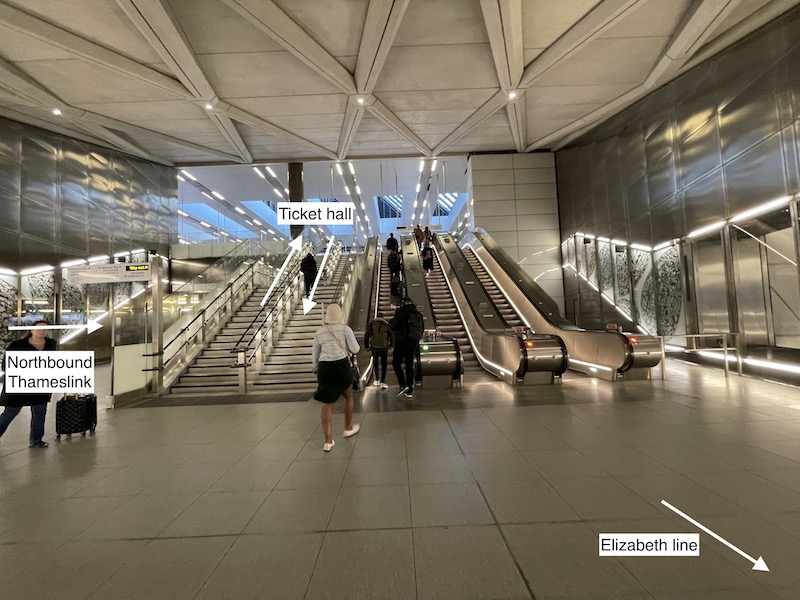
… to see the sheer numbers arriving, departing and interchanging as trains stop on both lines every few minutes.
Indeed, bearing in mind the vast space opened up by the Elizabeth line construction I am surprised this crucial area is so small (often leading to ‘commuter congestion’) …

… compared to the huge area between the extensive gate line by the station exit/entrance and the top of those escalators/stairs/lifts.
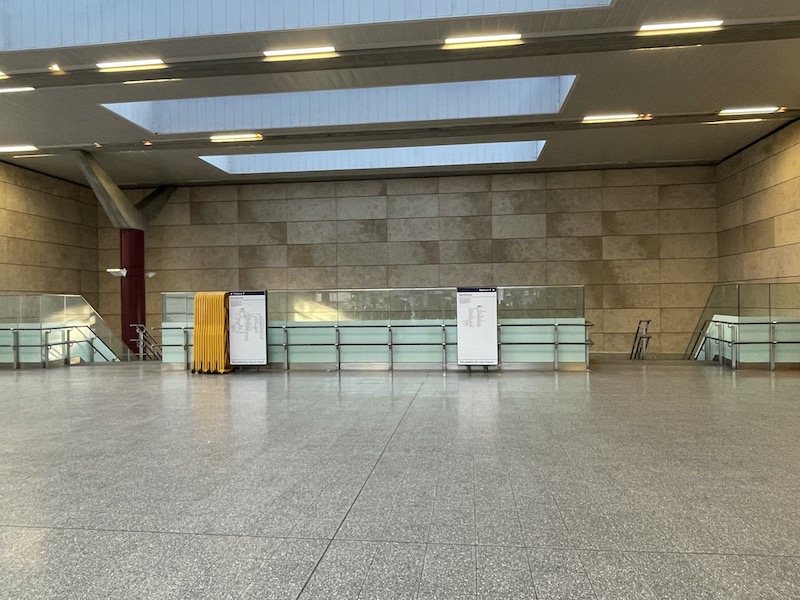
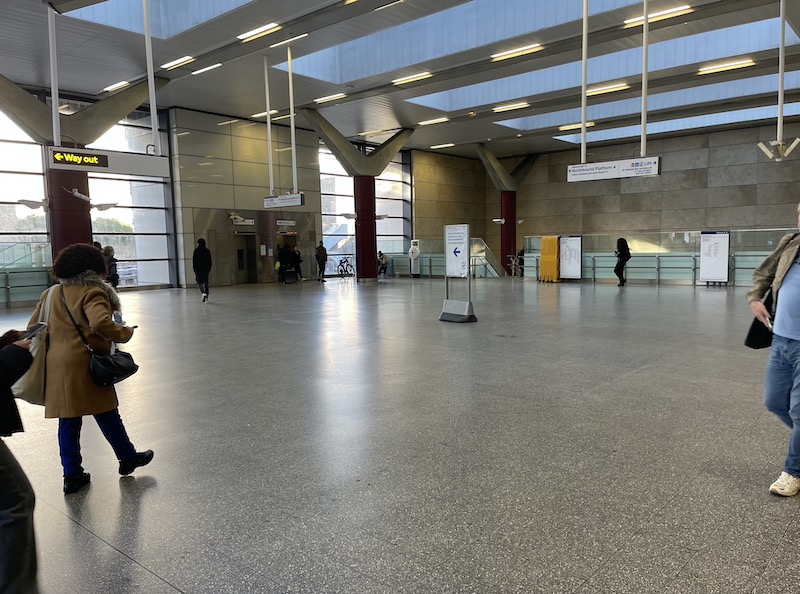
Farringdon was rebuilt as part of the ‘Thameslink 2000’ programme which saw its two platforms extended so they became capable of taking 12 coach trains. This severed the previously used peak time link eastwards towards Moorgate (on the “widened lines”) with all trains continuing south through the Snow Hill tunnel to City Thameslink, Blackfriars, London Bridge and south from there. The photo below shows where the tracks used to continue eastbound towards Moorgate alongside the Underground tracks.

The December 2011 timetable change saw all this and ‘Thameslink 2000’ work at many other stations (to accommodate 12 coach trains) completed.
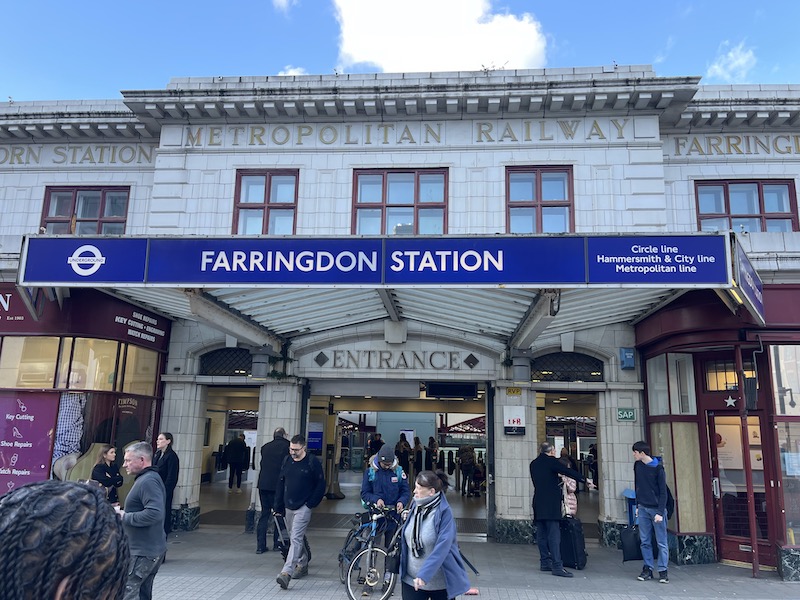
Before the 2011 changes and the Elizabeth line coming on to the scene, passengers using the Thameslink platforms would use the same station entrance and exit as for the London Underground lines with the same gateline.

That direct access (previously through the arch in the photo below)…
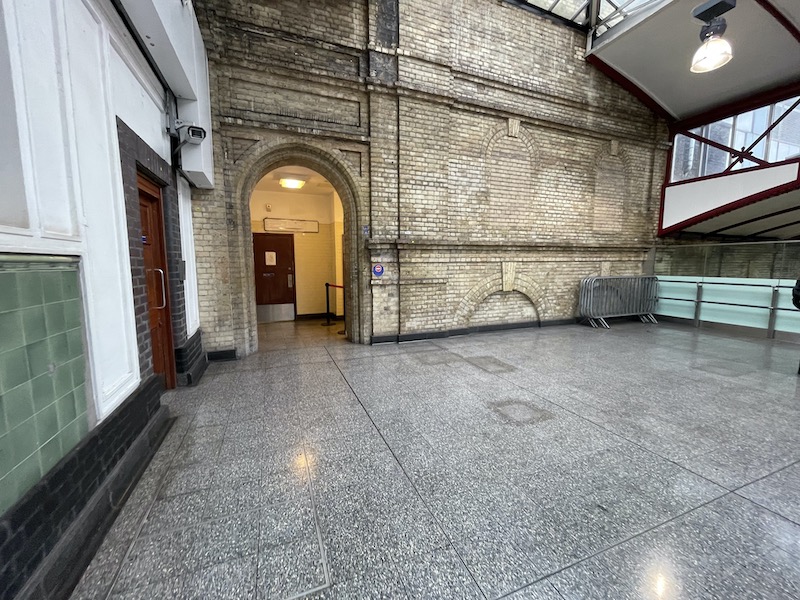
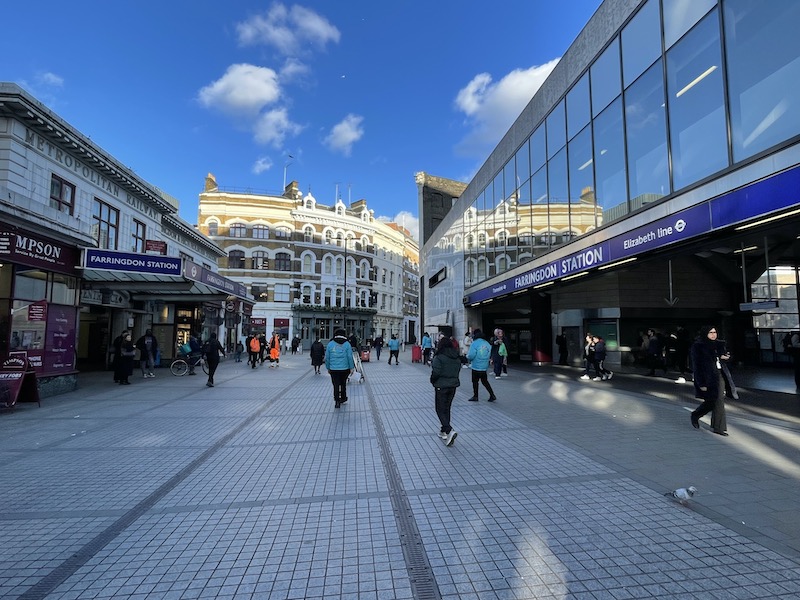
… was severed as part of the rebuild and now Thameslink passengers are directed to the new entrance and exit constructed as part of the Elizabeth line located immediately opposite the original London Underground station in the now pedestrianised western end of Cowcross Street.
You can still use the old route to access or exit from Thameslink via the Underground exit/entrance by using the Underground platforms and then take one of the two footbridges which link them to the Thameslink platforms mid-way along.
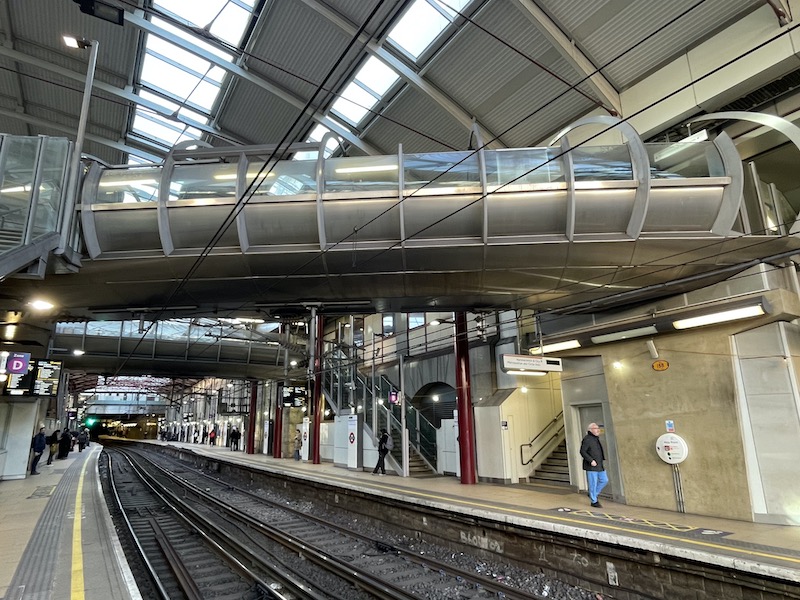
This also takes you to another exit/entrance to the station available during peak hours on the east side of the station in Turnmill Street as shown below.

Switching from a westbound Underground train to a southbound Thameslink …
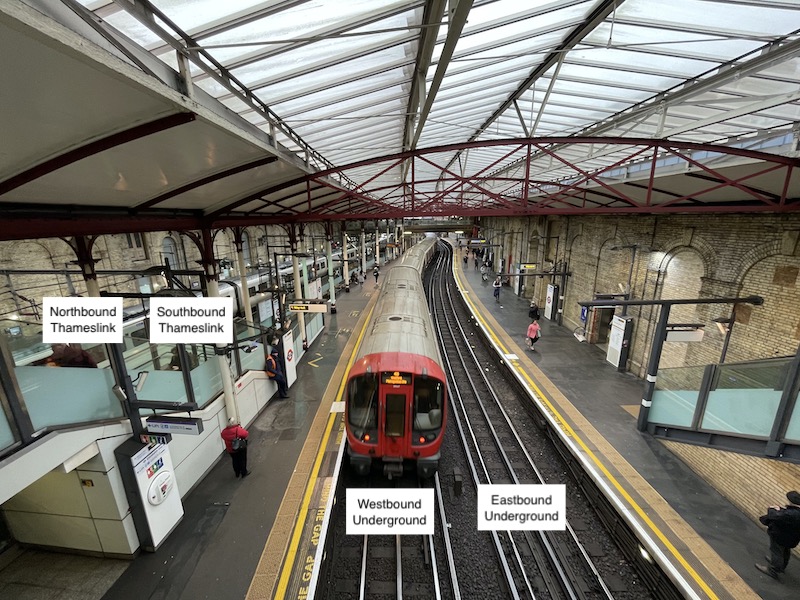
… is a doodle if you’re able to negotiate a few steps …
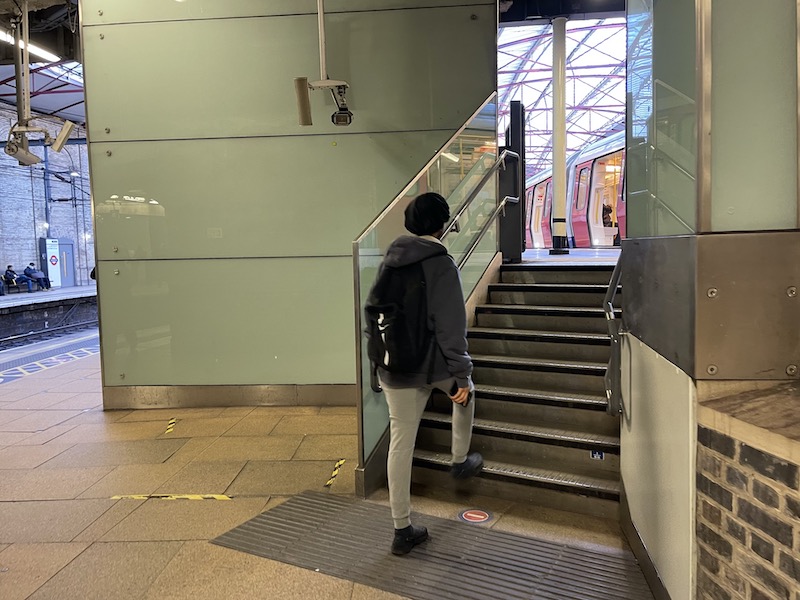
… between the adjacent platforms…
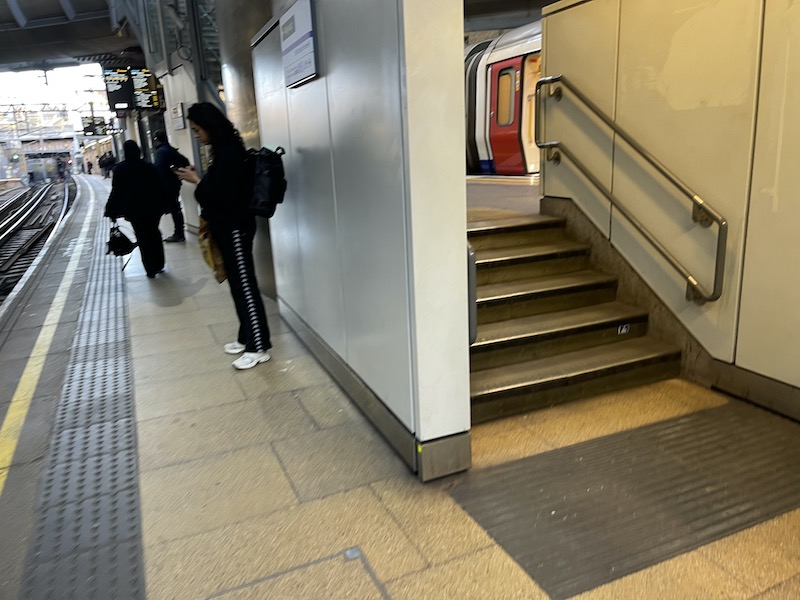
… but impossible if you can’t.
To use the northbound Thameslink platform you need to use one of the two footbridges, as you do, if arriving/departing on an eastbound Underground train.

Access to the Elizabeth line is signposted via the two gate lines …

… and crossing Cowcross Street at street level.

But you could take a convoluted route via the footbridges over the Thameslink platforms …

… and then via the northbound Thameslink platform to the signposted access to the Elizabeth line from there.

The above photo (and those below) show just how narrow the Thameslink platforms used to be, both the northbound…

… and the southbound…
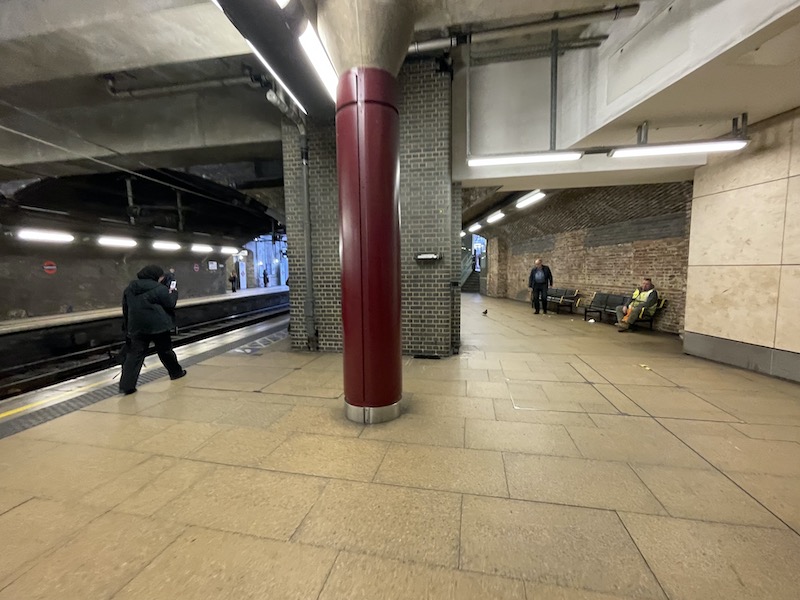
… before a ‘by-pass’ was built either side of the original tunnel infrastructure as shown above (southbound) and below (northbound).


Further down the western end of both platforms, they are still very narrow.

Which brings me to observe it’s so annoying for passengers, that eight coach Thameslink trains (for the Sutton/Wimbledon line) stop about two/three coaches short of the eastern end of the platforms where passengers arrive from the ticket hall, and tend to wait, as that’s the widest part of the platform…
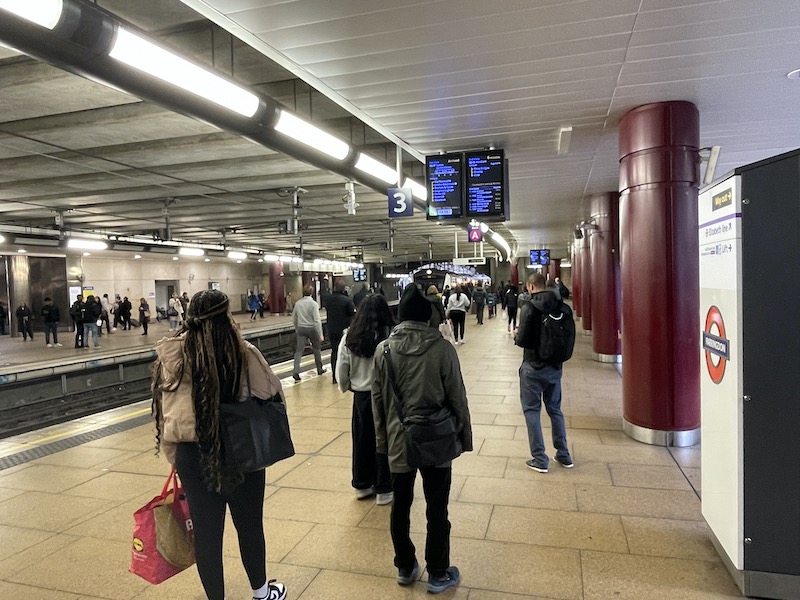
… so when a train arrives they all have to move down en-masse …
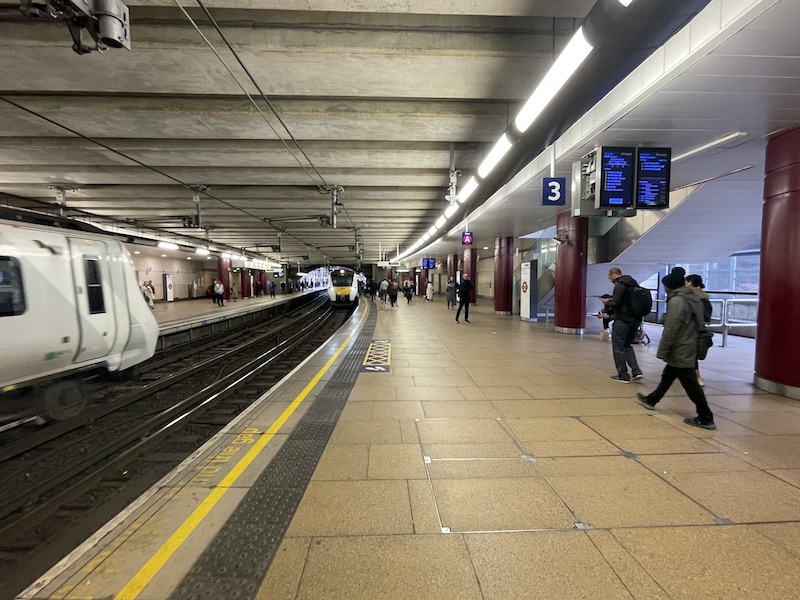
… and inevitably some arrive at the last minute and have to sprint down to catch it.

The same thing happens for northbound trains which stop well beyond the access from the ticket hall and Elizabeth line.

It would be much better if southbound trains stopped at the eastern end, as 12 coach trains do, and northbound trains stopped two thirds of the way along the platform, which would also avoid the need for passengers to alight and board on the narrowest part of the platforms at the alfresco end, and where, incidentally, another quirk can be found, whereby these two National Rail Thameslink platforms are signed as part of the London Underground rather than National Rail.

In complete contrast to the narrow Thameslink platforms, which date from another era of course, Farringdon offers the other extreme with the Elizabeth line.
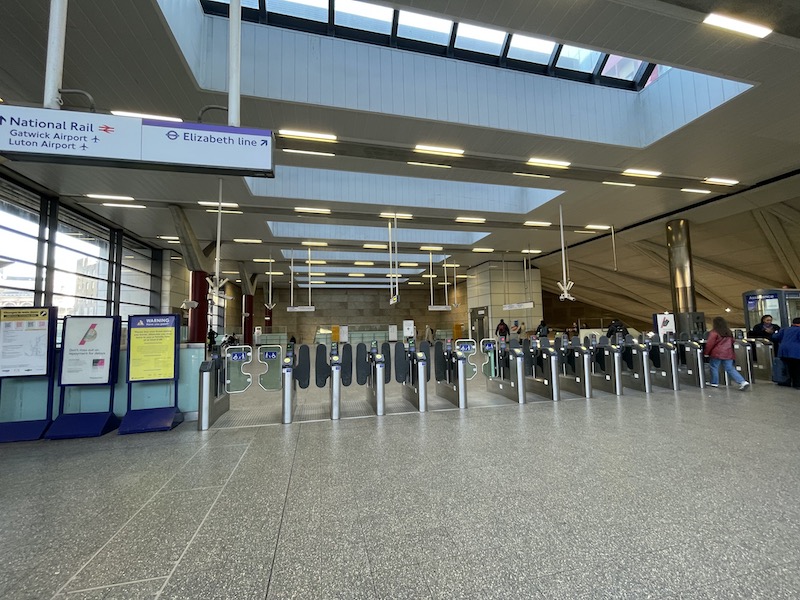
For passengers interchanging between Thameslink and the Elizabeth line (which TfL like to think of as not part of National Rail (see poster below) even though it is), there are a number of Oyster card readers for passengers without a paper ticket for a ‘through journey’ to tap in/out …
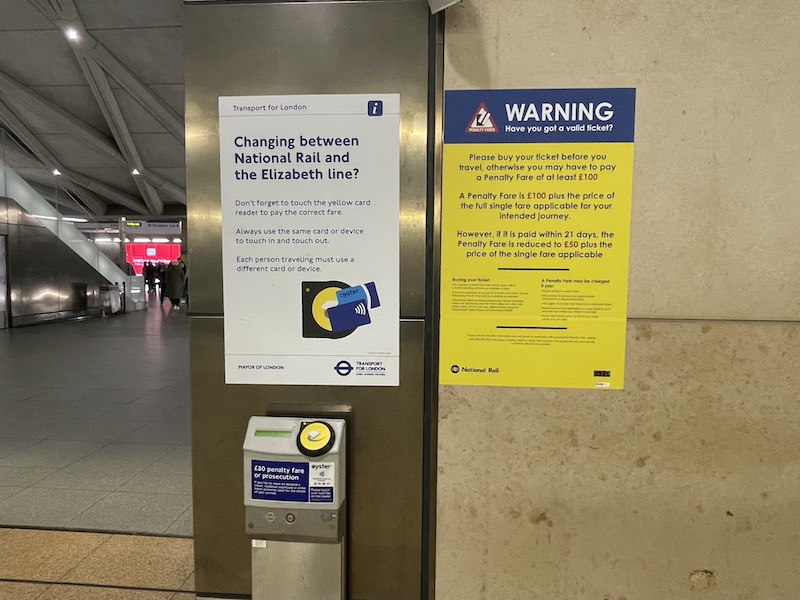
… before reaching the long escalators which take you to and from the platforms.

There’s a reassuring welcoming sign at the botom, encouraging passengers to keep walking onwards…

… until you reach the entrances to the platforms where you’re not told which is eastbound and which is westbound …
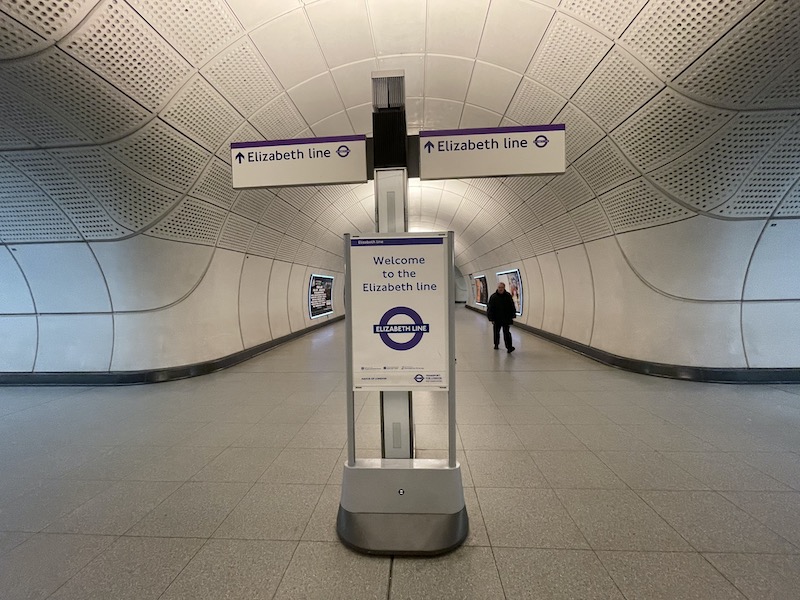
… to encourage you to continue walking (allowing those first passageways to be for passengers exiting from the platforms) although all the regular passengers know which is which…

… as the next sign confirms. And then you reach the very long platform with provision for taking even longer trains than the current nine coach formation.
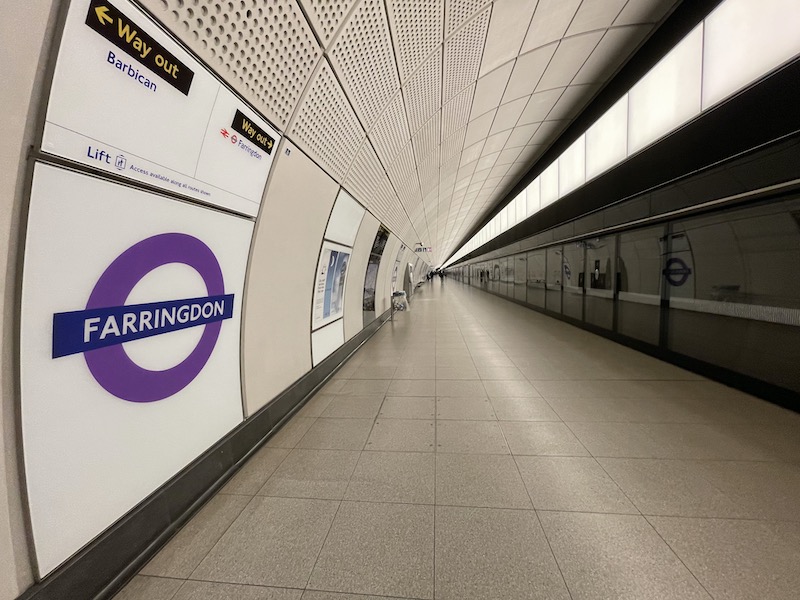
And if you walk to the other end, you reach the exit/entrance at the next eastbound stop on the Underground at Barbican – which saves getting the Tube.
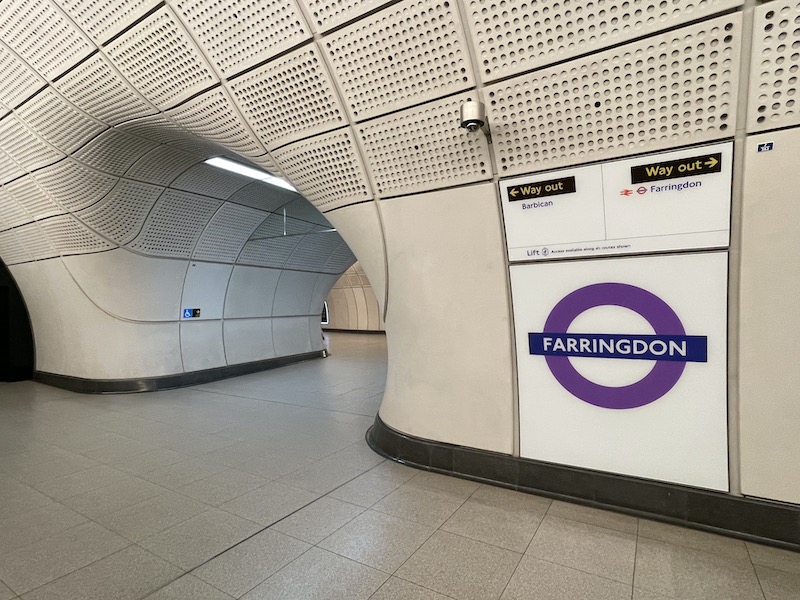
As you leave the Elizabeth line platforms you’re directed to the escalators and stairs for Thameslink, which is also the main exit…

.. and on the Thameslink northbound platform you’ll find a public toilet, installed as part of the ELizabeth line station extension.

But annoyingly it’s closed for a whole hour between 10:00 and 11:00 just as off-peak travellers are arriving.

One other quirky thing back on the Thameslink platforms is at the eastern end as trains enter Snow Hill tunnel, drivers are reminded to “PAN DOWN” as trains switch over to the DC current, although the overhead wires do continue as far as City Thameslink, the next station…
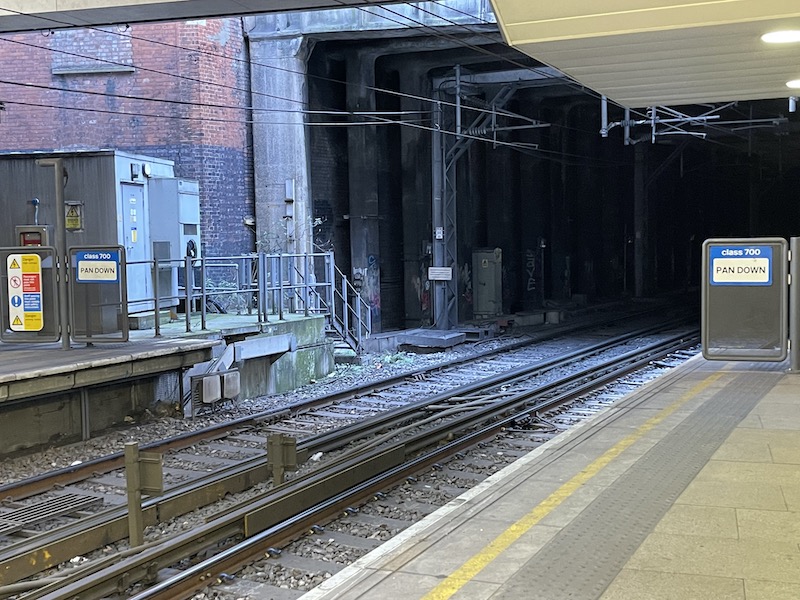
… while in the northbound direction, at the western end of the platforms, there’s a reminder to drivers that is the “Limit of DC Traction”, having been instructed to “PAN UP” at City Thameslink.

The section of track between Farringdon and City Thameslink has both DC current and overhead wires.
Finally you can get a sense of just how busy Farringdon is from the number of trains which call at the station. Readers may recall I explained in a typical hour at Euston there are 19 arrivals and 19 departures. By contrast, Farringdon sees 12 trains each way during an off-peak hour on Thameslink and 16 each way on the Elizabeth line making for 56 trains an hour, almost double Euston. And in the peak Farringdon see’s even more with 20 trains an hour (both ways) on Thameslink and 24 on the Elizabeth line giving a total of 88 trains in a peak hour.
Destinations include Brighton, Horsham, Rainham, Sutton/Wimbledon, Bedford, Cambridge, Peterborough, Reading, Heathrow (Terminals 4 and 5), Shenfield and Abbey Wood with East Grinstead and Sevenoaks in the peak and not forgetting as well as Heathrow served by the Elizabeth Line, Thameslink serves both Gatwick and Luton airports as well as St Pancras international so no wonder the station often suffers from suitcase overload.
I wouldn’t be surprised if Farringdon creeps up the chart to a higher position when the 2023/24 statistics are announced later this year.
I’ll leave you with a photo of the lovely facade of the entrance to the Underground station showing its original name bestowed by the Metropolitan Railway as Farringdon & High Holborn.

Roger French
Blogging timetable: 06:00 TThS including this weekend: a SSu ‘New Bus Route Weekend Special’ with journeys on new bus routes in North Wales and London.
And if you missed my live Secrets of a Successful Bus Operation webinar for the Foundation for Integrated Transport last Tuesday here’s a link to the presentation now on YouTube.
Comments on today’s blog are welcome but please keep them relevant to the blog topic, avoid personal insults and add your name (or an identifier). Thank you.


Thanks for all the interesting detail about the interconnecting passages etc. – important, given the predominance of interchanging passengers. One would have hoped that at the design stage a simpler scheme could have been considered, with the lines crossing at some lind of angle, so that four ‘lift+escalator’ combinations would serve everyone. But, then, what does an amateur know? I saw that a station designer had written somewhere that it is much more ergonomic to make interchangers walk a long way, so that they don’t make the platforms too crowded. (?!?!?!)
LikeLiked by 1 person
The Farringdon site is very constrained so they had to shoehorn it in
LikeLike
I hope you’ll be book-ending this excellent series with a look at Britain’s least-used stations and the reasons why, eg hardly any trains calling there and whether they’d be better used if only they had a decent service. Graham L.
LikeLike
I agree. We have a static caravan located between Skegness and Wainfleet, so sometimes use Havenhouse station, just for the sheer fun of it. I think it’s the fifth least used in the UK. I’ve never seen another passenger and it’s definitely one that wouldn’t be used more if it had a more frequent service .
LikeLike
A good case in point, and I’ve actually used Havenhouse myself too – more than once! A particularly glaring instance here in London is Sudbury & Harrow Road: located on a busy main road by a bus stop in a suburban town centre with new development adjoining it, yet with just four trains each way daily, Mon-Fri only – simply because that’s the way it’s been since the 1960s, and that’s all DfT say Chiltern Railways have to provide there.
LikeLike
Re the number of trains (Euston vs Farringdon), if you include the tube lines – Victoria + Northern’s two branches, each with at least 15 trains per hour in each direction – Euston would win. I’m ignoring the sub surface lines, as (if you take Euston Square as serving Euston) both stations get the same service level.
Of course, if you include buses as well, Euston wins hands down …
LikeLike
Some interesting observations Roger. Totally agree with you on the Thameslink southbound stopping mark. One other observation as a regular user is that from Elizabeth Line to Thameslink SB the lift route is much quicker and more direct (literally platform to platform rather than 2 escalators and a flight of stairs), which a lot of regulars have twigged, putting pressure on the lifts
LikeLike
The reason for the stopping points is so that the same coach on all trains is always at the section with the raised platform. Or, to put it another way, if you board a train from the raised platform (level with the train) and stay in the same part of the train, you will be able to alight from the train onto a raised platform (but, of course, only at those stations which have a raised section – many do not, yet).
This is very close to the entrance at St Pancras, so inevitably leads to congestion on that part of the platform and on the trains.
There are often announcements at Farringdon warning passengers when a short (8-coach) train is approaching and reminding them of the need to move along the platform.
John M.
LikeLike
Many thanks for the explanation John. That makes sense.
LikeLike
It only makes sense if you accept the undignified (and potentially dangerous) spectacle of passengers chasing after the back of the train, some pushing children or towing luggage, along narrow platforms. It is something that has spread like a blight in recent times. Once upon a time the train stopped where it was convenient for the customer, now there are many platforms where you may miss your train if you aren’t aware of how short the train will be.
In Paris you see a sign hanging up that indicates the rear of a short train. I call that common sense, but not not invented here.
LikeLike
The number of off-peak Elizabeth Line trains serving Farringdon is currently 16 per hour in each direction (eight each to/from the Abbey Wood/Shenfield branches), rather than 20 as stated. However, with the continuing growth in the number of passengers using the Elizabeth Line, it wouldn’t surprise me if the number did increase to 20 at some point.
Carllo
LikeLike
Thanks for the correction Carlio; post updated.
LikeLike
I worked at Thos Cook Freight in 1976 at Forwarding House on Cowcross Street. Your pictures tell a vastly different story about this station now! The nearest public house “The Castle” had a pawnbroker’s licence and may still display a pawnbroker’s sign (three brass balls) outside to this day.
LikeLike
I have to say, particularly in this day and age where “safety” has almost become a religion, how dangerous those narrow Thameslink platforms are. With frequent train delays, thus increasing passenger number waiting, most heads buried in mobile phones thus not aware of Someone trying to pass down a crowded platform in front of them, is a recipe for disaster although I realise there was little choice with building constraints.
In contrast to the Elizabeth lines below, it is not a pleasant place to await a train. The constant and mostly unnecessary bawling of both the Underground and Thameslink staff into their hand-held microphones during peak hours can be deafening, particularly when both are shouting at the same time!
But has certainly made a whole lot of journeys crossing London far easier than previously, so I for one am grateful.
Terence Uden
LikeLike
I would have thought that Farringdon would be fourth or fifth in the series
LikeLike
Is this really the BUSIEST station no 9?
Perhaps not.
The method of counting BUSIEST is flaw as it counts exits and entrances through this station but makes no allowance for interchanges.
We have interchanged from the Met line to the Elizabeth line – on one day 5 of us changed eastbound and then back again westbound. So we counted as 5 * 2 * 2 = 20 because each went through 2 ticket barriers each way. Yet we changed at Baker Street each way on the same journey and the count was ZERO because we changed between 2 underground lines and did not pass through a ticket barrier.
Take Liverpool Street station – another flawed count. If you change Overground to Central at Stratford then ZERO count, but change at Livery Street and you pass through at least one ticket barrier and so do NOT count as zero.
Chiltern Trev
LikeLike
Just to clarify, the ‘Barbican’ exit from the Elizabeth Line doesn’t take you into Barbican Underground station, instead there’s a new (separate) ticket hall on Long Lane, which is a couple of minutes walk from the Barbican Underground entrance. A direct link to Barbican LU wouldn’t really add anything to the Elizabeth Line’s connectivity anyway. It’s signed as ‘Barbican’ (without the roundel), because it’s the nearest exit to the Barbican Estate. That ticket hall is best described as ‘quiet’ (certainly in comparison to the rest of the station), but it won’t be if/when the redevelopment of Smithfield markets into a cultural venue gets done.
Considering the piecemeal development of the station (starting in 1863!) and the fact that the older bits are listed buildings, I think it works pretty well now and the occasional annoyances are far, far outwieghed by the improved level of service. But you missed the best bit – the passageway that runs alongside Turnmill Street (leading to/from the Underground ticket hall above the Eastbound Met/Circle) has a fantastic artwork based on the Underground’s Johnston typeface, well worth a detour.
Ricky
LikeLike
There is a direct exit onto the westbound platform at Barbican.
Rob.
LikeLike
Other complications at Farringdon are the River Fleet and the old extensive network of railway tunnels that served Smithfield Market. The current Farringdon station as well was not the first one
LikeLike
Another good report enhanced by the enlightening comments as usual. Useful information about the late-morning toilet closure period. It’s a handy facility I have used several times but never seen that notice before.
Steven Saunders
LikeLike
I’d be happy if the Portsmouth/Chichester trains were all routed via Thamesllink and Farringdon. Increasingly, Victoria proves an irrelevance as a destination. I nearly always change at East Croydon for either London Bridge, Blackfriars, Farringdon or KGX. Not to mention the Elizabeth Line…
LikeLike
Victoria is a more useful destination than London Bridge.
London Bridge is basically a commuter station. Victoria is where off peak traffic generally goes.
LikeLike
Victoria is only useful if you’re going to Buckingham Palace, the museums or the coach station.
London Bridge is much more useful, you can change there for Charing Cross which is within walking distance of most of the West End, and saves having to use the Underground.
Victoria’s usefulness has declined ever since the Jubilee Line extension opened 25 years ago
LikeLike
Why. The Victoria line gets you to most of the West End
LikeLike
Yes, but its the Victoria Line. Its packed. Its horrible. Depending upon where your final destination is, London Bridge for Charing Cross is usually much more convenient, not to mention cheaper as you don’t need the TfL add-on Travelcard. Coming from the south of the Thames you can pick your London terminal to avoid the Tube
LikeLike
And don’t forget its now a really convoluted trek to get to the Victoria Line at Victoria
LikeLike
This simply isn’t the case. From London Bridge you can get a train as far north as Peterborough or as far south as Brighton, not to mention services going to Kent. Indeed, the Thameslink services have improved so much over the last six or seven years that we now prefer to go into LBG to go to either Brighton or Gatwick rather than hike into Victoria.
LikeLike
Its amazing that TfL omitted to provide Oystercard readers for interchanging passengers when the Elizabeth Line first opened, only adding them as an afterthought
LikeLike
German bus and train drivers are striking
The public transport sector across Europe is facing a critical moment due to cost-cutting measures, primarily at the expense of bus and train drivers.
“Our public transport system is about to collapse. Bus drivers are completely overworked, many of us are off sick and many of us aren’t coming back,” says Mattias Kurreck, a bus driver from Berlin.
“Our shifts are getting longer, our breaks are pretty non-existent and we constantly stress about delays to the service.”
LikeLike
Clearly the Stats should exclude interchange between EL and Thameslink as NR journeys . in terms of most used station/s – while NR would need to know , in terms of passenger space provision, for terms of being an origin, or destination it must be a lower down ranking .
LikeLike
After your comments on Euston and its train indicator, I was surprised to see you had nothing to say about the one at Farringdon.
The National Rail entrance hall has one of the new style multi-screen departure boards. The first two panels list the next trains on the Elizabeth Line, ten in each direction, in chronological order showing the destination only (no calling points).
The remaining panels are taken up with an A to Z list of stations covering much of South East England. These show the time of the next Thameslink train to depart to the station in question, and whether it leaves from platform 3 or 4. I presume this is the next departure not the next fastest train but this is not stated. The flaw in this arrangement is that a station only appears on the list if there is a train going there in the next few minutes. Many stations only have limited direct services from Farringdon, so they are not on the screen much of the time. If your destination involves a change of train or has fast and slow services, then good luck.
Once you go down to the platform, everything changes: the next train will be (e.g.) to Bedford at xx:xx and you have to match up what you were told before with the real trains.
This A-Z list idea is spreading too, there is one at London Bridge. Is it a good idea to mix the train or station format in this way? Someone seems to think so.
LikeLike
@ChilternTrev:
The statistics for National Rail (which puts Farringdon at number 9 in Great Britain) *do* include interchanges. Figures are estimated and are published on the ORR’s website here:
https://dataportal.orr.gov.uk/popular-statistics/busiest-stations-in-britain/
with a link explaining the method of estimating. Latest figures are for the 2022/23 financial year (i.e. 1st April to 31st March), published in December 2023.
The column headings state “Entries and Exits”, but the note below the table states that the figures include people changing trains.
TfL’s figures are stated to be entries and exits, with no mention of interchange. They are published here: http://crowding.data.tfl.gov.uk/ and seem to be for the calendar year, so the latest figures are for 2022: http://crowding.data.tfl.gov.uk/Annual%20Station%20Counts/2022/AC2022_AnnualisedEntryExit.xlsx
John M.
LikeLike
How can they justify spending £30M on a small station and that’s only the budgeted cost. On the track record of these things it could easily double and how an earth can it take 3 years to complete
It is just a single platform and presumably no lift needed
A brand new train station costing £30m is set to restore passenger services in a town that’s been cut off for 60 years.
Aldridge Railway Station’s future site is being secured and cleared to pave the way for the start of construction, with hopes it will be open by 2027.
The project will see a single platform station built with a 40-space car park and road access from the town’s Westfield Drive.
LikeLike
the former Thameslink tunnels to Barbican are supposedly going to become sidings for the Met line, so they can stable a train or two in the City and run earlier northbound services than is possible at present. However the project has only got as far as building the junction and apparently the tunnel has become a bit of a money pit.
~MD
LikeLike