
Tuesday 20th February 2024
Department for Transport funded Bus Service Improvement Plans (BSIPs) have helped launch a number of new bus route initiatives around the country. I’ve recently caught up with Hertfordshire’s latest addition to the network as well as a new arrival in West Sussex.
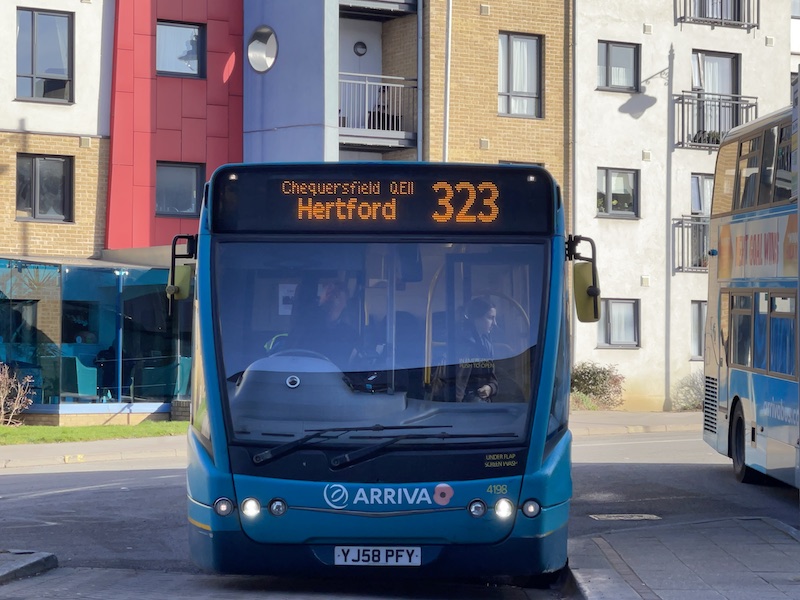
As reported in recent blogs, Hertfordshire has been introducing new bus routes to enhance existing inter-urban frequencies across the county. Politicians and officers are particularly keen to improve east-west links bearing in mind there are already good north-south rail connections.
The latest new service began on 7th January in the form of route 323 between Hertford and Welwyn Garden City and its northern suburb called Haldens. And this being Hertfordshire not doing anything by halves, the launch frequency for this new route is every 30 minutes with a span of day between 06:30 and 19:30, six days a week.

The towns of Hertford and Welwyn Garden City have long been connected by hourly Green Line 724 (on its long orbital Harlow to Heathrow Airport route)…
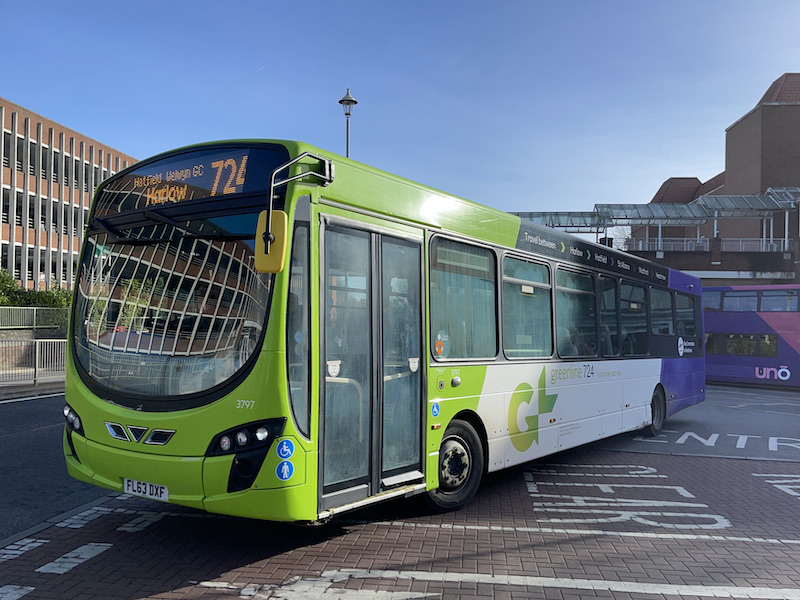
… to which Hertfordshire funded a supplementary hourly route 324 in May 2021, which takes a slightly different route but doubled the end to end eastbound frequency.

Now the 323 has doubled the end to end frequency again to every 15 minutes and this latest arrival on the scene follows a third alternative routing between the towns.
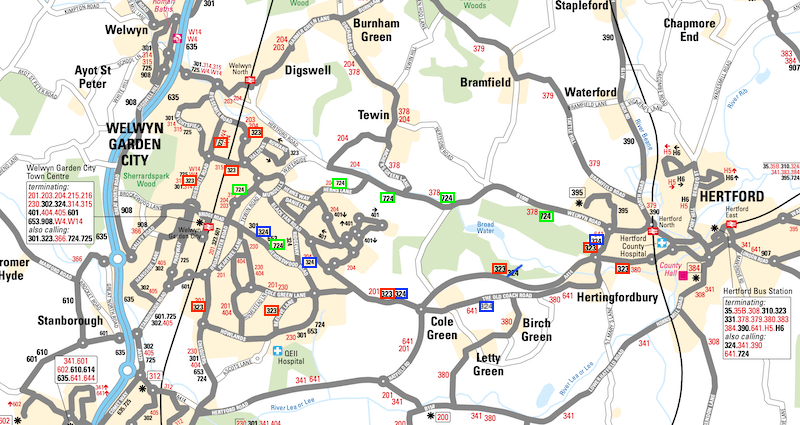
I’ve tried to highlight the three different routes on Hertfordshire’s helpful bus map (above) by showing the new 323 in red, the three year old 324 in blue and the long established 724 in green. A couple of journeys on the 324 continue to a college in Ware and although evening journeys use a non-stop stretch of the the A414 (which I’ve put a blue line through), daytime journeys serve Birch Green and Cole Green where I’ve added the route number.
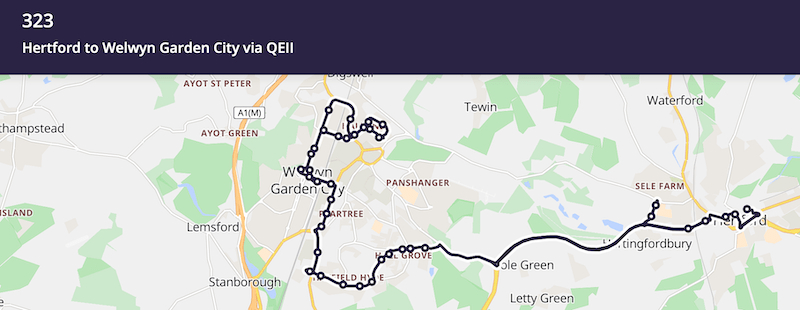
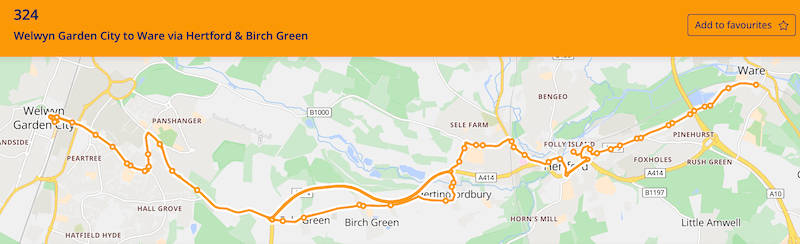

The opportunity has been taken to use the three buses allocated to route 323 to withdraw two of Welwyn Garden City’s local town routes (400 and 403). The 323 now performs a loop around the Haldens residential area, north of the town centre, which the 403 used to do and takes 22 minutes for the circuit, before buses return ready for the hop over to Hertford.
It does this by skirting the Woodhall and Hatfield Hyde residential areas to the south east of Welwyn Garden City town centre, also the preserve at one time of the 403, but once it gets on to the A414 it’s a non-stop run until reaching the outskirts of Hertford where it does a double run up Thieves Lane to serve a new housing area and school on the edge of Sele Farm.

The 323 takes 35 minutes for its end to end run (ignoring the loop around Haldens), the 324 takes 27/28 minutes and the 724 takes 25/27 minutes. Bearing in mind the constraints of the 724 timetable, Hertfordshire County Council has done a good job trying to coordinate departures from both ends.
It works perfectly from Welwyn Garden City with the 724 at 05 and 324 at 35 and the 323 exactly in between at 20 and 50 minutes past each hour, but from Hertford the 323 leaves at 20 and 50 with the 324 at 05, but the 724 varies it’s departure time at different hours although from mid morning to early afternoon is at 06, thus duplicating the 324, but there’s nothing that can be done if it’s to work from the Welwyn Garden City end.
I sampled the new 323 recently by travelling from west to east so rolled up in Welwyn Garden City’s bus station located alongside the Howard Shopping Centre which has good access to the railway station.

We took four passengers back home to Haldens and brought four back into the bus station who all alighted there and another four boarded for the 11:50 departure to Hertford with one alighting on the double run on Thieves Lane and the other three in Hertford town centre. There were no other takers.
I travelled back to Welwyn Garden City on the 13:05 route 324 which also saw four board (it was a day of fours) with another boarding by Thieves Lane, but two alighting, leaving three on board for the journey over to Welwyn Garden City and no other boarders until we got to Morrisons on the way into the town centre where one alighted and two boarded.

So, not particularly busy, but frequency enhancements, as Herts is doing, take time to become established and they do need lots of promotion and publicity to increase awareness. I wish them success.
I’ve commented previously on the brand confusion in Hertfordshire as the County rolls out its ‘Connect Herts’ branding alongside the Green Line brand and I see the 323, operated by Arriva, is part of the former (according to the pdf timetable)…

… but the 324, which is now operated by Centrebus rather than Arriva as previously, isn’t part of Herts Connect.

I also saw Vectare has introduced a new logo for the recently acquired Central Connect bus company which looks similar to the Interlink logo.
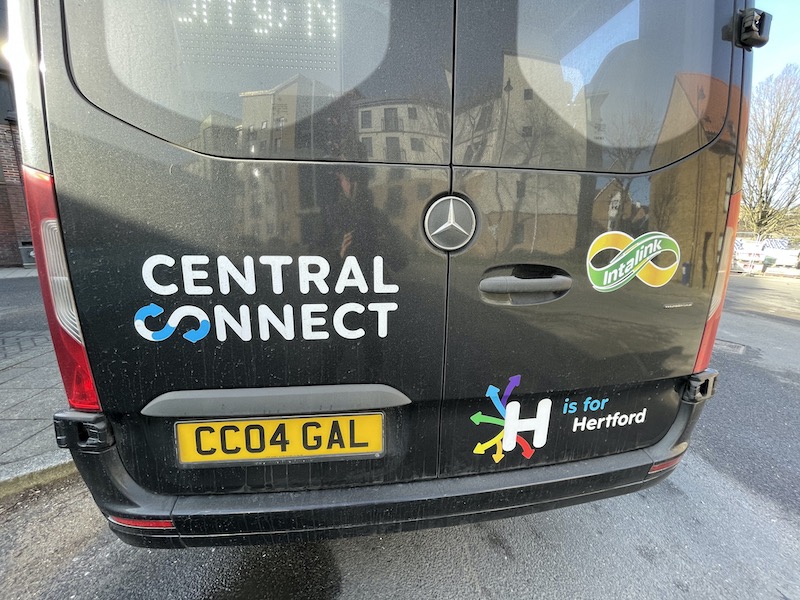
But at least it’s different to the Connect Herts logo for those routes which do carry the livery.

It’s all a bit confusing.
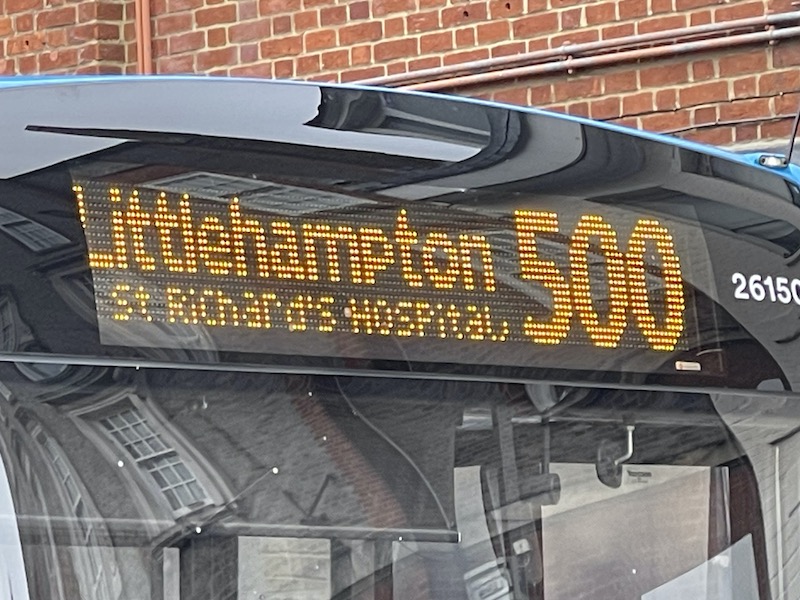
Meanwhile down in West Sussex another new half-hourly bus route began last July also funded by the County’s BSIP. It links Chichester and Littlehampton but whereas the long established Coastliner branded Stagecoach operated route 700 runs via Bognor Regis and Middleton this new route 500 takes a more direct trajectory via Tangmere, Fontwell, Eastergate/Westergate and Barnham.

It provides some very welcome new links as well as serving new housing developments particularly on the eastern outskirts of what is fast becoming an extended Chichester…


…as well as serving the town’s St Richard’s Hospital.
The span of operation is an impressive 05:10 to 00:50 and there’s an hourly Sunday service (starting at 07:05).
End to end journey time is 50 minutes (from Chichester bus station – the bus also serves the town centre and Cathedral on inbound journeys on a loop) leading to a requirement for four single deck buses.
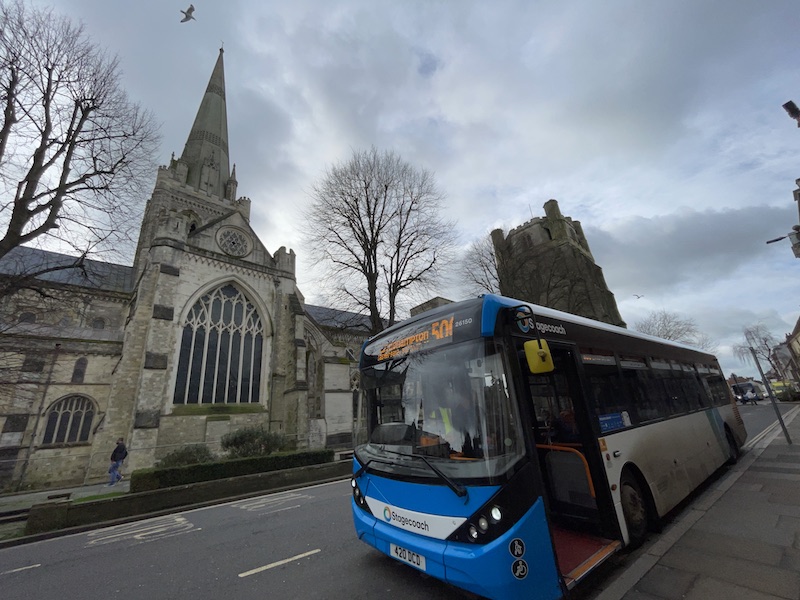
Coastliner 700 takes 70 minutes for the Chichester to Littlehampton section of route so the new 500 offers a significant saving and as it includes a non-stop three and a half mile stretch of the A27 between Tangmere and Fontwell you really feel you’re getting somewhere.
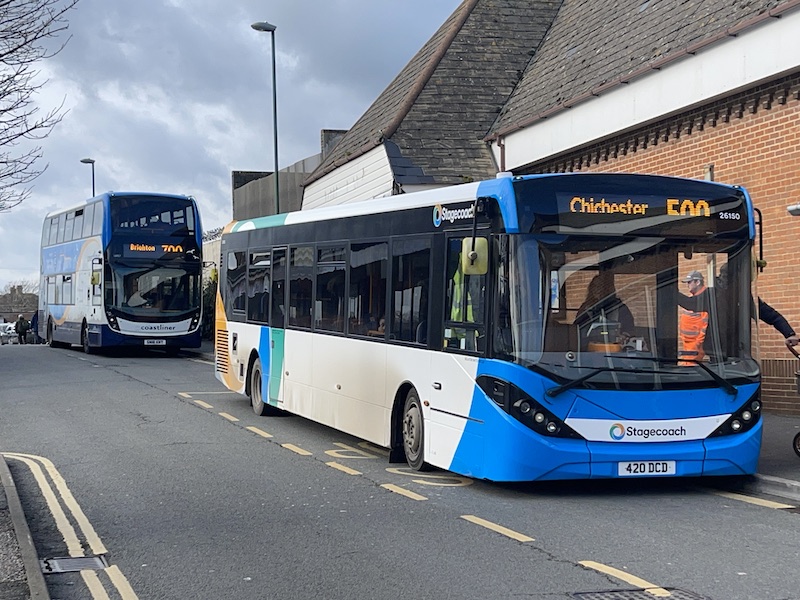
I caught the 13:25 departure from Chichester Cathedral (13:35 from the bus station) yesterday afternoon and an impressive 18 passengers travelled with many making journeys previously only possible with considerable inconvenience or not at all.

West Sussex has also splashed out on real time signs bus stop plates in many locations along the route…

… and Stagecoach has produced a timetable leaflet which encouragingly I found available on board buses on the 500 and other routes.

It’s very heartening to see BSIP funds being used for initiatives which look to be successful additions to local bus networks after just a few months.

Roger French
Blogging timetable: 06:00 TThS including this weekend: a SSu ‘New Bus Route Weekend Special’ with journeys on new bus routes in North Wales and London.
And if you missed my live Secrets of a Successful Bus Operation webinar for the Foundation for Integrated Transport last Tuesday here’s a link to the presentation now on YouTube.
Comments on today’s blog are welcome but please keep them relevant to the blog topic, avoid personal insults and add your name (or an identifier). Thank you.
 BusAndTrainUser
Wishing the new Hertfordshire routes every success.
The current enhancements make me wonder if they’d ever have been considered, had the railway between Hertford and WGC not been closed.
LikeLike
Are return tickets issued on these services – and, if so, is there inter-availability? A supposed 15-minute frequency is no use to you if it’s raining and your return half is for the “other” bus which won’t be along for another 25 minutes. Not a problem for Concessionary Pass holders of course!
Andrew Kleissner.
LikeLike
They would both be £2.00 single I would assume.
Robert Turner
LikeLiked by 1 person
I hadn’t thought of that – I live in Wales where the fare cap doesn’t apply!
Andrew Kleissner
LikeLike
Yes there is, but £2 fare cap applies to all journeys.
Dan Tancock
LikeLike
Very helpful and increases schedule/vehicle efficiency when new links can also incorporate a local town service as with the 323, provided en route traffic congestion allows.
And yes, the 500 has certainly taken on a life of it’s own, but has seemingly spent weeks being diverted hither and thither owing to the constant road works which appear to have mushroomed out of control just about everywhere in the UK this last year.
Terence Uden
LikeLike
West Sussex does seem to have invested heavily in realtime information at bus stops – as you’ll see when you do “our” 100 to Horsham
LikeLiked by 2 people
That’s really good to hear – I haven’t travelled on the West Sx 100 for a few years, and I hope it has improved use of the buses. I had a look on the internet to try and find out how RTI has increased loadings generally, and had a hard time finding anything; it would be a shame if the data is known but is “commercially confidential” – particularly seeing as it is mostly public authorities who pay for it rather than commercial bus companies! One figure I found – I think American – mentioned only a 2% increase in loadings! they sugared the pill by saying that that increased the revenue of New York’s buses by $5m …
But 2% suggests that there is in fact no general commercial basis for installing it, and the public benefit (lower congestion, better air quality, saving the planet etc.) would seem to mean that RTI is an expensive way of not getting very much – better advertising of buses, better quality of bus stops, and keeping them cleaner would probably get more extra custom at lower cost. And I’d like to know whether that 2% is true in the UK. Much might depend on secondary factors: e.g., as Roger has pointed out, is the ‘real-time’ info mixed in with timetable times, without any clear indication of which is which? In Tunbridge Wells, back in the days of John Prescott, a lot of people (not just regular bus passengers) got excited when screens with information started appearing at the central stops, and it was a massive let-down to find there was no actual real-time information.
I do hope the West Sussex bus-stop RTI does have a positive effect.
LikeLike
It probably isn’t commercially confidential but it is likely that no one really knows the answer outside a very deliberate academic review. It is often that RTI is deployed in pieces over an extended period of time which can make it difficult to get down to a level to spot the improvement to work out a number. Where it is done in a bigger scheme it will often be tied into bigger projects – Leicester has recently installed RTI screens across many stops but that was done as part of the wider Enhanced Partnership which also included multi-operator tap-on tap-off capping, new electric buses, simplified networks, new routes and other improvements which mean that separating out the effect of RTI would be practically impossible. As users we know that it makes it a less stressful experience which will make repeat usage more attractive but can we put a figure on what that effect is, not really.
LikeLike
The real problem is so called RTI at present is simply unreliable
LikeLike
I love that you take lots of photos of the busses. ________________________________
LikeLike
Nice to see you travelled on PD3 420!!
LikeLiked by 1 person
Stagecoach are launching a new half hourly service between Stevenage and Bedford
LikeLike
Hi Roger. Just a bit of added info, the 400 was indeed withdrawn and the Chequersfield and Burrowfields sections are now run by the 323. In a neat swap, the section of the 403 around Woodhall and Peartree is now covered by a new 402 using the same resource.
In terms of passenger numbers, it is indeed early days but both the 323 and 324 have been observed with considerably more passengers than you experienced but it’s not clear whether one route is benefiting over the other. The reliability of the 324 suffered in its first month of operation because of roadworks in the town meant a lengthy diversion to Hertford which didn’t affect the 323.
Dan Tancock
LikeLike
Travel between Hertford and WGC is pretty low I doubt the passenger numbers are there to be had
LikeLike
For our American Friend ( and Roger ) . I assume that RTI might be expensive to install but once the technology is in place the updates cost less and has a physical life the cost can be spread over – of what – five years at least. For bus operation the 2percent , or whatever , is key, it is the marginal extra (regular) passenger that takes your service from loss to profit (or justifies its level of subsidy).
For Roger – and Others – perhaps you can explain the flip-flop in bus service provision between (high frequency/regular service) interurban routes terminating in town centres , with local extra buses (which used to be minibuses in many places) running the in town routes (Cloverleaf serving communities up to 7min out of town were often popular so one bus could do 4 areas of residentials an hour), this was deemed not to delay either the local or the interurban so they were different routes (sometimes they might be an interworked bus but even that had reliability issues) , would be the flavour of the day, then a local (or two) would be linked- at one or both ends – to a longer service for “operational, or passenger, requirements, this would run for a few years, then the company would reverse it again and split the routes. What really is the most efficient, on cost, timekeeping and revenue/customer patromage
J B C Prestatyn
LikeLike
To try to answer JBC Prestatyn above …. there is no one answer!! Every town is different, and so every solution is different.
It can come down to local topography … if the town is in a valley and the estates are on hills, then town routes may prosper.
If the local hospital and station are there as well, then all passenger destinations are together, and can be served well.
I’ve noticed that, nowadays, standalone “town” routes do less well unless the frequency is high …. if I want to pop into town and the hourly bus has just gone, then I’ll get the car out … even a bus every 30 minutes might change my mind.
For that reason, planners (both bus and council) will often divert an interurban route round an estate to pick up the few passengers travelling; it maintains a service at minimum cost, but really isn’t ideal.
I wish there was a “best and final” answer …. if there is, then in nearly 50 years I haven’t found it yet!
LikeLike
Diverting an interurban bus around estates makes it slower and fewer people will use it then makes that route less useful so fewer people use it
Town routes in in view need to start at about 6:30 and continues to at least 8 pm and should at least a 20 minute frequency
peal routes as will could be different to off peak to an extent this already happens with school trips
In the am & pm peaks most passenger would want to go to the station or an industrial or business park areas but companies tend not to serve at present and most buses do not even run at the times these people need them so they use the car
LikeLike
Can anyone explain the bizarre route of the 323 in Hertford? Leaving town, the bus diverts onto the A414, missing out Hertford County Hospital and the North station stops, then does a double run to serve Sele Farm. The obvious (to me) route would be via North Road, Welwyn Road and Thieves Lane, serving all three places without the double run.
It seems perverse to deliberately avoid two “traffic objectives” in this way. But then again the East station doesn’t even have a bus stop, so Herts transport planners clearly have their own ideas about where passengers want to go.
LikeLike
Let me try. The 323 is routed to serve some stops in Hertford that otherwise have a very infrequent service and it is felt there are sufficient commercial services via the hospital. The diversion from the A414 doesn’t serve Sele Farm – doesn’t get that far -but a new estate called Blakemore Manor (though currently access is awaited into the estate).
Hertford East Station has two adjacent stops, at Claud Hamilton Way and at Tesco.
Dan Tancock
LikeLike