Saturday 3rd February 2024
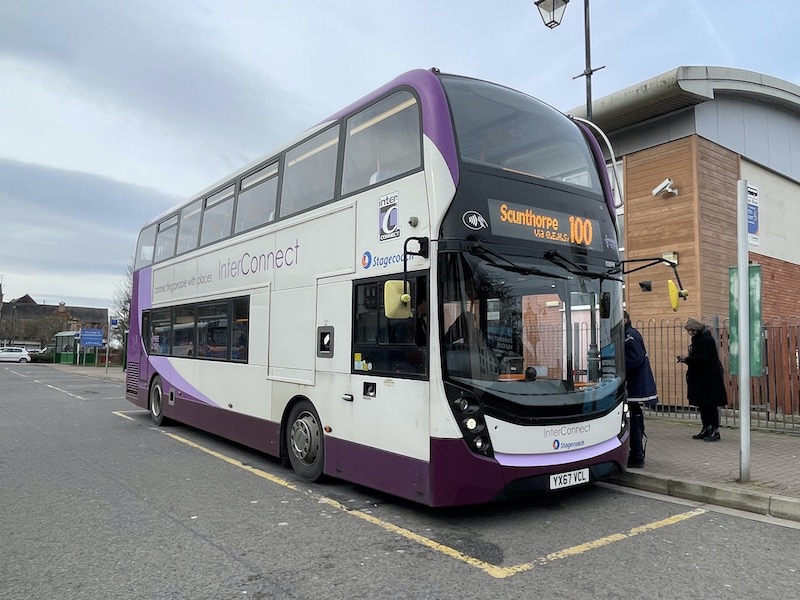
Third in this year’s fortnightly route 100 odyssey is another cross-county-border inter-urban bus route but, unlike the first two already featured (Stevenage/Hitchin and Crawley/Redhill), this one really is pure inter-urban. No wandering around residential estates in the urban centres for this double deck operated 35 mile route across some of England’s finest flattest countryside.
One of five route 100s operated by Stagecoach, it technically needs to be split halfway to avoid having to comply with more restrictive EU regulations for drivers’ hours, tachographs and not be eligible for Bus Service Operators Grant (BSOG) if it ran as one through route.
That’s why when I looked on the Stagecoach website this past week I wasn’t surprised to find two completely separate timetables under route 100.
One from Scunthorpe to Gainsborough …

… and the other from Gainsborough to Lincoln.

There was nothing to even tell you each trip is in fact a through Scunthorpe to Lincoln journey with what’s usually misleadingly referred to as a “guaranteed connection”. And then I thought good luck to any passenger trying to work out why most journeys listed are shown twice with complicated codes and an incomprehensible list of dates concluding no-one from Stagecoach could ever look at what information it’s displaying and see how ridiculous it looks, let alone will ever encourage passengers?
But then a commentator on this blog once it was published explained that gthe Stageocach website had technical problems last week and the normal timetable display had now returned.

Thank goodness for that.
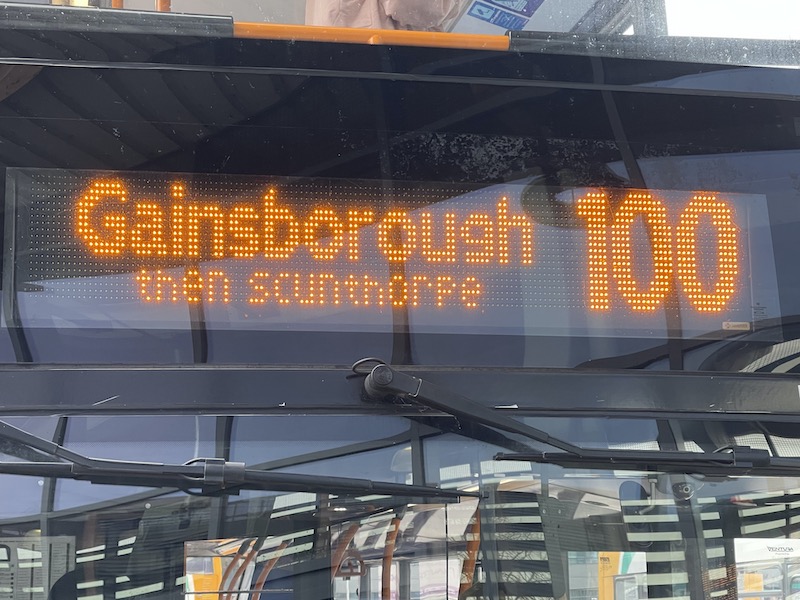
Just to add to the confusion, as buses leave both Lincoln and Scunthorpe the destination displays Gainsborough with the rider “then Scunthorpe” or “then Lincoln”.
As you can see from the “proper” timetable, the route enjoys a straightforward hourly frequency until afternoon school times and across the afternoon peak when there’s a widened headway for finishing time at Scunthorpe North Lindsey College and to allow for extra traffic on the roads. Journeys start up in Gainsborough around 06:30 and buses are back in that town (where they’re based) by around 19:00.
Ten minutes stand time is given midway In Gainsborough bus station with journey times from Lincoln and Scunthorpe to Gainsborough being 45 and 55 minutes respectively.
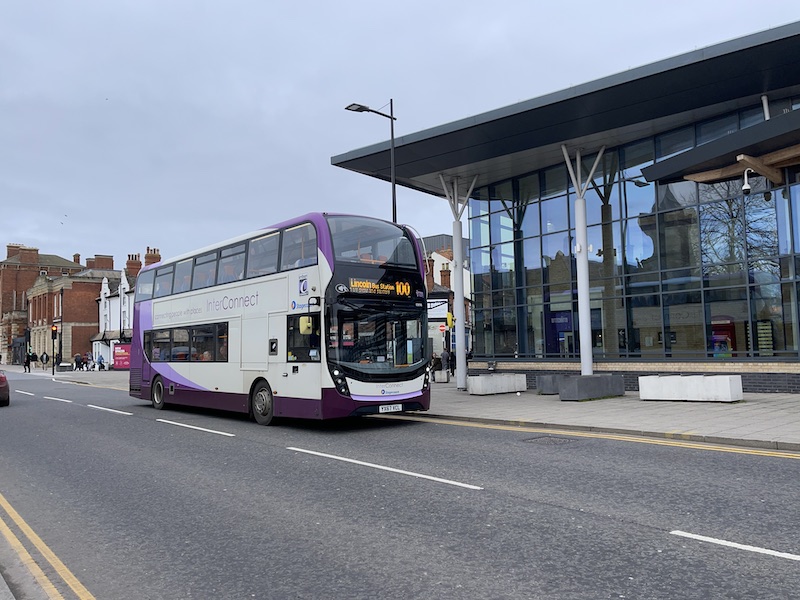
Four buses are therefore needed to run the service with 10 minutes layover in Lincoln and five minutes in Scunthorpe making for a four hour round trip.
The same timetable pretty much applies Mondays to Saturdays. There’s no Sunday service.
When I took a ride on the route from Lincoln to Scunthorpe last Saturday, buses were keeping well to time so no AI intervention needed here.
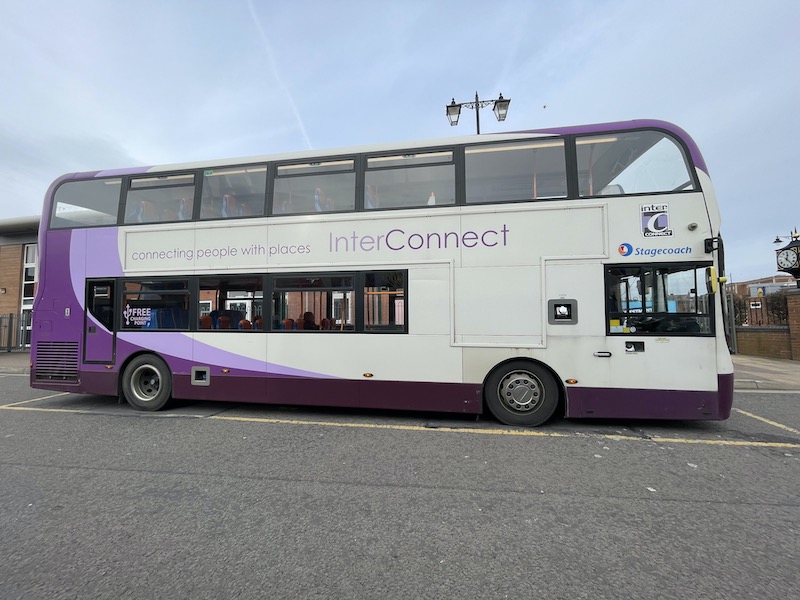
The route is branded by using two-tone purple coloured buses as part of Lincolnshire’s InterConnect network of inter-urban routes all numbered in the low 100s and stretching across the county including in route 100’s case, since 1996, across the border to the then newly formed North Lincolnshire Council – one of four unitary councils which replaced Humberside County Council that year.

I took a ride on the 11:35 departure from Lincoln’s relatively new city bus station (opened January 2018) with the bus arriving on time from its previous journey at 11:25 disgorging around half a dozen passengers but I’d noticed a good load of around 20 alighting at the previous stop opposite the railway station and closer to the shops.

We left on time with 18 on board and no other passengers boarding (or alighting) until we reached the village of Saxilby, seven miles north of Lincoln, at 11:50 where eight alighted and one joined us.
The quickest direct route to Scunthorpe would be due north up the A15 but that wouldn’t bring much trade with few houses or communities to serve…
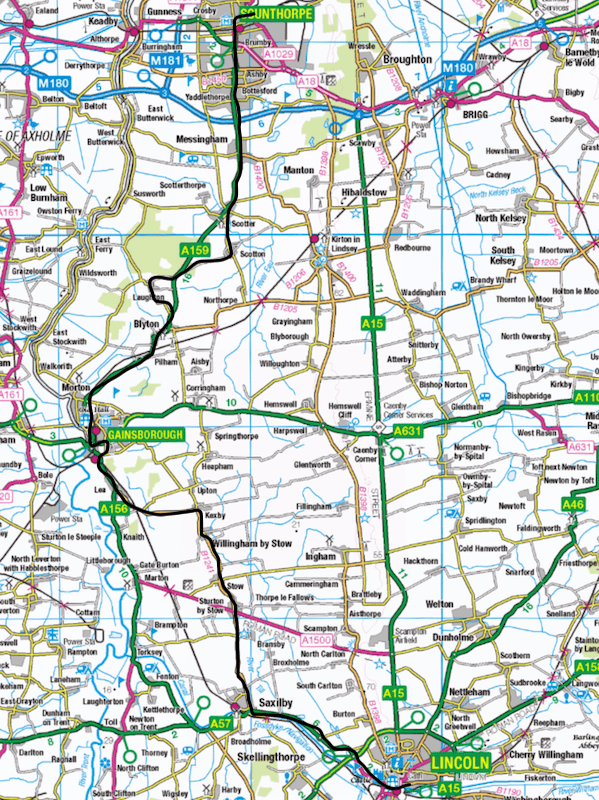
… so the trajectory to Gainsborough is more in a north westerly direction continuing, after Saxilby, through the villages of Sturton by Stow, Stow, Willingham by Stow and Kexby before reaching Lea on the southern outskirts of Gainsborough.
Four of our Lincoln passengers alighted as we passed through those locations with seven more joining us, so when we pulled into Gainsborough’s rather basic bus station (three bus shelters and a small parking area) we had 14 on board, 12 of whom alighted leaving just two and myself to continue on to part two of the route after the ten minute pause.
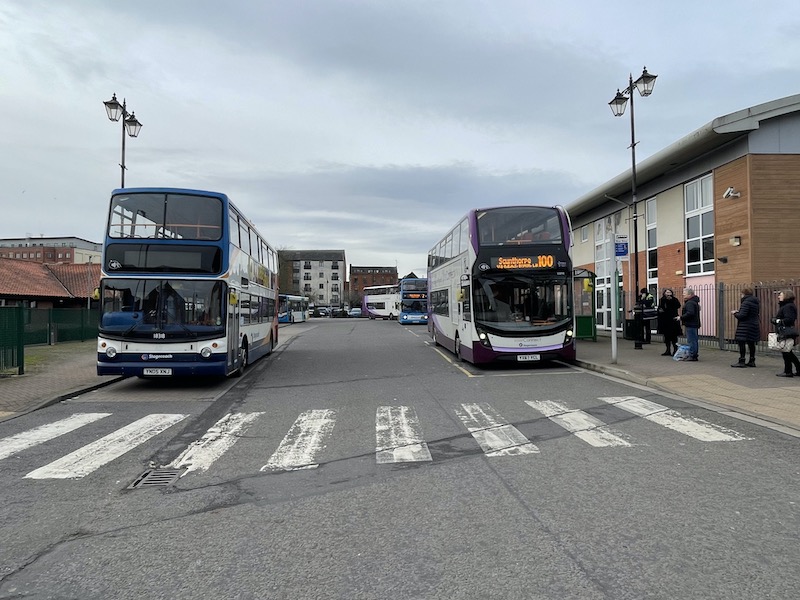
I took the opportunity of the short break and a driver changeover to stretch my legs and take a few photographs noting eight passengers waiting to board for the next segment to Scunthorpe.
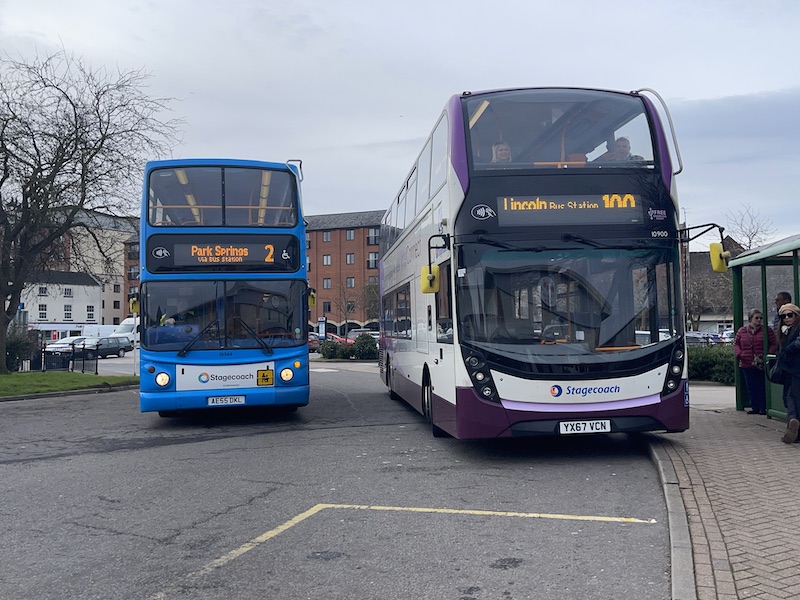
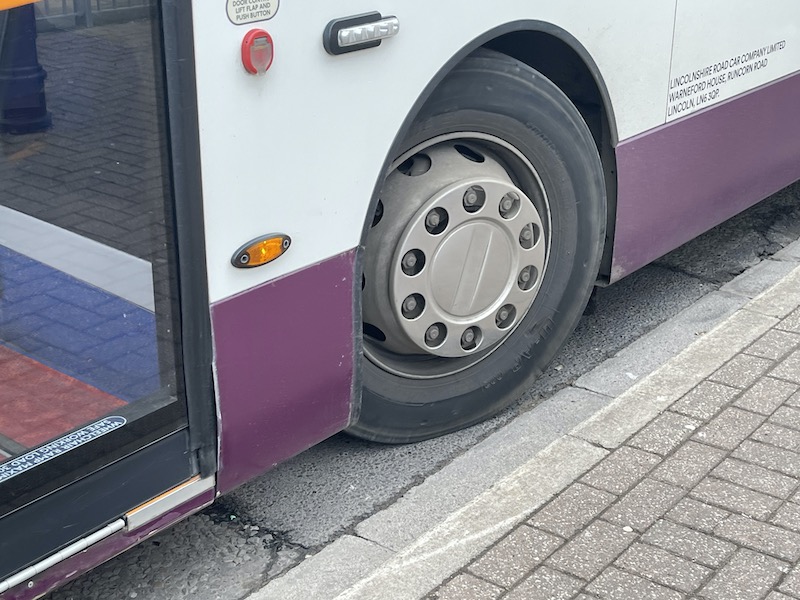
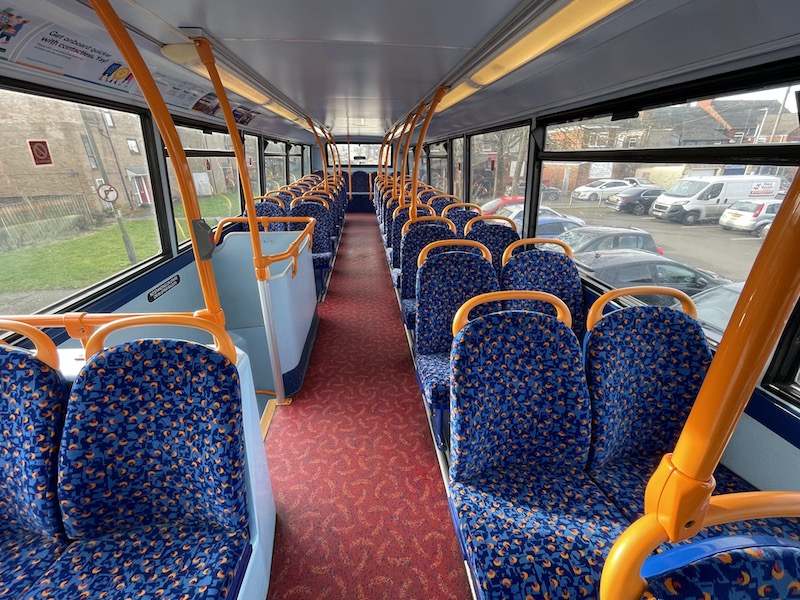
But one of the drivers noticed the front nearside tyre was looking a bit flat and they took the initiative of exchanging the bus over for a 19 year old Alexander bodied Dennis Trident which was parked up in the bus station.
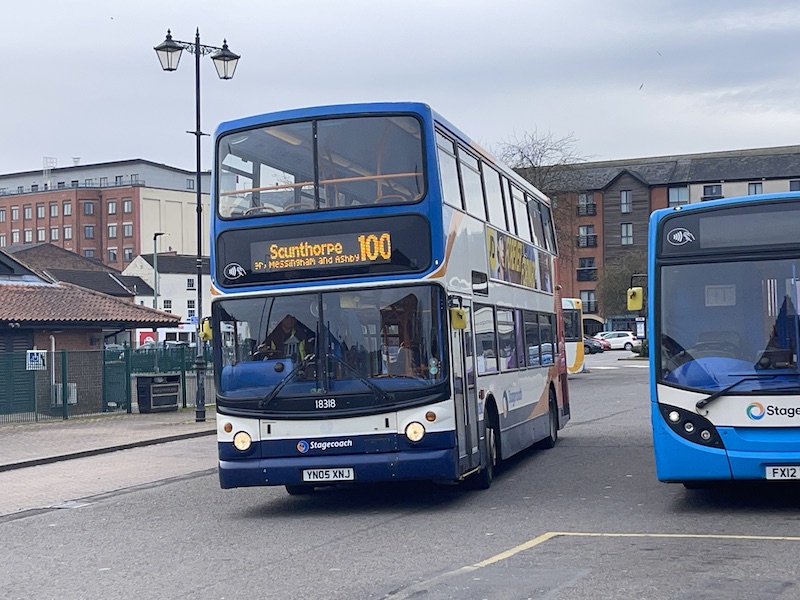
Myself and the ten passengers were soon on board and we left just five minutes down which, thanks to some expert driving, we soon made up.
It’s a much quieter second part of the route. Five of our ten passengers alighted in Blyton, nine minutes (five miles) north of Gainsborough.
The route continues north on the A159 with two deviations to serve the village of Laughton (lying west off the A159) and Scotton and Scotter (lying east).
In both cases it took us along fairly narrow roads for a double deck inter-urban bus route…
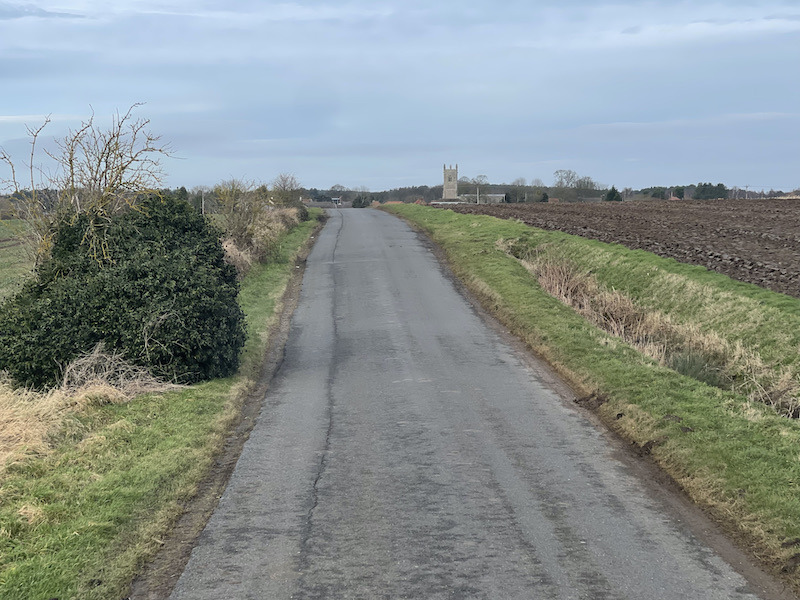
… but no passengers for us on Saturday
When we reached Messingham 17 minutes (5.2 miles) from Scunthorpe we lost one more passenger but began to pick up new ones heading into Scunthorpe with six boarding at various stops and all alighting as we continued towards the town’s bus station, with just one staying right until the bus station where we arrived a minute late at 13:26.
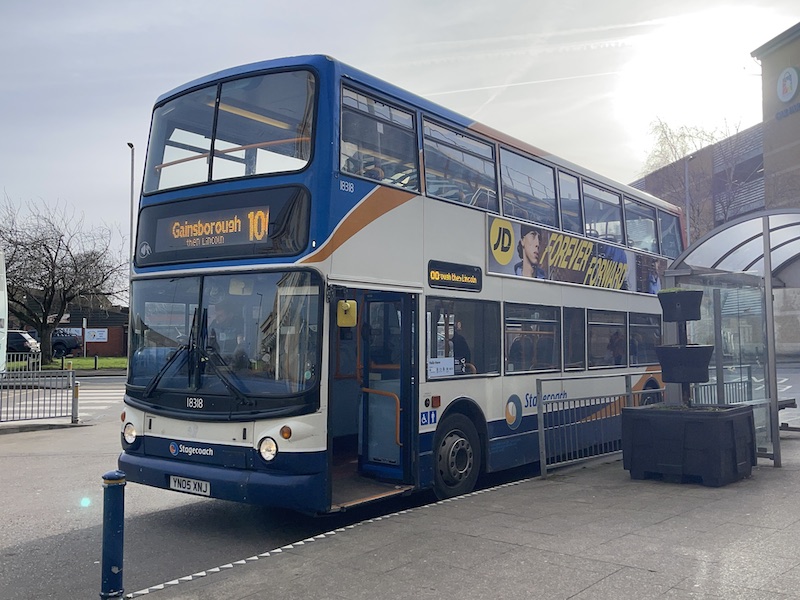
It had been an enjoyable journey with a very smooth ride on both the six year old ADL Enviro400 and 19 year old Dennis Trident which belied its age well.
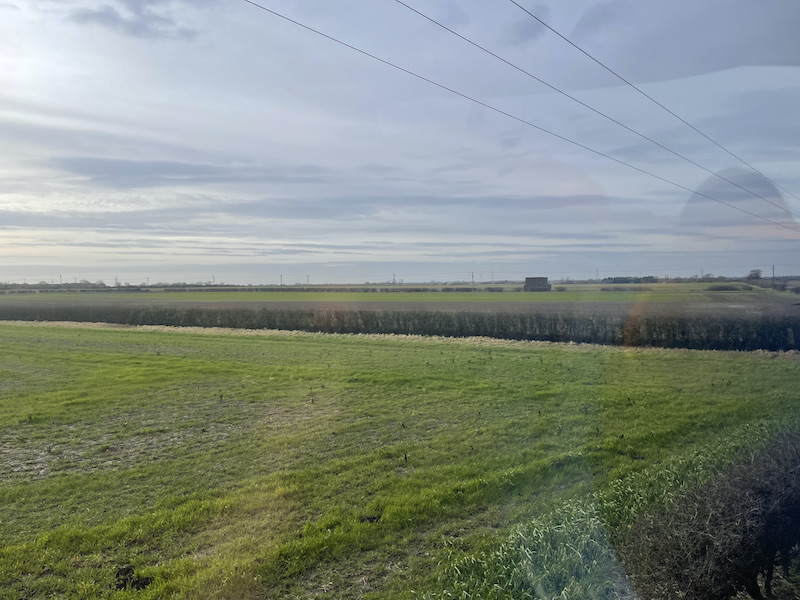
Lincolnshire’s scenery is characteristically flat but after a while you get used to it and the upside is there’s no hill climbing challenges for the buses.
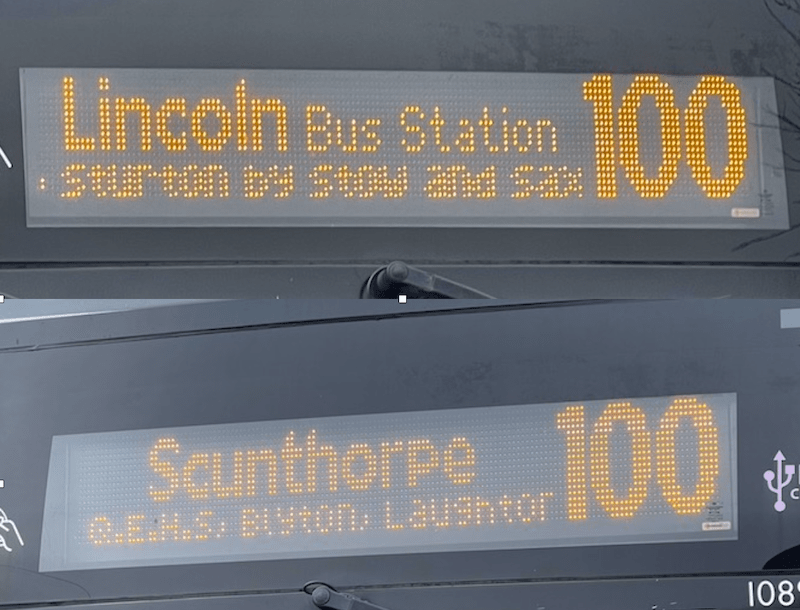
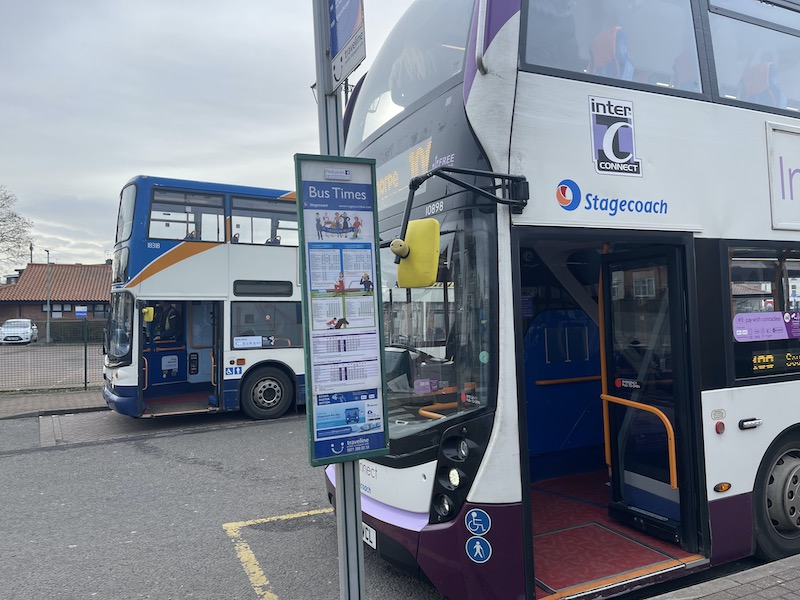
Both bus stations in Lincoln and Scunthorpe had a list of departures for the route at the departure stand as did Gainsborough with Lincoln having an electronic display confirming the departure time as can be seen in an earlier photo above.
There were no printed leaflets to be found so I guess Stagecoach reckon those that know, know (about the route) and they’re not bothered about those that don’t, as you’d hardly come across information by just casually browsing the Internet, and as I demonstrated above, that information (if you did manage to stumble on to it) is unintelligible anyway.
And, sad to report, the very welcome information counter at Lincoln’s bus station as seen a year after it opened for business in 2019…
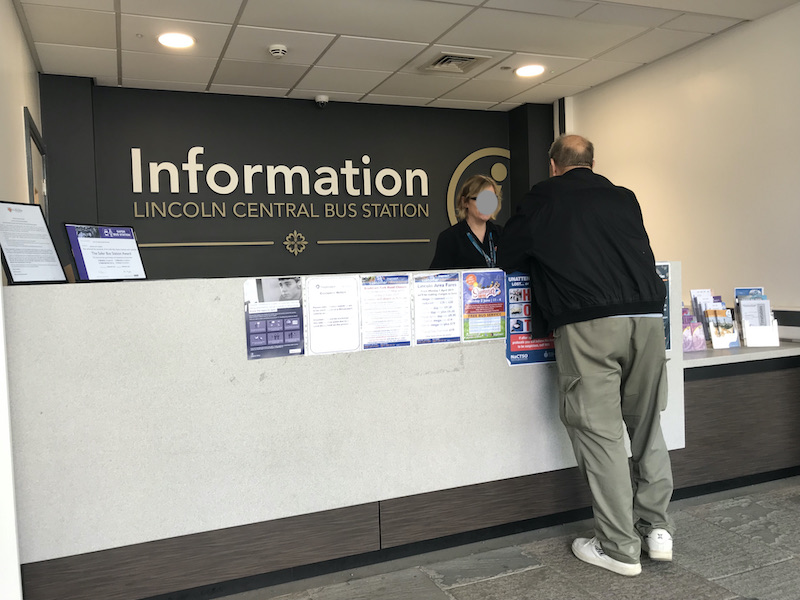
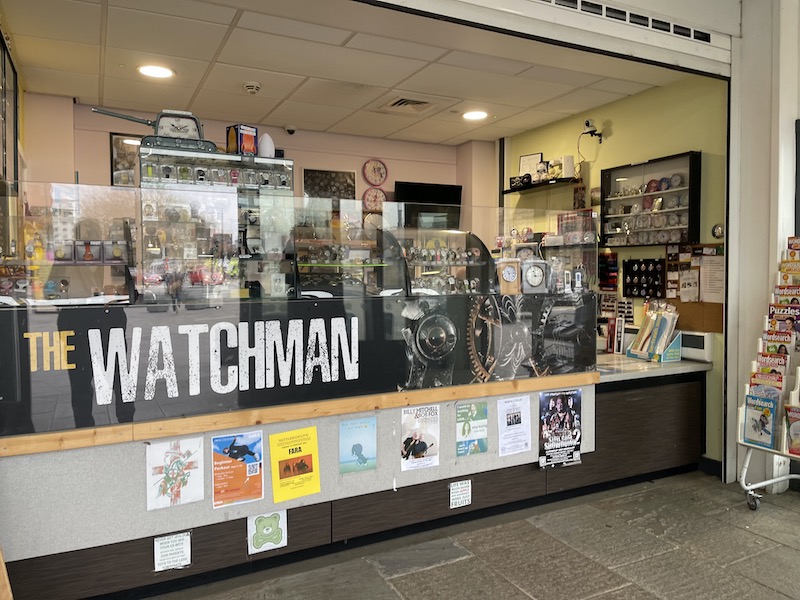
… has turned into a watch repair kiosk …
…. and obviously, Stagecoach closed its travel shop in Scunthorpe’s bus station.
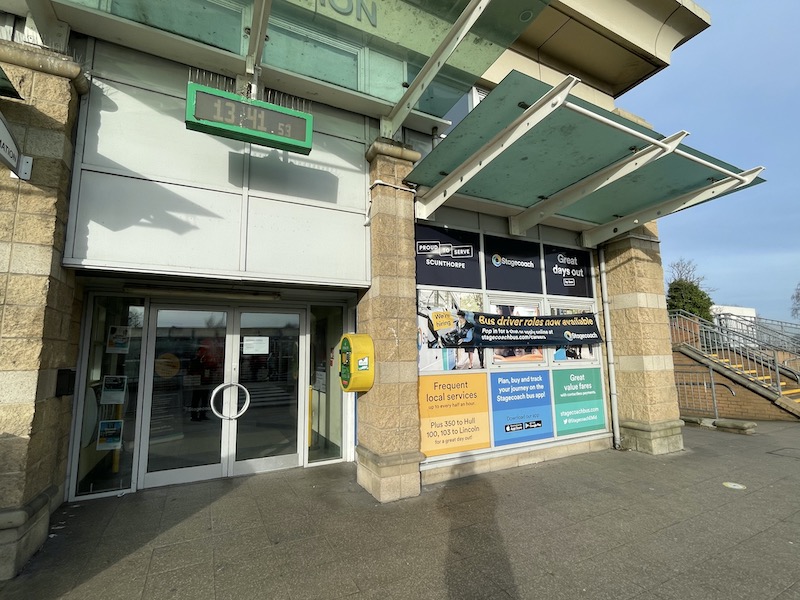
So much for encouraging passengers.
Roger French
Did you catch the first two ‘Every route 100’ blogs? Here’s 1 of 26 (Stevenage-Hitchin) and 2 of 26 (Crawley-Redhill), in case not.
Blogging timetable: 06:00 TThS including another Su extra Superloop blog tomorrow, and on Tuesday 13th February at 12:00 don’t miss a free-to-attend online webinar “Secrets of a Successful Bus Operation” thanks to the Foundation for Integrated Transport. Book your place here.
Comments are welcome but please keep them relevant to the blog topic, avoid personal insults and add your name (or an identifier). Thank you.
 BusAndTrainUser
Lincs CC has a very neat timetable of the full route here…the weird URL is a redirect from the main LincsBus home page.
cartogoldDOTcoDOTuk/lincs/map.html
There is also a “Find Your Timetable” search engine on the LincsBus home page, but it spilts the service in two, so even on the same web site they can’t sort this mess out. The HMTL version is also not formatted properly so only the afternoon journeys appear, I despair, does anyone test this stuff?
LikeLiked by 1 person
Looking at the information it splits the routes up into Call Connect. Interconnect and All other services ? Why? I have not a clue as to what routes are in what group having never visited Lincoln so you just flounder around try to find a route
LikeLike
Agreed!
Lots of local authorities do that – Herts for example has HertsLynx on a separate section of their web site with no indication as to what it is on the bus services landing page – not even a mouse over (at least Dial-a-Ride which is also on a different page is vaguely self-descriptive).
TfW must be the worst with their arbitrary division of the network between Traws Cymru (with a separate web site) and the rest. Made worse by the nonsense of some regular services like the 460 being branded as Traws Cymru Connect and Traws Cymru like services such as the X47 and the X75 (which would plug big gaps in the network) not being included.
I think that is all proves is both public and commercial sectors can be equally unfriendly in their presentation of information.
LikeLike
TFW will always be the worst. Full of lazy, overpaid, waste of fresh air staff. No one there is accountable for their poor actions and the sole care is what can they do to score political points on the day. Not a single care in the whole organisation for passengers.
It took TrawsCymru about a year to add the Llew Jones trips to the T8 timetable, they said they had to ask the operator what the times were as they didn’t know the timetable for their own services. Good for nothing people who wouldn’t last a minute in the private sector.
LikeLike
Hi Roger. I wish I’d known you were in Lincoln as I would have joined you on my favourite Lincolnshire route.
Just to further tidy up some of the village names in your excellent account of the 100 it’s Sturton by Stow (no o in Sturton) and Kexby.
When Stagecoach took over RoadCar in late 2005, the frequency of the 100 was improved and allocated second hand MAN ALX300s and the passenger growth was very good to such an extent that we upgraded it to brand new Scania E400s – the first batch bought for the enlarged Stagecoach East Midlands operation.
I would recommend a ride on this 100 with its lovely scenery and pretty villages.
LikeLike
Thanks very much. Typos corrected.
LikeLike
That Stagecoach timetable also assumes you know which town has the “Bus Station” and which has the “Central Bus Station”
Our local Stagecoach subsidiary (Cumbria & North Lancs) manages to produce printed timetable leaflets and displays those on its website. No nonsense there about routes such as the 555 being shown separately either side of Kendal either.
If they can do it…..
Jim Davies
(Posted as anonymous because I can never remember my psssword to log in.
LikeLiked by 1 person
There was a glitch on the Stagecoach website last week that meant all of the more customer-friendly timetables temporarily disappeared and ones as per the images above appeared instead which are fed by the Naptan stop names. Most are fixed now and the better version for the 100 is now available again.
LikeLiked by 1 person
Many thanks for that …. have added this info to the blog. That explains it. I thought it was odd.
LikeLike
But here’s a timetable from on the website today. (Still in that style you posted, if the link doesn’t work.)
Click to access XKCO001.pdf
LikeLike
“…..it technically needs to be split halfway to avoid having to comply with more restrictive EU regulations for drivers’ hours, tachographs and not be eligible for Bus Service Operators Grant (BSOG) if it ran as one through route”.
This has always struck me as completely bizarre gaming of regulations. Do the drivers work through, or not, and how many hours have they actually worked? ought to be the criteria, not some re-jigging on the formal timetable!. The worst form of regulation.
In any case, whether you were in favour of Brexit or not, why is the UK still, over 4 years after our formal exit, still imposing EU regulations?!
LikeLiked by 1 person
They are not even consistent as to how split registration routes work and frequently the passengers do not even know they are through routes. Some use the same number and some change the number
If you take Chambers they operate the 753/754 route between Colchester and Bury St Edmunds. It operates as a though route but changes the route number in Sudbury. If you look at the timetables on line you would not know that UNLESS you go to the PDF
LikeLiked by 1 person
This EU regulation wasn’t removed and because of how few instances there are of split registrations (in the grand scheme of things), there doesn’t seem to be an appetite to resolve it. Also to resolve it for buses would open up a whole can of worms for the intercity coach network.
LikeLiked by 1 person
It is more likely that the issue of EU hours applying to local bus services is down to senior DfT officials not really understanding the issue (plus having bigger issues to deal with at the moment). It wouldn’t be that difficult, in legal terms, to word the legislation so express coach services remained excluded as we already have rules around this and definitions built around registered bus services (distances between stops and the like that are used to define if a service can be registered or qualify for BSOG) that would form the basis and even National Express has moved away from registering sections of their routes with relatively close stops (so they could claim BSOG) as not being registered gives them more flexibility in operation to react to demand than 70-day registration periods and the like allow the these days.
The reason there is inconsistency between how operators implement split registrations is it was never an official ruling but DfT/DVSA advice, to deal with an EU rule they couldn’t change and missed the chance to adjust to avoid this issue (as there are very few routes like this, very long regular frequency & importantly strategic, in mainland Europe which aren’t coach services) but which was never established case law tested in the courts so each operator takes their own views on their interpretation and how much risk they are prepared to take. When the advice first came out many operators were very careful using different numbers and carefully worded destination blinds & publicity to ensure these appeared different but connecting services. As time has gone on some operators, and Stagecoach has been one of the leaders in this, have moved to less clear splits with the same route number and destination blinds showing the end destination as the view of risk has changed.
Removing EU hours from registered local bus routes would seem to be one of the easiest and least controversial ways for a pro-Brexit party to show they are ‘taking back control’ without actually having impact on our trade or relationship with the EU but unfortunately it seems none of the politicians who have been in a position to do that have any interest or understanding of buses.
LikeLike
This EU regulation thing is a complete red herring. I know some very long routes in the north of Italy and Austria and Switzerland (not technically in the EU but follows all the rules). None have this bizarre route splitting thing. The 811 PostBus from Zernez in Switzerland to Mals in Italy is 90 minutes and has no such break. There are many such examples. And in Ireland too, very much in the EU there are some very long routes, in fact an increasing number as they invest in rural routes, again with no timetable break. It’s ludicrous.
MikeC
LikeLiked by 1 person
As a general comment, I must applaud Roger for including maps of all the bus routes he travels on. Too often, articles in magazines such as Buses do not include maps so you can’t follow the trips, and when they do, they often do not include all the towns referenced in the article.
MotCO
LikeLiked by 1 person
It’s a fair observation, though far easier for the map owner to go after copyright infringement against a printed magazine, than a blog that can be altered in an instant. Even Open Street Map has some rules around fair use.
KCC
LikeLike
Nice to see Roger using a route I’ve also used!
I’m not sure the reference to InterConnect is correct. The 100 is the only Stagecoach East Midlands route numbered in the low 100s which is branded thus; the 103 is the quicker route between Lincoln and Scunthorpe via the A15, but is only 2-hourly, and the 106/7 are village routes between Lincoln and Gainsborough.
Other InterConnect routes are or were the 505 Spalding to Kings Lynn (recently relaunched but now disconnected from both the rest of Stagecoach East Midlands and the rest of InterConnect), the 56 Lincoln to Skegness, the 57 Boston to Skegness, the 53 Lincoln to Grimsby, the 51 Louth to Grimsby, and Brylaine’s B5/B5X Boston to Lincoln (now Monday to Friday only).
Just a couple of further comments on Lincoln Bus Station: the toilets are inconveniently located and not free; and the birds which are attracted to the premises by food scraps find it hard to get out again because the doors are mostly kept closed.
Ian McNeil.
LikeLike
Of all the 50-series InterConnect routes, only the 51 has its original number.
Oh, and of course there’s the Lincoln – Grantham route 1 which for some reason wasn’t renumbered into the “easier to understand” 50 series when the rest were.
That renumbering took out well-known numbers like the Lincoln – Skegness route 6 which had been running under that number since 1928 and changed them, allegedly at the whim of some office-dweller who just wanted to change things before moving on to do the same elsewhere.
“Simplibus” it was called in the towns where all the numbers were changed which allowed them to distract attention from the frequency reductions brought in at the same time, but there was no such justification for doing it to the inter-urban routes. And it wasn’t exactly a simplification in town route numbers either; where’s the simplification in changing 29 to 19 or 27 to 16?
Customer-unfriendly codswallop is what it was.
An occasional Lincoln bus user
LikeLike
The reason for the split registration is because the 100 was once two routes – the 27 from Lincoln to Gainsborough and the 351/352 from there to Scunthorpe. The 103 direct bus used to be the 353.
Not sure what is to be gained by a single route number as; a) there are few through passengers and they would use the direct bus, b) the buses/drivers can work through for efficient schedules and c) it is very easy to change the destinations these days. Like the MK1 in an earlier blog I do wonder why this confusion exists.
LikeLike
There are easy to read timetables on Stagecoach East Midlands website, look under Promotions & Offers then click latest timetables. Most are ok for printing but some are more difficult. There are no commencement dates on the timetables. They don’t make it easy to get bus timetable information in Lincolnshire as they don’t print any timetable leaflets except for Skegness. They do print some timetable leaflets for Newark, Mansfield & Worksop services.
LikeLike
What is the longest distance between two stops for a registered bus service? May be difficult to pin this down
LikeLike
Look at Green Line Route 757 . . . some journeys call at Bricket Wood; this is a stop inserted purely for registration purposes. The rule is that any service can only be a “local” service if there is at least one intermediate stop within a 15 mile stretch.
This applies to the trip only, so a fast coach between Luton Airport will NOT qualify for Bus Service Operators Grant (the former Fuel Duty Rebate), whereas a trip calling at Bricket Wood will.
The Stagecoach Oxford Tube service also has stops at Hillingdon Underground and Lewknor Turn (and now also at High Wycombe Coachway) for the same reason.
So . . . any bus service is a “local” bus service if there are stops within a 15 mile stretch; however, if the route itself is more than 50km in length, then the driver on any such journey must comply with EC drivers hours and rest period regulations . . . note that, if the journey itself is less than 50km, then EC rules don’t apply.
HOWEVER, if the route registration is split into sections of less than 50km, then the driver should comply with domestic drivers hours and rest periods rules, even though the bus may operate through, and the driver drives on the entire journey.
It’s all quite simple, really . . .
LikeLike
Route 811 run by Swiss Post Bus from Zernez in Switzerland to Mals in Italy is over 50km and has no timetabled split. Switzerland isn’t in the EU formally but follows all the rules. There must be plenty of other examples in Europe as I’ve never seen timetables presented the way they are here over there. Ireland springs to mind especially.
LikeLike
It’s only the UK DfT which has decided there has to be a timetabled and advertised split. Up until they did, the splits existed but were purely internal and no passenger would have ever noticed.
As an example, Midland Red South’s X50 Birmingham – Oxford route ran as one advertised, timetabled service as far as the public was concerned but had three different internal IDs which were used for the Almex Magnet ticket machines (8050, 8350 and 8450 ring a bell, but it was a long time ago!) with the splits being at Stratford on Avon and Chipping Norton.
As usual, the UK took an EU regulation, gold-plated it and over-complicated it further – and then blamed the EU for the UK’s ridiculous interpretation.
A. Nony Mouse
LikeLike
On 01/08/1977 I drove the Lincoln to Scunthorpe journey on my first motorcycle, a Honda CD175 as part of that year’s motorcycle holiday. I drove up the A15, Ermine Way avoiding Gainsborough. A tank of fuel for that beast cost on average £1.50. The following day I visited the NRM, and by God parking a motorcycle in York that day was the Devil’s “own job”, especially near the NRM! Motorcycle parking in Kingston upon Hull on another holiday jaunt was equally the Devil’s “own job”!
LikeLike