
Tuesday 16th January 2024

It’s timely to have a DRT update.
Firstly to Hertfordshire where the HertsLynx service based on Buntingford in ‘North & East Herts’ introduced in September 2021 and operated by UNO has been expanding across Hertfordshire.

The scheme was extended from 4th December to include Hertford and Ware, making for quite a sizeable area, reportedly with two minibuses added…
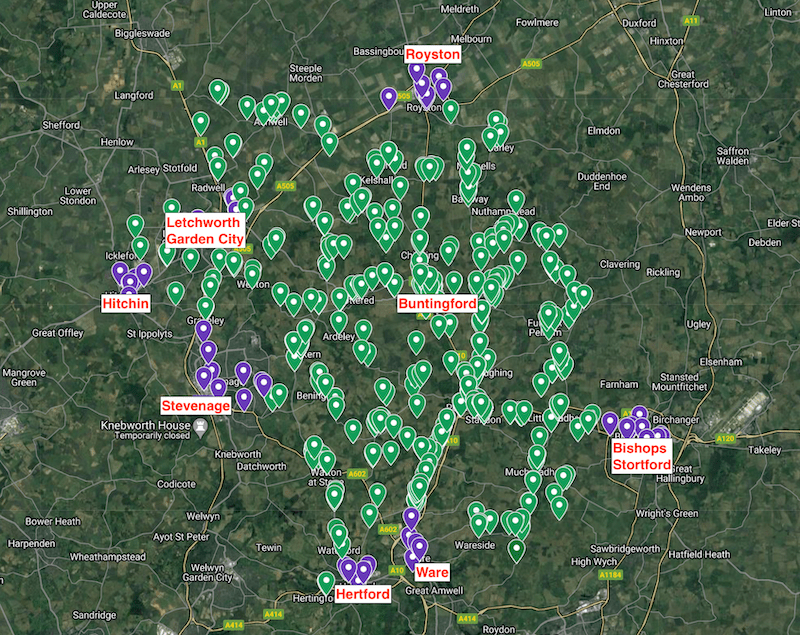
… and from 11th December a completely new scheme began serving villages in the Dacorum area in the west of Hertfordshire in a segment of the county west of the M1 and north of the A41 between Hemel Hempstead and Tring.
This latest scheme is operated by the Country Council itself with three minibuses based adjacent to Hemel Hempstead’s ‘magic roundabout’. I took a ride on Monday last week to see how the service is settling in.
As with the original scheme, the map shows stops in green where you can be picked up and set down as well as those in purple in the main urban areas where you can travel to and from a green stop but not travel within the towns with purple stops themselves.
The service operates between 07:00 and 19:00 on weekdays and between 10:00 and 16:00 at weekends and Bank Holidays.
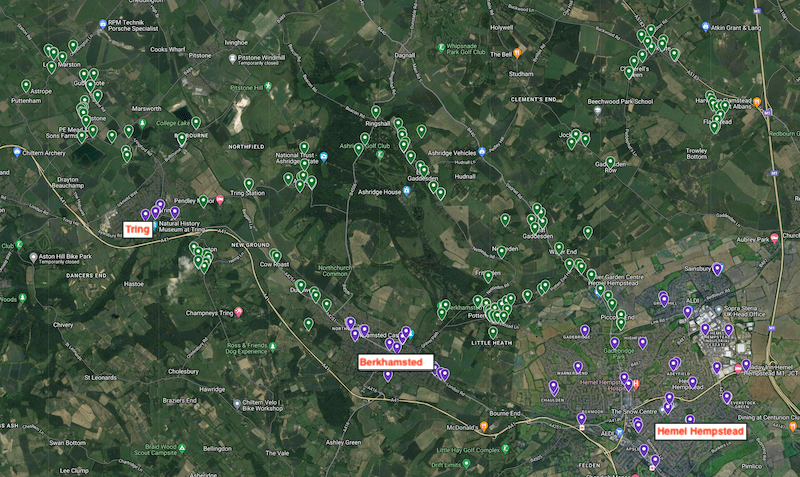
As you can see from the map above HertsLynx serves many of the villages in the area and gives access to Hemel Hempstead’s industrial area close to the M1 as well as other locations in the town and the commercial centre and stops along the A41 in Berkhamsted and Tring. The map below shows just how rural the area is outside of these towns.

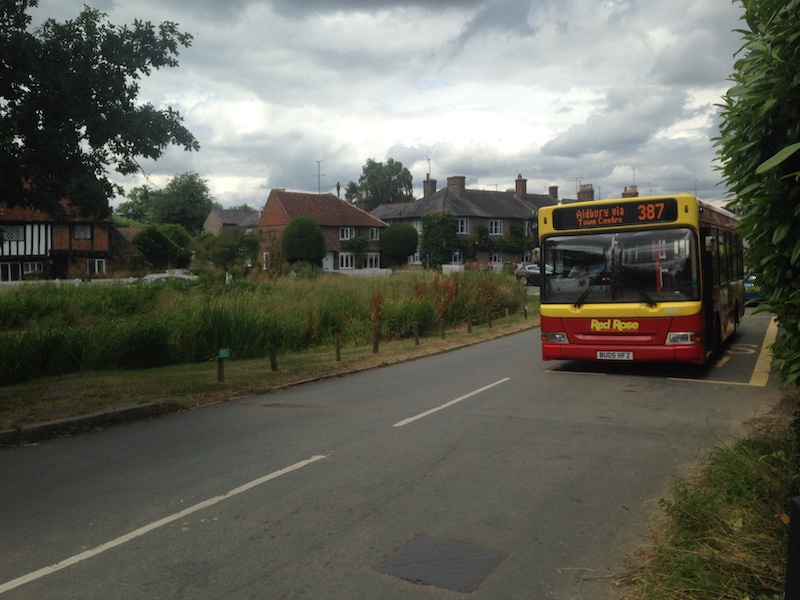
I booked a journey from Tring station to take me into Tring itself. This link is served by long established route 387 – a much loved former London Transport County Bus route to the village of Aldbury and its delightful pond – now in the hands of Red Rose Travel running every couple of hours.
My train from Euston was due to arrive at 11:02 and with the next 387 into Tring not due until 12:02 it seemed a good opportunity to see what HertsLynx would offer me. Booking on the app the day before, I was pleased to get an offer of a pick up at 11:18. Indeed, as you can see from the screenshots below, by scrolling across there were further pick up offers every 15 minutes (ie 11:33 and 11:48).

You can also see in the right hand image reference to the scheduled 387 at 12:01 (it allows a minute walking time to the bus stop) in line with the stated objective of not allowing HertsLynx to compete with scheduled bus routes….
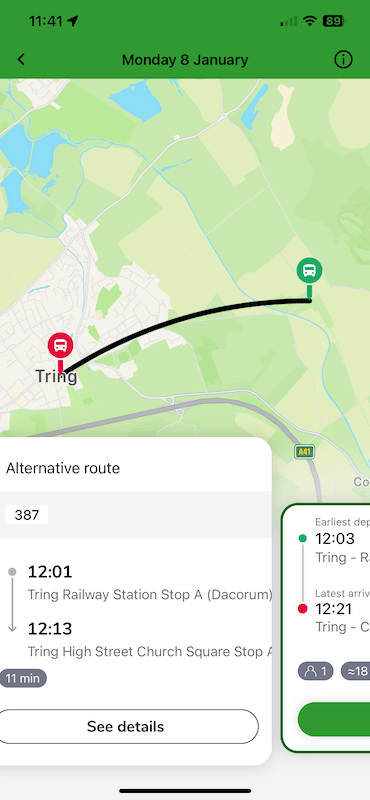
… except, it does. By scrolling to the next, up popped another journey offer at 12:03 in line with the 15 minute ‘virtual frequency’ (see above image).
Anyway, I settled on the 11:18 departure and looked forward to my ride.

Sadly there were signalling problems in the Harrow & Wealdstone area on Monday morning and my London Northwestern Railway journey got delayed. We left Euston 16 minutes late with further delays meaning a predicted arrival time in Tring of 11:23 was showing on the National Rail app.
I gave the HertsLynx booking telephone number a ring to see if the pick up time could be rearranged. There’s an option to press one for North & East Herts and two for Dacorum meaning the two schemes have different call centres – and spoke to a very helpful person called Peter who explained the bus had another trip after mine but he’d see if he could swap things around. After a while he got back to me to say he’d managed to reschedule my pick up for 11:28 and sure enough the app had been updated which was all very impressive, and proved the benefit of (a) having human intervention and (b) a poorly utilised DRT scheme.

We arrived into Tring station at 11:23 and Arjit was already waiting for me as it turned out he hadn’t got another job after me and was able to wait the additional ten minutes Peter had asked him to.

Arjit had previously worked in a warehouse and was looking forward to his new role as a HertsLynx driver which he began as the service started last month. He lives in Luton but wasn’t yet familiar with the area covered by the Dacorum scheme, in particular how to reach Church Square in the centre of Tring from the station. I said I could show him the way which he readily accepted as his SatNav would only work to give him the necessary instructions if he entered a postcode for the destination and I told him I didn’t know one for Church Square.
Six minutes later we arrived into Tring’s delightful High Street – made all the better by the A41 by-pass – and I bade my fond farewells and wished Arjit the best of luck with his new job.
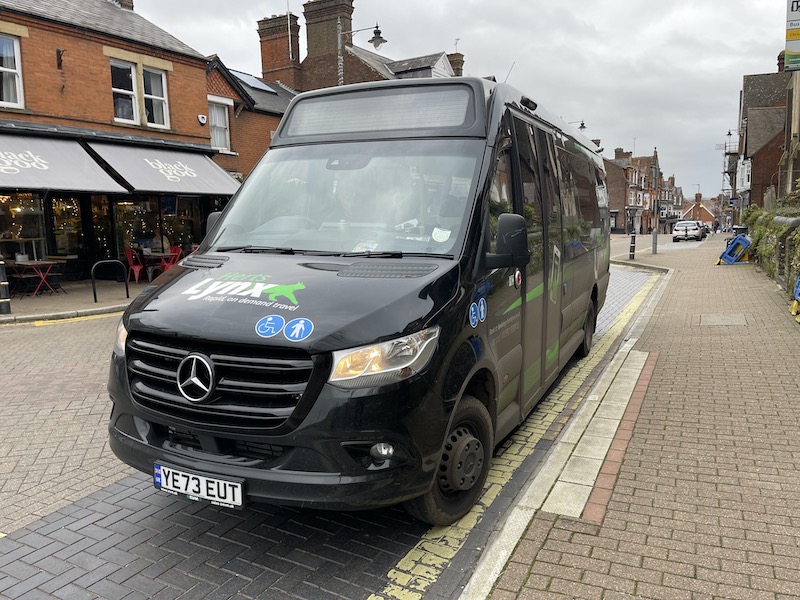
Leaving Tring on an X5 to Aylesbury about 15 minutes later I noticed he was still parked up waiting for his next job and I got the impression the new scheme is not overrun with booked passengers.

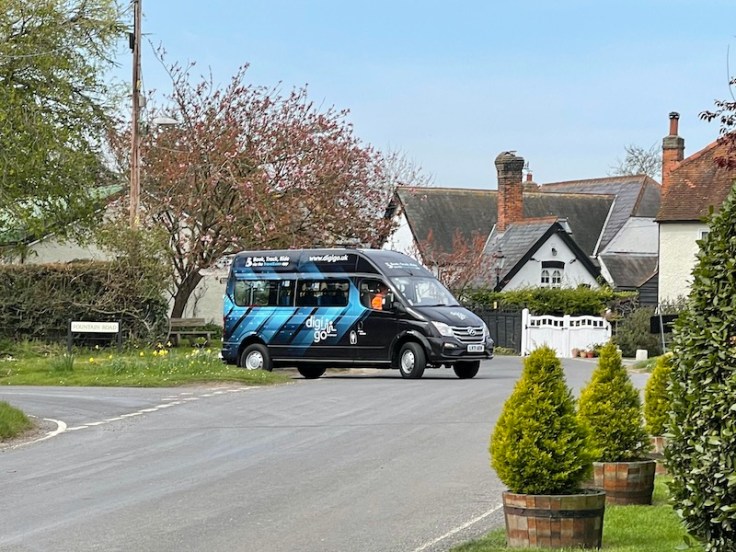
Other DRT developments in the news this month are in neighbouring Essex where the Council have announced the replacement of two fixed timetabled bus routes in the Braintree area (hourly 9/9A and half-hourly 21) operated by Capital Connect, Stephensons and Heddingham as well as a couple of one journey a week routes (345/SB21) operated by First Bus and Arrow Taxis by the County’s existing DigiGo DRT scheme.
The third development to report is more machinations at Cambridgeshire & Peterborough Combined Authority where its Transport & Infrastructure Committee has one of its bimonthly meetings tomorrow and among many things in the 379 page agenda and reports pack for councillors to read is the latest on its Bus Strategy Update.

This includes two reports written by the Authority’s consultants, Integrated Transport Planning Ltd.
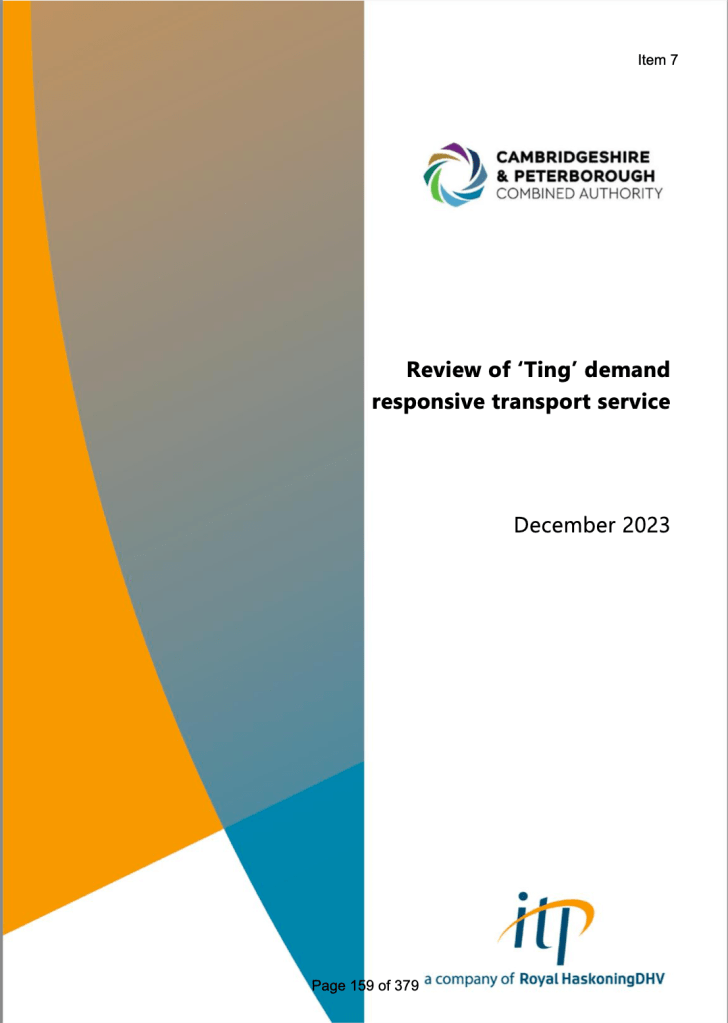
The first report, at 56 pages, is entitled “Future role of DRT in Cambridgeshire and Peterborough” while the second, at 40 pages is a “Review of ‘Ting’ demand responsive transport service”.

As you can see, it’s noteworthy the first report is dated June 2023 while the second is more recent from last month. This strikes me as the cart before the horse. It would be instructive for councillors to study the 40 pages setting out the results of what they’ve been funding for the past two years before considering what areas they need to extend the concept to next, and perhaps even pausing to ponder on whether such a move can be justified in any event.
For example, despite the Ting scheme being in operation since October 2021 at an annual cost of around £500K to the Authority, two key statistics in the second report are (a) the cost per passenger trip is £42.31 and (b) the vehicle utilisation is reported as being less than one person per vehicle per hour in the first six months of 2023.
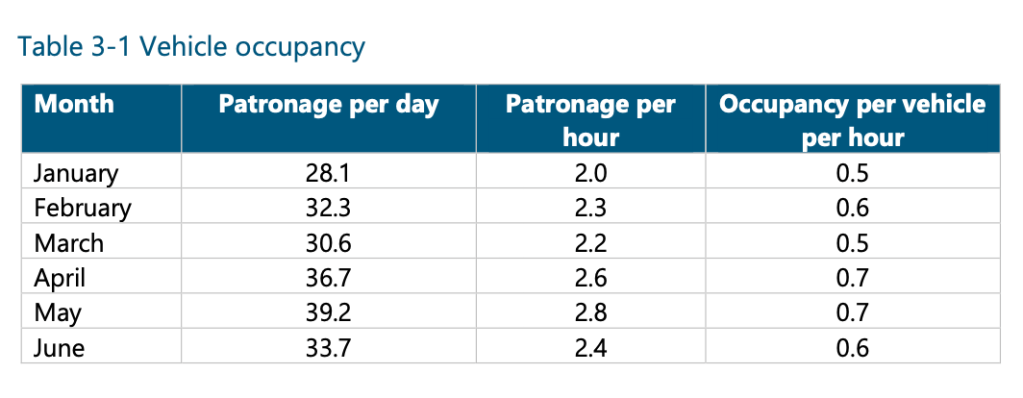
It’s like having your own personal chauffeur.

Other nuggets from the ‘Review’ include the fact that ”only 1 in 3 requests resulting in an actual trip being made” noting unsurprisingly that “trip cancellations and rejections are high” with this statement being a clincher “the service is characterised by low vehicle occupancy and a much higher cost per passenger than most supported fixed bus services…” (my emphasis) adding … “in addition the success of the service is hampered by its booking system and the user application”.
Despite this woeful situation , the consultants optimistically state “there is clear scope to improve the Ting service to grow patronage, increase useability, provide value for money for the taxpayer and set a basis from which the Ting concept could be rolled out in other parts of the CPCA area”.
Instead of pulling the plug after two and a quarter years of this farce the Report recommends various changes including dividing the operating area into separate north and south zones, restricting certain journeys to avoid abstraction from fixed route services, increasing fares and change the booking system. Oh, and “extend the contract duration to enable the service to grow and develop”.
Unbelievable.
Which brings me to the first of the two reports dated from last June in which Integrated Transport Planning Ltd recommend four new DRT schemes in Wittering, Wisbech, East Cambridgeshire and Longstanton as well as procuring an “areawide DDRT back office”.
The consultants reckon ballpark costs for each scheme involving two vehicles across a three year time period will be over £1 million (so £4 million if all four schemes go ahead) with fares income building so that in the whole of year three it will reach £1,000 a week covering just 12.5% of the costs.
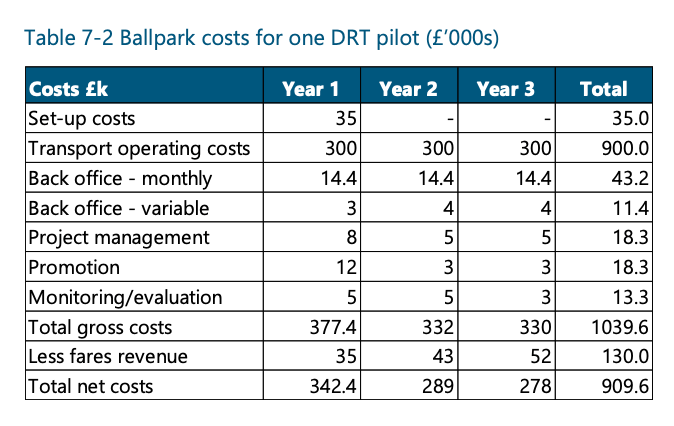
A £2 fare for a 12 hour day, six days a week, gives a vehicle occupancy of 3.5 passengers per hour, every hour on each vehicle. Based on the experience reported in the second report (as well as the DfT’s published review of DRT schemes elsewhere) this looks like fantasy expectations to me. But if the recommendation is accepted, there’s a whole gamut of work to be done in introducing the four schemes, evaluating their success, implementing further schemes, and even within 10-20 years “explore [an] option for driverless DRT vehicles in operational service” (yes, I kid you not) it’s all set out in the ITP report….

… and guess what, it’ll certainly mean consultants are kept gainfully employed.
When this report is considered tomorrow I just hope one of the councillors will remember the little boy in the Danny Kaye song ‘The King’s New Clothes’ who innocently pointed out rather than “the most remarkable suit of clothes ever seen” the King was “in the altogether but altogether the altogether he’s altogether as naked as the day that he was born”.
Roger French
Blogging timetable: 06:00 TThS
Comments are welcome but please keep them relevant to the blog topic, avoid personal insults and add your name (or an identifier). Thank you.
 BusAndTrainUser
ITP’s report says it’s a ‘Research Report’ . They have done so little research that the picture on the cover is of a real bus with passengers, and not one operated in the U.K. either. With Rogers other report Cambridgeshire is heading the list of wasteful projects, Ting, pointless bus route in Peterborough and wasteful station car park in the middle of nowhere.
But there is no stopping the DRT bandwagon at present.
LikeLike
In Essex the F312 which is a part fixed part variable route is being withdrawn and added to an existing DART service which already covers a very large area with one vehicle
LikeLike
So they intend to integrate DRT with home to school transport. That will mean zero chance of a booking during home to school travel times.
Driverless DRT as well that should be fun on narrow unlit rural roads . Pure fantasy I would say
It is clear beyond any doubt from the endless DRT schemes that they simply do not work. They are lucky if they average 1 passenger an hour and cost per passenger can range from £30 an hour to a £100 an hour
The last one to fail in Watford never reached anywhere near the fantasy passenger numbers they built into to the project
Why council think that keep repeating DRT will change the outcomes I do not know
LikeLike
If only the Councillors read Roger’s blogs.
MotCO
LikeLike
If only they read there own reports which clearly shows DRT does not work
I suspect the bus service the DRT replaced had lower costs and higher passenger numbers
LikeLike
A few thoughts occur to me:
a). Tring: Once again a poorly-used service – and a driver who doesn’t know the area he’s been allocated. Not his fault but not very clever. And it’s always baffled me why there isn’t a proper, frequent scheduled bus shuttle between Tring station and the town.
b). Cambs & Peterborough: I hope they look at the current absurdity whereby there’s no bus or DRT link between Manea station and the (expanding) village a mile or so away. Traveline actually tells you to get the train to March and a bus from there – an almost circular trip taking nearly 90 minutes! Graham L.
LikeLike
There have been many many attempts at a Tring Station – Tring shuttle (historically Route 387) over the years . . . right back to the heyday of the 1960s and early 1970s, when Tring Garage was still open. It has always failed, because there simply aren’t enough passengers. During peak hours, loadings used to be decent enough, but off-peak was another matter.
Since 2020, even peak loadings are insufficient . . . a double-deck car park is barely 50% full midweek, and on Mondays and Fridays even less so.
Tring itself, even after several building “spurts”, simply isn’t big enough . . . and which trains in which direction should buses connect with? Milton Keynes can be argued as being just as big a draw as London now.
Unless trains are timetabled to call at exactly the same minute in both directions, and unless bus drivers are specifically instructed to always wait for trains, any such service will be doomed to fail.
Ultimately . . . the only effective connecting service can be the ultimate DRT . . . a taxi!
LikeLike
Suffolk Katch. Not much of an update on it other than it is put as Ridership is still an issue
Now funded by East Suffolk Council. I doubt there pockets are very deep so without more funding I suspect it may go by the end of the year
Probably not helped by the very poor bus stop infrastructure in Suffolk
LikeLike
It’s a good job that Tring isn’t served by Ting !
(I’ll get my hat on the way out …..)
Petras409
LikeLiked by 1 person
Another excellent piece of work Roger particularly on the council’s reviews.
May I suggest that you undertake a similar update on the mother of all DRTs, WECAs Westlink which is experiencing all the issues you have uncovered but on a mammoth scale. ( 30 vehicle fleet)
I can’t help but feel that perhaps we have yet another case looming of gross misuse of public funding where the councillors / officers do not listen to the public and only the consultants and providers are the winners. In the meantime the public ( especially rural) suffer big time
LikeLike
Westlink woes:
https://www.telegraph.co.uk/news/2024/01/20/somerset-row-council-axes-bus-routes-villagers-stranded/
Peter Brown
LikeLike
May I direct the Editor of the satirical and investigative magazine Private Eye towards this blog and your others dealing with DRT? The Rotten Boroughs column features corrupt and incompetent Councils wasting taxpayers’ money.
Chris B
LikeLiked by 1 person
And another one begins in West Berkshire replacing a timetabled service,….. although it keeps 1 scheduled bus in each direction for scholars and commuters, so guess not on demand around those times.
https://www.bbc.co.uk/news/uk-england-berkshire-67987237
Steve
LikeLike
A couple of typos (sorry Roger):
London Transport Country Bus
Actual times at Tring were 11:23 and 11:28
Excellent report just the same.
Ian McNeil
LikeLike
Many thanks Ian; now corrected.
LikeLike
“The Emperors New Clothes” indeed! So wastefully extravagant are some of these schemes and their wild predictions of “future growth”, One almost wonders if there may be collusion between “Consultants” and certain Councillors ……but surely that could never happen?
The shortest paragraph in the blog certainly summed it up…..”Unbelievable”
Terence Uden
LikeLike
can I go off topic for a second. (or maybe not if you want to add sarcasm to things) Buses Magazine is celebrating its 75years of publication and there is a readers survey (on line for those subscribers etc signed up to get their emails), to choose your best vehicle from the last 75 years (which rules out the London B Type) 10 are presented but you can nominate your own , however there is no space to state why you have made your choice. Perhaps Roger can take a look and give a view, etc. I think one is the Mercedes 709D minibuses. I cannot recall if these were used on DRT in the past , perhaps someone can help me.
On the costs of 3 year set up there does not appear to be a realisation amount of sale of vehicles (or are they all leased,along with premises to work from), so that £1m+ cost might reduce down come Y4. As to why recent years DRTs have been under used , aside from the desire NOT to abstract from fixed routes, AND not being offered outside effectively 7am to 7pm and being used in essentially thin areas where I suspect a lot of people dont even run their car everyday, there has been a grand change in travel during, and after Covid so I think there might have been greater usage had the economic landscape not had the shocks of the last four years.
Finally a though , in rural areas, what happened to Post Buses ?
LikeLike
Another excellent blog Roger. Re Essex – their consultation reports have got them in a knot. The half hourly 21 is generally commercial. The (current) tendered journeys are early morning, plus evenings. So it’s these that are being replaced by DRT – hopefully….. Though if the DRT actually duplicates the commercial service all day it wouldn’t surprise me…….
Bill Hiron
LikeLiked by 1 person
Thanks Bill. It’ll be interesting to see what happens with the 21.
LikeLike
I think it should be a whole gamut of work, rather than a whole gambit, although given the risks they’re taking with taxpayers’ money, you may have been right the first time.
Keep up the good work,
Pedant of Hexham
LikeLiked by 1 person
Many thanks for spotting that. Now corrected.
LikeLike
Hampshire County Council (HCC) is a further local authority in England to plan swingeing cuts to its support of bus services because of a mounting financial crisis.
HCC has a budget shortfall of £132 million that must be met by April 2025. Its Future Services Consultation proposes the withdrawal of all remaining funding for passenger transport that it is not required by law to provide.
LikeLike
I’m grateful that Bill Hiron has clarified the situation re Service 21, I couldn’t make sense of what Essex County Council had said. It’s hard to see how changing the tendered journeys to DRT will make any significant savings. The current service is basically one vehicle on the move all the time so is very efficient in terms of vehicle utilisation.
I believe the earlier comment re “F312” should read F315 (Sudbury – Halstead).
Nigel Turner
LikeLike
Who knows what is the difference between the Essex Digigo and DART services ?
LikeLike
I believe that the Digigo service is directly operated by Essex County Council while the DART services are contracted. Digigo has electric vehicles so it might have been harder to find a contractor.
Nigel Turner
LikeLike
DRT is brilliant for those who are geographically and socially isolated, and has provided a very welcome transport option. There are also some great successes across the country where new users are changing their previous habits and taking DRT and more conventional bus services. Hurrah.
LikeLike
Example please
LikeLike
I think that Anonymous at 6.40pm may have their tongue stuck very firmly in their cheek.
Having looked at the Digigo terms and conditions I see that dogs are not allowed on board which has come as unwelcome news to my friend who is about to receive her first bus pass just as our real bus service is withdrawn. Is this common with DRT?
Nigel Turner
LikeLike
Thanks Nigel. But please be assured that they don’t – the huge difference DRT can and has made to improving accessibility is a game changer for so many in our communities.
LikeLike
DRT – one of those things that sounds great as a concept on paper, but just doesn’t really work in reality.
As Roger has pointed out in numerous articles, local authorities are receiving huge amounts of funding for bus service improvements, which consultants and ‘experts’ advise them to hand over to tech companies for an ‘app’ and the associated back-end control system software.
These DRT schemes come with huge setup and operating costs, and will never end up paying for themselves through passenger revenue, and thus are always doomed to fail.
When the scheme fails and is shut down, all that money is wasted, but at least the tech companies’ bosses and shareholders have been handsomely rewarded.
In my opinion, BSIP funding should be spent on actual bus services that run to set timetables, to support those that are not otherwise commercially viable. But equally this funding should also be used to encourage more people to use bus services, as it is passenger revenue that makes them viable.
DRT is no more than a glorified taxi service.
Stu (West Midlands Bus Users)
LikeLike
I wonder if you comment from a position of working within the local authority or DDRT arena and are sharing experience and knowledge of the “tech companies charges”? Because from my knowledge and experience the tech costs are not so very high. It’s all relative of course. And is there a problem with a glorified taxi service I wonder – if passengers find it suits their lifestyle, allows them to participate in society, let’s them access other bus and trains, and enjoy a quality of life many might take for granted that seems good to me.
LikeLike