Saturday 13th January 2024
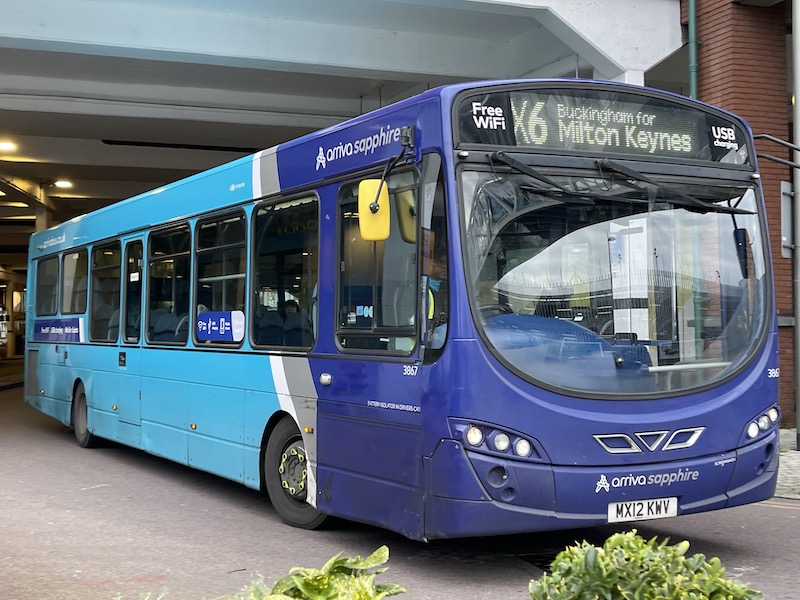
Arriva introduced a new ‘Connexions’ brand with a suite of changed route numbers using the X prefix for its inter-urban network based on Aylesbury this week.
It’s a very welcome step presenting a joined up route network with easy to understand timetables.

The first rule of renumbering is to have plenty of publicity available in advance and make sure bus stops and displays are all updated for day one.

Thanks to the hard work of Arriva’s Network Manager Matt King who’s masterminded the changes, having introduced new networks for Leighton Buzzard and High Wycombe last year, I was very pleased to see timetable booklets available on board buses when I had a ride around on Monday morning, the first weekday of the new arrangements.
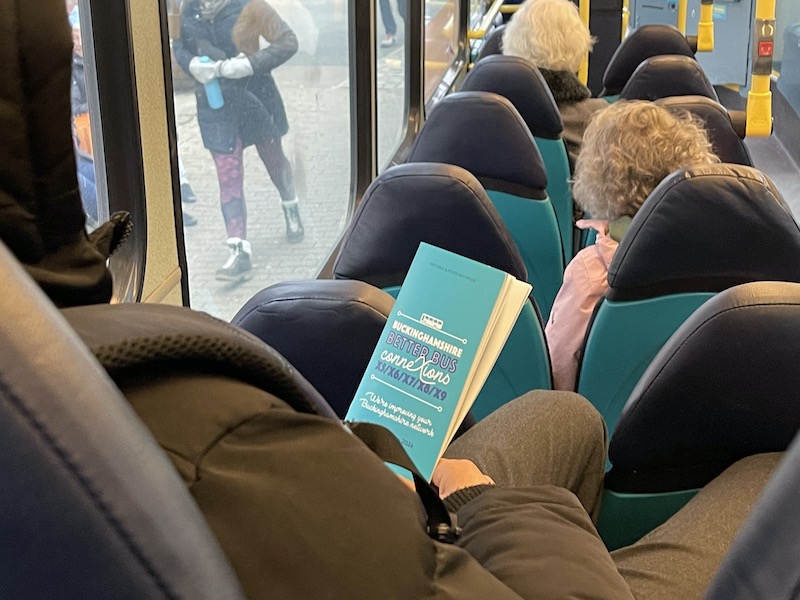
It can be quite a challenge to get local authorities to update bus stop displays in time, let alone soon after a Christmas and New Year shut down, so it was also impressive to see both Buckinghamshire and Hertfordshire had delivered in the areas where I travelled on Monday.
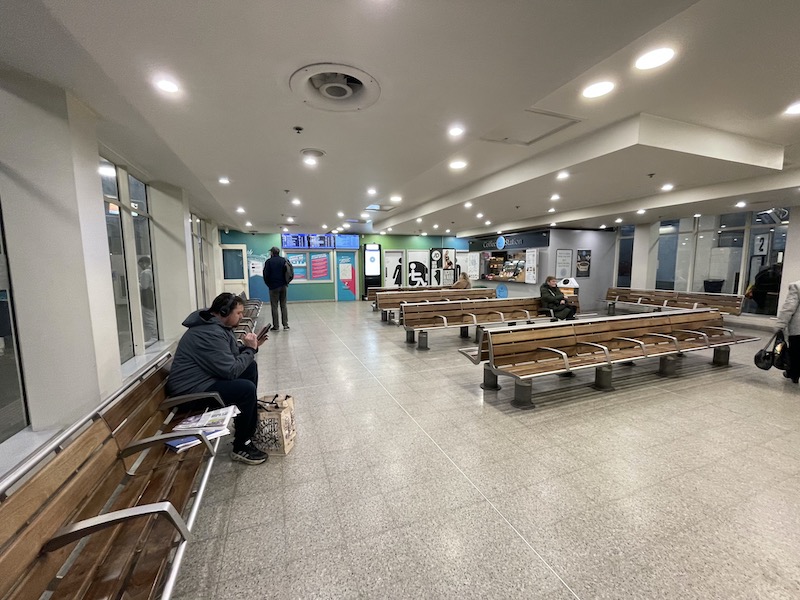
Indeed, the comprehensive timetable display in the waiting area in Aylesbury bus station was bang up to date (displaying proper timetables too)…

… as were all the bus stand departure lists and electronic signs.
There was even a listing and diagram showing which routes depart from each stand which might also benefit from being more widely posted in the departure area too as not everyone visits the waiting room.

Posters on display throughout the bus station showed details of the changes so passengers have been well briefed, which is good to see.

The only two minor niggles I could find was a wonky departure listing on stand 10 (I know; that’s really nit-picking of me) …

… and a poster on Arriva’s former travel office inside the waiting room still promoting the old route numbers but Matt tells me its replacement is in hand and just delayed due to the festive period.

As to the new route numbers themselves there’s always a debate among bus route number aficionados about the significance of using an X prefix and whether it means limited stop. Here, it’s aim is to denote the ease of making connections (‘connexions’) between the routes using Aylesbury as a node, not least as rail lines tend to be radial and this network is complementary to that.

The network comprises five main routes linking Aylesbury with neighbouring towns. The hourly X4 and hourly X6 both go to Milton Keynes via Buckingham and Leighton Buzzard respectively; the half hourly X5 to Hemel Hempstead; the half hourly X7 to Oxford and the 20 minutely X9 to High Wycombe.
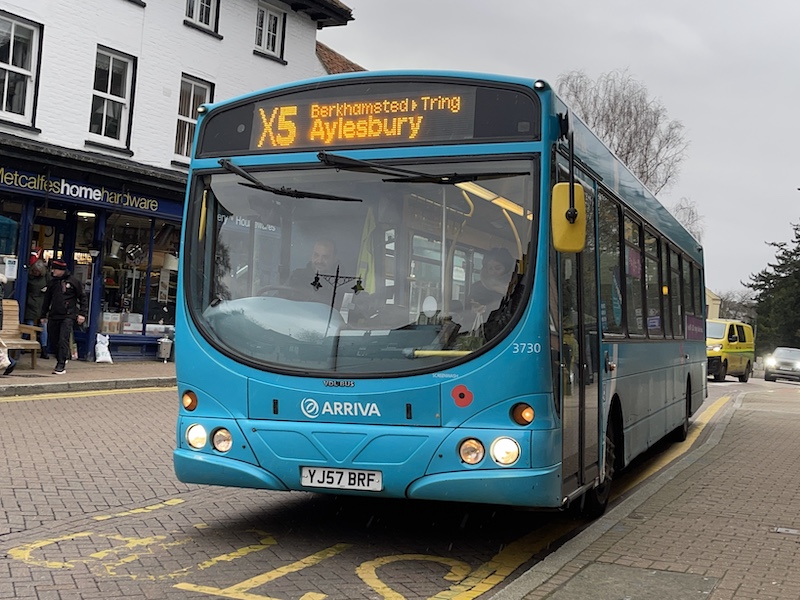
Former route numbers in the same order were 150 and X6 (Milton Keynes); 500 (Hemel Hempstead); 280 (Oxford) and 300 (High Wycombe) so you can see the new regime presents itself as much more of a family of coordinated routes which is what a network is all about.
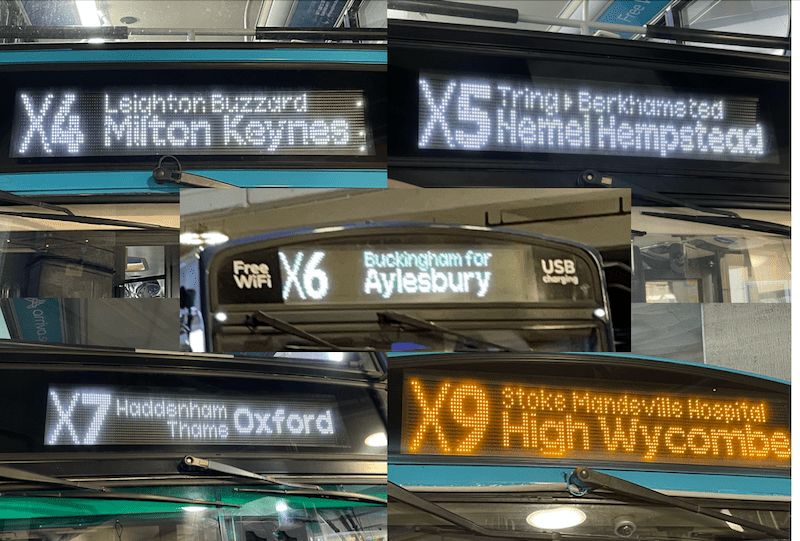
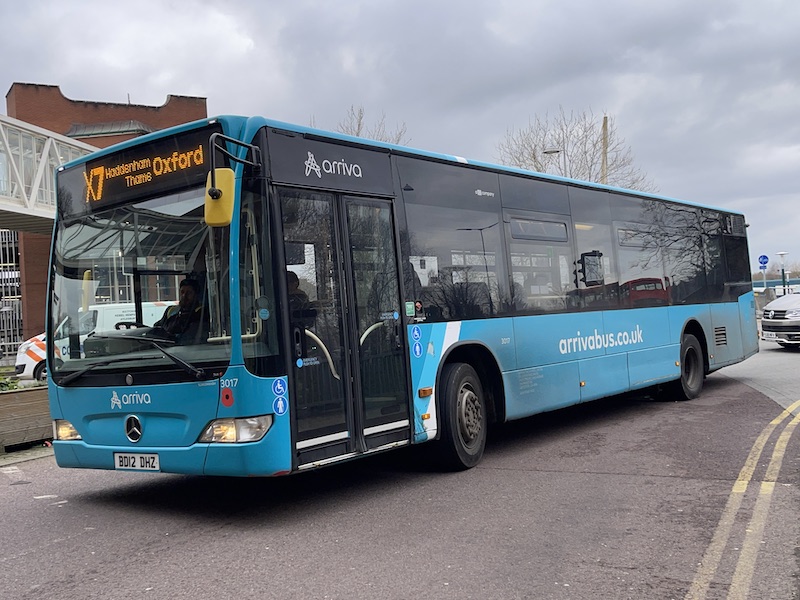
The use of the number X8 which had previously been for peak journeys supplementing the 280 to Oxford is now used for half hourly journeys between Thame and Oxford making for a 15 minute frequency (with the half hourly X7) on that section of this contested route.
Finally certain journeys in the peaks are speeded up and run as an X90 rather than an X9 to and from High Wycombe.

As well as competition from Redline on the Oxford corridor (it’s recently increased the frequency of its X20 to half hourly) the company also provides competition to High Wycombe with its 15 minute frequency route 130 while Red Rose operates hourly route 100 to Milton Keynes, albeit not via either Buckingham or Leighton Buzzard but via Wing and Fenny Stratford (which will feature in an upcoming ‘Every Route 100’ blog).

At one time Arriva was the dominant operator in Aylesbury but the ‘Red’ brigade now operate all the local services as well as nibbling at the inter-urban market.

I’m sure this latest initiative will go a long way to enable Arriva to fight its corner on these key inter-urban corridors and raise the profile of its network. I’m hoping Arriva’s piggy bank will be emptied to allow a full blown branding with a bespoke livery to promote the network very visually on the buses themselves as this will really help promote it even more to potential users.
It was noticeable how all the vehicles I saw had been stripped of any legacy route branding and now the Sapphire brand is a thing of the past a network like this is really crying out for a bespoke high profile attractive livery.
It was also noticeable how clean the buses I saw were despite the wintery weather on Monday.
There was a time not so long ago Arriva were keen to boast how the company was no longer producing paper timetables (typical ‘greenwash’ saving the planet PR nonsense) so it’s a real welcome turnaround to see an excellent timetable booklet not only produced in good time for these changes but distributed too.
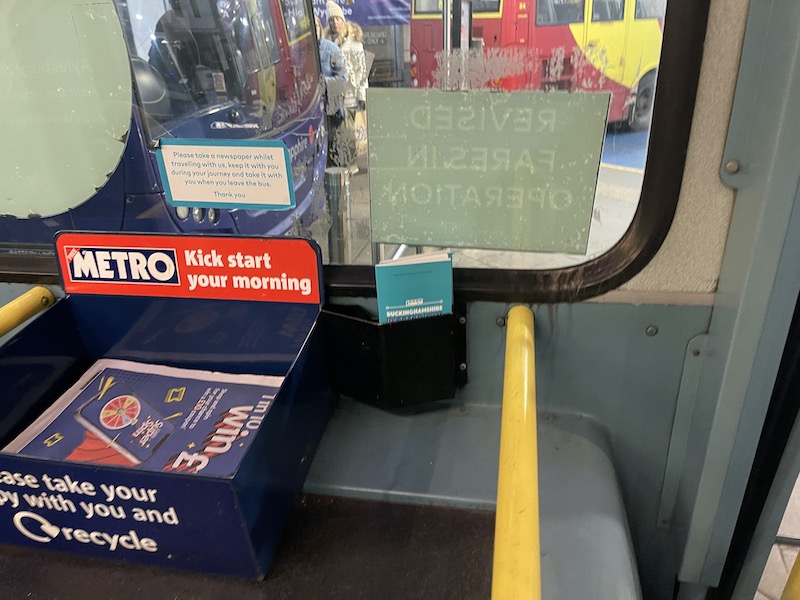
As well as timetables for the X routes the booklet also has a helpful map showing not only this newly promoted Buckinghamshire network but also its inter-urban routes in Luton Borough and Hertfordshire County.
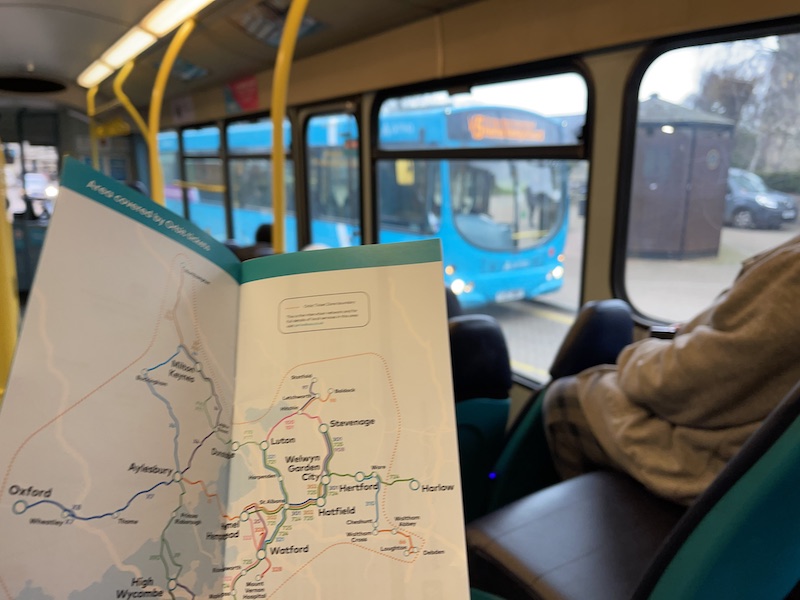
As has been covered in a previous blog, Hertfordshire County Council is establishing its own ‘Connect Herts.’ brand for inter-urban routes – another new route, the 323 between Hertford and Welwyn Garden City also began this week – which means the newly numbered X5 into Hemel Hempstead gives the County 3xx, 6xx, 7xx, 9xx and Xxx routes for inter-urbans. It looks like ‘Connect Herts.’ is going to have to do some heavy lfiting as a brand.

A couple of other number anomalies are over in Milton Keynes there are now two bus routes numbered X6 with Stagecoach’s Northampton X6 also using this number along with Arriva’s Aylesbury and on a Sunday, Red Rose Travel cover the route from Aylesbury to Hemel Hempstead (as a tendered operation) and continue to use the number 501 although it does continue on to Watford (as Arriva’s route 500 used to do at one time – and as the original London Transport Country Bus route numbered 301 did too).
Aylesbury is not the only location with a route renumbering this week. As recorded in a recent blog, Blackpool Transport also introduced a ‘reimagined’ (their word, not mine) network from Sunday, where I hope to pay a visit later this month.
In the meantime for Aylesbury, Matt King and colleagues involved in the town’s inter-urban network relaunch deserve congratulations for a job well done.

Roger French
Blogging timetable: 06:00 TThS
Comments are welcome but please keep them relevant to the blog topic, avoid personal insults and add your name (or an identifier). Thank you.
 BusAndTrainUser
I’m old fashioned. Rebranding seems to me an expensive exercise. I was happy in my youth just watching the bus actually turn up. And in the same familiar livery.
LikeLike
And the confusing route numbering continues with the Prefix X being used for everything and anything. In this case it can mean an Inter Urban service or a limit stop service. To my mid the Prefix X should always be limited stop, If it is not a limited stop service do not use the X. It appears as well the duplication of route numbers for different routes continues as well
I agree thar route branding is just a waste of time and money. They rarely keep to the correct routes in any case. It ca make sense for special services such as open top tourist buses but that’s about it. Even dafter is routes that have names rather than numbers
LikeLike
One of the unfortunate side effects of the £2 maximum fare is that it amplifies the interchange penalty for changing buses.
This appears to be a great initiative and I wish it well. Good to see operators working with local authorities and updating printed materials in advance.
I would describe the timetables as marketing materials as they are the final piece of the jigsaw. Once work has gone in to understanding existing travel flows, frustrated and potential travel flows and how these can be best and profitably served then the opportunity to sell the destinations available and how to there should not be missed.
Gareth Cheeseman
LikeLike
Ah – memories of the first LT Country Area route I ever used, the 301 from Aylesbury which had RT buses and was worked – at least in part – from Tring (TG) garage.
At that time there was also the 61 from Aylesbury to Tring, Dunstable and Luton, operated by United Counties with new FLF Lodekkas.
Ian McNeil
LikeLike
A shame they’ve moved route numbers to the offside on the front destination display, making them harder to read for passengers from the kerbside. The route number is what people look for when a bus is approaching so that should be closest.
LikeLike
Couldn’t agree less with this – offside is the right and correct position for route numbers. If you need to read a route number from the kerbside just in front of the bus – such as when it’s in a queue of buses at a stop – the bodywork often obscures some (or all) of a nearside route number. An offside one remains eminently readable from this position, and is far more useful.
Mike
LikeLike
For a moment, I thought the bus in your photo of route X6 was carrying ‘all over’ branding for the London Oyster card: the colours are almost identical!
Carllo
LikeLiked by 1 person
I always think route renumbering is pointless and confusing for the public, who are used to familiar numbers. I always remember Kentish Bus and their renumbering in the late 80s – independants came in with routes in competition using the traditional numbers.
Using ‘X’ for non-express services is also a mistake, as ‘X’ signifies express services everywhere else. Another confusing change for the public. I do find Arriva tend to be out of touch.
LikeLike
If the routes are centred on Aylesbury, why not number the routes A5, A6 etc. TfL use this method for their prefixed routes – C for Chelsea, E for Ealing, R for (O)rpington ( or Roundabout, the original brand name) etc.
MotCO
LikeLike
Most I think are inter urban routes rather than town routes . The old LT used to have fairly sensible numbering of routes
1 to 299 for London Bus Routes
300 to 399 for London Country routes North of the Thames
400 to 499 for routes South of the Thames
700 to 799 for Greenline
500 to 699 for Trolleybuses
LikeLike
Well, nearly. The allocation until 1962 (when trolleybuses ended) was 1-299 Central Buses, 300-399 and 801-849 Country Buses northern area, 400-499 and 850-899 Country Buses southern area, 501-699 Trolleybuses and 701-799 Green Line Coaches. From 1966 501-599 was used for Red Arrow flat fare routes in central London. (Not all the numbers in some of these blocks were ever used.) From 1970 this system slowly decayed after the National Bus Company had taken over Country buses and Green Line Coaches. Congratulations on a very informative blog, by the way.
LikeLike
Hello, Roger, Interesting piece about Arriva in Aylesbury, thank you. You may have picked this up already, but Arriva in the north east are introducing a new service (funded by BSIP) between Morpeth and Newcastle Airport. Links from the airport by bus are poor and Metro is the principal provider. The new service is numbered 777 and begins on January 28th. Kind regards, Alex
Sent from Yahoo Mail for iPhone
LikeLike
Not convinced by the X numbering. It may be lovely for Arriva to think they’ve got their own network, but for me the network involves all operators wherever I happen to be and a single X prefix route is pretty meaningless in Leighton Buzzard for instance. Meanwhile in London, TfL (or possibly the Mayor?) thinks that SL is the best way to tell passengers that a route is limlited stop.
Andrew S
LikeLike
Interesting blog post. Good to see awareness that they are running a network and not just a bunch of individual routes. Passengers should be able to easily travel form any point to any other point on a network, that expands the market for the operators and the attractiveness to the user. The rail sector (national rail, metros, trams) always operate this way.
Peter Brown
LikeLike
“Passengers should be able to easily travel form any point to any other point on a network”. Try doing that in Cardiff where, in the continued absence of a bus station, termini and stops are dotted all over the city centre.
Andrew Kleissner.
LikeLike
To my mind an X service indicates ‘express’ with limited stops however I doubt the average passenger votes or knows as all they want is a bus to turn up around the time shown in the timetable.
LikeLike
Apologies should have added Tony Burns.
LikeLike
In Cardiff, Adventure Travel used the X branding (including livery) for their Cross-city (get it?) route X1. That was a bit confusing as, for instance, the X in Newport Bus’s X30, which joins the two cities, means “express”. The X1 has now become the C1, in line with Adventure’s other routes. That’s sensible.
Andrew Kleissner.
LikeLike
The 61 operated by Arriva(Aylesbury depot I believe) was still fairly popular and still operated generally by double deck buses, until the Bus Way opened in Luton, but then it got cut off in Dunstable and became Dunstable to Aylesbury via Tring. I don’t believe Arriva operate the remaining route anymore.
LikeLike
From the Central Beds (Council) web site along with the announcement of these routes.
“Uno Routes C1, C10 and C11 (Milton Keynes – Cranfield – Bedford) – Update
The proposed change to this route from 7 January 2024 has been postponed, the previous timetables will continue to operate until further notice. Timetable displays at bus stops and shelters had already been changed to show the new timetables so these are not currently correct.”
Damned if you do and damned if you don’t!
LikeLike
Customers are so very confused in Milton Keynes at.the moment with the X60 rebranded to the X6 simply because Stagecoach have a service X6 which goes to Northampton…..not practical to have a the same service number run by different operators
LikeLike
I’m sure the NBC could have sorted that out.
KR.
LikeLike
Pity the rebranding info didn’t reach the Oxford area, resulting in my 80 year old neighbour waiting over 1 hour in the freezing cold in Oxford for the 280 as no info at stand saying this was now the X7. Finally gave up and caught the 400
LikeLike
The Omen666 I have traveled from Hemel Hempstead to Tring since 2005 for work. Service 500 as was until January 2024 has always been I bad service especially in the evening. By changing the Service number to X5 will not make it a better service or more reliable
LikeLike
The updated stop flags and timetables in Aylesbury are quite a contrast to Watford. There the bus stops are still displaying numbers for routes that disappeared nearly two years ago.
The 500 has always suffered from poor timekeeping due to congestion. Unless the route has a more realistic running time I don’t think a new brand and route number will make much difference.
Keith
LikeLike
All good stuff, though Aylesbury’s subterranean bus station is awful (or was last time I used it). And though there’s a nice screen display outside the railway station, showing the upcoming bus departures from the bus station, there’s nothing to tell you how to get to it….. Graham L.
LikeLike
One can partly sympathise with Arriva in Aylesbury, as the former network was a horrible mis-match of inherited route numbers from former LT, UCOC and Oxford operations, not to mention former subsidised service numbers such as the 501. But many passengers have only known a particular number for years and a radical change to an “X” prefix, whilst a nice tidying up exercise, really only causes confusion. And perhaps someone should have looked at other Operators numbers when planning….
Branding may work on urban services, although the cost far outweighs any benefits, but just causes operational difficulties on an inter-urban and rural network such as this. Impossible to route bound vehicles with such a small allocation.
The Aylesbury subterranean bus station is cramped, but does have a good waiting room, toilets, tea/coffee bar and direct access to the shopping centre, so better than most.
Terence Uden
LikeLike
Arriva don’t care about passengers in Milton Keynes except those travelling on the Bletchley – Wolverton corridor so I can’t imagine they would care about any confusion caused be renumbering their X60 to X6
IanD
LikeLike
Just need an all-day ticket to avoid the £2 interchange penalty. They could call it a Green (or Blue) Rover. Maybe have one valid on all Arriva Home Counties services (Golden Rover?).
LikeLike
There is one that covers the Herts,Beds, Bucks, Berks, and Oxon end of the Home Counties. The Orbit.
There is also a All Zones ticket which also adds Essex
J
LikeLike
My personal few is that route branding is a waste of time and money and makes life difficult for the garages
I want a smartly tuned out bus with a clear route number and at least the final destination
There is an argument that router branding increases passenger numbers. I think this is down to a misunderstanding. Yes in many cases when a route is branded passenger numbers do increase but that’s usually down to investment in the service such as new buses and a more frequent service and not the branding
Across the UK we can see the shambles of the many route branding attempts with branded buses appearing on random routes
LikeLike
Do you really think that the Exmoor Coaster would be the success it has been if the open toppers simply wore First livery rather than were branded? Or the 36 to Leeds was simply just red and cream.
Branding does work, but it’s all part of the product mix. The right product (type of bus, comfort, frequency and, above all, reliability) delivered at the right time and at the right price. Good marketing can’t save a duff product and so slapping on some branding is not going to be a silver bullet.
That vehicles in some firms routinely don’t appear on the correct routes indicates that many other things are also wrong in terms of service quality.
BW2
LikeLike
Branding Open Toppers can make sense as it is highly unlikely they will ever appear on a different route. ASS for the 36 who cares what colours it is. IT is successful because it is high frequency not for he colour it is painted
LikeLike
Ipswich Buses used to have an Atlantean open-topper for its town and coastal summer services. I presume that it was only licensed for 6 months out of the 12, but it quite often appeared on town routes (usually 9/10) on sunny days in the early summer, before the tours etc started. And just last year I saw Cardiff Buses open-topper working on the “Baycar” route 6 rather than its usual route to Penarth.
Andrew Kleissner.
LikeLike
Done well, and that’s the important point, branding and marketing can be a real benefit.
My point about the open toppers is do you think that had they have been painted in standard First livery, or dealer white, that they’d have been as successful. Those, and those on the 36, are acting as massive moving billboards. Of course, a nice livery beloved of enthusiasts isn’t a guarantee of success – far from it – but do we really think that marketing doesn’t have a role in attracting passengers?
As I said, the product mix means that the 36 isn’t just successful because it is frequent. In fact, it is much more frequent because Harrogate and District (as was) invested in more modern fleet and then began to market it effectively and that created the virtuous circle of being able to increase the frequency etc. Some of the other stuff, like on board libraries, is a gimmick but why is that a bad thing?
What marketing and branding can’t do is redeem a bad product. So for this to work in Aylesbury, Arriva will have to ensure that the buses are reliable (turn up on time and run to schedule), are clean and comfortable, operate when people want/need them, and then you can market them – that’s the marketing mix.
BW2
LikeLike
X7 service is as bad as the 280 it replaced. Cancellations at short notice, unannounced early arrivals and so on. X8 runs Oxford to Thame so stops short of connecting with the Haddenham and Thame rail station. Why?? Makes no sense to stop short of a stop with a good supply of customers.
LikeLike
Because needing another bus to do so is not going to generate the £200k additional fares to cover it.
Dave H
LikeLike
Not serving railway stations seems to be a missed opportunity
If good frequent and reliable bus services are provided from residential areas to the rail stations I think hey will get the passengers
Parking at rail stations can be difficult and expensive
LikeLike
No evidence of that whenever it has been tried, and it has been tried repeatedly. Rail Stations may bring in some extra income if you can serve it as part of something more but there is little evidence that a rail station can generate enough passengers to pay for even a single extra PVR all day. Generally any demand is very ‘peaky’ and as commuter focussed tend to be earlier than a normal bus day so extra cost & unpopularity with drivers due to earlier starts & later finishes impacting recruitment or pay.
LikeLike
I would suggest that’s because it hasn’t been done properly. Time and time again this blog highlights poor information provision, lack of simple wayfinding to buses from rail stations.
Serving rail stations is the standard operating model in The Netherlands, Switzerland, most European countries. Some good examples in the UK, Bath for example has its bus station alongside the rail station.
Verdict: must do better UK.
Peter Brown
LikeLike
I wonder if Connexions buses in Yorkshire know about this, and how well they have protected their brand….
From Delenn
LikeLike
I doubt they care (especially as they have borrowed other peoples brands before) look at how many different Coastliner / Coaster brands there are for instance.
LikeLike
Go South Coast have been using the X prefix for their cross-country routes for many years, so I don’t see what the issue is here. Personally I find it rather neat. Besides, true limited stop routes (which apparently are more deserving of the X prefix) are rare these days as such routes don’t bring in the revenue like an all-stopping service does.
LikeLike
I cannot find timetables for the new “X” services on either the Arriva website or the App – it might be my inability to use the correct search terms, but I doubt it. In fact the App does not recognise the new “X” numbers or, in most cases, the old route numbers. Crazy.
However, if one searches a particular journey on either platform then the “X” services are shown.
LikeLike
Changing the numbers doesn’t improve the horrible service. Maybe actually making sure the buses are on time and not 40 minutes late would be a good start. Or making sure there is a double decker during busy school runs so the bus isn’t horribly overstuffed. (X60/X6)
LikeLike
How AI is helping to prevent three buses turning up at once
Mr Pearson says that it has resulted in 20% more punctuality during some peak periods, and that the firm is now rolling out the AI across all its UK routes. However, this level of improvement has not been enough to satisfy passengers in some of the trial locations, who report that the bus services remain irregular.
LikeLike