Thursday 11th January 2024
London’s most bizarre bus route

There wasn’t a cake and a candle to mark its first birthday, but there was definitely a celebratory atmosphere among the passengers and driver on board London’s most bizarre bus route yesterday morning.
The one journey a week Rail Replacement bus service for Chiltern Railways between West Ealing and West Ruislip has just clocked up its first 12 months of operation and BBC London was on board to mark the event.
Reporter Harry Low had got in touch to ask if I’d join him on board the bus for a live feature into Eddie Nestor’s morning radio programme during the journey and how could I turn down an invitation like that?
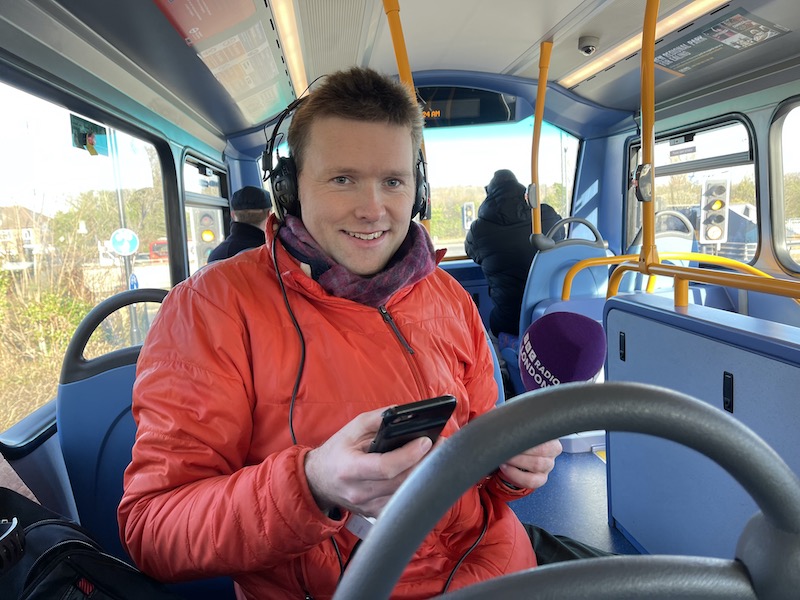
I nearly didn’t make it though. Despite leaving plenty of time, a broken down Elizabeth line train at Acton Main Line was causing delays in excess of half an hour for westbound trains with my train caught up in the chaos leading to the inevitable station skipping (including West Ealing) once we were on the move again.
Thanks to a trusty black cab ride from Ealing Broadway I arrived in the nick of time for the 11:17 departure from the bus stop in Argyle Road round the corner from West Ealing station.
Harry had positioned himself on the railway bridge about 50 yards further south to get good footage of the bus drawing up and after a bus on the E7 had departed there were three other likely looking passengers waiting at the bus stop recognisable by that knowing look you give on first sight to fellow nerdy bus riding professionals on once a week rail replacement bus journeys.
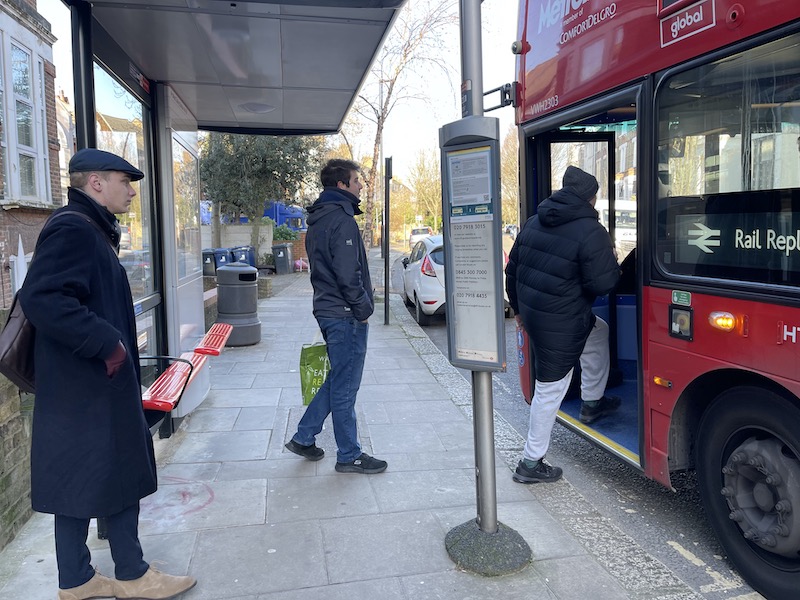
And just before 11:17 the Metroline bus duly appeared with Tommy in the driving seat and we all got on board.
Tommy works in Metroline’s schedules office at Cricklewood as his main job but shares the Wednesday Rail Replacement Bus driving duty with another office based colleague, each taking a turn fortnightly.
Metroline took on the service from Stagecoach last October following a revised timetable on the Oxford Tube rendering the timings impractical to continue. It’s now slotted into a vehicle working at Metroline’s Perivale bus garage which does peak hour journeys on other routes, so a nice cost effective set up, and way cheaper than running a train.
Tommy welcomed us all on board with a very professional announcement over the bus public address system confirming the stations we’d be calling at along the way (obviously none) and our destination being West Ruislip. It was very rail like and all we missed out on was a refreshment trolley.
As we set off Harry set about interviewing fellow passengers while he handed me over to Eddie Nestor live on air at the BBC’s New Broadcasting House leading to a wide ranging enjoyable conversation about the bizarreness of the whole thing as well as other topics including favourite London bus routes, the different Routemaster buses that once ran, Lord Peter Hendy and Leon Daniels owning preserved buses, other bizarre transport topics (Imber, of course) and before I knew it, we were arriving into West Ruislip twenty minutes later.
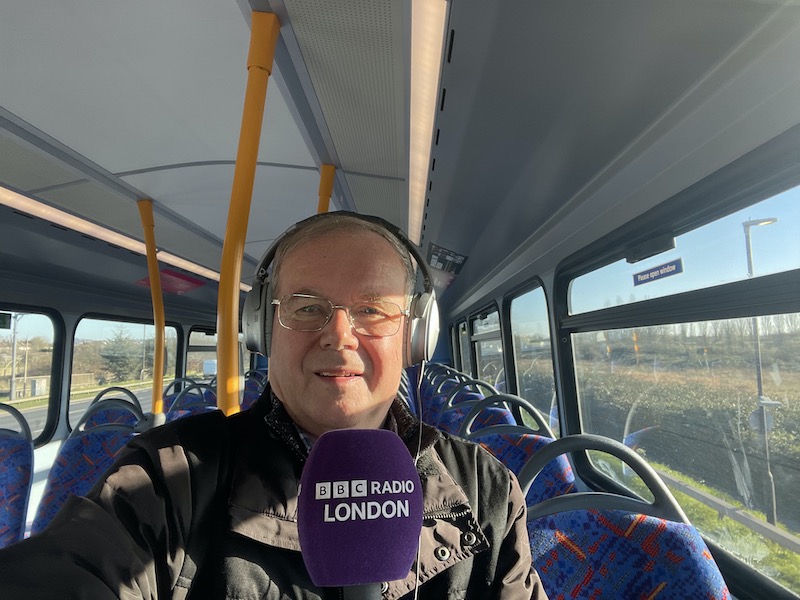
Tommy kindly held on at West Ruislip to enable Harry to complete all his interviews for the BBC London Evening News programme on BBC One including with Tommy himself who’d made the whole anniversary experience very special before heading back to Perivale.

Metroline’s contract to run the journey lasts until the end of May as there’s talk the Chiltern Parliamentary Train could return with the May timetable once the imminent works to install battery charging equipment at West Ealing are complete enabling GWR to start running its Class 230 trains on the Greenford branch.

Personally I doubt that’ll happen. It’ll just add to the costs and be a more expensive waste of money. At least the replacement bus, bizarre though it is, is a cheap waste of money.
Obviously what really should happen is the Parliamentary procedures are enacted to “close” the line which, in practice, thanks to HS2 is already severed towards Old Oak Common and impossible to use. But there again, the bus is probably cheaper than even that bureaucratic administrative process to enact a formal closure.
So, here’s to the second Bizarre Bus Birthday in January 2025.
London’s least frequent bus route (was) under threat

Meanwhile on Tuesday I was pleased to join my friend Geoff as he made a video about London’s least frequent bus route (that’s aside from school, night, former mobility and bizarre rail replacement bus routes).
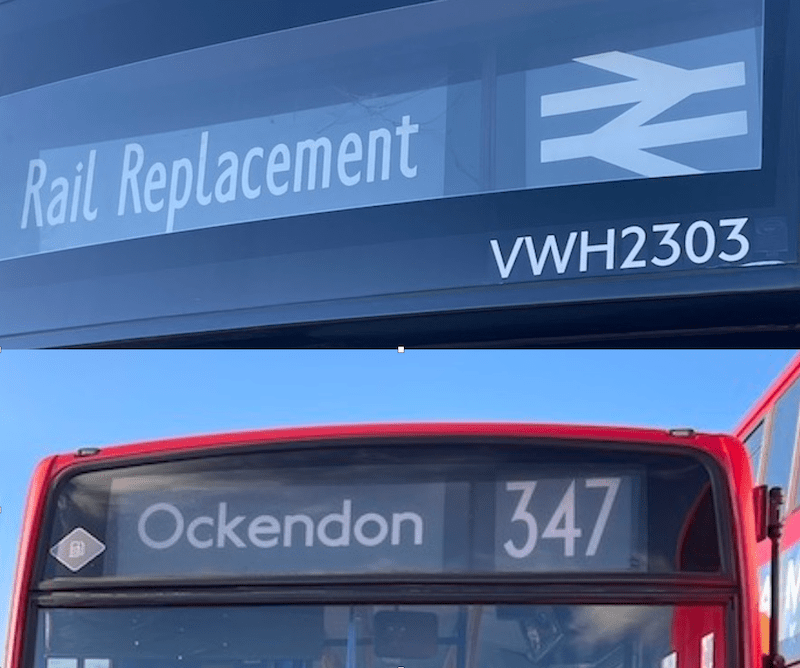
It’s the Arriva operated route 347 which runs only four return journeys on Mondays to Saturdays between Romford station and Ockendon station, the latter located just over the Greater London boundary in Essex and outside the M25.
And there’s no hint of an AI derived timetable here with easy to remember departures on the hour from both ends of the route (09:00, 11:00, 13:00 and 15:00 from Ockendon and 10:00, 12:00, 14:00 and 16:00 from Romford) making for a one bus operation and a 46 minute journey time.

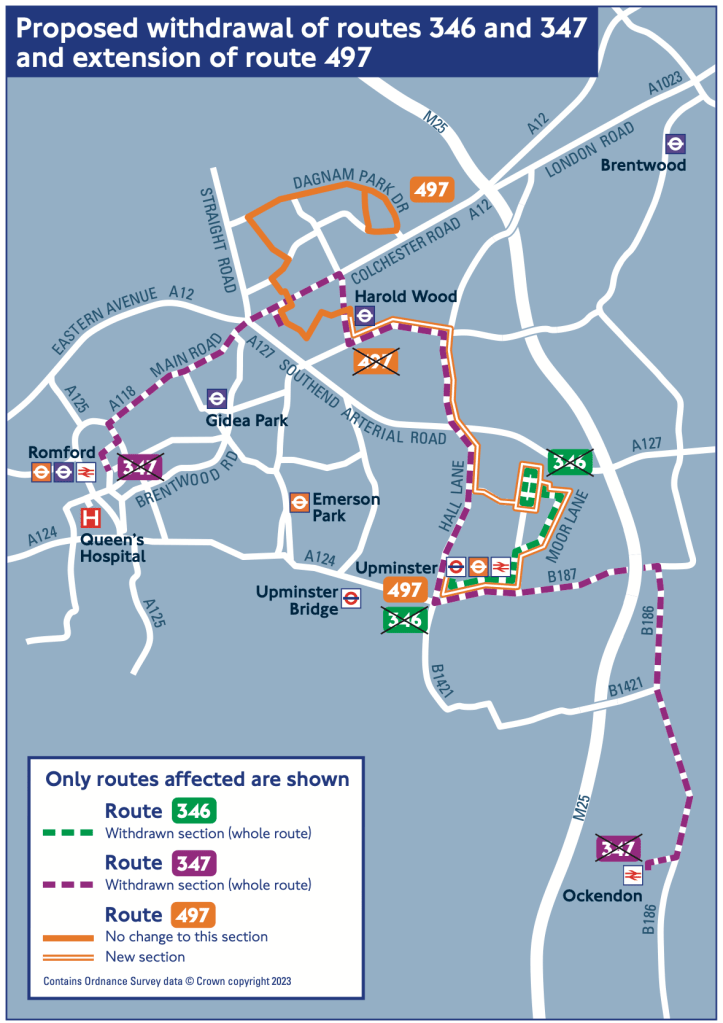
As well as the oddity of experiencing a journey on TfL’s least frequent bus route, we wanted to take a ride as the 347 has been under threat of withdrawal following a TfL consultation launched early last year which also proposed changes to two other routes (346 and 497) in the Upminster area but leave sections of roads used by the 347 between Upminster and Ockendon completely unserved, albeit they’re sparsely populated.
It was going to be interesting to see how many passengers would be left without a bus on the route’s withdrawal.
You can see the answer in Geoff’s video now available on YouTube here but in a very timely move, it was announced yesterday, 24 hours after our trip, route 347 has been reprieved (albeit still being kept “under review”).
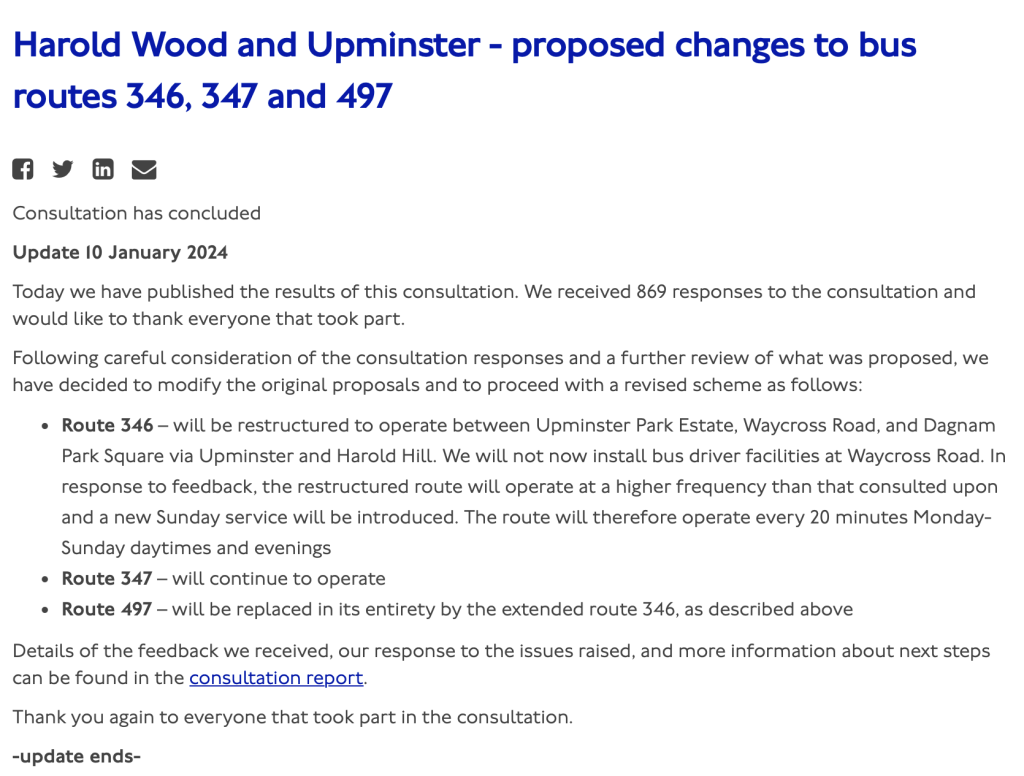
Also the 346 will be extended from Upminster to Harold Wood then take over the 497 route every 20 minutes to Dagnam Park Square rather than the 497 taking over the 346 as proposed. Either way, this new 20 minute frequency includes part of the current route of the 347 (between Upminster and Harold Wood) which currently only has four journeys a day, so a somewhat substantial uplift.
You might be as surprised as I am to see this significant uplift, and the 347’s reprieve, when you watch the video.
Anyone would think there’s a Mayoral election this Spring.
Following our success with last Autumn’s Travelcard video which not long after uploading saw TfL announce the popular ticket would be reprieved, this latest experience just goes to show, if you want a withdrawal threat removed …. who you gonna call?
Geoff and Roger.
Sorted.

Roger French
Blogging timetable: 06:00 TThS
Comments are welcome but please keep them relevant to the blog topic, avoid personal insults and add your name (or an identifier). Thank you.


At West Ealing the battery charge kit is already in place – including graffiti on the power supply containers. I suspect it just needs the 230 to be brought down from Long Marston for it to be tested to confirm it works
If the train was to be reinstated; it will need all of Marylebone Drivers to be retrained on the branch due to the fact as of last May, are out of route knowledge; but it would be just as quick to go through the service removal given its possible to make the journey by GWR and Central Line
LikeLike
Tony Barnfield: Most enjoyable post, Roger.
LikeLike
When money for public transport is tight this is a complete and total waste of money. In the grand scheme of TfL’s budget it is a small amount but it is money that could be saved
LikeLike
Essex Tendered Routes
Final decision on which routes stay and which are being axed. What logic there is being them who knows. One of the routes with the highest number of comment is being axed yet other that had minimal responses are being kept
There is no real review of the routes I suspect it is more a cost cutting exercise
https://cmis.essex.gov.uk/essexcmis5/Decisions/tabid/78/ctl/ViewCMIS_DecisionDetails/mid/422/Id/9815/Default.aspx
LikeLike
Being curious, I looked up bustimes.org to see how the Metroline bus was shown on that site during its Parliamentary trip yesterday. As I expected, it wasn’t shown at all.
Nor was there any trace of peak hour journeys on other routes which it might have undertaken. So as far as bustimes.org is concerned, the vehicle spent the whole day off-grid.
Ian McNeil
LikeLike
No reason why it should be on bustimes, as it’s a train, not a bus. It is on realtimetrains, as are all scheduled rail replacement buses, but of course that only shows the timetable times, not the actual times, because as it doesn’t actually run on rails the train tracking system doesn’t know where it is.
There’s a disconnect here: we can track buses, we can track trains, but we can’t track rail replacement buses.
There would appear to be an opportunity for a crossover. Get the clever bus tracking software to track the rail replacements and send the data to the train tracking software which can use it to update the replacement bus times.
Getting that to work should keep the techies out of mischief for a while.
MW
LikeLike
The West Ealing – West Ruislip RRS is not registered, or operate under a TfL contract, nor does it require a working ETM. Therefore, it would not appear on bustimes.
VWH2303 is allocated to HT Garage, which always used to have some peak-hour only buses, so that would seem to be a logical place for it to run from (although a little distant from the garage). TfL don’t like peak-only buses (they feel that, if they’re paying for the bus, then it should be out all day . . . however wasteful it might seem).
LikeLike
Some rail replacement vehicles are tracked on bustimes maps (though not against the timetables) so they look at first glance like out-of-service positioning runs.
VWH2303 moved from HT to PV at least 6 months ago – yes I know it still carries HT on the sides – and spends most of its time on the 245 or 90.
Ian McNeil
LikeLike
Oops! Thanks, Ian . . . I should’ve read the blogpost more closely!
LikeLike
Re the 347, it will be interesting to know – when the new arrangements start – how much extra custom is brought in on the section Upminster-Harold Hill station (even now it’s quicker to change off the 347 on to the Elizabeth Line to get to Romford). Is there no publicly available data on the relationship between frequency and passenger numbers? – surely TfL should know about this … if they don’t, they should start finding out!
A classic example of the benefits of increasing service frequency is of course Croydon Tramlink – the half-hourly Wimbledon-Croydon trains were under-used and always under threat. Put on trams every 10 minutes (they are now often every 5 minutes) and you have a thumping success on your hands. Even in the rural bus world there are examples like Stagecoach’s 51/251 being used better half-hourly than the original hourly buses. And new ventures like the Brighton & Hove 7 started with a minibus every 6 minutes and graduated to double-deckers! Let’s see what a bus every 20 minutes brings to that part of the 347 route.
Rick Townend
LikeLike
In the Rural Bus world things can get even stranger with buses running in one direction only with no return journey
LikeLike
Well of course TfL know the relationship between passenger numbers and frequency!! It forms part of the economic appraisal of planned service changes.
LikeLike
I know it’s off topic but thanks to Mr. Anonymous at 9.38am providing a link to Essex County Council I now learn that my village is to lose its hourly bus service after 103 years of operation. Admittedly there has been so much “lost mileage” recently that it is impossible to use it for anything critical.
Nigel Turner
LikeLike
It’s a pity Tommy the Driver didn’t announce “See it, say it, sorted” over the public address to give you the full ersatz train experience.
Steven Saunders
LikeLike
The West Ealing-West Ruislip getting the converted LU stock 230s, good luck with that, they’ve been a disaster since introduction on the Bidston-Wrexham line, every one cannot do a full day’s service without having to go & recharge the battery at some point of the day, & when they do run they cause delays due to them being quite slow.
SM
LikeLike
It’s different technology being tried out here. Opportunity charged batteries rather than diesel engines charging batteries. Also the route is considerably shorter.
Peter
LikeLike
The notion that “TfL doesn’t like peak only buses” is an odd one.
TfL isn’t interested in what operators do with their buses. It’s the overall cost and whether the schedule works that’s important.
If you look at schedules on the TfL website you’ll find plenty of examples of peak only buses. However, given that inter-peak running times are increasingly often the same if not more than peak running times the scope for doing so is decreasing.
Peter
LikeLike
That existing 346 looks to be a candidate for TfL shortest bus route.
Roger – I am surprised you didnt really know about the history of 2nn/3nn/4nn route numbering in the London Transport areas when talking to Geoff (though Geoff’s edit missed a lot of stuff I feel).
2nn were originally used (by Bassom/London General at first?) for Single Deck Central area (red) bus services. I cannot recall which existing (or new) 200 route was the first to use double deck vehicles (and I am not sure if the Lowbridge RLHs were counted a double deck for 2nn services they appeared on). 3nn services were Country Area Operations to the North of London – London General tended to contract with National pre 1933 with LTPB retaining the distinction after its formation. This might also explain some of the Eastern National own routes from Romford/Brentwood out to Grays/Chelmsford also being in a 3nn series (but were the Wood Greens ex City Coach Co a 2nn ?) . Some London General arrangements included Amersham and District , not sure of other operators. To the south of London General the contract arrangement was with East Surrey ( and a bit of Autocar of Maidstone) with routes being in the 4nn series. For London Transport this carried on , with 5nn and 6nn series being Central Area oddities and 8nn (Stevenage mainly?) seeming to be Country Area oddities. (Green Lines were 7xx after the London General A-Z route letters were given up) The LTE post 1970 seemed to retain the distinction and it has not been until TfL in recent years has decided that route suffixes (eg 77/77a/77b/77c/77d) would be eliminated and hence the need for more numbers , allocated somewhat at random, for new services or changes to other services. So the 77a became the 156 ( with route modifications), the southern section of the 77 became the 127 (77 add 50), new route around Wimbledon somewhat covering a bit of the 93 was given 493 and so on. As you worked out from the London Country (area) map the 347 was a legacy of the 300s north of the thames, and I assume it was operated by Grays garage even then, with London Country driver and conductor wages tending to be lower than Red Bus garages.
LikeLike
Just to clarify, the system you describe (1-199 Central area d/d, 2xx Central Area s/d, 3xx Country Area north, 4xx Country Area south) was introduced by the LPTB when it was formed in 1933, replacing the cumbersome Bassom system in the Metropolitan Police area and the various legacy systems inherited from its predecessors outside it.
5xx and 6xx were trolleybuses, but once they had gone 5xx was re-used for Red Arrows. 7xx was as you say introduced after the War for Green Lines. 8xx was introduced for Country Area overflow in the ‘fifties, because the Country Area was running out of numbers. As most of the new Country Area routes were in the new towns, that was where most of the 8xx routes were, but that wasn’t deliberate policy, it just worked out that way.
After the Country Area was hived off in 1970, 3xx and 4xx numbers became available for use by London Transport and its successors. Personally I always find this a little disconcerting. When I lived in Norwood one of my local routes was the 468, which I thought ought to go to Chessington Zoo. (To be fair, it went to Croydon, where the exotic local fauna wasn’t that different from Chessington Zoo.)
MW
LikeLike
Apparently the 347 according to consultation responses has a suggested first westbound journey that is used by schoolchildren. (If I read it correctly). I think the LB Havering response is good vs the Khanspeak political “better buses in the outer areas” vs Khanactivity of reducing funding for said buses. TfL threw the ball back to Havering to improve footpaths so people could walk better the 600metres to the alternative (and slightly more frequent at present 15min alternative service in nearby roads). Your noting of distances between bus stops on the 347 omitted to note that some sections operate as hail and ride ( and again TfL suggest HAVERING should place more “timetable” cases on those roads to promote the hail and ride of 347 and other routes in the area ). One reason for cutting back the 346 total frequency from 15min to 20min was the 248 – which had been a “high frequency at 8mins route , but reported and confirmed subject to operational cuts due to lack of drivers. As to if 20mins for the new 346 will be sufficient we will find out, it should I presume either way lose 1 or 2 vehicles (thus freeing up drivers) due to an overall less layover time by through running across Harold Wood.
As a question generally why are there stock answers for combining routes that contradict the reasons for routes being split (reliablity/ better connections / direct route vs better reliablity hopper fare )
LikeLike
Oops meant to comment re present 346 it has six named stops between the two terminal points, going back to earlier comments , is the the route with the fewest number of stops between its terminals ? (in London / in UK ?)
LikeLike
The “Parliamentary Bus” is now on the BBC news website … including our esteemed blog meister … fame at last!!
LikeLike
I came here from the BBC article and thought hold on, is that Roger from Geoff’s videos? And then I saw the link to the blog, and have thoroughly enjoyed reading this. I’m sure you’ll get quite a few new visitors like me.
(Article link: https://www.bbc.co.uk/news/uk-england-london-67955990 )
LikeLiked by 1 person