... costing £250 per passenger.
Thursday 28th December 2023
Cambridgeshire & Peterborough Combined Authority Mayor Nik Johnson has aspirations to take control of the region’s bus network through franchising but if a recent meeting of the Authority’s Transport & Infrastructure Committee is anything to go by, he’s going to have his work cut out to make the finances work.
The Committee meeting on 15th November received a report highlighting 19 supported bus routes costing frighteningly high levels of public money for pitifully low numbers of passengers travelling. The report was further considered at the Authority’s full Board meeting a couple of weeks later as reported in the local media…

Two of the most glaring examples highlighted in the list of struggling routes are the 7A and 29.
The former provides four off-peak journeys between Duxford, Whiitlesford and Hinxton with Sawston where connections are made with commercial journeys on Stagecoach’s route 7 to Cambridge and Saffron Walden.
According to the Combined Authority’s report, A2B Travel operates the service for a tender price of £96,000. In 2022/23 the route saw just 771 passenger journeys (that’s 2.5 journeys a day) at a staggering subsidy cost of ….. wait for it …. £124.83 per journey. So if one passenger a day makes two journeys (out and back) it’s costing the taxpayer almost £250 for that person to travel with a further £125 for the passenger making the third journey.
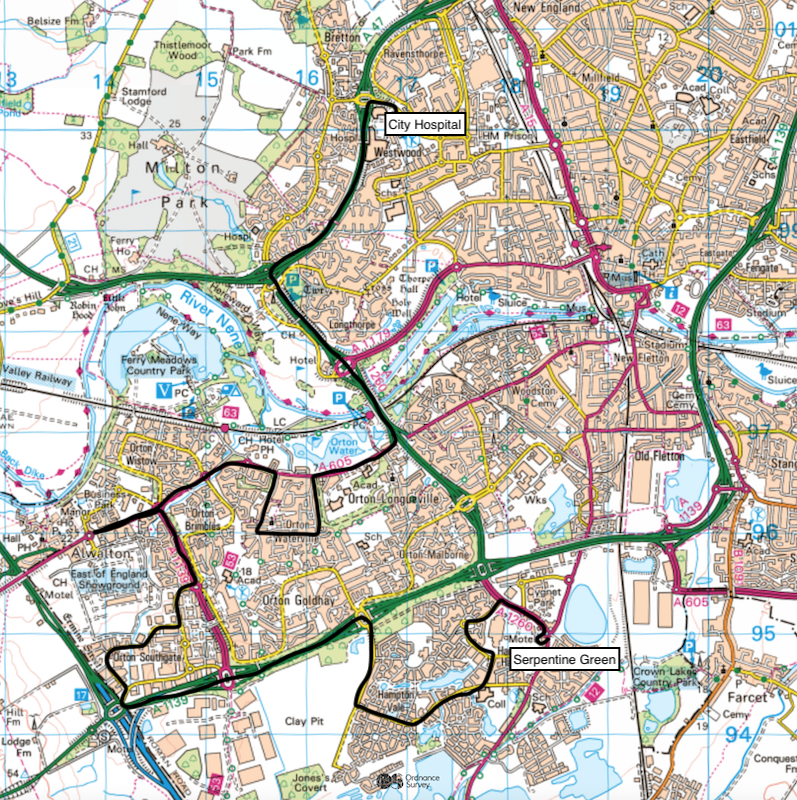
Route 29 is not much better with a subsidy cost per passenger journey in 2022/23 of £74.71 with the report confirming 1,833 passenger journeys were recorded, which makes the tender price £137,000. Contracted to Dews (but as commentators have explained, is sub-contracted to Fowler’s), this route involves six off-peak return journeys linking Hampton Hargate and the Ortons in south and west Peterborough on an orbital route between the Serpentine Green shopping centre and the City’s hospital. Passengers per journey work out at 0.5, which, assuming each passenger makes a return, means three people are travelling per day.
You might be surprised to know at the 15th November meeting rather than pull the plug on these routes, councillors agreed to implement modifications to the 7A timetable and a review of the 29 with “further engagement required”.
Not only that, but Mayor Johnson is proposing to treble the council tax precept set by the Combined Authority that’s ring-fenced for expenditure on buses. It’ll increase from £12 to £36 per annum per household in Band D raising £11 million. Now I’m all in favour of hypothecated tax to support buses but I can’t be the only one having serious doubts if it means funding bus routes used by so few passengers.
Against that background I couldn’t resist a trip to Cambridgeshire and Peterborough to find out more about these two routes with the bonus being my presence would significantly boost passenger numbers for the day. Although by using my concessionary pass, I probably made the finances worse.
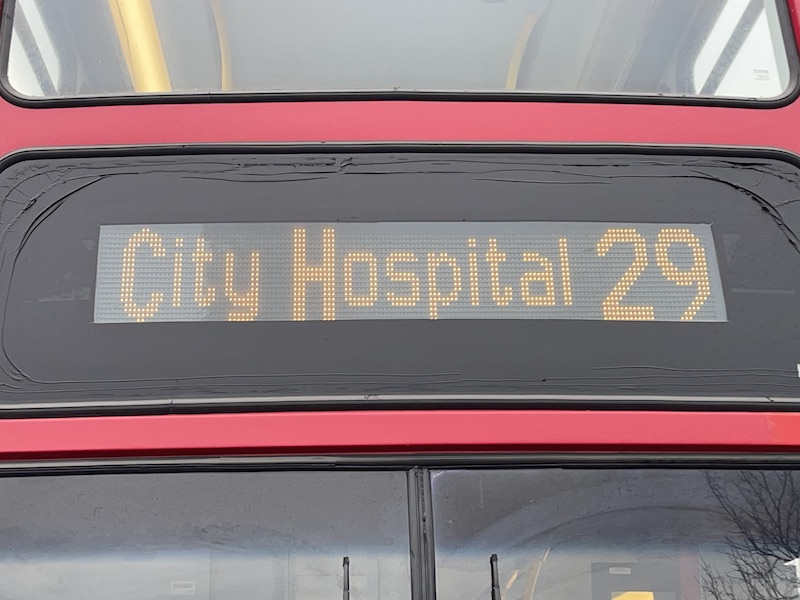
First up I took a ride on route 29, the one where “further engagement is required”.

The Report explains the background for councillors:
“This service [to the city hospital] was introduced as a trial to provide an alternative direct route to the existing interchange option which is available. The service has seen very limited take-up over a number of years and therefore it is proposed to undertake a further review to establish if the trial should end. Last year there were less than 2,000 passengers. In addition to this service, the communities have access to important destinations, including the hospital via interchange at Peterborough bus station.”
The service was actually launched on 1st March 2021 by Stagecoach amid a great fanfare of it being an “innovative orbital bus service for the city” …

… removing the need for passengers to travel into the city centre, change buses, and out again to access the hospital. Optimistic claims were made it would reduce city centre traffic and ease congestion. Seriously.
For an orbital route to work it must serve densely populated residential areas and offer attractive destinations people want to reach on a regular basis. It’s no good just running a bus around a circle shaped route and think it will attract passengers.
A city hospital, at one end of the route, is important for those needing access, but isn’t a big enough draw as a destination in itself while the Serpentine Green shopping centre at the other end is not as attractive a retail offer as the city centre itself.
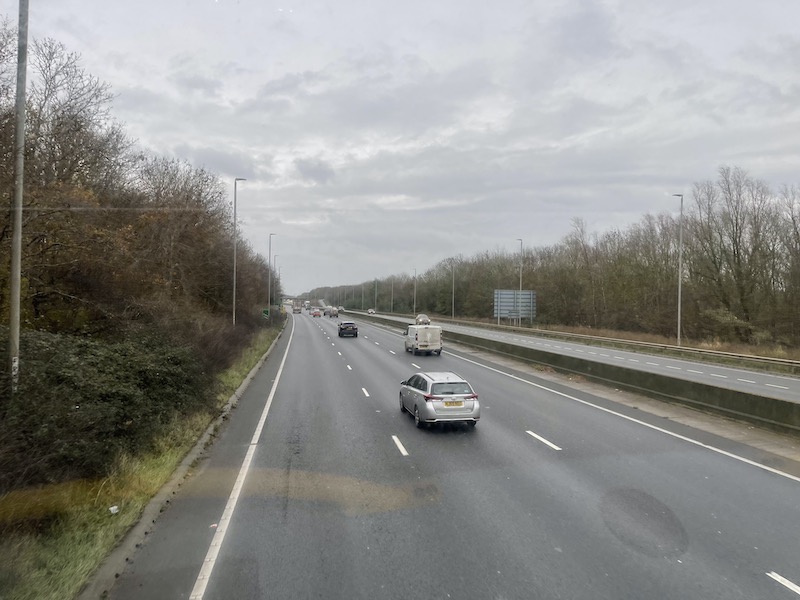
But what came across to me while riding up and down the route was just how much mileage involves travelling along fast flowing dual carriage roads with no bus stops as there’s nothing to serve.

Aside from two residential areas – Orton Waterville and Hampton Hargate – the route also includes the Orton Southgate Business Park…

… but it’s not the sort that’s going to attract hordes of commuters (there was no ‘footfall’ to be seen as we passed through), and in any event, the timetable only runs in the off-peak.

Furthermore, Orton Waterville is what I’d call a ‘well heeled’ residential area…

… and although Stagecoach operates its commercial X4 between the city centre and Corby via the area it’s not hard core ‘bus territory’…

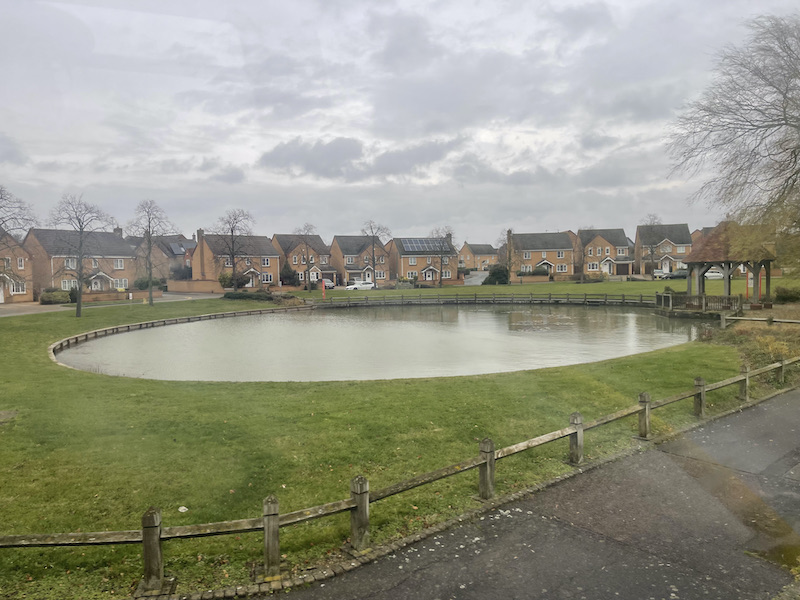
… while Hampton Hargate is a rather nicely laid out low density relatively new residential area which enjoys a 20 minute frequency on Stagecoach route 6 to and from the city centre, taking just 15 minutes.
Route 29’s terminus at Serpentine Green is dominated by a mega size Tesco Extra …
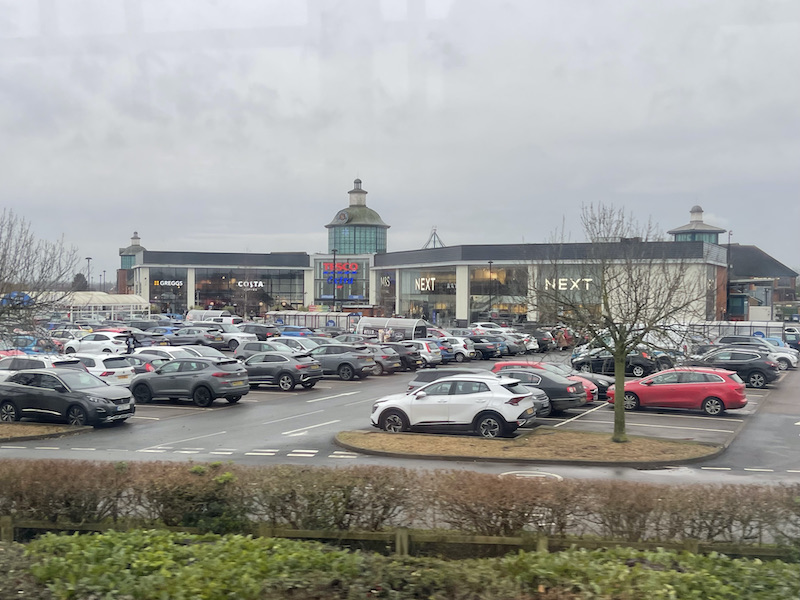
… as well as other familiar retail names and lots and lots of free car parking.
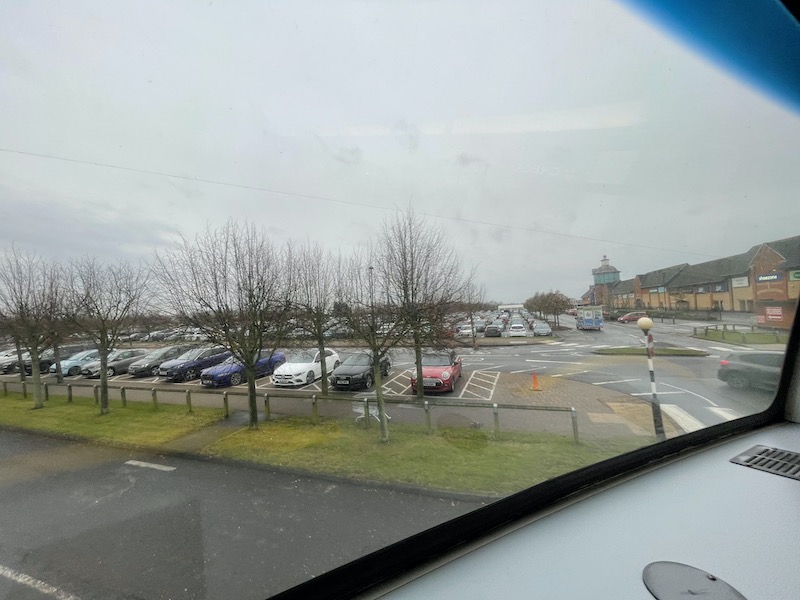
And that’s about it for what the route serves. It also does a double run to the East of England Showground Entrance on the A605 for good measure, but no custom.
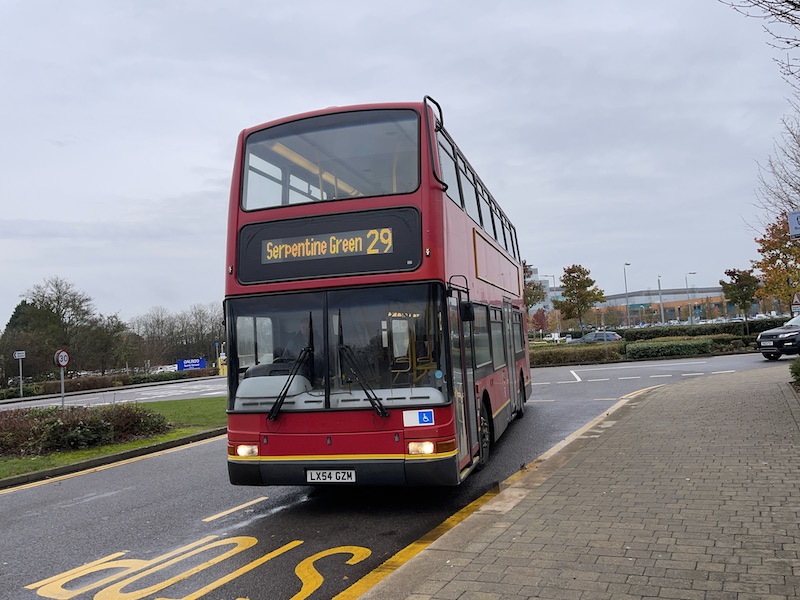
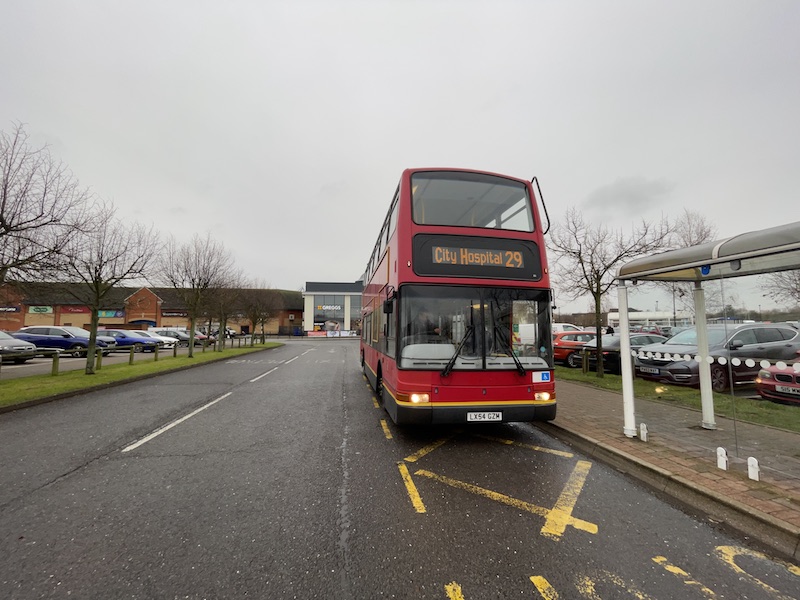
The bus used by Fowler’s on behalf of Dews on the day I travelled was certainly not in its first flush of youth, as they say, being a tired 19 year old ex London General Plaxton bodied Volvo B7TL which is used on a school contract before and after the operation on route 29…

… and even more pertinent, there was not a scrap of evidence of the route’s existence at the city hospital. No timetable or route details, just departures for the three Stagecoach city routes (2, 3 and 4) which terminate there.
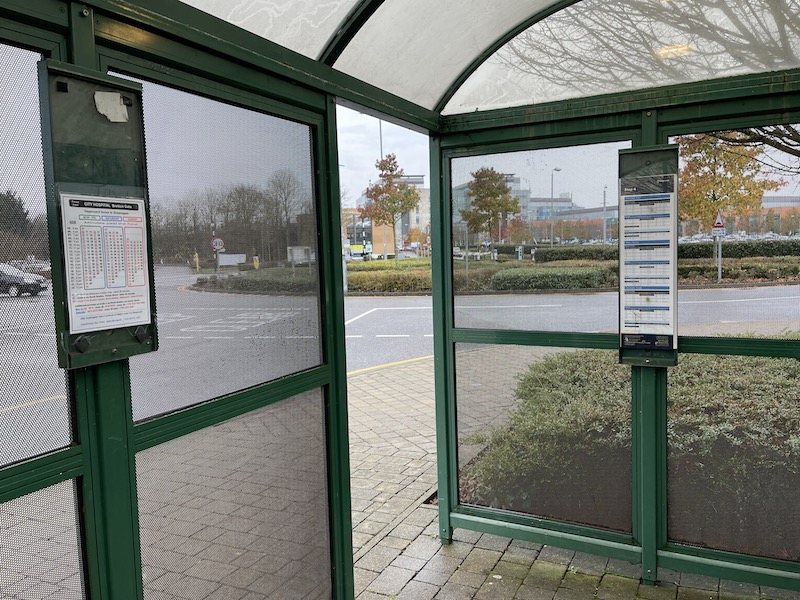
Furthermore the 29 doesn’t even go to the main hospital entrance, as Stagecoach buses do, but turns on the outskirts of the huge hospital estate by the Mental Health Unit.

Mind you everything was fine when we left at 13:00 but returning an hour later at 14:00, the entrance to the hospital was chocoblock with cars queueing for the massive car parks…

… presumably as afternoon visiting had started …

… and it took seven minutes to reach the turning point by the Mental Health Unit.

In some ways it was just as well the bus didn’t continue to the hospital entrance as that would have meant another three to four minutes delay as Stagecoach buses were encountering.

Both the driver and I were surprised when a passenger boarded at Serpentine Green and travelled on the return journey all the way to the hospital and I seriously wondered if he might also be doing so to write a blog about it, otherwise why else would you travel from an out-of-town shopping centre to an out-of-town hospital? No-one else had travelled on the outward journey.
Another interesting facet is there was no ticket machine on the bus and the driver just waved me on as he did the other passenger on the return journey, merely observing our concessionary passes. So that might explain why the number of recorded passengers is so low; they’re not being recorded. But my observations indicate there are hardly any (passengers) anyway.
All in all, route 29 is a lost cause and the sooner the plug is pulled the better. The route is serving no useful purpose, no-one is travelling, and £137,000 of public money could be saved each year or redeployed to better bus projects.
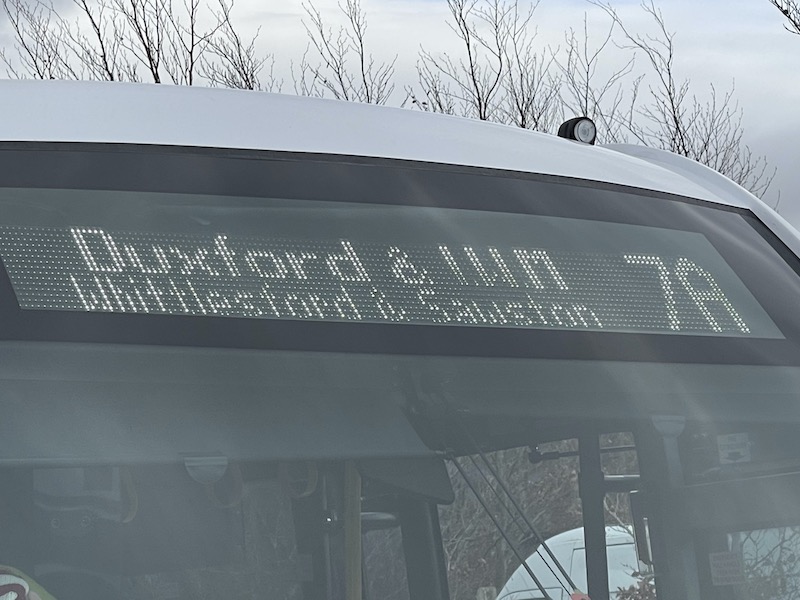
Next up on Monday morning last week, I enjoyed a ride on the Daddy of them all when it comes to subsidy per passenger, route 7A. The route shuttles from Duxford (outside the Imperial War Museum rather than the village itself) and the nearby hamlet of Heathfield via the village of Whittlesford (which used to be served by Stagecoach’s route 7) then a double run south to the hamlet of Hinxton, then back north to Sawston and finally back via Whittlesford to the museum at Duxford and Heathfield.

Here’s the timetable.
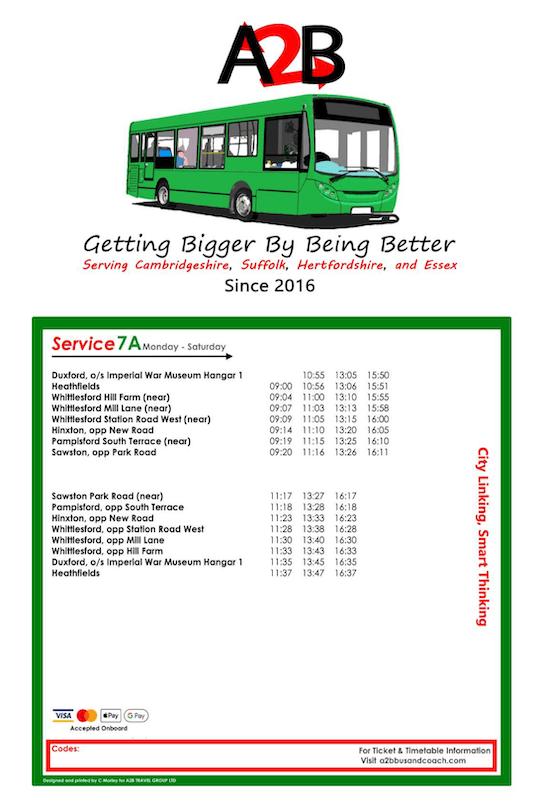
The recommendation approved by the Transport & Infrastructure Committee was to “retain with improvements” which was explained in the following summary:
“This service has been reviewed as part of a package which includes 7A, 31 and 75. The 7A is recommended to be merged with a home to school service. This will provide a more cost-effective solution for both CPCA and Cambridgeshire County Council, while retaining connections for the community. A number of options have been considered for the three services, which together are intended to provide a more joined-up and integrated service, while significantly improving the value for money.”
Services 31 and 75 are also operated by A2B Travel with the 31 comprising three return journeys between Fowlmere (close to Heathfield) and Addenbrooke’s Hospital as well as a peak journey into Cambridge. Brian, the friendly owner of A2B Travel, confirmed to me the 31 already interworks with the 7A providing one efficient vehicle working so I don’t know how the Authority thinks it can “provide a more cost-effective solution”. Brian already seems to be doing that as he does with route 75 which links Orwell with Cambridge to a similar pattern including a morning and afternoon peak journey catering for school children.

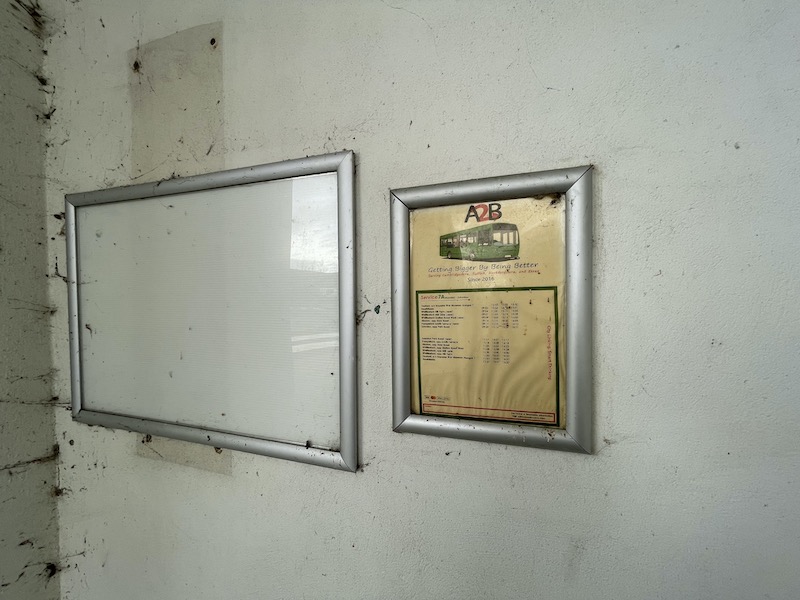
I aimed to catch the first journey from outside the Imperial War Museum at Duxford at 10:55. Unfortunately a Just Stop Oil protest in Cambridge delayed the bus on its preceding journeys on the 31 resulting in it running around 20 minutes late, but as you can see there was a nice spacious shelter to wait in (complete with timetable on display) outside the museum entrance …
… and when I rang the company to enquire about its non appearance, the phone was quickly answered by Brian himself who kindly rang the driver to get an update and reassured me it would soon be with me. In the meantime we had a good chat about the route with Brian explaining how it performs a very useful function for the few who do travel and he’d done all he could to operate the service as cost effectively as could be done.

The bus soon arrived with the wonderful Sharon in the driving seat. She’s been bus driving in the old Eastern Counties area for nigh on 35 years and knows all the regular passengers who use the 7A by name. My journey didn’t attract any takers on Monday morning – Jean, who often travels from Hinxton wasn’t travelling that day.
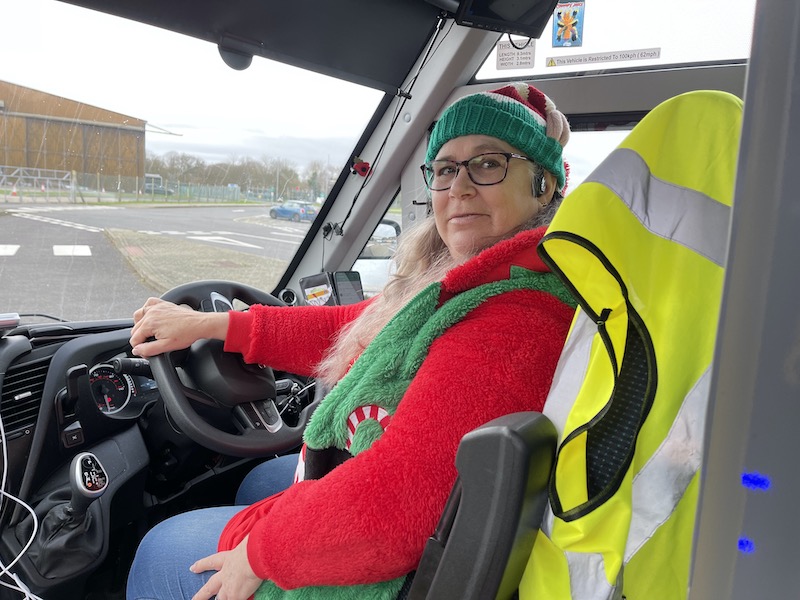
Sharon explained the route can be useful in the summer, when the Museum attracts many visitors, by providing a connection from Whittlesford station to the Museum, a distance of just over one and a half miles on the A505, which is not a pleasant road to walk along.
It also provides connections for residents of Whittlesford, Hinxton and Heathfield with the Stagecoach route 7 in Sawton where Sharon pointed out the bus shelter for onward travel.
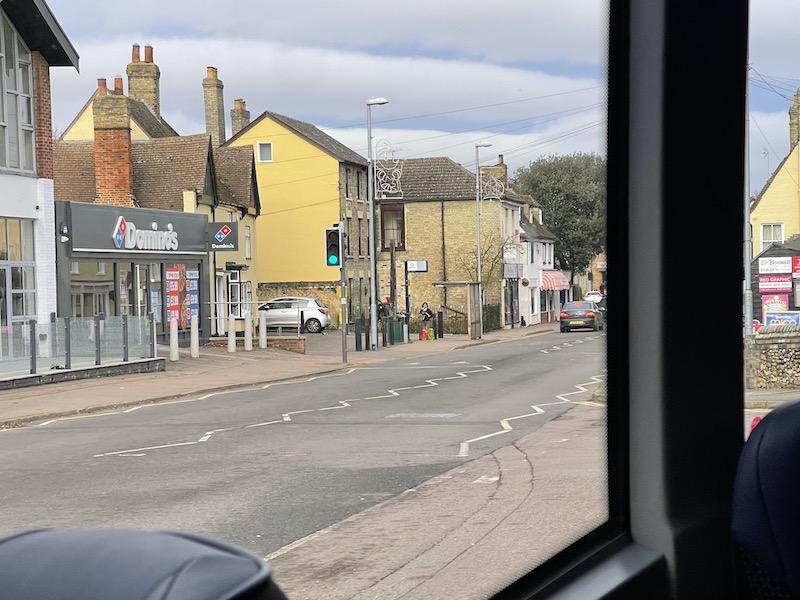
In the very picturesque village of Whittlesford there’s even a real time sign for the four journeys a day that pass by.
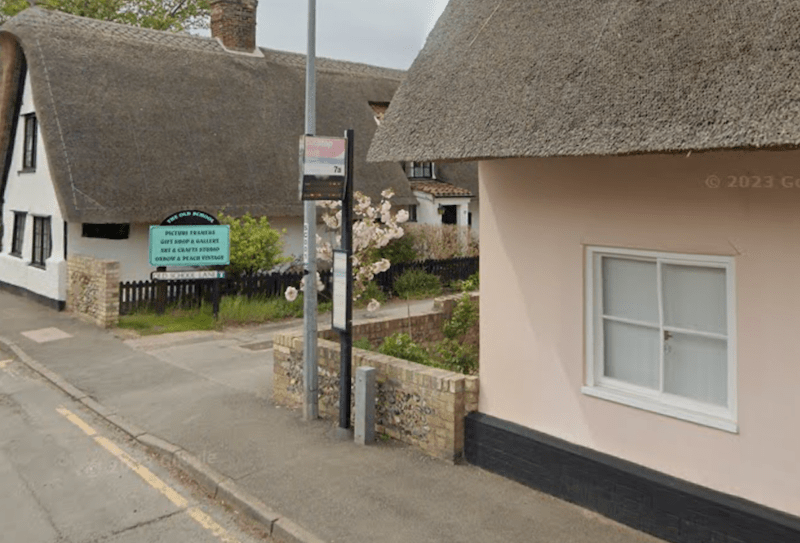
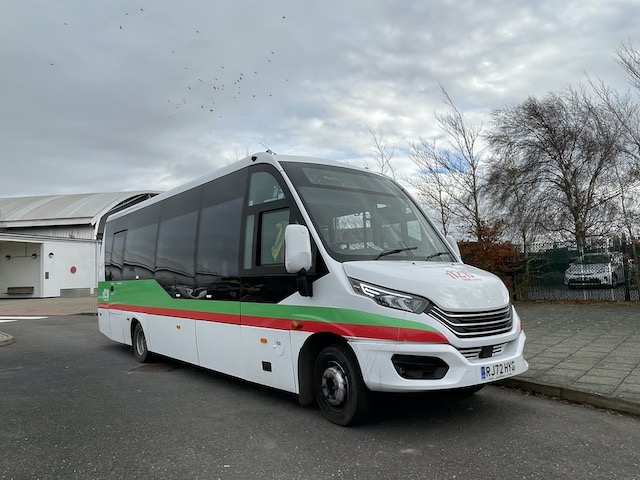
The bus couldn’t have been more of a contrast with the one I encountered on the 29 – a smart and very comfortable one year old Ilesbus …

… seating 29 with two further tip-up seats or a wheelchair space.

As you can see from the map, the route is essentially a local shuttle service between four communities providing useful links for the few who use them, but the bus also provides a peak hour journey to and from Cambridge and other journeys on route 31 which also needs to be taken into account. It came across how much A2B have invested in trying to make the route a success, but ultimately the numbers just don’t seem to be there, and consequently the finances don’t “add up” resulting in what must be a record breaking subsidy per passenger.

You’d hope these examples would provide valuable lessons for the Mayor and officers at the Combined Authority about public funding for bus routes. Yet at the meeting of the Combined Authority’s Board on 29th November, which received the report about the 19 bus routes under the microscope, plans for four new bus routes were also approved including three new DRT schemes costing £900,000 representing 40% of the Authority’s £2.3 million BSIP+ funding, despite it also being reported the Authority’s existing ‘ting’ branded DRT based on St Neots (and appearing on that list of 19 “use it or lose it routes”) is costing £42 per passenger journey.
It doesn’t bode well for judicious financial management if the Mayor proceeds with his aim of taking full control of every bus route in the region.
Roger French

My thanks to Paul Hollinghurst for letting me know about these routes as well as Brian Clifford of A2B Travel for the background and Sharon for the wonderful journey she provided. I can’t say for sure if the 7A really is Britain’s Most Subsidised Bus Route, but it must be a strong contender.
Blogging timetable: 06:00 TThS.
Comments are welcome but please keep them relevant to the blog topic, avoid personal insults and add your name (or an identifier). Thank you.
 BusAndTrainUser
Thanks for this somewhat sobering but important report. Obviously, with bus services at this level, you cannot ‘run them and the people will come’, as has been the case with a lot of rail re-openings for example. Two comments – first: per your conversation with A2B owner Brian, looking at the commerciality of just one route like this is over-simplifying, and perhaps a better basis – maybe the one being used by ‘the Committee – is to see what is the best benefit:cost ratio you can get per bus, or bus+driver+running costs. If you already need a double-decker for the school-run, I can’t see that having an extra minibus as DRT would improve the overall finances.
Secondly, as the council’s problem – not one faced or addressed by Stagecoach etc. – is that there are voters who don’t have cars but who have transport needs. The council may already have adopted one obvious strategy – ask them! (in my 70-odd years I have been asked three times by councils for my views on buses; never by a commercial company). The council probably also has an aim to get car-drivers to use public transport, but I don’t think that even hourly buses will do that, particularly with no bus lanes at the hospital etc..
I think you could add one more pre-requsite for peripheral bus services – they must connect well with the radial routes they cross. London’s Superloop does this well, though maybe the publicty – maps, way-finding signs etc. – could be better. As you cmment, not even having a timetable is pretty abysmal!
LikeLiked by 1 person
Writing my comment as a reply to another comment because the regular comment box seems to be missing in my browser. I recently moved to Heathfield as a non car owner and had been cycling to Whittlesford and then catching the train to Cambridge for my work commute. But having just been diagnosed with serious health problems, the bus may well prove essential for me to get to the station and also the GP surgery at Sawston! I think that these bus services are poorly used because only people with cars tend to move into these hamlets and villages, so it’s self selecting. I think I am in the minority in not owning a car here.
LikeLike
This encapsulates all that is wrong with LA’s and bus services . Poor planning ( it misses obvious traffic generators) , lack of attention to detail (inadequate publicity) and an inability to systematically review and remove poor performers. And it shows the sheer cost of running a bus these days. The Peterborough service will be linked to a school route at £250+ per day and on the Cambridge one the tender price is only half the story as the bus does the 31 which presumably has a separate tender price.
The big increase in precept is presumably linked to the Authorities’s Franchise plans, although in the recent cabinet report a quality partnership is still being considered as well.
LikeLike
I see that the Combined Authority has adopted a Bus Strategy that says buses should be :
Convenient
Routes connecting to places and activities that people want to get to.
All areas are well served by buses.
Direct routes with little deviation.
Frequent services with limited waiting time in-between.
Services are available all day and into the evening, every day.
Range of tickets to meet different needs.
Attractive
The network is simple and easy to understand.
Buses enjoy an excellent public image and everyone is happy to use them.
Services can be relied upon and runs to time.
Cost of using a bus is considered good value for money, with targeted fares that incentivise users.
Buses are direct and quick.
Buses are clean, comfortable and pleasant to ride on.
Services are well marketed and there is plenty of clear information in a range of formats, available via different media.
Waiting environments are attractive, offer seating and information, and feel safe to use.
Pleasant and helpful drivers, able to assist when needed.
Zero emission buses, offering a quiet and smooth ride.
A network that evolves in response to changing needs and demands.
Easy To Use
A single understandable network that functions as one, with connecting services, branding and system-wide ticketing.
Ability for people to transfer between bus and other travel modes (walk, cycle, e-scooter, car, coach, train).
A clear service offer, backed by a Passenger Charter.
Buses run at regular time intervals
and with consistent frequencies.
Stable services with minimal changes, removing uncertainty and confusion.
Simple fares with payment through a range of methods.
A system that is accessible and can be used by all.
Plenty of information is readily available.
It doesn’t look as if these criteria apply to the routes that Roger surveyed. Perhaps they should read it again ?
As usual local councils are full of good intentions but perhaps it would be good if these were looked at by a Scrutiny Committee to ensure that they follow the aims of the strategy ?
Martin W
LikeLike
By all means introduce new routes that might be of use to the travelling public . . . but for Gawds sake set a target, and a review period. If usage doesn’t meet the target, then pull the route.
LT in the 1960s tried a route extension from Toot Hill to Ongar . . . it lasted 3 months as usage was effectively zero.
Herts CC in the mid 2010s tried a route linking the two stations in St Albans . . . intending it to be an electric bus. They had to accept a standard minibus (no other tenders), but thankfully limited the contract to one year . . . it lasted 9 months, as there were very few passengers.
I’m sure there will be other examples . . . why don’t LTAs learn from history? By all means try it, but if there are no takers, accept your premise was wrong and cut your losses; don’t simply throw more money at it. Of course, if it isn’t actually your money . . .
LikeLike
Always interesting to read, Roger, thank you. Best wishes for 2024, Ian (McAllister)
LikeLiked by 1 person
Thanks Ian and very best wishes to you too.
LikeLike
With regard to the 7A, and numerous other services of their type including some DRT, Passengers do not like, or rather risk, relying on “connections” to/from town centres. Inward, usually fine, but can be nail-biting on return when a missed connection can leave you stranded. They rarely work.
Terence Uden
LikeLike
Having DRT link to Hubs where you can so it is claimed connected with scheduled services is one of the latest brain waves . The fact that it cannot possibly work is conveniently ignored
LikeLike
I understand that Fowler’s of Holbeach Drove operate the 29 with Dews having subcontracted the route to them. The scruffy shed you had the misfortune to travel on is one of Fowler’s fleet, a shame they feel the need to put that out in service.
LikeLike
Yes the 29 is operated by Fowlers, and the regular vehicle is RIG 6495, a 2006 single decker that originated with Arriva Southern Counties and then went to Lothian, where it acquired its N Ireland registration and its green livery.
Oh, and the 29 goes to Hampton, not Horton!
Ian McNeil
LikeLike
Thanks for the info – have updated the wording and corrected Horton!
LikeLike
Many thanks for that info; have updated the wording.
LikeLike
The layout of the minibus looks awkward for the driver to collect fares and issue tickets – and there’s no obvious sign of a ticket machine here either. I’d be really surprised if the contract didn’t require a ticket machine – it’s absolutely essential, and the amount of information that comes out of a Ticketer machine (other brands are available) is phenonmenal.
KCC
LikeLike
The ticket machine cable is the white wire you can just see and the unit itself is handheld , (you can just see the corner of it on the dash) and Is capable of reporting everything (and indeed more) than Ticketer systems
LikeLike
Good to know.
thanks
KCC
LikeLike
In Peterborough I agree with you. An orbital hospital route is sound concept, but here the implementation has let it down… but then I find any convoluted bus route depressing.
LikeLike
A few bits of history would not go amis, here, Roger.
Route 29 in Peterborough was introduced, with great fanfare, by the former mayor of Cambridgeshire and Peterborough Combined Authority, James Palmer, together with Whippet’s Cambridge-Corby service and the Stagecoach 905 (X5 replacement) via the Science Park. Quite how all of these were ever going to fit into a coherent network is a moot point. What of those routes now?
And Palmer did bring us the Manea car park, in conjunction with Fenland District Council. See https://busandtrainuser.com/2023/12/19/busandtrainuser-verify-2/
Suffice to say that Palmer took a long time to be convinced of the overriding importance of buses to the Combined Authority area’s public transport needs. More energy (and a shedload of public money) went into consultants’ glossy brochures for the ‘Cambridge Autonomous Metro’ a bundle of untried, untested, novel technologies in one hugely expensive package.
For more on trackless trams ‘Are trackless trams really ready to replace light rail?’ – https://ptcbr.org/2021/11/14/are-trackless-trams-really-ready-to-replace-light-rail/ – is well worth the read. (Spoiler alert: the conclusion is, “No.”)
Meanwhile, the 7A was brought in as as supplement (partial replacement) of two former Stagecoach services – a summer season only direct Cambridge – Trumpington P&R – IWM Duxford service with IWM funding and later ‘branches’ of Stagecoach’s route 7 Cambridge – Sawston/IWM/Pampisford/Saffron Walden/etc.
When, subsequently, Stagecoach took route 7 purely commercial, simplifying the route, leaving some destinations and some villages unserved, following withdrawal of Cambridgeshire County Council subsidies (the Transport Authority before establishment of Cambridgeshire and Peterborough Combined Authority) various iterations of route 7A have been attempted.
As a subsidised service, under the current rules, dating from the 1980s, it must not significantly overlap a commercial route (Stagecoach’s route 7). Arguably, a regular, through, Hinxton/Whitlesford -Addenbrooke’s Hospital – Cambridge centre service could be more nearly self-sustaining.
Linking and interoperating the ‘commercial’ and ‘subsidised’ routes (quote marks to take account of BSIP+ ZEBRA and other public money feeding into ‘commercial’ services) is not going to be practical/possible until/unless there are formal Enhanced Partnership agreements or Franchising, upon which the former mayor (Palmer) belatedly started work – pre-pandemic, then suspended – and upon which the current incumbent Dr Nik Johnson is now working upon the business case(s).
LikeLiked by 1 person
Many thanks for all that interesting background Richard; much appreciated.
LikeLike
Note the extended first and last journeys on the 31. You can trace these back to the days of Premier Travel, which had a garage in Chrishall. The conductor (who worked in the Cambridge garage during the day) lived in Barley. In the old days, they were attached to the 7 timetable.
I drove the evening service a few times in the early 1980s. 1735 off Drummer Street (with a regular duplicate as far as Sawston) then foot down all the way to get people home.
Steven Salmon
LikeLiked by 1 person
Great memory Steven. Thanks.
LikeLike
As already mentioned, the 29 was, I believe, Mayor Palmers only transport spend in Peterborough during his tenure. It doesn’t run at a time anyone needs (i.e. Staff) and hourly until mid afternoon doesn’t offer outpatients a viable choice. However initially it was operated by Stagecoach which gave it 2 benefits. One it was a part of the dayrider ticket and the other it appears on bus stop timetables.
However that stopped when Stagecoach walked away. Truth is there has never been published bus times at stops since 2022, and the route taken through Hampton – it’s only real opportunity to attract users, doesn’t even have bus stops.
Is there any wonder it has failed.
Ignoring residental areas, not advertising its existence and not actually offering a use is a text book example on how not to run a bus service
Interesting (sic) Vectare are running a new route in January, which will I fear replicate the failure of the 29. Uses too much dual carriageway, avoids high residential areas and serves no purpose. The only difference is vectare give timetables a good go.
I hope you will visit in January to sample the new route and offer some vital feedback.
LikeLiked by 1 person
Off Topic (sorry) but can you look at todays London/Khan press release to reduce the number of London Buses (by speeding up routes – how on a 20mph road network?)
LikeLike
If you want to see an orbital route that links a retail centre, a hospital, several estates and the town centre look at route 4 in Basingstoke
LikeLike
In parallel with this story and the abilities (or otherwise) of local government is that in The Times this morning on the bankruptcy of an increasing number of Councils. Due to “poor management” – failures of management or failure in governance. Maybe the examples shown are such examples of “going off course” and not seeking value of money.
LikeLike
The root cause of all Council funding problems is ultimately lack of money from Government. Councils were encouraged, and then pretty much forced, to find alternative income streams so no wonder so many turned to property etc – only to find market changes left them in the proverbial.
Yes, funding from Government might now be increasing, but not enough to cover rising costs and to repair the damage done by the austerity years.
Dave H
LikeLike
Will 2024 generate any real improvement in bus services? So far in general bus services have continued to decline and with no real sign of the transformation promised
LikeLike
Hi Roger, great piece, it does just go to show the daunting challenges local elected officials are facing when trying to balance prioritising public polices to enhance bus service’s, with the challenges of spending what money they do have wisely.
Darren Roe
Stagecoach East
LikeLike
It seems to me that part of the problem is that it is hard to deliver an intermodal service that can support residents that need a social transport service (in rural areas), due to different governance models for trains and buses.
Taking Duxford (and it’s hinterland) as an example, there is frequent train service to Cambridge from Whittlesford Parkway–so close to Duxford yet so far, and normally someone who has a concessionary bus pass can’t ride the train for a short journey as part of that concession, nor is a £2 leg fare straightforwardly possible. This can be fixed–providing a local minibus shuttle service to the outlying villages to an interchange point, or subsidised local taxi voucher service to the interchange,and working with the train operator to fund concessionary travel for short distances, but needs a lot of negotiation to address the barriers to use from the customer point of view. For non-concessionary travel needs council to make intermodal travel easier and cheaper–extending schemes like “plusbus” and allowing intermodal ticket purchase on the bus. At £125 per leg there is a lot of scope to deliver an effective service for much less! (Dare I say it a lot of this complexity could be addressed with something like the “Deutschland Ticket” model)
Ultimately, in rural areas, I feel using a hospital as a traffic generator is a false premise, it’s just too complex for the customer if the journey is infrequent, unreliable and not single-seat. Better to use council money to fund a volunteer-driver hospital car service in rural areas for those that need to attend medical appointments in any nearby location, with support companions. Yes that can be hard luck for those that need to visit patients (work with the hospital to provide hardship funding for taxi journeys, and good publicity of intermodal taxi/train options)
Given shift patterns you can’t realistically expect hospital staff to use an infrequent bus service unless you carefully design the schedule to match shift changes (and the hospital commits to a “guaranteed ride home” promise of a taxi if the staff is released late from shift).
MilesT
LikeLike
All very interesting, Thanks Roger.
I grew up in Hinxton in the 80s and as teenagers we were pretty sad about the low frequency and limited hours of the bus service there. I’m wondering if fellow commenter Steven Salmon ever drove me. I’m pretty sure it was it was Premier Travel route 9 that served Hinxton. The 17:35 departure time certainly rings a bell. I remember the services being well loaded and also remembered an occasional conductor on board.
Lord knows what my sister and I would have thought of having to catch two buses to get to Cambridge. We’d probably have used the 112 (now 7) Cambridge-Saffron Walden service from Ickleton more often or cycled.
The Glory days of Hinxton bus services were a few years from the mid 80s onwards when there was a stop on the A road passing the village for the Green line 799 service. A villager had campaigned successfully for the stop. We often used the 799 to visit Cambridge and on one occasion went all the way to London. It was close to Christmas and the Driver was wearing a Santa Claus outfit. Of course the 797, 798 and 799 are all deceased now.
LikeLike