Tuesday 28th November 2023
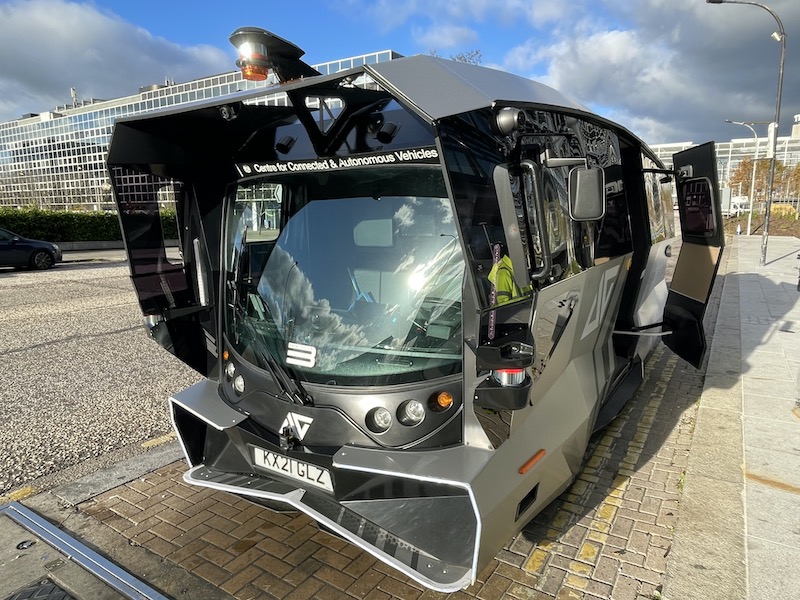
The autonomous vehicle industry is certainly booming as more trials get underway on the UK’s public roads including this latest one in Milton Keynes involving a rather strange looking bus.
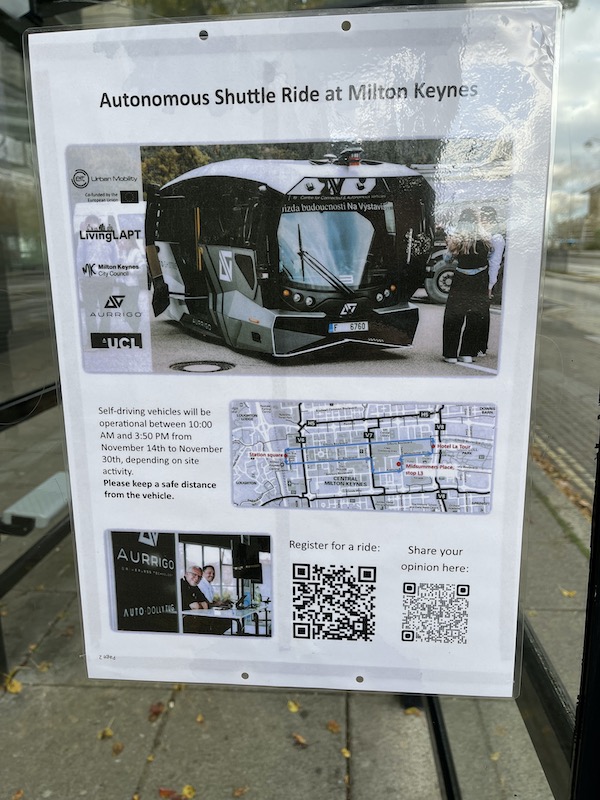
It follows both the Didcot trial involving funding from the DfT’s Centre for Connected and Autonomous Vehicles (CCAV) operated by First Bus and a whole host of tech partners and the Edinburgh CAV Forth trial involving Stagecoach and others with this latest escapade using the odd shaped vehicle running on a one-way circuit between Station Square, Midsummer Place shopping centre and Hotel La Tour over the past fortnight.
I paid a visit last Friday to see how it compared to both the Didcot and Edinburgh trials.
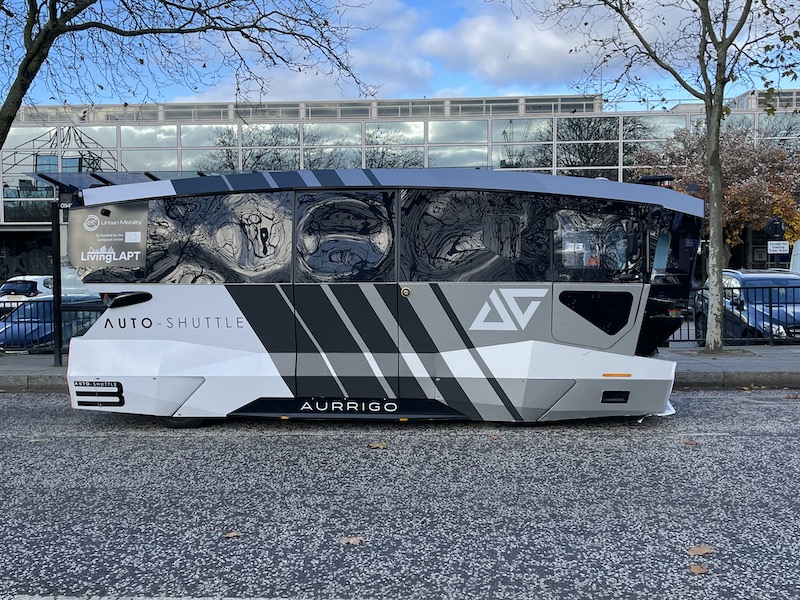
The project is being overseen by a Coventry based company called Aurrigo which has been involved in automotive technology for 30 years. It’s “autonomous technology division was established in 2016 to develop autonomous capabilities supported by the Group’s strong and extensive experience in the automotive division for vehicle engineering. It develops and manufactures autonomous vehicles and supporting systems from the “ground up.” Aurrigo designs and manufactures 4-seat, and 10-seat autonomous vehicles, and autonomous baggage-handling dollies.”
The trial is part of a Europe-wide research project funded by EU money under the European Institute of Innovation & Technology’s Urban Mobility Group which oversees projects under a LivingLAPT brand which stands for “a living lab for autonomous public transport and logistics services”. Who comes up with all these crazy titles?
Other comparable trials are taking place in the City of Ricany (near Prague, Czech Republic), Hasselt in Belgium, Kongsberg in Norway and Helmond in The Netherlands.
As in Didcot and Edinburgh, this trial is all about gaining experience of autonomous shuttle type services and learning the pitfalls and assessng opportunities for future applications.
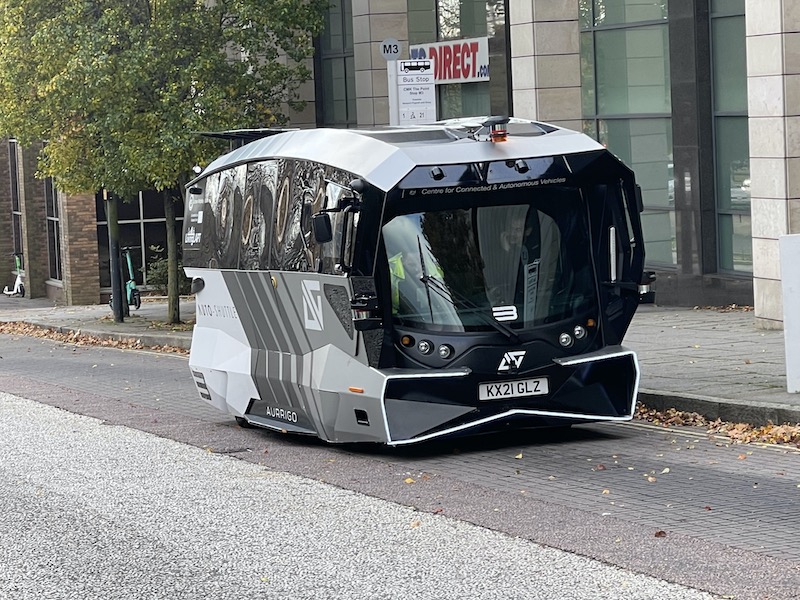
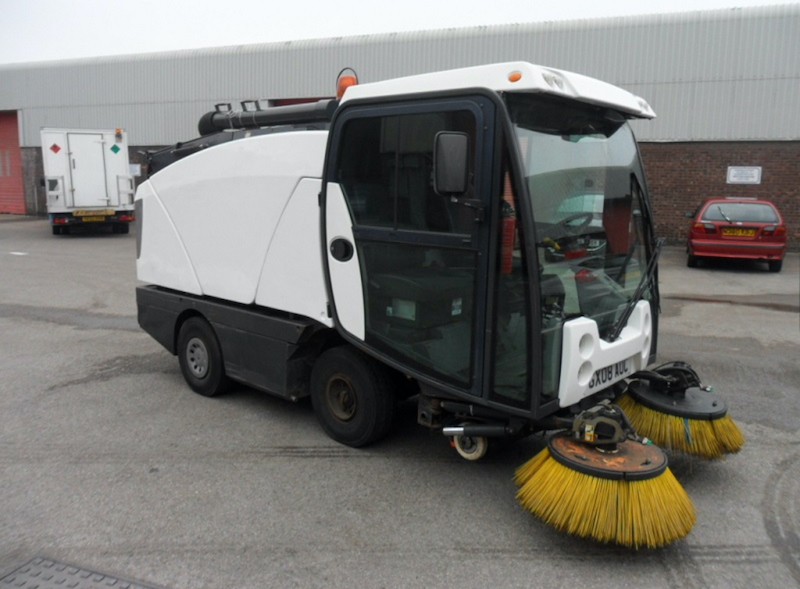
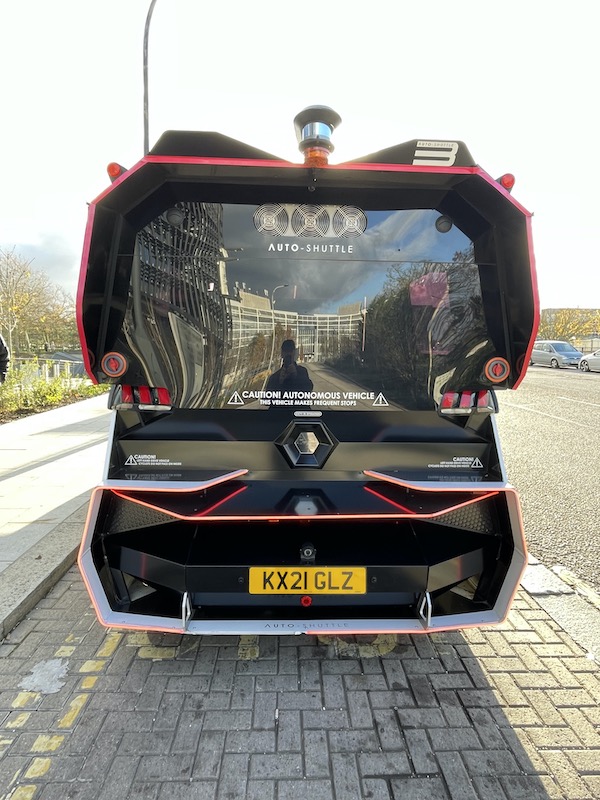
The vehicle used in the Milton Keynes trial has certainly drawn many comments about its rather unusual design and appearance. Having posted a video of it on the social media channel X, I was deluged with replies about how much it looked like a road sweeper, not least with its flashing orange light on the front.
One wag suggested fitting brushes at the front and fulfill two objectives at the same time.
I thought it looked as if it had been half squashed by one of those vehicle crushers before being rescued.
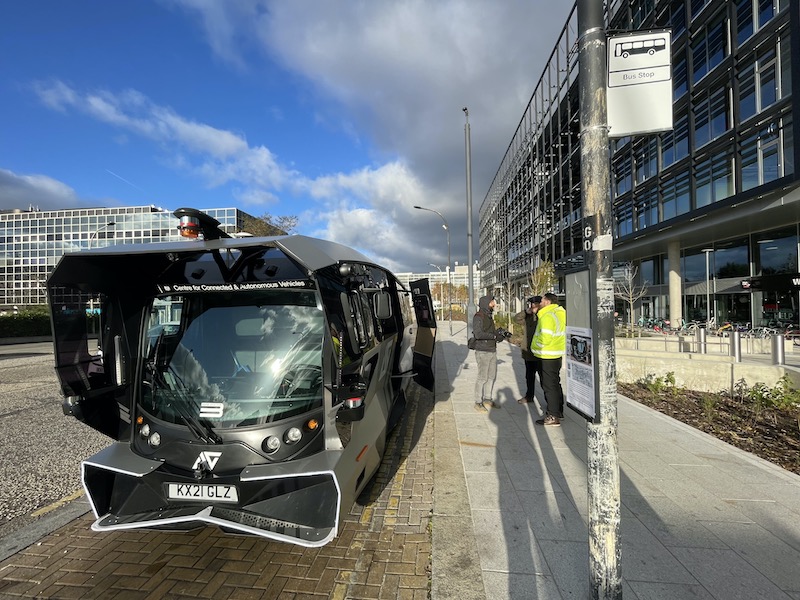
Steve, Aurrigo’s project manager for autonomous vehicles, was encouraging those taking a ride in the trial to feed back their comments including about the design, as he thought the designer would be interested to hear them.
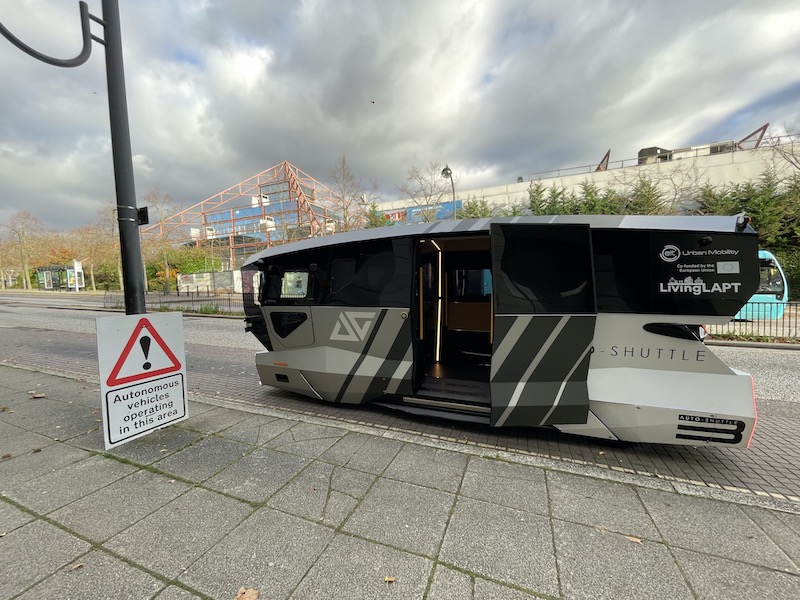
The vehicle uses five lidor sensors and seven cameras to create a full 360-degree view around it and navigate safely along its route which has been painstakingly mapped out prior to the trial using intricate software so it knows exactly where to go and how to get around obstacles it might meet along the way.
The circuit I took was in full autonomous mode except for negotiating the first (and only) roundabout and the final pull into the lay-by opposite Station Square which the driver on board controlled.
Aurrigo has a number of autonomous vehicles in its portfolio including an “Auto-Pod”. The one used in Milton Keynes is called an “Auto-Shuttle” which the company states is “a ten-seat passenger vehicle with the ability to operate fully autonomously or driven manually as a conventional EV shuttle. It is the first road legal vehicle to be manufactured by the Group.”
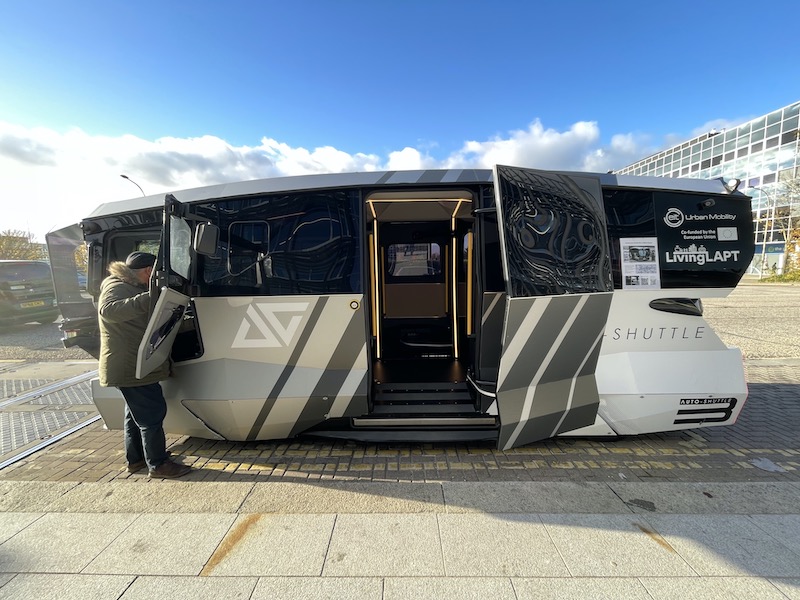
However, the ten person capacity includes two in the front cab so eight people travel in the body of the vehicle – four facing each other along similar lines to the pod I travelled on and blogged about on Harwell Campus, except this one offers no forward view of where you’re going as the window to the compartment where the driver sits is blocked by two monitors playing promotional videos.
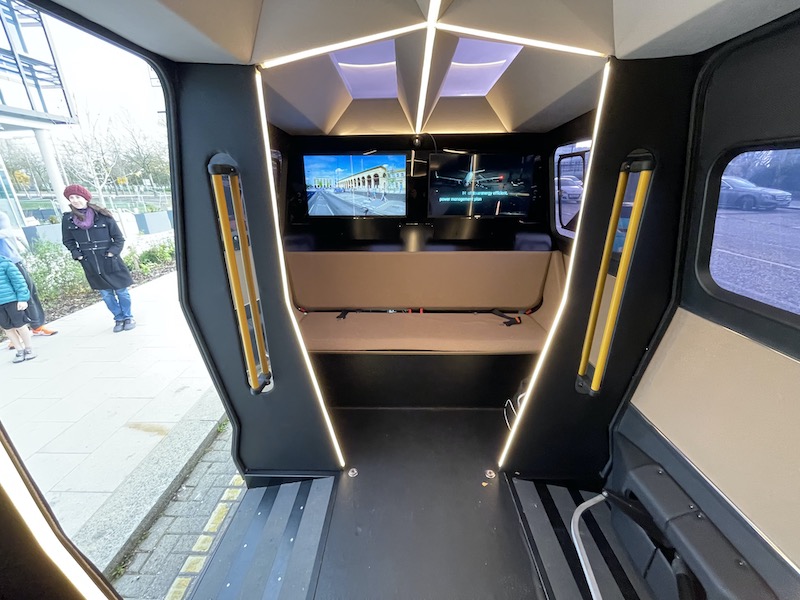
Steve acknowledged the design flaw and said it would be modified in future designs.
The window in the rear is clear to see out.
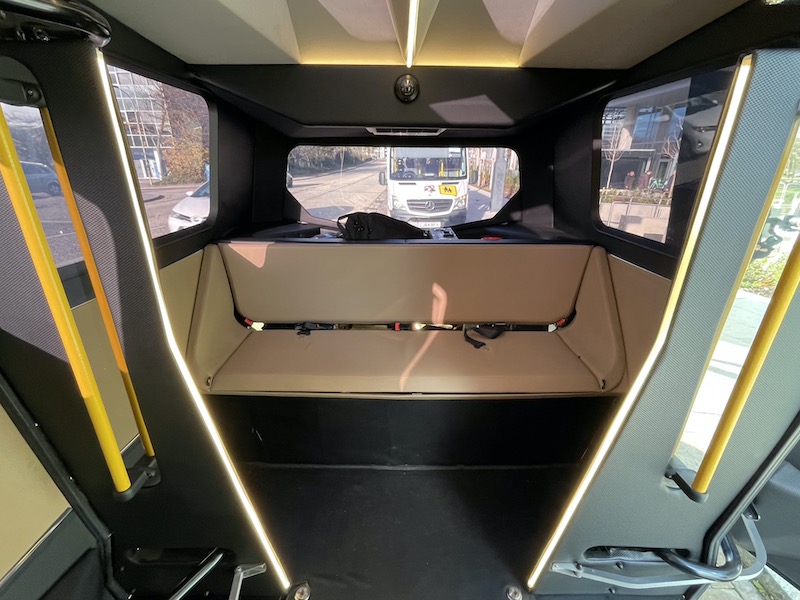
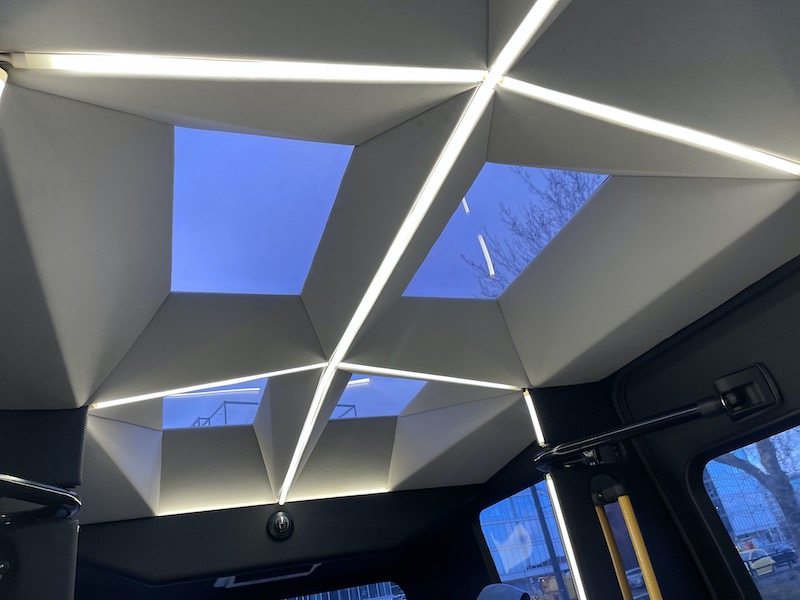
There are also windows in the roof to watch the sky as you ride along.
The front compartment where, for now, the driver and safety operator sit has a rather strange access arrangement.
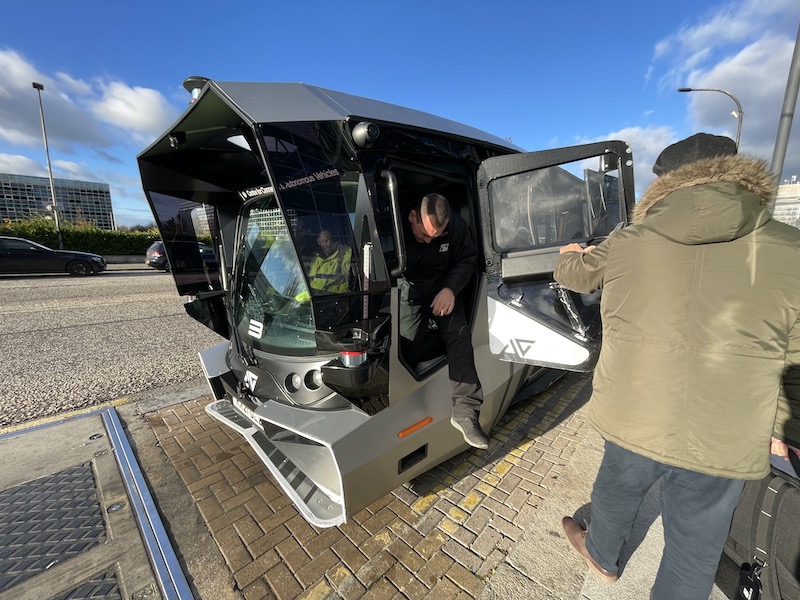
There’s room for two people as under current UK legislation as well as a driver behind the wheel there has to be a safety operator keeping an eye on the computer.
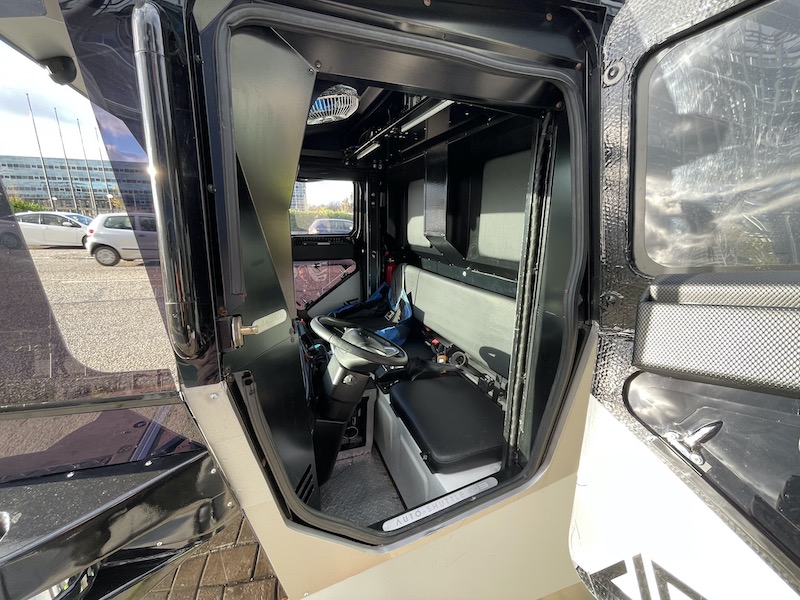
However, Steve was telling me the next trial is due to start next March involving two vehicles in Sunderland and will be in association with Stagecoach when they hope to get DfT approval to have the safety operator monitoring progress remotely rather than sitting in the vehicle.
Aurrigo also explain the Auto-Shuttle “has been designed to provide economical public transport in under-served or previously less cost-efficient parts of the country, as well providing an excellent transport solution in airports to move passengers to and from terminals and to operate airside with applications such as VIP transport and crew movements.”
It continues: “our 10-seat, autonomous shuttle vehicle is set to transform the way people transport around towns and cities. The shuttle, which comes after the success of our smaller AUTO-POD® (four-seat) vehicles, which are already gaining popularity globally, is the world’s first conventional electric and autonomous vehicle. The product helps to provide transport for city centres, shopping and care facilities, airports and heritage sites.”
It was interesting to take a ride around the circuit in Milton Keynes last Friday as it could well point to a possible application providing a link between the railway station and the shopping centre which are a frustrating 15-20 minute walk apart, although if you know from which bus stop to catch the next bus at both ends, Arriva operate a frequent service across a number of its local routes and in such circumstances who needs the expense of an autonomous vehicle?
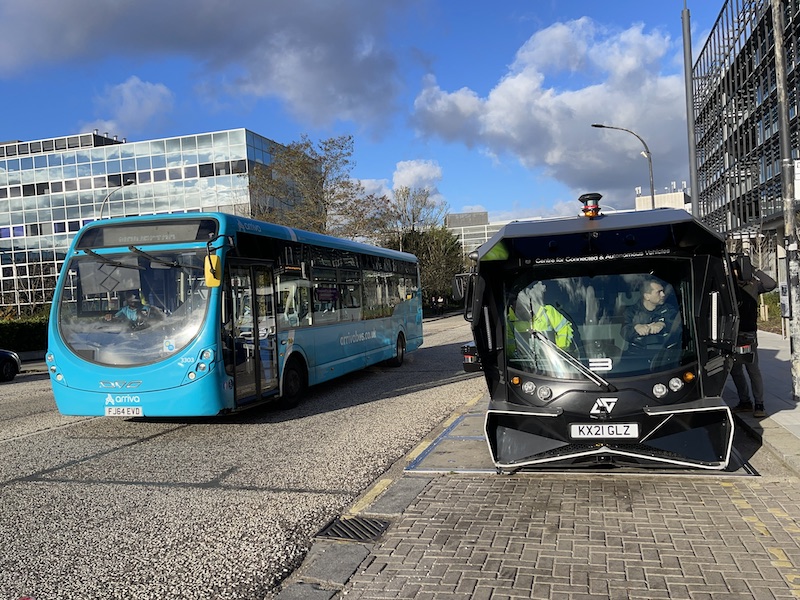
The current vehicle is limited to a top speed of 20 mph but Steve told me the Sunderland trial will see the speed potential increase to 30 mph. Both the Didcot and Edinburgh trials involve standard size buses travelling at normal road speeds.
The Milton Keynes trial ends on Thursday so grab a ride while you can but pre-booking is necessary to avoid disappointment.
And if, like me, you’re thinking we’ll never see vehicles like this in mainstream bus operation other than for very niche areas, then think again. As only yesterday afternoon just before 16:00 an email popped into my inbox telling me to “get ready for our exciting weekly update from the Bus Centre of Excellence that you won’t want to miss!” It seems the excitement comes from “the BCoE team” adding “two must-read blogs to the website: “Autonomous Buses: Unveiling the Era of ‘AutoBus’” – Explore the future of transportation as we delve into the fascinating world of autonomous buses.”
My excitement boiled over as I clicked on the embedded link to see what gems I could add to my very own blog on the subject. And sure enough blogger Deni Krevesic didn’t disappoint with his insight of where Autonomous Buses will take us … in these short extracts from his musings…..
“Enhancing mobility and accessibility, it offers convenience for individuals who prefer not to or cannot drive. This will address the challenges of poorly connected areas with public transport and ensure inclusion and sustainable economic growth. By potentially reducing the number of cars on the road, AutoBuses could relieve busy highway networks, reduce accidents, and minimise pollution. Furthermore, they can improve safety and reliability by eliminating human errors.
“A chronic shortage [of drivers] is expected to double in five years, and the adoption of autonomous technology could significantly reduce costs associated with drivers and energy consumption. AutoBuses have the potential to be more cost-effective than conventional buses, lowering operational costs in the long run.
“AutoBus prioritises accessibility with features like ramps, wheelchair spaces, and multilingual interfaces. Flexible fares and routes promote inclusivity and equal access. By intelligently addressing challenges and prioritising safety and accessibility, AutoBus solutions hold the promise of reshaping our perception of self-driving vehicles.”
It sounds like Cloud Cuckoo Land to me. I’m beginning to wonder whether to take the Bus Centre of Excellence seriously. As I am Autonomous Buses.
Roger French
Blogging timetable: 06:00 TThS.
Comments are welcome but please keep them relevant to the blog topic, avoid personal insults and add your name (or an identifier). Thank you.
 BusAndTrainUser
Thanks for this. I had a sense of deja vu when reading this as Aurrigo had a similar trial of a few weeks using what looked like the same vehicles at Madingley Road Park and Ride in Cambridge in summer 2021 on a circuit linking with the nearby University complex. Interesting that Aurrigo are having another go.
Chris Atkins
LikeLike
On the map of the autonomous shuttle the route ( in blue ) is a neat oblong except for a kink at Midsummer Place. This kink was caused by the removal of the road that went direct as expanding the shopping centre was seen as far more important than disrupting the bus network, and no doubt there was a substantial amount of money thrown at the Council. However in the planning permission there was a proviso that zero emission vehicles would be allowed to use the former direct road, running directly and removing the kink. 15 years or so ago zero emission vehicles did not exist, and whilst they don’t exist now because of the emissions required to build the vehicles and generate the electricity, in common parlance they do. So it will be interesting to see if any bus operator attempts to assert the right built into the original planning permission. Milton Keynes did get a chunk of Zebra 1 money but eventually Arriva backed out.
LikeLike
Very interesting but until these vehicles become completely AI autonomous they won’t be trusted.
Sunderland- I absolutely and completely disagree with the notion of the safety operator being in a depot port aka in somewhere not in the vehicle.
Driving is boring enough as is (as I write these very words my bus driver has tuned out to the bell and sign (and the passenger standing next to him waiting to alight) calling for a stop, and driven past the stop). Driving the same route again today more so.
The notion that a remote driver will be in on time, concentrating on the virtual highway in front and not nodding off, having a fag, playing a video game is for the birds. Everything nowadays is remote, online, telephone only, but call volumes are high and your call is important to us blah.
I would not wish to be on the Lessons W bus.
One critical element that the driver at the front brings is the safety of being the first to go through the windscreen if concentration lapses.
That’s what makes me not drink alcohol the night before an early, sleep well enough, and keeps me reporting for a shift on the Big Lemon as close to ready as I ever am.
No thanks to remote.
LikeLiked by 1 person
*portakabin*
LikeLike
Steve Wedd how do I login as me? Ask the loginbot
LikeLike
Has anyone at LAPT given any indication why they’ve stuck loads of additional metal with sharp edges all round the vehicle?
LikeLike
I assume it’s because the “designer” thinks it looks cool, rather than thinking about boring things like road safety.
LikeLike
There seems to be little if any stricture to these trials with lots of random trial and I have seen no real results from these trials and they still seem a very long way off of ever being used commercially
To me they would be far better to focus on driverless trains. The technology is pretty much proven and trains operate in a much more controlled environment
LikeLike
The Elizabeth line might be one worth converting to driverless. The central section of the line is already capable of driverless operation. The complicated section are the GWR line section and the Great Eastern line section both currently use two different old signalling systems. A further complication is both those sections of track are shared with other services
LikeLike
Oh my word. What a trial. Autonomous bus need a driver to negotiate a roudnabout and pull into a layby. Where shall we try it? Ah, let’s try Milton Keynes where there are more roundabouts than traffic lights and almost all the bus stops have laybys. I think they have chosen the only bit of town where there’s only one (or two) roundabounts. Then they’ve drawn a map showing where the bus goes except it includes parts where there’s no road. I stand by my conviction that these have no prospect of squadron use for decades except, perhaps on entirely segregated roads/tracks.
From 100andthirty
LikeLike
This blog is the “Bus Centre of Excellence” for my money… 😂
LikeLike
Gadgetbahn!
How is the MK DRT going?
Peter Brown
LikeLike
Why does it have to look such a mess. I think I would rather walk.
LikeLike
First Bus has announced a series of service updates underpinned by artificial intelligence (AI) planning software, aimed at enhancing reliability and punctuality in Glasgow.
First says its technology-driven approach has already demonstrated promising results, with a modest pilot across select Glasgow services in August and September showing improvements in punctuality and reliability by up to 16%.
LikeLike
They need to be a lot more aggressive and ambitious with this Automated Bus lark, they should approach Arriva and bully the government into approving automated trails throughout the Heckmondwike Depot operating area, including those routes into Leeds. More than fed up of endless cancellations on the 200 and 255, the sooner all bus drivers are replaced with full automation, the better. Get on with it stupid wishy washy people in this so called great nation, not!
LikeLike
Wouldn’t be seen in that, alive or (more probably) dead. Why waste money on this stuff when they can’t even get the basics of bus operation right?
17A
LikeLike
I’m sure I saw something like this is my TV21 comic in the sixties. Shouldn’t be long before someone somewhere is planning demand responsive transport operated with autonomous buses.
Steven Saunders
LikeLiked by 1 person
The BBC reported on a “driverless” taxi (without an human “safety driver”) in San Francisco about a year ago:-
The report says that there have been accidents, but there are also accidents with human drivers.
RC169
LikeLike
Design flaw! Um – er – It’s one of the most basic human desires to be able to see where you are going. How that was ignored is absolutely beyond me.
LikeLike
Interesting article on how China came to be the world leader in e-bus adoption. Perhaps UK government at all levels should focus more on bus electrification, and major bus use expansion rather than silly niche autonomous shuttles.
https://www.bbc.com/future/article/20231206-climate-change-how-chinas-electric-vehicle-revolution-began-with-buses
Peter Brown
LikeLike