Tuesday 14th November 2023

Cardiff may be struggling to get its Transport Hub completed (as featured in Saturday’s blog) but up in the North East North Tyneside Council opened a sparkly new facility in North Shields at the beginning of September having only finalised plans for its construction as recently as February 2022.

North Shields Transport Hub’s £13 million price tag has been funded by the Transforming Cities Fund via Transport North East, the North of Tyne Combined Authority and North Tyneside Council. As well as the five bay Hub the funds have provided for an adjacent revamped Town Square as part of the Council’s “Ambition for North Shields and the Fishquay Masterplan”.
Previously the Transport Hub site was home to a small supermarket, service yard, four bus bays and three layover spaces. These have been demolished and swept away to make room for a somewhat angular shaped building fronting two sides, one with a setting down bay and a departure bay and the other with three departure bays.
The site sits conveniently opposite the Metro station for ease of interchange …

… and alongside the new Town Square and the town’s main shopping street.
The ferry to South Shields is just a short walk away.
Oddly, for what is quite a large building for just five bays, there’s only one pedestrian entrance/exit into it.

As I entered and wandered along the first frontage from this entrance …

… and at the end of the corridor turned through 60 degrees along the second frontage I was expecting another exit/entrance.

But no, it was blocked off and only used as an emergency exit.

Although officially opened on 2nd September, there was still a lot of scaffolding up in the main passenger circulating area – where the two frontages meet at that sharp angle…

… and the kiosk hasn’t yet attracted a commercial tenant.
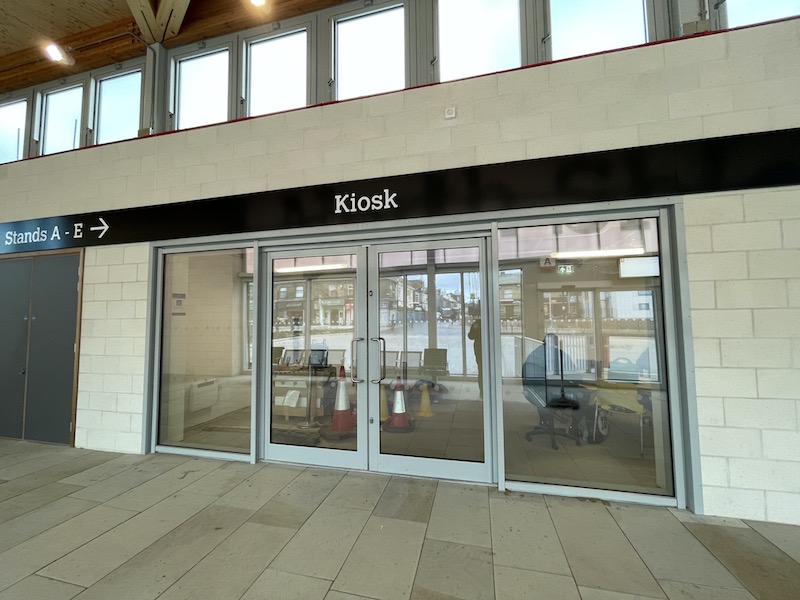
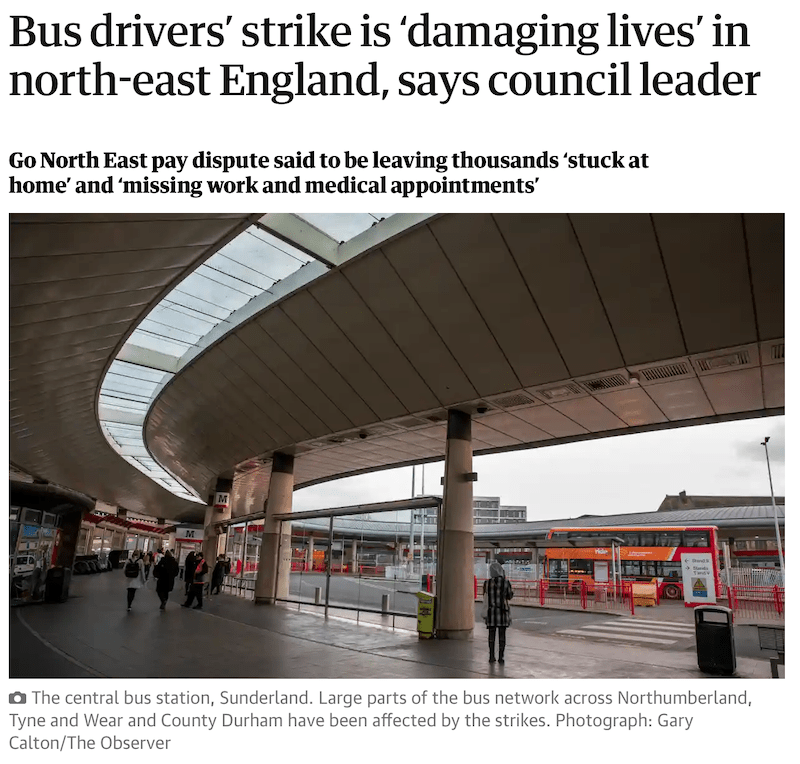
Which is just as well as there’s a distinct lack of buses using the new facilities and consequential low footfall due to the ‘indefinite strike’ by Go North East Unite members which has devastated bus provision across the region since it began at the end of last month after two separate week long strikes in October.

However, Stagecoach are running two routes which bring six buses per hour to the Transport Hub (half hourly route 11 to South Shields and half hourly route 317 Wallsend to Whitley Bay) …

… and Gateshead Central Taxis run tendered route 19 for Nexus to Backworth (half hourly) and on to Cramlington (hourly).

Arriva also runs hourly tendered route 57A on Sundays and weekday evenings to Whitley Bay and Ashington.
Once Go North East resolves its industrial relations dispute it’ll restore its busy 20 minute frequency route 1 between the MetroCentre and Whitley Bay to the Transport Hub (but oddly not in the other direction) along with the new hourly North Tyne Rockets branded routes 353 (to Cramlington) and 354 (to Newcastle). Ironically these two routes were only introduced on 3rd September, coinciding with the Transport Hub’s opening, when Go North East took over a number of routes abandoned by Arriva due to “no longer being financially sustainable for them”. It’s not been a good start to Go North East’s involvement on these and other routes given up by Arriva. Finally, Go North East will normally operate the 20 minute frequency route 307 to Newcastle via Hadrian Park.

Back to the Transport Hub and bus departures are displayed on screens above each departure bay with a full listing of upcoming departures on a few other screens dotted around.
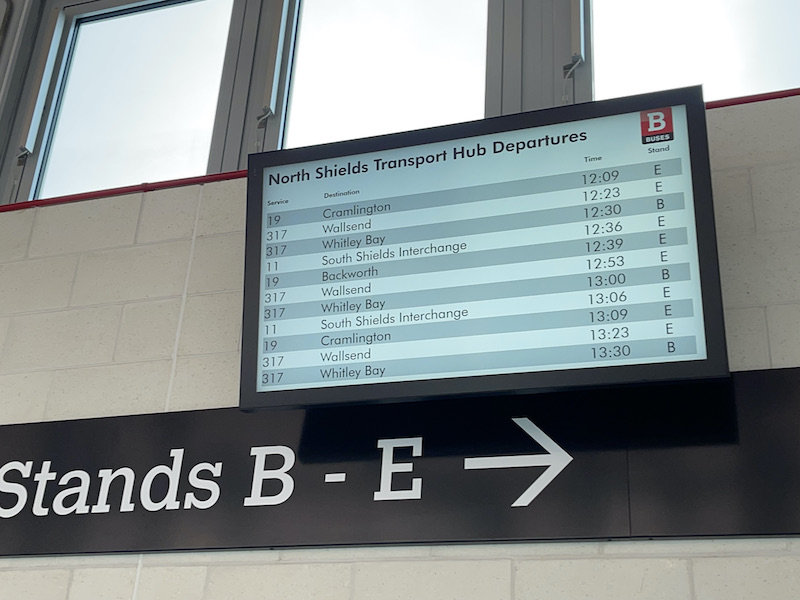
There are printed departure listings on free standing units by each departure bay resulting in details being rather low down to read. It looked like a stop gap measure to me, almost as though either someone had forgotten to specify the display of timetables throughout the Hub, or along with the scaffolding, the interior is not yet quite finished. But over two months on since opening I’d have expected something a bit better.

There are a small number of seats by each departure bay and two longer rows where the two frontages meet (under the scaffolding) but it didn’t strike me as a lot of provision.
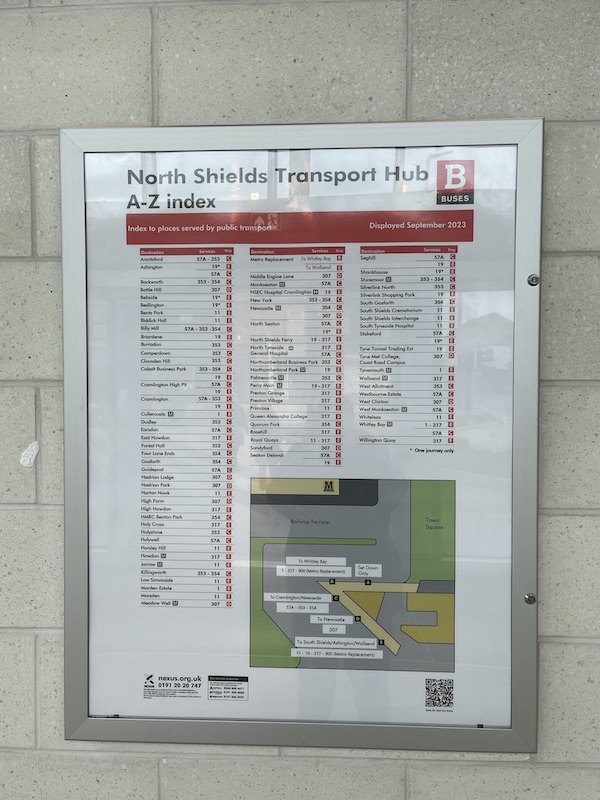
There’s an A-Z Index poster displayed by the entrance which advises the bay buses depart for each destination and confirms Bay A is for set down only. It’s an ideal spot along that corridor (see early photo) to also display printed timetables for all the routes.
The toilet provision was quite impressive comprising about ten individual gender neutral cubicles (including an accessible one) but it wasn’t easy to see which were engaged or which were vacant and would be helped by easy to see red/green lights as some facilities are now adopting.


I’m sure the Town Square alongside the new Transport Hub will be an attractive place to sit during nice weather especially as it’s envisaged there’ll be community activities and I noticed a largish screen in place.

On my visit on Saturday there was a lone busker and sadly for him, not many other people passing by.


The strike by bus drivers at Go North East has given an unfortunate start to the new Transport Hub. Sadly it doesn’t look as though it’s going to be resolved any time soon with the Company expressing dismay as Unite representatives walked out from the most recent meeting brokered by ACAS held on Monday last week.

The Company has offered a 10.3% pay increase but Unite have reportedly “demanded six monthly pay increases, as well as rises backdated to July 2023, and another in July 2024, Unite are now insisting on an additional pay increase on 1 January 2024. All increases they say, must be higher than anything already on the table.”
The Company also reports “Unite had been hanging their hat on references to North East drivers ‘earning less’ than their counterparts in Manchester. However, Manchester drivers work to far more flexible scheduling rules. Unite confirmed to us today that they would not want to swap their package of wages and conditions for that of Manchester or anywhere else. They want to keep their conditions as they are now.”
Unite’s General Secretary Sharon Graham on the other hand has said “Go North East could end this dispute with the stroke of a pen with the equivalent of money they’d find down the back of a sofa. The parent company is awash with cash and yet they won’t stump up the funds it would cost them to end this dispute right now.“
The last set of published accounts for Go North East (year to 2nd July 2022) showed revenue of £87,837,000 and operating costs of £89,745,000 (ie an operating loss of £1,908,000) before an exceptional “goodwill impairment cost” of £2,983,000 added even further to that loss. (The “goodwill impairment cost” is “due to the challenges in the current performance of the business and the slow recovery from Covid-19.”). The balance sheet for the business shows total assets of £55,724,000 and total liabilities of £64,776,000 giving net negative assets of £9,052,000.
Go North East drivers are reportedly receiving £70 strike pay per day from Unite the Union.
Bearing in mind the company’s dire financial position, maybe Unite the Union, reportedly ‘awash with cash’, should put in a bid to buy the loss making business from the Go-Ahead Group.
Sadly the dispute shows no signs of being resolved any time soon. But I’m sure one day this welcome new Transport Hub for North Shields will become busier with buses and passengers and make that £13 million investment look like it was a sensible investment.

Roger French
Blogging timetable: 06:00 TThS
Comments are welcome but please keep them relevant to the blog topic, avoid personal insults and add your name (or an identifier). Thank you.
 BusAndTrainUser
That scaffolding wasn’t there on opening day, nor two weeks ago when I visited so must be to allow some repairs.
When, or perhaps if, GNE drivers return to work there will be 16 departures per hour in a typical Mon-Sat daytime hour.
The eastbound service 1 already used the old stops in the area so had time in the schedule to use the new Interchange, but the westbound (Metrocentre) journeys would need either an extra bus adding to the schedule or the route shortened to omit ASDA at Metrocentre in order to have enough time to double run down to the Interchange.
LikeLike
I’m all for a fair pair for what is a tough job, but when I read that Unite walked out of talks with ACAS, that they’ve turned down over-inflationary offers, they’re not willing to adopt flexible working patterns, and they want money from profits which aren’t there, this seems to suggest that the demands are unreasonable.
I’d want to understand what Stagecoach pay in the area and to look at pay movements over a longer period to be definite, but failing that, if I were Goahead, I’d be very tempted to close the whole operation.
It seems that unions are emboldened to a point of biting the hands that feed them in some disputes in the transport sector in particular to an extent that can only damage the industry in the long-term.
LikeLiked by 1 person
I would have though that costs in the North East are lower than in Manchester particularly housing costs so I would expect pay in the North East to be lower than in Manchester which is quit a high cost area
LikeLiked by 2 people
With respect, Michael, just because one union is behaving in a way we can’t understand – and it’s worth noting that we’re mostly only seeing the company’s point of view in this dispute, Unite are being particularly poor at explaining their position – it doesn’t mean that all unions are equally bad.
LikeLike
I acknowledge that not every dispute will necessarily be a union wrong/company right situation and also that, as an outsider, I’ve only got a sketchy picture of selected facts. I’m seeing in this case a pattern of behaviour which suggests the union are more wrong than right. I do also see a wider pattern of emboldened unions making big demands, raising expectations of members and backing themselves into corners with little case and at the same time resisting reasonable change. More rail than bus to be fair. Just as well as this will just drive bus companies to abandon even more of their networks (which actually suits the union preferences for them to be publicly run).
Having said all that, another poster commented that the company are asking for dead mileage to be unpaid, which, in my view, would be wholly wrong.
LikeLike
GoNorth East is loss making it also owes
£50m to other group companies. It probably cannot afford to make much of a pay rise if they do it would mean putting up fares and probably giving up some route
LikeLike
Also noteworthy on this new facility is that a new contra flow (n/b) bus lane was introduced on Nile Street (previously one-way s/b only). This gives buses a quicker and more direct route north from the Town Centre.
LikeLike
Whilst one should not decry a new Transport Interchange, for 24 departures per hour this seems an excessively large building and very wasteful of space. Is it good use of £13m? And ongoing maintenance will be quite expensive in what is a deprived area? Roger’s pictures don’t show much footfall in the areas out the interchange, although of course traffic using it will be reduced by the GNE strike.
It’s interesting it’s called a Transport Hub, and the use of ‘Interchange’ , what happened to ‘Bus Station’? I accept that it’s proximity to the Metro merits it being an Interchange.
LikeLike
This was going to be my other point. We live in a world of haves and have-nots in respect of bus stations. In too many locations, we have new facilities built (as part of a redevelopment) that are too small or are constrained by commercial considerations. Exeter is a good example of this, and at least they still have a bus station whereas many places continue to lose them (e.g. Salisbury, Taunton).
However, I can think of countless examples of where new facilities are built (mainly in PTE areas but the odd local authority) that a completely out of proportion for what is required. West Yorkshire is perhaps the most culpable in that respect, but they are most certainly not alone.
Still, gives some local politician another photo op when they snip a ribbon?
An excellent blog (as always) and good to see Roger in my native North East. I had hoped he’d be enjoying the new Transport North East tickets that now encompass most operators from Tees to Tweed but bit difficult when the second biggest operator is in the midst of a strike (even if a few limited services are being brought back)
BW2
LikeLike
Why such a fancy impracticable design who knows. It adds to the costs but does not do much else. Why is the building so tall. ? It will add to heating costs if nothing else assuming it has heating. Why the roof overhang outside? It will provide no real protection from the weather
For a 4 bay bus station it seems to be an excessive cost and excessive design. Some of that money might have been better spent on improved bus services
Will the Kiosk ever open. Will there ever be enough passengers to justify it ?. The plus is it is a bus station . Most councils just get rid of them and have the buses parked up in random streets
LikeLike
There are a few reasons of why this Interchange appeared, the advantage of having family in the area.
The building is tall as the metro station is above it. Much of the reasoning behind it was due to events in the area, including Great North Run, needing good bus provision.
LikeLike
The metro station is across the road from the interchange (photo 4). It occupies an elevated but that doesn’t mean the new building’s roofline has to match it. Architecturally, it has little in common and it just seems so oversized. If the justification is that it is for the occasional event like the GNR, it seems a bit much.
In terms of the existential question of bus station provision (anon 08:24 and Rick Townsend), it really should be dependent on individual circumstances. Bus stations really benefit (inter-urban) services in towns with lower headways reflecting longer customer waiting whereas roadside stops are better for high-frequency urban services. Facilities should be good enough for people to wait in safety away from the elements without being an attraction for ne’er do wells. The other problem is that you’ll often have authorisation for capital spend but then nothing for ongoing management and maintenance, and North Shields looks ripe for that issue.
Intrigued to know Ian McNeill’s criteria for a good bus station. Eldon Square in Newcastle is really quite poor in terms of design (ask a driver – the angles for approaching stands are not good), whilst Derby is another one that’s a bit too small for what it needs to do.
Hull is probably the best one on that list IMO. Leeds is probably another superb example. Middlesbrough was ahead of its time and despite showing its age, it performs well.
LikeLike
The Metro station is on the other side of the road. Its height is really of no relevance to that of this building, other than in the broadest terms of scale and massing.
It doesn’t need to be tall to accommodate large numbers of people!
KCC
LikeLike
In respect of the industrial dispute, neither party is coming out of this with any credit. Go Ahead has traditionally paid a lower rate than Stagecoach, which is a historic continuation of the position for years. Go Ahead drivers are on 12.83/hr whereas Stagecoach NE drivers are on 13.69/hr. They want a pay rise and you can understand their position. However, the position of Unite is that they are benchmarking the drivers’ wages (and claim) not to drivers 5 miles away in Walkergate, but to Go North West drivers that are on >15.50/hr. The union is also coming out with the usual lines about how profitable Go Ahead is as a group etc.
However, that isn’t to say that I don’t have sympathy for the drivers. As I understand it, they were offered a pay rise but with some big changes to conditions. Not least that Go Ahead, having consolidated operations to a few super depots, wants to exclude dead mileage from being paid. In essence, it would be no pay rise. After the first few stoppages, there was a revised offer where the renegotiation of terms was removed… for the moment, and that they would then look to agree terms on a depot by depot basis. Unite has interpreted that as divide and conquer.
Sadly, both sides are entrenched and the pronouncements from both sides are making it much more acrimonious and that again will make it difficult to achieve a solution.
As an aside, the photos do show how Go North East has lost its way over recent years. Those routes are all ex GNE services, and the idea that Stagecoach would have services in North Shields and Whitley Bay would’ve been considered unbelievable even just a few years ago. Some of the new services were introduced on Arriva’s exit and Stagecoach also made a land grab by extending some of their services (although not to North Shields). Suspect not all the competing services will return when the dispute is sorted.
BW2
LikeLiked by 1 person
Wow, easy to see why Unite would reject unpaid dead mileage to consolidated depots that may involve increased travel costs for drivers compared to their original depot.
Peter Brown
LikeLike
Fully agree that neither party are covering themselves in glory, however my understanding is that the Unite pay claim made no such demands of parity with GNW. From memory it was 13% ish, whilst inflation at the anniversary date was north of 12%. 10.3% is the latest offer, with or without strings depending on your interpretation. GNE are up until now insistent on a 2 year deal, which for a lot of drivers is the main sticking point.
If GNEs offer is accepted, that puts the drivers on £14.14. For comparison, SCNE are currently on £13.69 and Arriva (Northumberland) £14.14; both of which are due negotiations imminently
Steve.
LikeLike
I wonder why Go Ahead Group notorious for defrauding the British Tax Payer of £51m simply doesn’t undertake here a fire & rehire policy which it undertook quite sucessfully at its Manchester operations to stop the dispute in its tracks. Let’s face it this organisation is far from ethical given its past history
LikeLike
Richard – it wasn’t relevant when you brought this up before in relation to Go South Coast, and it isn’t now.
BW2
LikeLike
What is of relevance is the historical context of an organisation that is now notorious for the institutional fraud of Government Funds. It may be irrelevant to you and you are happy to accept a fraud of this magnitude but all comments need to be in the context of the organisations reputation. As an accountant fraud is fraud and one is duty bound to report and comment on it under our strict AML & MLR rules.
LikeLike
As an accountant, are you suggesting that there is any fraud here?
The inference that I find fraud acceptable is vile and malicious. I do not find it acceptable. That Go Ahead Group was fined and paid back the outstanding monies is a matter of record. It has nothing to do with this industrial dispute.
In addition, your statement about Go Ahead Group successfully undertaking a fire and rehire policy is manifestly incorrect. Not only did they not ultimately pursue that policy, you are clearly unaware that Go Ahead Group and Unite signed a binding understanding that such an approach would not be used either with Go North West or any other group subsidiary.
As someone who knows the facts, I feel duty bound to correct the record.
BW2
LikeLike
That is of course your view on the events regarding the erroneous payments claimed by The Go Ahead Group the reality is somewhat different given it was described by H M GOVERNMENT as an “appaling breach of trust” of its activities between 2006 and 2020 and yes Unite negotiated successfully the attempt by Go Ahead Group to fire and hire at Go North West my comment was alluding to a surprise they haven’t tried it again in yet another dispute they now have on their hands.
LikeLike
Richard – the issues of the past surrounding Southern are well documented. We all know of them, and what happened. However, it is not relevant to the discussion of pay dispute in North East England.
Your surprise only illustrates that you are unaware that they have a signed undertaking with Unite not to pursue fire and rehire at any Go Ahead subsidiary. Therefore, it was never an option in this dispute.
BW2
LikeLike
Have just noticed the spellcheck had changed unsuccessfully to successfully and it should have read “which it undertook quite unsuccessfully at its Manchester operations” . Please accept my apologies for the error above now corrected.
LikeLike
Apology accepted
BW2
LikeLike
With all the claims and counter-claims it’s very difficult to make a judgement as to whether the current pay claim passes the reasonableness test, particularly without knowing what previous pay awards were. However, I wouldn’t mind betting that GNE’s poor operational performance is down to a large extent because of short-notice journey cancellations due to the shortage of drivers, many of whom may have left the employ of GNE to work in better paid jobs elsewhere.
The problem for bus companies across the land is their management teams are negotiating when they know they are still miles away from having a full complement of staff. Add high inflation to the mix and no wonder unions are flexing their muscles.
Dan Tancock
LikeLike
Most bus companies at leas outside of London appear to be trying to operate bus service with inadequate resources and insufficient reliable and serviceable buses and over ambitious timetables. The result being constant cancellations due to staff shortages and bus breakdowns and constant later running. Traffic congestion also plays a part as does inadequate bus stations
Sadly there is little to no sign of any improvements
LikeLike
Re the departure listings ‘low down’ by the departure doors. Is this to aid people in wheelchairs?
MotCO
LikeLike
At £13m Bus Stations are going the way of the rail industry, such as the £40m for a fairly basic Thanet Parkway. I would have thought you could have had 4 departure bays, an unloading/layover area and toilet block for £5m, although note that the unused facility at Barry in the Verify blog , which would probably been adequate for North Shields, came in at (only) £2.3m. Working from £5m that leave £8m.If you really wanted to spend it on Transport Infrastructure then I am sure you could put in good shelters and real time information at every stop on routes in and to North Shields and still have some change . The Interchange strikes me as a future neglected white elephant.
LikeLike
All building costs in this country are sky-high, it’s not just transport.
One issue is that we still believe that a million pounds is a lot of money; it’s not any more.
There was a time that a million pounds would mean you were set for life, able to buy a big house cash and a snazzy car and have lots of holidays in the Caribbean or wherever, and still have more money than you knew what to do with. That era was gone by decimalisation fifty years ago and yet it’s still how we think of a million.
The reality now is that even outside London if you win a million on the lottery, buy that big house and snazzy car and have a few decent international holidays, it’s almost gone.
But we still react as if a large building costing 10 million or 20 million is horrendously overpriced. It’s not, unfortunately.
LikeLike
I get your point but when you look at Exeter bus station at a quoted £8m, this coming in at £13m does seem steep in comparison and that’s from 2-3 years ago. Durham is being rebuilt at just over £10m. That’s the comparator
It may be that the cost of land included in that. Even so, it’s a lot and I’m not entirely convinced it’s a great design nor value for money.
BW2
LikeLike
BW2, I agree with you on all counts. I assume that it’s land costs which have really bumped it up, and I definitely agree that it’s neither a great design nor value for money!
I wonder if the “kiosk” will eventually be replaced with that currently unfashionable thing which used to be called an enquiry office? I think the Powers That Be massively underestimate just how many customers appreciate having a face they can ask questions of which is easy to find and actually knows what they’re talking about, and how offputting it can be when there is no such person. A security guard dressed up like a stormtrooper doesn’t exactly radiate approachability.
LikeLike
What’s a bus station for? Are they a place in or adjacent to the town centre where you know all buses will leave from? Or are they just to facilitate interchange between buses, and can be situated some distance away? If there’s a station (or ferry) should they always be situated conveniently for interchange? A place to layover buses off the street or an administrative hub needing driver accommodation and offices? Do they need a cafe and a waiting room if they’re in the town centre, or are these essential if they’re not? Is extensive bike parking something that’s needed? Do they need to have an information point, and should they always be staffed?
LikeLike
There’s scope here for blog readers to nominate their favourite bus station(s) based on their experiences and preferences. I suggest Poole (despite showing its age), Derby, Hull, Wolverhampton, Eldon Square, and pretty well anywhere in West Yorkshire.
Ian McNeil
LikeLike
West Bromwich Bus Station owned & operated by Transport for West Midlands has to be one of the best. It has dedicated staff on hand from 6am to 8pm & is fully integrated with the West Midlands Metro
LikeLike
I wouldn’t have described West Bromwich as the best in West Midlands let alone nationally, being an older & unrefurbished site though as you say well located & still with reasonable facilities. If you don’t mark them down for the West Midlands tendency to slightly complicated layouts then Wolverhampton or Stourbridge which have most of the same advantages as West Brom but in newer & more attractive packages are nicer. Most of the old PTE Combined Authorites are good for bus stations but each has their own design idiosyncrasies (such as island layouts etc) so it depends how you view those as to where they sit in a list. Outside these Leicester St Margarets is very good (Haymarket isn’t bad but is a little more congested in the passenger waiting area), the new Nottingham Broadmarsh is attractive for passengers but the vehicle area is a little dark as it is under a car park.
Dwarfer
LikeLike
West Bromwich Bus Station stand layout is designed for easy access between services and has recently been refurbished. Stourbridge is newer but dur to its position is only really accessed by lift for wheelchair users. Wolverhampton now has the West Midlands Metro running thru it but isn’t as good as West Bromwich as it is outside the town centre which West Brom Isn’t. Bilstons Bus Srarioin recently won a top award while Walsall is best described as functional but central. Halesowen haS a unique design which is fully enclosed and is right in the main shopping area. Dudley is being demolished in the New Year and replaced by a new facility including West Midlands Metro. Pool Meadow also provides a hub on the edge of the City Centre of Coventry. Overall I rate West Bromwich the best simply because it is in the heart of the town center, it has entirely step free access . It is totally enclosed and large enough to easily cater for the vast number of departures from it. Off all the excellent unrivalled facilities that Transport for West Midlands provides across the West Midlands. West Brom ticks all the boxes and indeed Andy Street CBE has made it one of his prime objectives as Mayor to launch his safer BUS STATION CAMPAIGN FOR THE BENEFIT OF ALL. One only has to venture slightly over the West Midlands County boundary to Kidderminster Bus Station to discover the stark reality of the excellent facilities passengers have the benefit from in the West Midlands Combined Authority.
LikeLike
No, West Brom doesn’t tick all the boxes, as passengers still have to cross roads to reach some stands – and therefore not fully undercover in the way that other sites mentioned (mostly or exclusively drive in-reverse out) are, let alone the risk of buses and pedestrians colliding.
It also means it can be a long walk between some stands for interchange purposes. It may be good from an operational point of view, but I think it is still wanting from a passenger’s point of view.
JC
LikeLike
In the early days of Andy Street CBE becoming Mayor of West Midlands Combined Authority one of the first things he instigated was a through review by the newly created Transport for West Midlands of all its surface management. Major changes resulted in West Bromwich Bus Station and involved crossings closed or reappointed this led to a safer and more comfortable Interchange for passengers. The very large size of the bus station also equates to plenty of seating for those less able and an Interchange of high quality with only 1 Pelican crossing giving easy access to West Midlands Metro. The majority of access points from the core shopping area does not include surface road crossing save from the old Spoons & Upper High Street.
LikeLike
With all bus stations there is this multi-layered view to take when taking an opinion and everyone will value each aspect differently. Location, size, facilities, design & layout will all carry different weight & achieving one may impact on another so if you value one higher than someone else will mean you hold a different view to someone else – both are valid opinions just based on a different set of criteria of importance.
If location is your most important aspect then West Bromwich will score well but it is a little draughty & less light (just being of that older design to newer builds like Wolverhampton is that cause and it is probably better than bus stations of a similar age elsewhere) so as a waiting environment for passengers it is less attractive but little short of a full rebuild (as Dudley is due) can fix that sort of issue. It has plenty of room for the buses & passengers but then so does Wolverhampton in that sense (though I suspect Wolverhampton would have a problem if all the services in the town ran in as West Bromwich does) which is a credit to the authority who own these sites in maintaining such larger sites.
Personally I find West Bromwich isn’t brilliant for transfer between services due to the layout, though whether you could get a better solution on that site with that volume of bus movements is a more relevant question, but I can see how it may do so on a different view of how it is used and it is consistent with how West Midlands lay out their bus stations (see Wolverhampton, Pool Meadow & Wednesbury as on similar lines) so locals probably understand it differently to a regular but not local visitor such as myself. The smaller sites in West Midlands (like Bilston) are in many ways better layouts than the larger ones, and are to be even more praised for their existence as serving such smaller settlements before you get to the quality of the facility itself.
Dwarfer
LikeLike
Thank you for the comments raised & I will pass all your points to Andy Street CBE Mayor of West Combined Authority & lead of Transport for West Midlands for thier consideration.
LikeLike
Don’t do it Dwarfer!!
I always felt that, like Middlesbrough, Leicester St Margarets was one of the beacons of good design in a time when there were some truly awful places in which to wait for your bus.
Of the PTEs, my experience would point to Metro (West Yorkshire) having the best examples. Even the older locations (such as Huddersfield and Leeds – yes, it’s now 30 years old) are well-designed and well-maintained, and they did a decent job in redesigning Bradford. However, they have fallen into the trap of taking that template and rolling it out across the region so you have some small towns with outsized facilities, reminiscent of North Shields, served by a handful of routes e.g. Batley.
As an aside and staying in the North East, Bishop Auckland bus station is now closed for redevelopment. That was definitely overdue!
BW2
LikeLike
Replying to Dwarfer’s comment at 13:24, I’m not so sure that Broadmarsh is attractive for passengers. Last time I went in (admittedly back in Spring) there was nothing there apart from the basics of bus stands, a few seats and toilets. There was no food or drink available in the bus station; the nearest was a coffee shop across the road on Carrington Street. There seemed to be a number of empty units (which don’t help make anywhere feel loved or welcoming), and there were plenty of random passages and escalators which led to closed doors or unsigned exits!
On the positive side the security guard was friendly, chatty and helpful!
LikeLike
I’ve not been to Nottingham since last year when the bus station was still under construction. That said, I remember the old one (and the old Victoria one) – fume laden hell holes that have thankfully been erased! Of course, escape the city into the shire, and Nottinghamshire embarked on programme of bus station building that again sees some rather grandiose construction. Newark is another structure that really seems a bit OTT for what is needed.
It’s worth noting that compared to the 1980s/1990s, there are very few really awful bus stations. Those subterranean cesspits or wild windswept collections of 1930s concrete shelters with smashed windows are thankfully just captured in photos now.
BW2
LikeLike
The problem for Broadmarsh is that they took so long to rebuild it (Leicester knocked down & rebuilt St Margarets in the period between the Broadmarsh site being cleared & construction of the new building started) that half the services that would have served it had either been withdrawn or got so used to new routeings that it made no sense to move them back. Add that to the wider redevelopment of that area of the city centre appears to have been further delayed and there are still lots of work sites around isn’t helping finding tenants for the units around the bus station. Broadmarsh is a decent design but it may be in the wrong place now (it was always slightly peripheral but at least it was attached to a shopping centre and near the station) and reduced need (only two operators don’t participate in the council partnership allowing them access to the city centre stops so most buses have served more central stops already) mean it may never reach its potential or fill its empty units, hopefully when the other developments are finished things may turn round.
Dwarfer
LikeLike
I like Bath bus station, central location, opposite lower end of the shopping area, fully enclosed concourse, adjacent to Bath Spa railway station.
https://images.app.goo.gl/sNU8cZcAh3iRLuW9A
Peter Brown
LikeLike
I too like Bath, and also Leicester St Margarets which I didn’t mention because many of its more useful routes (and therefore connections for passengers) have been removed to Haymarket which is overcrowded. Nottingham Broad Marsh lacks connectivity with the Victoria routes and is badly located on an island site.
Among more modern facilities, both Mansfield and Lincoln are overcrowded and lack free toilets.
Pool Meadow is underused, as many out-of-city routes which one would expect to find there start/terminate in nearby streets without proper facilities for staff or passengers.
West Bromwich suffers from complex vehicle movements and – at least the last time I was there – too much pedestrian access via potentially unsafe crossing points.
Ian McNeil
LikeLike
Leicester redistributed bus services between their bus stations in April so Haymarket is less congested and St Margarets is now busier. Essentially St Margarets has most, but not all, services heading north & west out of the city centre whilst Haymarket has most services heading east & south out of the city centre. Many of the routes that had moved into Haymarket previously was to deal with redevelopment of parts of the city centre, it did take some time to get operator agreement to move services around but that was always the plan. It also helps that the two sites are close together so interchange between the two bus stations, & so all services in the city, is actually very easy (it is no further than walking from one end of Haymarket to the other).
Most modern bus stations are designed down to the minimum size of a theoretical number of departures, allowing no expansion or change, and don’t allow for waiting (often either passengers or buses) as consultants can simulate it working on computer because they don’t look at how operators or passengers want to use it.
With all bus stations there is this multi-layered view to take when taking an opinion and everyone will value each aspect differently. Location, size, facilities, design & layout will all carry different weight & achieving one may impact on another so if you value one higher than someone else will mean you hold a different view to someone else.
Dwarfer
LikeLike
West Bromwich Bus Station has recently been thoroughly risk assesed for Transport for West Midlands & the crossing points have been modified accordingly.
LikeLike
Are there any statistics about level of public transport use in towns which have bus stations/transport hubs vs those which don’t? In Kent, Tonbridge and Tunbridge Wells don’t (though both used to have bus garages in central-ish locations) but, to be honest, I can’t see that this makes much difference. Sevenoaks has a (small) bus station but it does have an excellent information desk (run by Go-Coach Hire, who operate most of the Sevenoaks routes) and a cafe/restaurant, which was excellent when I was there last. £8 million seems a lot for a travel desk and a still-not-occupied kiosk, and I’d suggest that real time information all over the town would have generated a lot more custom.
Certainly having a well-publicised, well-signed point of interchange with other bus routes and the Metro seems a good idea, but could that not have been achieved by resiting and upgrading the central stops? I’m sure it’s convenient for operators to have a central point where staff facilities and bus layovers can be accommodated, but for passengers I’d say having through routes which all call at the shopping centre and a Metro or rail station would be preferable, and use the money saved to install real-time information and rent a shop close by to have a cafe/seating/information point. Cross-town services should simplify the network so that the town bus map becomes easier to use, and though they might only generate 10% extra use, isn’t 10% extra what the bus companies have been trying for post-covid?
Rick Townend
LikeLike
Considering the money and passenger facilities lavished on Rail, I don’t think anything spent on bus stations is wasted. To be able to change services, wait in the dry, have essential toilet facilities and information to hand is something Rail passengers take for granted, so why not bus users?
If reports of the Unite Union paying Drivers £70 a DAY are correct, I don’t imagine we will see a Go-Ahead bus on Tyneside streets until sometime south of 2025. And clearly memories have faded regarding the disastrous consequences of the 1958 London bus strike. It is amazing that out-dated working practices have survived so long after privatisation.
Unfortunately, in comment to Rick Townend, the Go-Coach Sevenoaks enquiry office has long closed. Probably on the grounds there isn’t much left to inquire about!!
Terence Uden
LikeLike
£70 a day strike pay is correct. That’s the standard rate that Unite pays. Given it’s tax-free loss of earnings must be minimal for anyone who routinely works the basic week without overtime or rest days.
Steve
LikeLike
TBH Go North East’s problems started long before the strike, ever since MG left the company it has been going downhill, massive cancellations and unreliability across the network were followed by using branded buses anywhere and generally abandoning route branding, meaning a blizzard of branding on all routes.
No strike of this nature happens with good management (do you ever hear of Nissan on strike?) GNE’s problems start at the top
LikeLike
I think you’ll find MG instigated the problems at GNE. Service changes in the middle of lockdown. THREE major fare reorganisations in three years. Endless repaints. I could go on
LikeLike
Hi there Roger
I am enjoying your blogs. I wonder whether you might visit the disaster that is Exeter’s new bus station? It has fewer bays than the old one, it’s too small for the crowds waiting for buses – with very little seating – and it’s further from the city centre. The reduction in the number of bays means that buses coming in have to find vacant bays regardless of the allocated bays for particular routes. There are only rare announcements which means, if your bus comes into a different bay from the one indicated, you may miss it (I have seen this happen) if you don’t happen to notice where it’s gone – and that, if a bus is cancelled, passengers are left ignorant of it. The displays are not real time and only show scheduled times so that (as you have noted elsewhere) departures disappear from the display at the appointed hour often without a bus being in sight. There is no enquiry office, no printed timetables and, usually, no staff around to ask. There is no refreshment place and no shop of any kind. At least the turnstiles to the toilets broke soon after installation and the toilets are now free again. That’s something…
The old bus station in Paris Street was a bleak place and needed to be replaced but the new one is a sorry excuse for a modern bus station, I’m afraid. Take a look!
And keep up the good work.
Iain
Revd Iain R McDonald 1 Coastguard Cottages, Dawlish, South Devon, EX7 0BT
LikeLike
He’s already been – blog from 2021 https://busandtrainuser.com/2021/07/27/exeters-new-bus-station/#more-22211
He shares a number of your observations 🙂
BW2
LikeLike
Thanks. I wasn’t on board in 2021! I’ve now read that blog. Just sorry to say things have got worse since then – and the displays are not real time.
Best wishes
Iain
Revd Iain R McDonald 1 Coastguard Cottages, Dawlish, South Devon, EX7 0BT
LikeLike
Interesting that the union cite Go North West pay rates by comparison, especially as the MD of GONW (Nigel Featham) is also MD at Go North East. Or do the drivers based in Greater Manchester gain, pay wise, as an unintended consequence of it’s new franchised bus network?
LikeLike
Steve 12:42 has summarised the situation correctly. Unite’s approach (I assume) was that by comparing to current local operators that have a pay rise pending, then a pegging to that would be underselling their members. Hence the comparison with another group firm. Indeed, the new rate offered has been touted by GNE as making the drivers the highest paid in the region… by a penny/hour and not reflecting pending pay awards elsewhere.
Pay rates in the North West across transport and logistics have always been higher than the North East so doubt the Bee Network has any impact.
BW2
LikeLike
Off topic (sorry)
Nice to read about major enhancements on the Chippenham to Bath service effective this Sunday. New more direct express service supplements weekday existing service. Later evening buses. Sunday service improved to hourly.
https://www.faresaver.co.uk/newsitem.php?i=9463110
Peter Brown
LikeLike
I was pleased to see today that the bus stop flags in Corsham have been renumbered and someone was replacing the timetables.
Big groups please note how it’s done.
Peter Brown
LikeLike
If we’re nominating good bus stations, I would give a shout out for Cornwall.
Penzance and St Austell are close to the railway stations, but are not manned; Newquay is handy, but tucked away and out of sight; Camborne is OK, but the winner, in my opinion, is Truro, prominent, close to the shops and offering a covered waiting area with a view of the buses and no roads to cross.
Peter Murnaghan
LikeLike
Peter – I think you’re being a bit kind there. St Austell is probably the best one with decent information and good rail interchange, whilst Truro probably has the best facilities. Newquay is a bit windswept and peripheral but it’s not a long walk.
Penzance is really quite poor despite its proximity to the station. As for Camborne, it is well past its prime. My wife said the ladies’ toilets were grim, and it had little spent on it as a) it’s a First facility, not TfC and b) there’s much discussion about an alternative/redevelopment of the site
You missed out on the other two Cornish bus stations – St Ives (rudimentary but fine) and St Just.
LikeLike
Regarding BW2’s comment about awful Bus Stations try Boston, Lincs. Absolutely dreadful
LikeLiked by 1 person
Hi anon 8:53 – Boston is awful. Previously, a selection of stands with each one having a grubby shelter. They decided that people shouldn’t have to experience those…so they removed all the shelters a few years ago save one at either end of the row of stands.
Was last there in 2019 – I assume it hasn’t changed much in that time.
BW2
LikeLiked by 1 person
Kidderminster has an absolutely vile bus station that is not just grim but quite a frightening place to visit. Worcestershire County Council seem unable to have timetables posted with Diamond Bus having to stick its own timetables to the ramshackle shelters. It just about sums up this country’s laughable approach to buses.
LikeLike
*IF* it’s true that GNE are wanting drivers to drive their buses on dead runs unpaid, then I don’t understand how anyone can possibly criticise the Union or its members for outright refusing to accept that. And with Roger having been a respected figure in the industry, I’d be very disappointed if he was endorsing such things at the young bus manager events. If a driver is out on the public roads driving a bus, they should be paid for doing so. As if the driver shortage isn’t bad enough, I think expecting bus drivers to drive buses unpaid isn’t exactly going to encourage that situation to improve. Hopefully reports of such a proposal in comments here are exaggerated or just gossip.
LikeLike
Reference driving buses on dead runs unpaid at GNE, I think this has to be an unfounded rumour as that would contravene the working time directive which basically says time at work ( in this case any driving) would have to be paid.
LikeLike
More likely to be that with the merger of multiple sites into fewer larger ‘super-depots’ that transferred drivers were being paid travel time from their old base location to their new depots and they are looking to remove this as part of the current pay negotiations. A normal thing to do but it tends to require a greater pay increase than would otherwise have been offered which GNE may be trying to minimise and is the result of some disquiet.
LikeLike