
Saturday 28th October 2023

Welcome to BusAndTrainUser Verify a new occasional media monitoring service which aims to fact check the veracity of headline grabbing negative claims about buses and trains so beloved of modern main stream and social media channels.




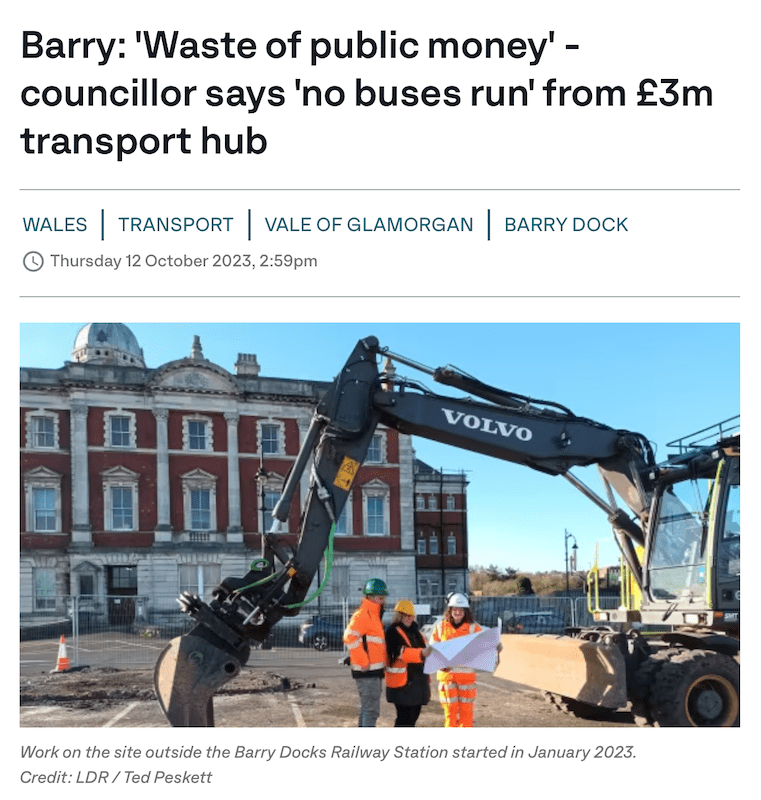
To kick off here’s a story that appeared across many media outlets earlier this month claiming variously £2.7 million to £3 million has been wasted building an extensive new transport interchange alongside Barry Docks railway station in south Wales to provide seamless modal interchange between buses and trains.
Except the media reported no buses use the sparkly new facility which includes four bus stops, four bus shelters, four real time signs and seats, cycle hubs and copious seating around extensive landscaping.
It’s reported the last bus route that ran nearby (albeit north of the railway tracks and not where the transport interchange is, south of the tracks) was Adventure Travel’s tendered route 88 between Barry and Penarth, but this was withdrawn in July following post Covid funding cut backs by the Welsh Government and the same local authority – Vale of Glamorgan – that built the new transport interchange.
The story sounded a bit too surreal to be true. It’s hard to believe a local authority would authorise so much expenditure on such an extensive facility when the one and only bus route in the vicinity, that couldn’t easily use it anyway due to the road layout and the railway tracks being in the way, was under threat of withdrawal by the very same local authority?
Inevitably the coverage included on location photographs of glum looking “exasperated councillors” from opposition party, Plaid Cymru, making the most of the incongruity of it all. And the media loved it.

But is it true?
…
In a pause worthy of TV’s Would I Lie To You …… I can reveal …..
…
Yes, it is true.
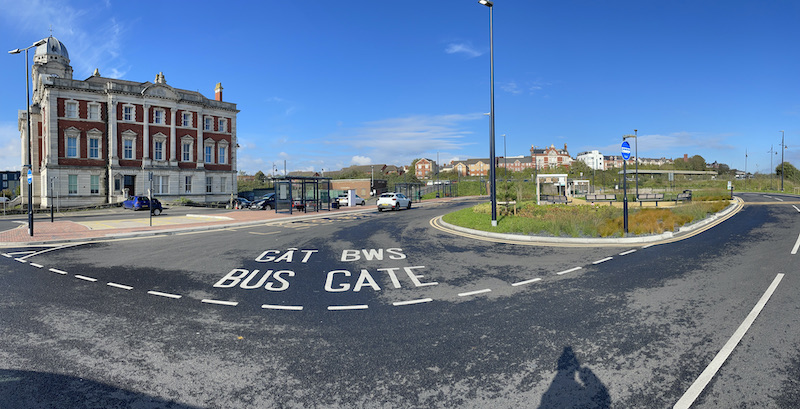
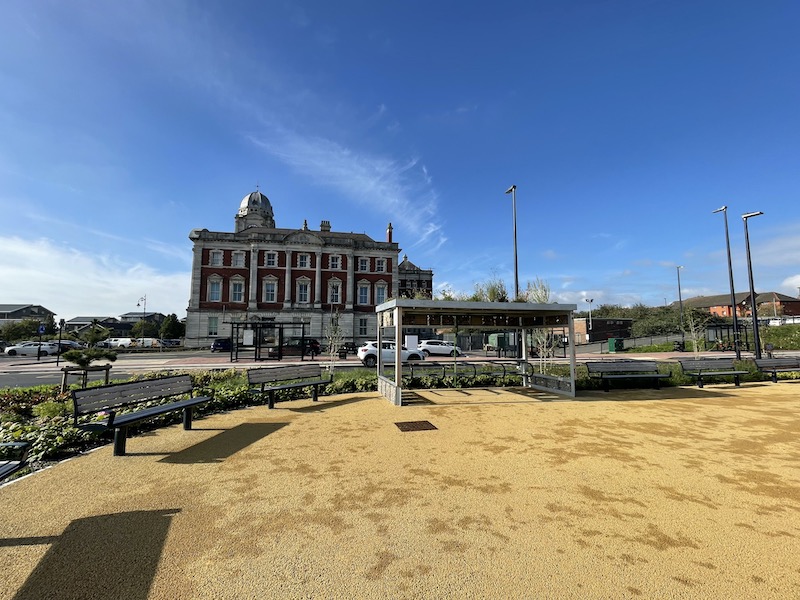
A beautifully landscaped four bus stop interchange has been constructed on the south side of Barry Docks railway station at a cost of almost £3 million and no bus routes go anywhere near it and are unlikely to for the foreseeable future.

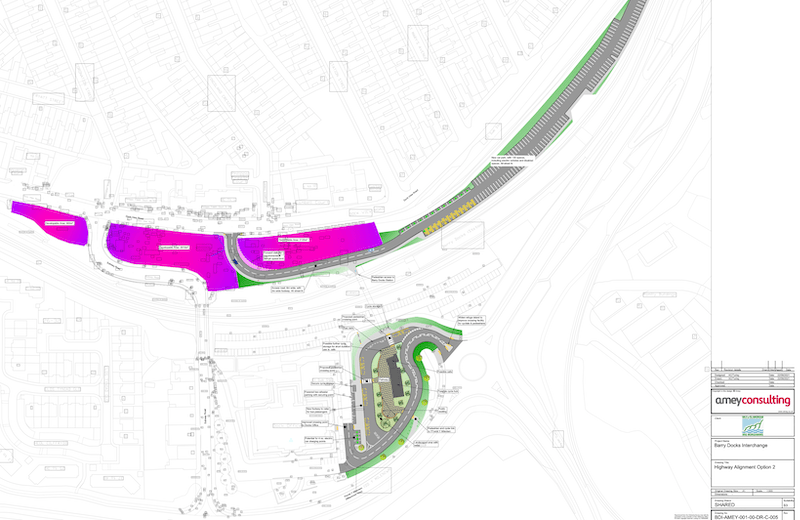
Here’s an aerial map/diagram to get your bearings and note the railway line cuts this area in two with most houses to the north, previously served by the withdrawn tendered route 88. Areas outlined in red either side of the tracks are said to offer development potential and to the south of the station lies a small existing Park & Ride site as well as an imposing Grade II Dock office overlooking the area set aside for the transport interchange.

Vale of Glamorgan Council consulted on its plans for the transport interchange in October 2021. The stated aim was “to enhance station access and facilities to accommodate additional passengers, using additional trains, which will stop at Barry Docks Station from 2023 onwards”.

The public were shown three different options incorporating (for option 2, compared to option 1) residential and commercial development on the area north west of the station within the red bounded segment and coloured purple on the map below, while the third option proposed locating the transport interchange there rather than south of the station.
Plans for options 1 and 2 showed a nicely laid out circular bus and taxi area located immediately outside the station’s southern entrance/exit with cycle racks and a landscaped area for pedestrians in the centre. It’s located on the former office car park for the adjacent Dock offices.

Eight months later in June 2022 Vale of Glamorgan’s Cabinet received a 165 page report seeking approval of the Business Case and authorisation of the expenditure to go ahead with Option 2 – the recommendation from consultants Amey and council officers. This was approved by councillors at the meeting.

Bearing in mind the outcome we now know, the report and its recommendations makes for fascinating reading but it’s a long a turgid read and I wonder how many councillors read it from cover to cover, not least the actual Business Case which stretches from pages 15 to 165 and includes a myriad of tables, maps, diagrams and figures with eye-glazing-over table headings such as “Sensitivity of PVB to Endogenous Demand” and “Sensitivity of PVB to MEC values”. I’m thinking, like me, most councillors probably just skim read it, at best.
Aside from the usual word salad of righteousness, for example it identifies six “issues around the station” including “repurpose Barry Docks station as a key gateway for Barry, its town centre, employment opportunities and attractions” yet Barry town centre lies a mile to the west and is well served by the next station along the line, funnily enough called Barry – ideally located for the town centre. Other “issues” include the usual baloney about “improving access” and “increasing rail use” with words like “sustainable”, “Mobility Hub”, “integrated network of sustainable transport solutions” culminating in this classic…..“to integrate and align the Mobility Hub services with the wider transport network for Barry, facilitating co-ordination and seamless interchange between all modes.”
But, keep with it, and all the facts are spelt out not least in paragraph 2.10 on page 7…
“At present access to the station by sustainable modes is limited. In the case of buses there is only one service that stops within a reasonable walking distance of the station. Council Supported Local Bus Service 88, stops on Dock View Road, but only on its journey out of Barry to Penarth. There is no bus that offers onward travel from the station to access the town centre or that can distribute rail users to other destinations in the town. The nearest point to access such services is the stop west of Barry Dock Station on Ffordd Y Mileniwm and adjacent to Morrisons Supermarket, which is used by a majority of Barry bus services as a major timing point. This stop is some 900 metres walk from the station, over double the maximum walking distance commonly considered acceptable to access a bus stop. This is a substantial barrier both to those seeking onward travel from Barry Docks to destinations within the town or its surrounds and to residents of Barry seeking to access the station who would potentially use a direct bus.”
My eye was also caught by this table comparing the idea of locating the interchange either north (option 3) or south (option 2) of the station (note there was no option of not having a transport interchange!).

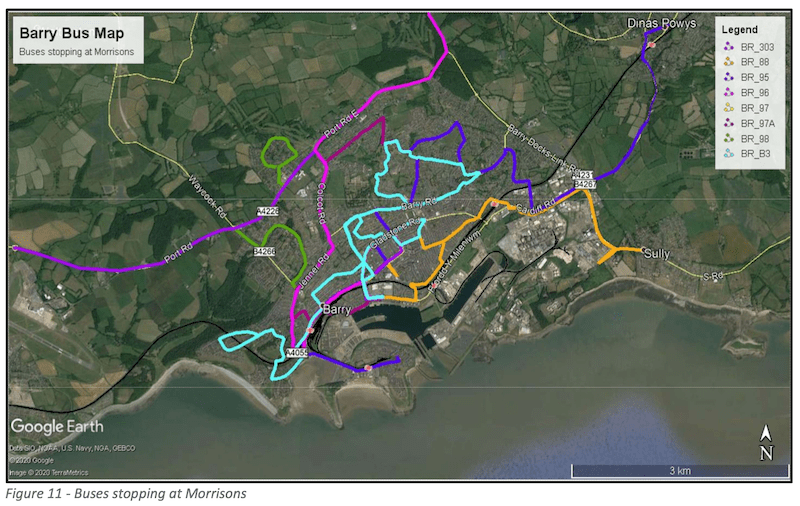
Bearing in mind Cardiff Bus doesn’t operate bus routes close to the south of the station (see its network map below) and Adventure Travel and the Council withdrew its service, the statement “Interchange to the South … Most attractive to bus operators” is rather stretching things a bit.

The Business Case included a rather incomprehensible bus route map including route 88 in orange.
The Business Case also contains a short section (3.3.7) entitled Bus Services which explains the Welsh Government’s aspirations for a franchised bus network (albeit without mentioning the ‘F’ word itself). Instead it notes a White Paper for Buses published in March 2022 with yet another word salad…..
“…. is about creating a bus system dedicated to providing the best possible service to the public. That means a bus system which is governed and designed to serve the public interest, with the widest possible geographic coverage, fully integrated connections between different services, the highest possible service frequencies, and simple unified easy-to-use ticketing and information – expressed simply as ‘One Network, One Timetable, One Ticket’.”
So, once bus franchising comes to Wales, it looks as though Vale of Glamorgan councillors are pinning their hopes on a redrawing of the Barry bus network with buses flocking to Barry Docks station transport interchange…. because it’s been built there. Good luck with that.

As to the costs of the scheme, the overall costs for Option 2 are stated in the Business Case as £7.6 million but the June 2022 report only authorised Phase 1 which involves those works south of the railway line (ie the Transport Interchange) rather than the development to the north west. This was just as well as the three sources of funding involved – the Local Transport Fund, Cardiff City Region and the Vale of Glamorgan Council had agreed a three way split of the Phase 1 budget comprising £1.5 million from the first two and “a further capped £1.5 million having to be found, if required, by the Vale of Glamorgan Council”. The £3 million cost therefore looks to have been achieved within those first two funding pots without recourse to the Council’s finances. As far as I can see no further expenditure (for Phase 2) has been agreed.
Following the June 2022 report getting the thumbs up, construction work on the new transport interchange began in January 2023 and impressively in quick time has just recently been completed, hence now, the outcry about the folly of it all and the media coverage.

Against all that background I couldn’t resist a trip over to Barry Docks on Wednesday to check out and BusAndTrainUser Verify the new facilities for myself.
What immediately struck me as I left the rather basic station …
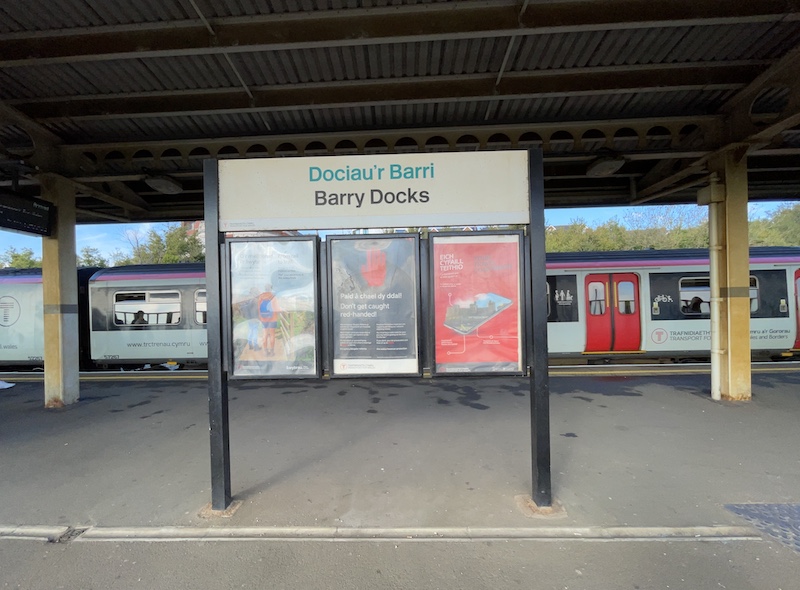
… island platform …

… and turned left at the bottom of the ramp to walk under the Barry bound track to the transport interchange …

… while everyone else turned right and passed under the Cardiff bound track towards the houses located nearby…
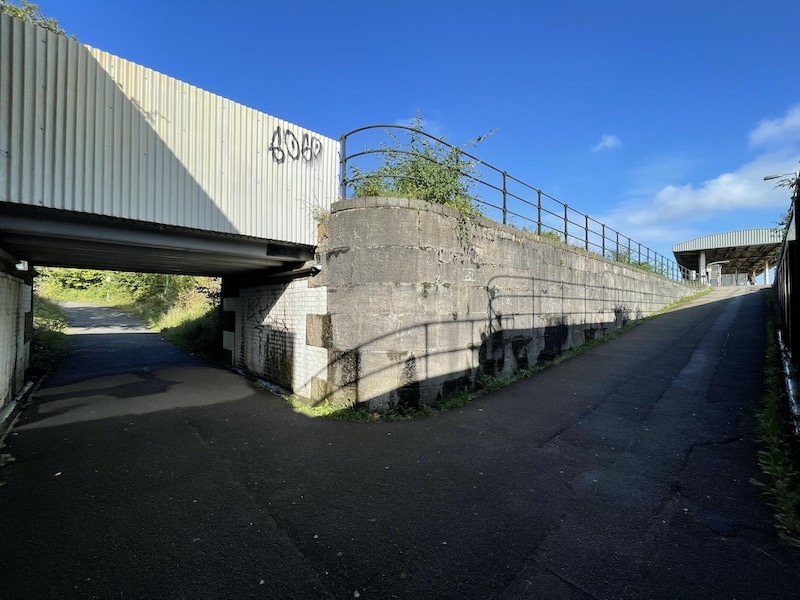
… is just how quiet the area is with absolutely no one around.
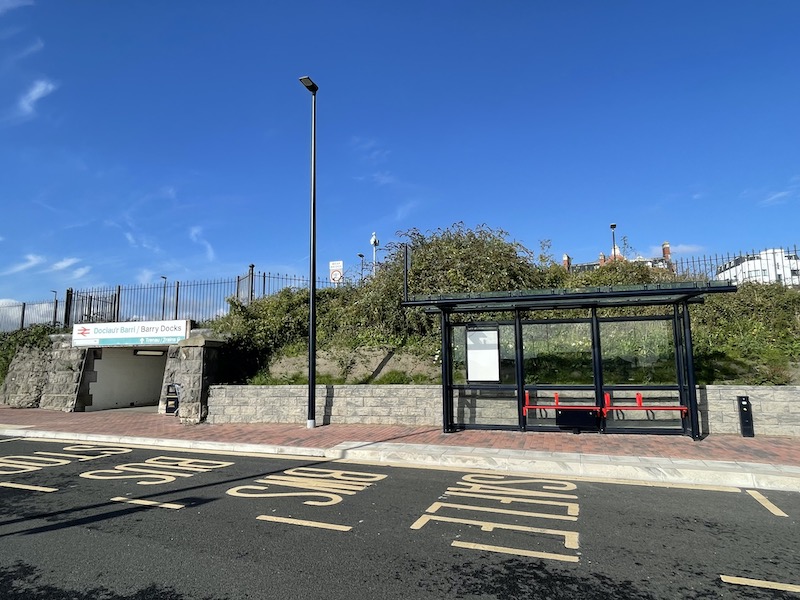
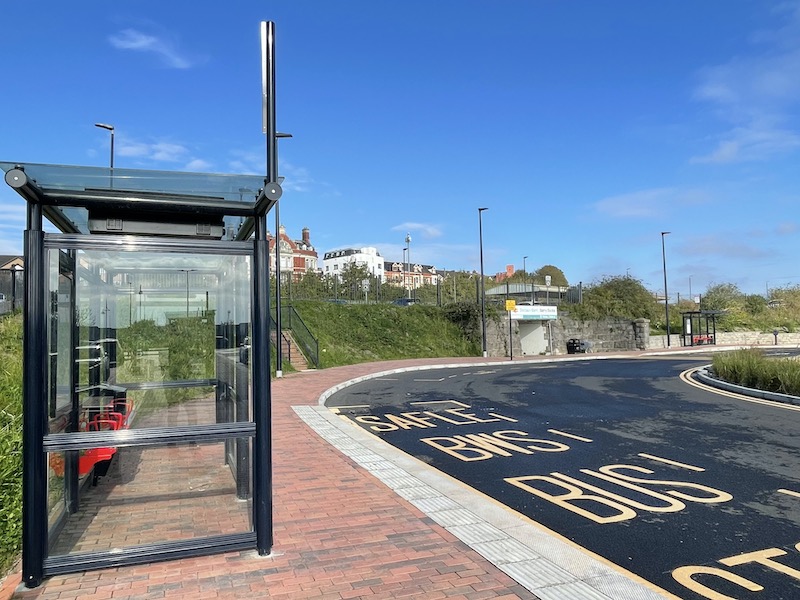
I spent almost half an hour wandering around and didn’t see another soul other than a couple of motorists arriving or leaving the Park & Ride car park.


It was a surreal experience inspecting each of the four bus shelters …
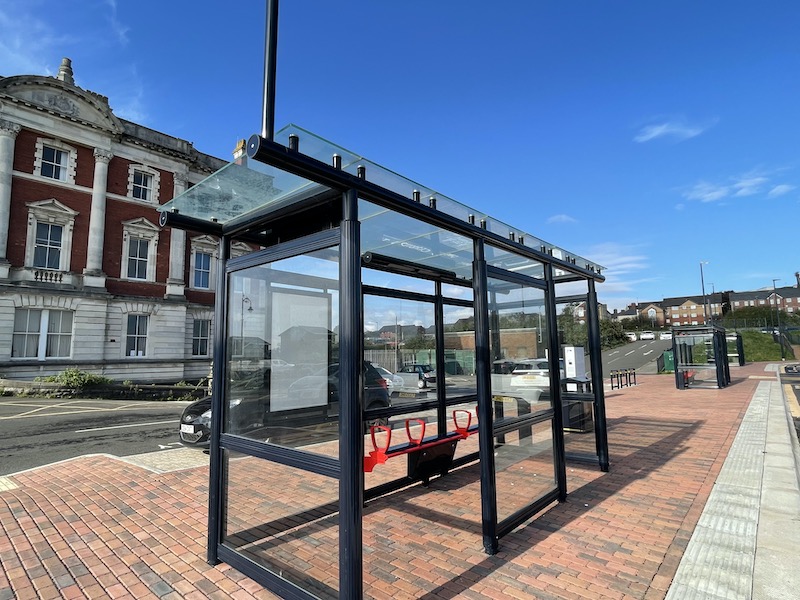
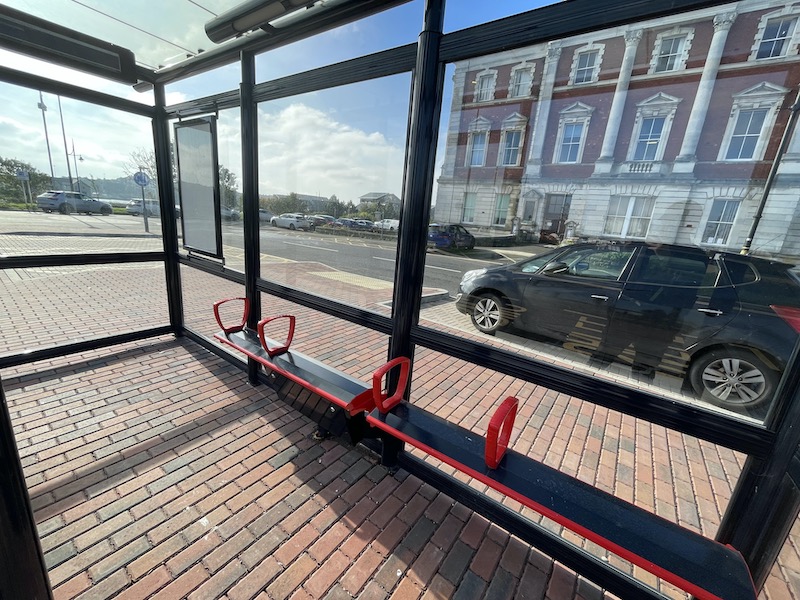
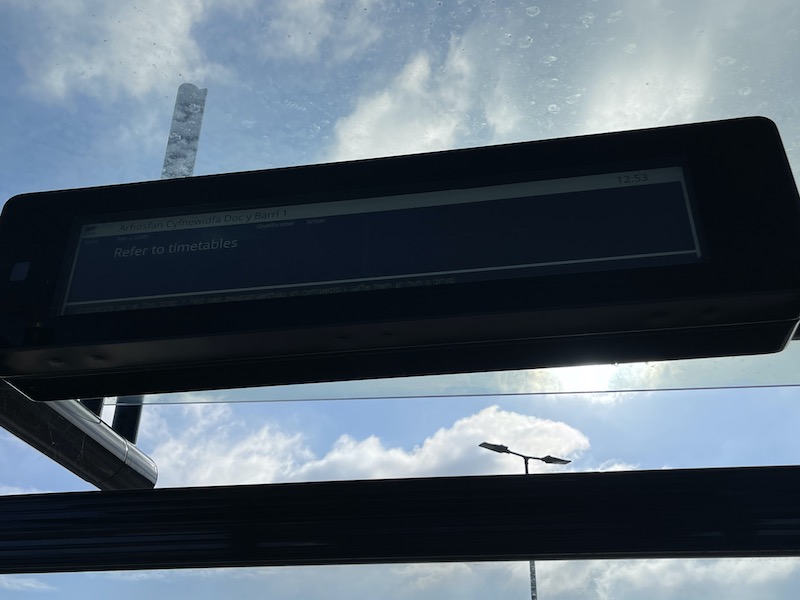
… complete with real time signs ironically displaying “Refer to timetables” bearing in mind there are no timetables on display as there are no buses.
In the centre of the rather delightfully landscaped area is a cycle rack with no cycles …
… and a bike hire docking station with no hire bikes.

Placed around the landscaped central area which the phantom buses encircle I counted five litter bins with no litter together with 12 rather nice bench seats (including four as you leave the station – see first photo at the beginning of the blog with one seat offering an unrivalled view of the station exit) …

… for the non pedestrians to stop and rest and enjoy the foliage planting before catching a non existing bus or catching a train which at least do run – every 15 minutes into Cardiff.
In the litany of failed publicly funded projects, £3 million for a bus interchange with no buses is nowhere near being the worst example of wasted expenditure on transport projects. And I guess there’s the forlorn hope if and when the modest residential and commercial development is built in Phase 2, new or changed bus routes could be introduced to make use of the newly installed bus stops and shelters. But Cardiff Bus would never see that as a commercial proposition so it would need the Welsh Government achieving its objective of “taking back control” of buses. The problem with that being it’ll incur even more public expenditure … and look what happened to route 88.

If you see something trumpeted in the media (either outlandishly hyped up positive claims or exaggerated downbeat negative reporting) that could usefully be fact checked by BusAndTrainUser Verify, do get in touch.
Roger French
Blogging timetable: 06:00 TThS
Comments are welcome but please keep them relevant to the blog topic, avoid personal insults and add your name (or an identifier). Thank you.


An own goal for sustainable transport.
LikeLiked by 1 person
On the many occasions I have to read various Council Committee reports I am staggered about the mass of information, the length of the reports and the short time Councillors or other elected officials have to read and digest these massive tomes. No wonder things go wrong
But don’t blame the Councillors, how come the utterly incompetent transport consultants Amey ever suggested the scheme without a thorough review of bus services in the area. It shows how useless the transport consultants are, the continual cost overruns on HS2 being another recent example.
LikeLiked by 1 person
Wow! What a spectacular waste of money! Outrageous.
One assume the location used was ‘easy’ to develop – free from making a real improvement for the public transport network that would have meant local and national politicians making ‘grown up’ decisions.
It’s a while since I went to Barry, but the main shopping centre was nowhere near the railway station.
Contrast this folly with the other news headlines in Wales about a complete collapse in bus services due to funding – but rail getting another £125m just to finish this financial year off.
Seemingly taking control of the railways by their government will more than likely bankrupt them and put a squeeze on all other areas of their duties.
I read about the statements of their be no rail strikes in Wales as they had settled their dispute. I wonder at what cost – both finically and to whom!
Shame on their government and TfW.
LikeLike
Sounds like the same thing RBC & WBC did when Reading buses 500 was withdrawn
LikeLike
Yes ……….. consultants! I wonder if there is, in the world of local government, a black-list, with the names of consultants who have clearly demonstrated their uselessness?
LikeLike
I seem to recall a similar issue in Greenwich c2000. A guided busway was built to allow guided buses to serve the Millennium Dome. In the end they never materialised and the busway was unused for many years. I think the confusing layout also resulted in several accidents and even deaths. In the end it was ripped up and replaced I think by a dual carriageway. Greenwich has a bus station with a very poor layout which could be improved. There was also a proposal for a Greenwich Waterfront Transit using guided buses but that never happened either.
LikeLiked by 1 person
The busway was still there when I used it this year.
Mike C
LikeLike
I wonder what those consultants engaged had any of their concerns listened too, or not? This smacks of the latter. What a waste!
LikeLike
Around twelve years ago I attended a local Parish Council meeting where one of the agenda items was the replacement of a bus shelter demolished by a lorry. In vain did I point out that there was now only a school bus route serving that shelter . . . the decision was to replace the shelter “because it had always been there”.
Four years ago the shelter at Kings Langley station . . . brick-built and with real time screen . . . was demolished by another errant lorry. 18 months later, the shelter was replaced . . . brick-built and with real time screen. Number of buses using the shelter? One per day, either at 1040 or 1123. Passenger usage? Pretty much 0 passengers per day. The last regular bus route to serve the shelter was in 2017.
And we ask, again and again, why bus industry professionals fear local authority involvement??
greenline727.
LikeLike
Did you travel on any buses for the blog? The New Adventure Travel 304 is a right mess – both in terms of reliability and the buses used. If there was ever a need to someone to undertake some monitoring and vehicle inspections it’s this operator. Woeful.
My latest experience on Wednesday was a relatively new single deck where the seat was I went to use wasn’t bolted right. Oh, and the driver had his ear buds in again. And 33 m utes late.
Despite raising this to them, they do not address these issues.
LikeLike
If you haven’t already, bypass their customer services and message/tweet/X or whatever it’s called now (!) Adam Keen directly.
Keith Briant
LikeLike
Engineers design and build, and once they’ve delivered, they then move on to the next project. They don’t sufficiently question what purpose their creations will serve.
Consultants don’t care either. They just want the commission and the more positive the spin they place on a project, the more likely it gets the nod. In turn, the consultant’s commission is extended and the money continues to roll in.
The councillors really should be sense checking the plans, but the 165 page reports are overwhelming and the occasional word salads are appetising.
LikeLiked by 1 person
Councils have a very long and very sorry record with bus stations. Usually demolishing them. If they build new ones they are usually badly designed and to small. Ones that come to mind are Hertford, Chelmsford, Colchester but there are plenty more. One has to wonder as to the capability of the expert consultants.
You get he same sort of vague plans and lots of words in the LTP’s. These are written and just filed away very little that is put in them actually happens . To add into the mix there are no the bus improvement plans. Lots of committees have been set up and lots of reports have been written but very little has actually happened
Council are now starting to ask the government for more money for their failing DRT schemes . The cost of these schemes compared to the benefit they provide is just crazy as it is. Will the government throw even mor money at existing DRT schemes? I doubt it. There is no sign that they will ever even reach breakeven
LikeLiked by 1 person
Never a week goes by without somewhere in the UK that a nus station is closing or there are service cuts etc or in our case a late running metro extension project in Wolverhampton. As someone heavily involved with the local transport authority here in Brum surely we should be congratulating the local authority for delivering the project and providing here an facility that is a high quality Interchange between transport modes. Its is clear with covered shelters , electronic indicators and quality seating the project has been delivered to a high standard. I always welcome projects which enhance local facilities such as this. In this instance it obviously meets the high standards laid down for value for money in a public expenditure project as demonstrated in S2 E1 of Yes Minister:where a newly built hospital has a full administrative staff but has no patients at all due to a government imposed reduction in the recruitment of medical staff. For some reason, Sir Humphrey does not want this particular boat rocked. He explains that they should measure success by activity, not by results. ….
LikeLike
Yet another “Emperors New Clothes” moment, where “Consultants”, who have probably never stepped on a bus in their lives, blind-side Councillors, most of whom similarly know absolutely nothing about buses but are let loose to splash an allocation of what is actually OUR money…..
But never mind, Politicians know best……just Lord help the places where they seize full control.
Terence Uden
LikeLike
Looks like Vale of Glamorgan Council is following in RBC & WBC foot steps when they both agreed to upgrade a patk & ride after the bus number Readings 500 became non existing
LikeLike
A totally useless project. Buses don’t go to that side of the station – there is no need whatsoever for them to do so. There’s not much of a shopping area in the King Square/Holton Road area these days – certainly not enough to attract loads of visitors. A better facility in the King Square area would have been much more useful.
LikeLike
A similar report of the long running saga of Cardiff’s long lost bus station and the still not open, much smaller, replacement, might reveal much more than is usually available from local media. Meanwhile Cardiff Bus have reduced or removed a number of services, including some in Barry, and traffic problems and council road works have resulted in passengers being left behind by buses “regulated’ and driving by” Not in Service” on the only available route from their area.
LikeLike
Plenty of comments on here lambasting “consultants” for not acting as some kind of moral gatekeepers or referees over public spending. This displays a very poor understanding of how things work in the, unfortunately, imperfect real world. Consultants are paid, and therefore contractually obliged to undertake a stated task by a client. They can of course not bid for the job in the first place, or indeed if they have the relationship and opportunity to do so, suggest that the question being asked isn’t the correct one to be asking. But that doesn’t change the overall fact that it is the client who sets the exam question – not the consultant.
Given the levels of competition in the consultancy market, at least one firm will bid for a job regardless as to whether those responsible personally believe in the merit of that particular brief. At the end of the day, people like their wages continuing to come in so they can pay their mortgages and put food on the table, and shareholders like to see their dividends and stock prices rise for similar reasons.
Which brings me back to Barry Docks. Clearly the language used in the brief demonstrates that the consultant was fully understanding of the situation regarding current and future bus service provision in the local area. The legalistic prose (or “word soup” if you will) used is a way of demonstrating this plainly evident fact without straight up undermining the case which the client had paid the consultant to make.
So therefore we come onto the question of why the brief the consultants responded to was so limited in scope, given the obvious uselessness of such a facility in that location? We can be sure it was either cock-up or, if not conspiracy, then certainly convoluted justification. Sadly, my years in both consultancy and the public sector suggest that both are potentially valid explanations. Budgets get argued for and buttoned down early for political reasons, making it hard to back down once the uselessness of these ideas has been pointed out at early stages. Complacency is also a frequent culprit – sometimes its expedient to ignore the reality and allow a project to run its course despite being fully aware as to its lack of value. Alternatively, those promoting the scheme within the local authority might have genuinely not had the understanding of what they were pushing for – they are, in the most cases generalists after all.
Either way, I do hope the full story does come out, although I strongly doubt that it will be the last occurrence of such a (relatively) profligate waste of money.
M.P.
Addendum: Please don’t read the above as a defence of the system of transport planning as it currently stands.
LikeLiked by 1 person
I don’t blame the Consultants. Most of the comments here betray a lack of understanding of the client-consultant relationship.They will have been following the brief set out for them by the commissioning officers.
I have no doubt that the responsible Consultants will have pointed out the lack of service available to use the new facility, but it will have been seen as phase 1 of a long-term development. In this case, it appears that the new facility has been constructed in a remarkably quick timeframe.
LikeLike
One of the best I terchang3s I have experienced in recent years is in Galashiels.
Maybe Roger would like to take a trip to view.
Tony Burns
LikeLike
There’s one in England,the Hartlepool Travel Interchange AKA bus station, which is next to the railway station which has hardly any buses stopping there.The only regular services are the buses to Durham which I think are the 58 and 59.A couple of early ones on a few other routes and National Express twice a day.For some reason the two dominant bus companies prefer not to use it opting for on street pick ups.
LikeLike
The course of the railway at this point is south of the commercial part of the town centre, and was presumably built that way so that the station would be as close to the docks as possible. The history of the railways in this area is very complicated – the docks in Barry were developed by David Davis, and his company also built the Barry Railway, but this line came into Barry from the north – the more direct line from Cardiff via Dinas Powis, which also continues west to Llantwit Major and Bridgend had already been built.
As has already been pointed out, the main commercial centre of Barry is at King Square (near the town hall at the junction of Holton Road and Tynewydd Road), and due to the southward curve of the railway, this is quite a long way from Barry Docks station. For interchange purposes, Barry station (about a mile further west) would have been much more convenient, as the stop at Barry Hotel was quite near the station.
About 45 years ago I used to occasionally work as a conductor on the routes from Cardiff, and all three main routes ran through Barry from Barry Hotel via King Square and on to Cadoxton to the east of the town centre. The stop at Barry Hotel was also served by some town services and the route to Llantwit Major. Although the passenger train service to Llantwit Major and Bridgend has in the subsequent years been reinstated, I suspect that Barry station (not Barry Docks) would still be the most sensible location for a bus/rail interchange of this nature.
As I understand it, the volume of coal exported from South Wales ports reached its peak in 1919. Given that Barry Docks was built principally to serve the coal export trade (including to other parts of the UK), one could logically conclude that the requirement for the interchange has been in decline for 104 years. From my perspective, that is basic local knowledge that councillors should have, so I would agree with some of the above comments, to the effect that it is not the consultants who are at fault. The local representatives should have known whether the proposed solution was appropriate or not, and should have provided the consultants with appropriate guidance.
On the other hand, Roger’s photos suggest that there is quite a lot of land in the area around the station, so that perhaps some of the 1.5 million new homes that Mr Starmer claims that we need could be built there. Then the interchange might yet have some useful purpose.
Nigel Frampton
LikeLike
I will further add that austerity removed areas of expertise from local councils. My retirement has paused because I am being called all over the country to plug gaps because there are no permanent staff. My work is not in transport. I am used because I have the skills and go away at the end of the job with no redundancy payoff. It is seen as good value because I am not on the headcount. The reality is that there is no residual capacity so they call in a trouble shooter next time. And, at 67, it isn’t going to be me for much longer.
LikeLike
It isn’t only consultants – sometimes bus operators need verification too.
An example is Stagecoach East’s route 36 from Peterborough to Eye and Thorney, which Roger sampled after it was extended to March last year. He commented that the extension was light on passengers (from memory he was the only one) and questioned its viability.
Indeed within a few months Stagecoach decided “with great regret” to withdraw the entire route and “use the resources” to provide additional journeys on the parallel 37 between Peterborough and Eye.
This would leave Thorney village with no bus service to and from Peterborough except the hourly non-stop First excel. Yet a Stagecoach spokesman quoted that service as running “up to every 30 minutes” which was parroted by the local press but never challenged. In fact the minimum First service interval in either direction is one of 55 minutes towards Peterborough on weekday mornings, as all excel buses that are more frequent use the A47 Thorney bypass.
There is a separate and much smaller place 2 or 3 miles along the A47 called Thorney Toll which does get the full excel route – but a local spokesman wouldn’t confuse that with Thorney, would he?
(A stopping service between Thorney and Eye was eventually provided by FACT.)
Ian McNeil
LikeLike
I would have thought that planning a transport interchange would factor in from where and to the connecting bus services run, if these services already exist, if not how would you procure them. As others have said Barry Station in the town centre appears a more logical choice.
I often wonder how much money was wasted on the Swansea (ftr) Metro, given that nothing now exists of that project.
Peter Brown
LikeLike
For a small bit of balance, until September, Cardiff Bus did have more buses terminating at Morrisons and so I think some of the idea was for these buses to extend the extra minute or two into the new interchange. This is something which makes sense, especially when the buses were carrying on to near the interchange for their layover because the Morrisons bus stop doesn’t have enough space.
What no one thought about at any point though was how busy the Morrisons stop is and for all of the buses to serve this new interchange would mean either buses having to double back to serve Morrisons on the correct side or force the many, many passengers who board at Morrisons to walk the extra 250 metres to the bus stop on the other side of the road. Of course neither option would be preferred by operators nor passengers.
Sadly nothing will change in Wales, Full of useless, waste of fresh air and waste of NHS budget councillors and politicians. None of them have got a braincell between them and they have certainly never used buses before in their live.
LikeLike
This jogged my memory about the Poole park and ride scheme in the early 2000’s. Considerable sum of money spent on building the facility with the pre-GoAhead Wilts & Dorset contracted to provide the service for which they bought 3 Optare Excels. Before it opened there was a change in local authority control and the whole scheme was scrapped before it opened. I think Wilts & Dorset took legal action for breach of contract and to recover their costs and it was settled before court. The site sat empty for a long time and the 3 Excels found their way onto my then local route, the X4 Salisbury to Bath.
Keith Briant
LikeLike
A lot of the problems associated with projects like this is the council officers who need to tick certain boxes and spend an allocated fund. Councillors only have a limited amount of time and to receive a 165 page report to read and understand in a short space of time will only be glanced at. Unless the member is particularly interested in the subject matter they will have to go with the officers.
This should never have got off the ground and senior officers should have put an end to this before it went to cabinet. I really must go and have a look at what I have contributed to in my council tax!
NT
LikeLike
Unbelievable! Hope someone tips off Private Eye about this fiasco. In fact I might do so myself.
LikeLike
anyone that has ever visited Barry ill know that Barry Island as seen on the TV program is where any transport hub should be
having read a number of these reports by consultants I am not impressed
i would question the need to even use consultants there should be enough expertise in the LTA and bus companies to establish any need for a bus station. its size and Posible locations/ Consultant’s ho have zero knowledge of local buses are not in a position to come up with sensible plans in general they do not even engage with the bu companies
LikeLike
Someone has specified that four bus stops were required, no more, no fewer. I wonder if somewhere in the 165 page there is an explanation on how they came to this conclusion? It’s a rhetorical question and I admit life is too short for me to check for myself.
Steven Saunders
LikeLike
When I was a Member of LOTS, their monthly journal (TLB) regularly had an item on the last page – abandoned bus infrastructure discovered many years after route changes. The tabloid newspapers enjoy a similar novelty feature: bus shelters put to other uses after route abandonments and the occasional shelter built by councils ignorant of their local bus networks, on roads never served by public bus services. There are currently bus cages along Bollo Lane near Chiswick Park Station where Route 440 used to go. What has happened at Barry staggers me.
LikeLike
When I worked in the public transport section of a County Council in the 70s the chief officer would not accept any draft committee report longer than two sides of A4 because “the members will not read it”. If they want
more information “they will ask”. How times have changed!
17A
LikeLike
When considering where to put a bus station and what size it needs to be you need considerable knowledge of the local bus services and the local road network as well as needing to know as to where passengers want to get to in the town centre
Consultants simply do not have that level of knowledge hence the poor designs and locations of most new bus stations
The only think Consultants add is costs and time delays. I guess the many charts and pretty pictures though impress the Local councillors most of whom will have never set foot on a bus
LikeLike
Given Cardiff Bus spent so much effort trying to get the Barry/Penarth services to Cardiff off what was National Welsh (and contributed in small part to the troubles that privatised company had ( many factors elsewhere were greater ), I always find it ironic that Cardiff Bus cuts back / removes services in / to those areas. Obviously for the Transport Interchange development will come depending on how useful the docks land is, and maybe there are other council reports that better show how future development is planned at an indicative scale and time frame. In the meantime it seems an ideal place to run Barry Bus Museum Services on a summer weekend to as plenty of stand space.
LikeLike