Thursday 26th October 2023
A ride on the Waverley paddle steamer
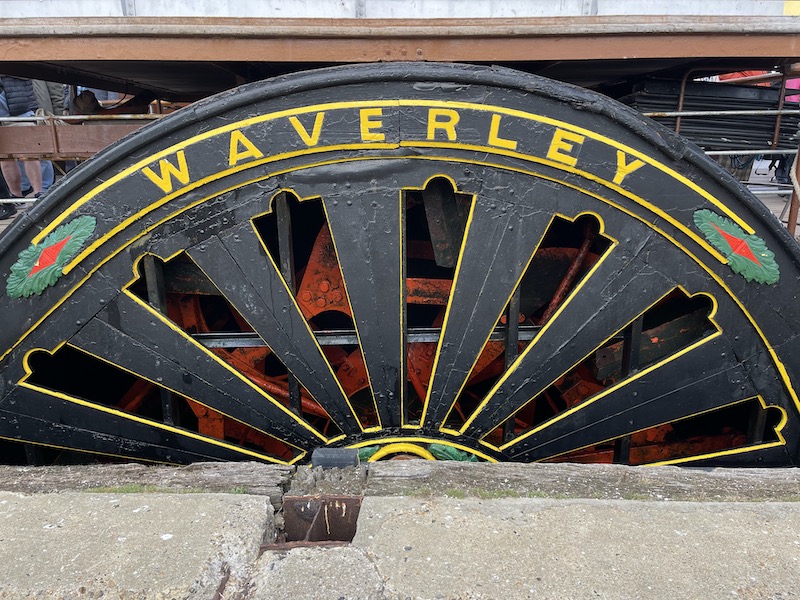
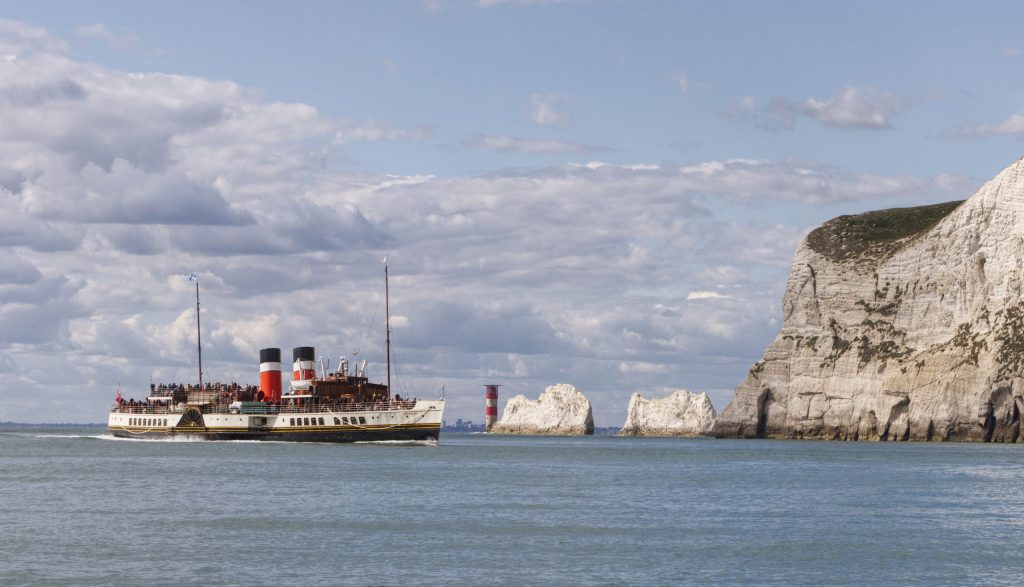
Earlier this month the famous Waverley – the world’s last seagoing paddle steamer – was in London operating a series of daily tours along the Thames estuary as part of its Summer seasonal programme of trips around the coast of Britain. The paddle steamer is registered on the National Historic Fleet as a vessel of “pre-eminent national significance” and has operated in preservation since 1975 carrying over 6 million passengers.
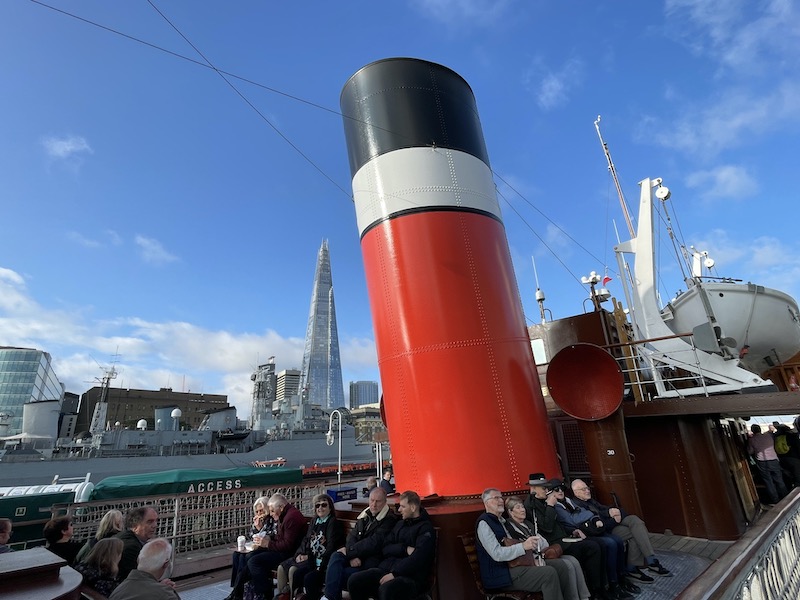
As neither my friend Ray Stenning or I had ever had the pleasure of taking a ride on this magnificent historic vessel we eagerly booked a journey from Tower Pier to Whitstable on the north Kent coast.

It was a hugely popular event and we were both surprised at just how many people were already on board for the mid week journey when we arrived at the Pier sited on the north bank of the Thames between London and Tower Bridges soon after 09:00 and joined the queue to embark.

We were soon on board and joined those passengers at the front of the steam ship ready for a full on view as we would head east under Tower Bridge along the Estuary.

First up though the ship had to turn around which was achieved with the help of a sturdy tugboat pulling up alongside and then getting attached to the front …

… and then the sight everyone wanted to capture on their cameras …

… sailing under the raised Tower Bridge…
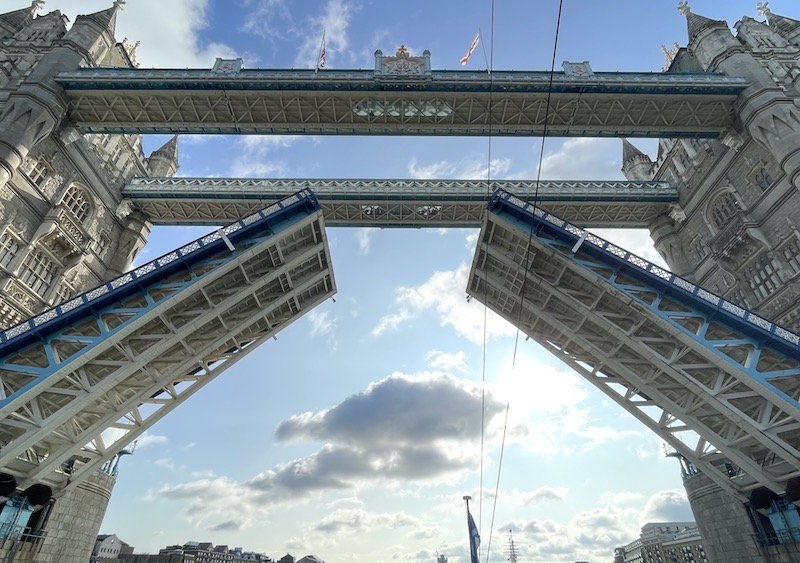
… got the cruise off in fine style.

As I’ve found on previous River journeys (with Thames Clipper/Uber Boat), it’s a fantastic way to see the familiar sights either side of the Thames and a well informed live commentary kept us informed of historic and contemporary references to the famous landmarks we were passing both alongside and underneath.
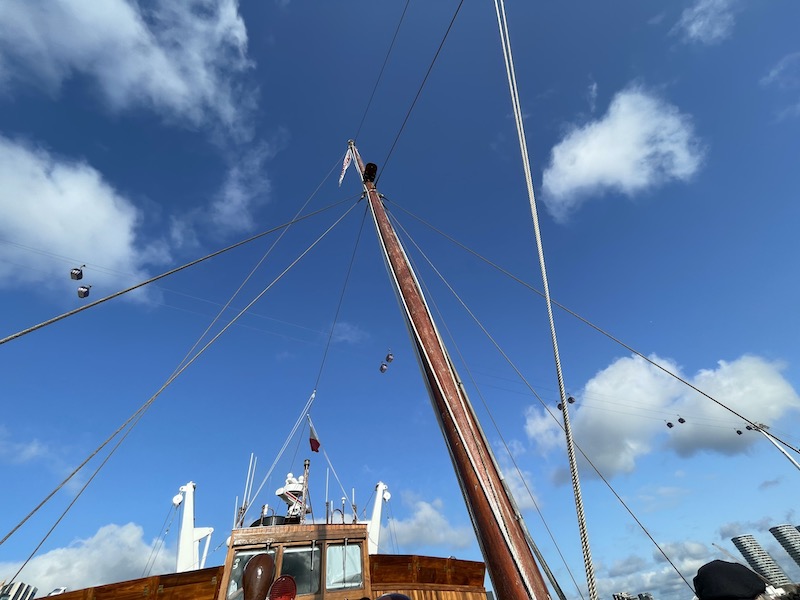


It wasn’t long before we reached Gravesend and our first call where we took on more passengers and then continued east past the new Pier at Barking to serve the growing Barking Riverside development and then into the wider stretches of the River with more distant views of Essex and Kent.

Passengers were moving around the vessel enjoying the refreshment areas on board as well as observing the “triple expansion steam engine” in operation which was powering the paddles enduring our easterly progress along the Estuary.

After passing south of Canvey Island we reached our next stop at the end of Southend-on-Sea Pier where we off loaded a fair number of passengers as well as taking on many more new passengers…

… after which we began the final leg of the journey, crossing the Estuary to reach Whitstable where everyone disembarked.

Waverley was returning via Southend-on-Sea and Gravesend to London Bridge later that afternoon but we’d only booked a one-way ticket and returned on Southeastern instead.
It had been a lovely four-and-a-half hour cruise and a trip on Waverley is recommended if you get the opportunity during next year’s seasonal programme which begins on Friday 17th May and a Glasgow to Oban sailing on 20th May. This will be followed by sailings from Oban to the Inner Hebrides until 27th May including Waverley berthing at Kyle of Lochalsh on 21st and 22nd May making for a wonderful opportunity of a steam ship excursion coupled with a ride on the iconic West Highland and Kyle of Lochlash railway lines next year.
Next year’s programme will also include a visit to Plymouth and other ports/piers in the south west.
How’s route 907 doing?
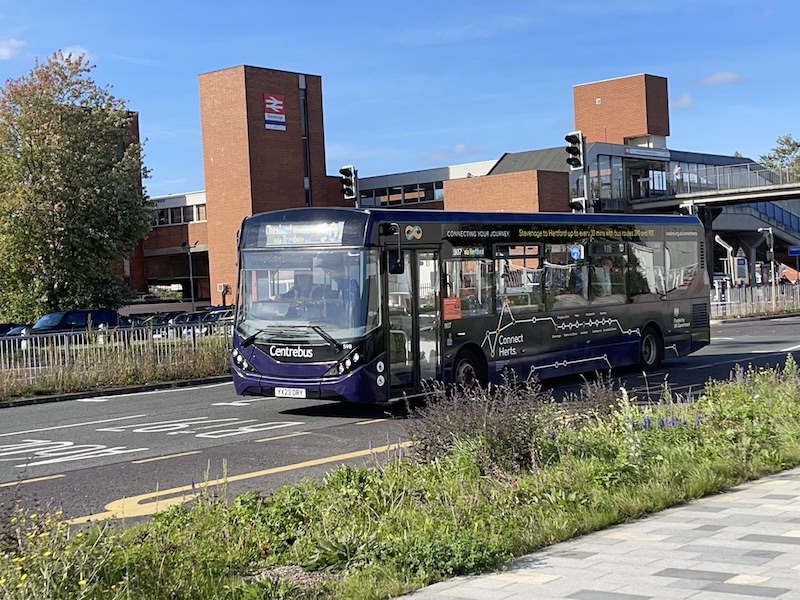
Readers may remember I took a ride on the then newly introduced bus route 907 between Stevenage and Cheshunt back in April. It’s operated for Hertfordshire County Council by Centrebus whose owner Julian Peddle was telling me how impressed he’s been with the growth in numbers of passengers travelling; so six months on I took a another ride on Tuesday last week to see for myself.

Back in April the late morning Cheshunt bound journey I travelled on carried nine passengers – seven of whom had alternatives that would have been just as quick. This time, an early afternoon departure from Stevenage carried 21 passengers, so some welcome growth, and although around a third of those made local journeys in the Stevenage area, Ware to Hertford or Hertford to Hoddesdon corridors covered by other routes, another third made longer journeys which could have alternatives but the 907 offers a better direct journey while the remaining third were making journeys without the need for changing buses thanks to the 907.
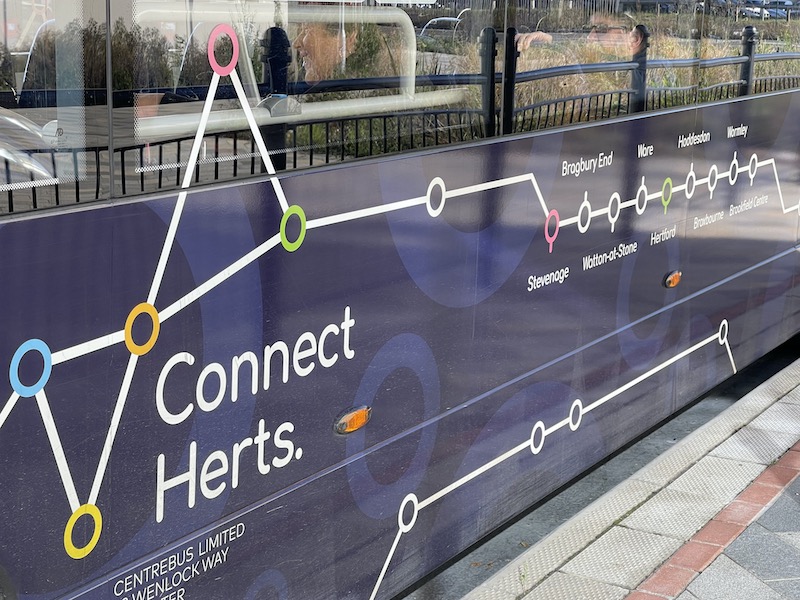
It was also good to see the three new buses bought with Government funding especially for the new route with Connect Herts and route 907 branding were all on the road.
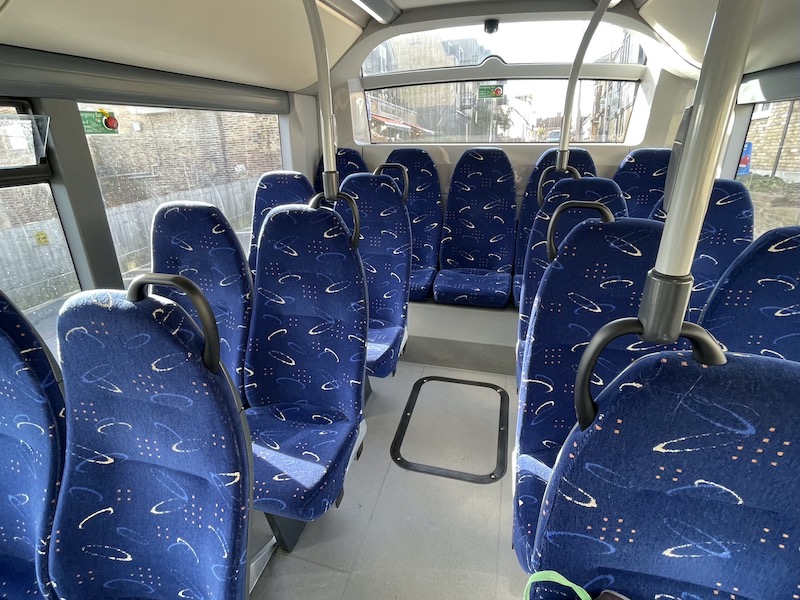
The omens look good for the 907’s future but I got the impression the section of route between Corey’s Mill Sainsbury’s and Stevenage’s bus station at the north end of the route and between Broxbourne and Cheshunt’s Brookfield Centre at the southern end are the weakest sections of the route. Those sections represent 25 minutes running time, or 50 on a round trip. Not quite enough to save one of the three buses on the route.
Another new route – the 908 – operated by Arriva, and also to be branded Connect Herts begins on Monday between Stevenage and Welwyn Garden City and I’ll report on that next Thursday.
Book Review – Muddle and Get Nowhere

Keith Shayshutt has kindly sent me a copy of his latest book, this time written with co-authors Ben Colson and Robin Bennett. It’s what one might call a speciality book; not so much ‘written’ but painstakingly ‘compiled’ featuring a quite incredible amount of detail on the Eastern Counties bus company in 1970. Ben Colson who’s already written a great book on the company – ‘A Journey’s End’ – has this time written an illuminating two-page introduction highlighting the wonderful idiosyncratic working practices that bedevilled the East Anglian based company through the 1960s and 1970s.
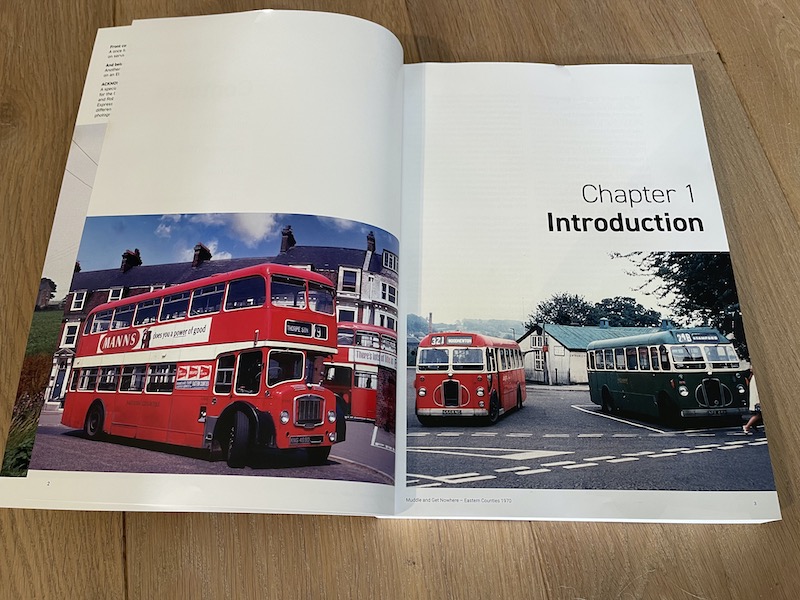
Whereas reviewing A Journey’s End I wrote… “it’s not a book for bus enthusiasts who want detailed route chronologies and fleet lists; nor for those who like their transport books full of photographs. This is something for those interested in the links between society, communities, workplaces and transport”, this latest 348 page (and that’s not a typo, it is 348 pages) …

… is packed full of everything a bus enthusiast with a specialist interest in Eastern Counties in 1970 could possible want.
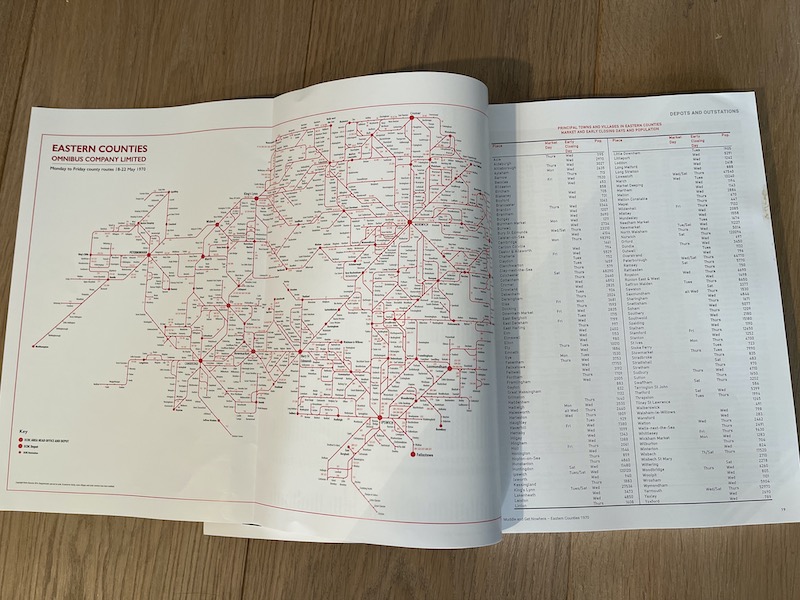
There are three pages of photographs and details of all the vehicle types operated by the company in 1970; two pages detailing the opening date and address of the company’s 79 (not a typo either) depots and outstations including the vehicle allocation as at May 1970 of all incredible number of outstations; there’s a fold out diagrammatic map of the bus network, information about principal towns and villages served with market and early closing days and population; followed by four pages of a route list with details of revenue, miles, average mph, running hours, percentage crew/OMO, cost and profit/loss (mostly the latter); then three pages of contracts operated by the company and then the two biggies…..
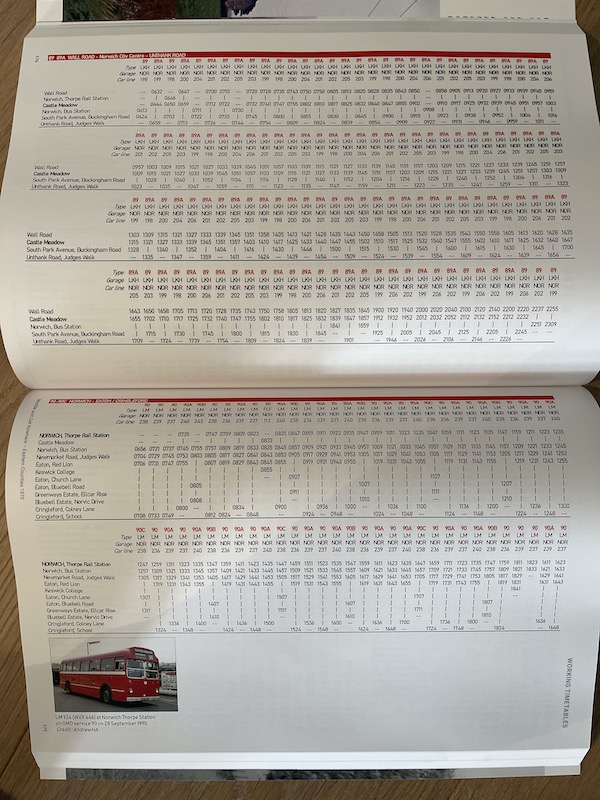
Chapter 6 details every bus working in May 1970 across 30 pages with chapter 7 detailing the working timetables showing every listed journey (including express services) laid out timetable fashion showing the route number, type of vehicle, garage/outstation and vehicle working which covers the remaining 288 pages of this quite incredible publication.
All this detail is liberally illustrated with some wonderfully nostalgic photographs which admirably capture the 1970 era of bus operation.

If you like detail. If you have an interest in Eastern Counties. If 1970 is a special year for you, as it was for Ben, Robin and Keith, then this certainly is the book for you. And although costing £40 you won’t find a better ‘page per pound’ let alone ‘detailed information per pence’ bargain anywhere else on the bus book shelf.
Roger French
Blogging timetable: 06:00 TThS
Comments are welcome but please keep them relevant to the blog topic, avoid personal insults and add your name (or an identifier). Thank you.


“It wasn’t long before we reached Gravesend and our first call where we took on more passengers and then continued east past the new Pier at Barking to serve the growing Barking Riverside development”.
Think you mean Greenwich not Gravesend.
LikeLiked by 1 person
Thanks Phil! Getting my Gs confused. Post updated.
LikeLike
Wholeheartedly recommend Muddle and get nowhere, well worth the money.
Glyn
LikeLike
Would love to get a copy of the Eastern Counties book, but having searched on the internet am unable to locate a source… Is there an address/email site at which it can be bought?
Anthony Holden
LikeLike
I’ll make some enquiries and let everyone know.
LikeLike
Presumably the initials of Muddle & Get Nowhere and the Midland & Great Northern railway (formerly serving the Eastern Counties area) being the same is an astonishing coincidence? ( or perhaps not…)
Mike M
LikeLike
Mike, the M&GN railway was itself known, allegedly affectionately but more likely disparagingly, as the Muddle & Get Nowhere. It’s a name in the great tradition of the Grass Weeds & Rubbish (polite people called that one the Great Way Round), the Late Mucky & Slow and the Late & Never Early railways.
LikeLike
Mike M, it’s the same coincidence as the former DMU train service between Bedford and St Pancras being known (perhaps affectionately) as the Bedpan Line.
Ian McNeil
LikeLike
Thanks for the pointer of Keith Stayshutt’s book – I can well believe that ECOC had that many outstations and depots from open parking and dormy sheds in pub car parks to more substantial affairs as well as principle depots. Perhaps only pre-1971 Southdown could rival them!
It’s available from MDS books https://www.mdsbooks.co.uk/muddle-and-get-nowhere-eastern-counties-1970.html
Thanks again, Roger
BW2
LikeLike
Very many thanks for the info on MDS books!
Anthony Holden
LikeLike
MDS Book Sales now have six copies of Muddle & Get Nowhere in stock and I’m eagerly awaiting my parcel from them.
Back in the 1960s the sole “bus book” I had was the Ian Allan ABC for East Anglia so my only other source of information was timetables. At the age of ten in 1963 I acquired timetable books for both Eastern and Western areas of Eastern Counties presumably from their Drummer Street Cambridge office as we visited family friends there occasionally. These became my bedtime reading matter, pouring over the pages trying to work out how all the routes fitted together. I’ve only had to wait sixty years for the book that is going to explain everything to me.
Nigel Turner
LikeLike
Regarding the ‘where do I get it?’ comment-
https://www.ebay.co.uk/itm/325836570404?hash=item4bdd5f7f24:g:SGEAAOSwqkNlHXTA&amdata=enc%3AAQAIAAAAwOGgw27UhrXWLz9X3jvrS3tsZZRhnbX9SxoN2NqIqOg5FGh23%2BqXQWseAUmk8n6DZZgMjnwLE2DLfhl%2FAi7ljSxn4ClJX5Qt8g2uxOm6oRxM2%2F3Mb4OzN3Ie0Wuv1UQzIsDkx8mBJNk0HRt8IN5DDonC%2BuwbqjLyme4gJy%2FsxNoZfLgZPWpAowQ3NmZrqzU71qfXfEQ15kn%2FKQG2fwyCG%2FQ5JMlPx2zfvaG329OpmabRQhQaJr3pfLLEZWCdl8Xpuw%3D%3D%7Ctkp%3ABk9SR4qFhrLtYg
is the ebay site for Keith’s book. He has several copies in stock.
LikeLike
Route 907.
Thanks for this update, Roger. A minor typo; it should be Hoddesdon.
The increase in usage of the 907 is indeed heartening, even more so given the parallel 390 service between Hertford and Stevenage is also experiencing growth. What has helped the 907 is the withdrawal of a route in the Bragbury End area of Stevenage (to be replaced by a new SB18 route next week) and, of course, the £2 fare cap and rail strikes have all played their part. Credit should go to Centrebus for their continuing excellent stewardship of both the 390 and 907 routes in this age of driver shortages and is all the more remarkable given the buses have to come in ‘cross country’ from Luton on a daily basis.
In terms of the quieter ends of the route, it will be interesting if the Brookfield section sees the expected increase in patronage in the run up to Christmas. North of Stevenage bus station there are numerous buses up to the Lister Hospital but on some peak hour 907 journeys going south NHS lanyard-wearing passengers have been witnessed travelling through to Hertford and Ware which suggests some commuter demand.
Dan Tancock.
LikeLike
Thanks for that background Dan; typo corrected.
LikeLike
Extensive history here http://easterncountiesomnibusco.com/index.html
LikeLike
Many thanks for the evocative piece on the wonderful Waverley. I bet that Mr Stenning was tempted by those funnels as a potential canvas….
I still have vivid memories of sailing on her from Plymouth in the late ’70s with a brass band playing aboard. A chance encounter with SS Shieldhall meant that two of the last remaining steamships in Europe passed each other with much whistling, hooting and cheering. Mind, the fact that the Shieldhall was still a working sewage slurry tanker might have detracted slightly from the splendour of the occasion…
LikeLiked by 1 person
Indeed, many thanks for the trip report. I’d strongly recommend a trip on the SS Shieldhall too – some of the longer cruises (and in particular the Bournemouth Airshow trip) make for an absolutely brilliant day out.
LikeLiked by 1 person
I remember the Thames Estuary steamer services as I had my Nan and Granddad living in Birchington at the time, late 1960s. I was never able to use them for several reasons. My best trip to Birchington on my own was a cab ride in a 4-CEP unit as the driver failed to lock himself in the leading end of the train. The Penge and the Medway tunnels were a delight for this twelve year old boy. The leading Guard’s van, behind the motor cab, was filled with off duty railwaymen making their way to Gillingham. They were all delighted to have amongst them a railway enthusiast when we left Victoria. We had possibly not reached Herne Hill when I was permitted up front with the driver and I remained there until the station stop at Birchington. As to motor vessels especially on the Clyde Estuary: my best day out at sea using an All Line Rail Rover was on 12/08/73. Ardrossan to Brodick on the usual ferry then an excursion boat (Queen Mary II) from Brodick to Campbelltown then back to Weymss Bay. I timed it just right: full waiter service luncheon on the QMII between Brodick and Campbelltown. Those were the days! BTH beds for the night all over the place. Another gem from that week: Windermere passages using the same ticket. I may have done the Severn Tunnel that week for the first time too. Another childhood cab ride was more modest: Central Line from Ealing Broadway to White City.
LikeLike
It is interesting to hear that the 907 is doing well. I remember and earlier Herts CC initiative with Green Line 750 known as the Herts Speedline. That did what the 907 does, plus continued to Luton and Hemel Hempstead. Hopefully Herts can rebuild Green Line in their patch!
LikeLike
Dear BusAndTrainUser I am attaching reports of the Riverlight 2023 event in Sleaford, Lincolnshire and of the disastrous floodings in Ruskington on Friday and Saturday last week – both with railway connections. Regards Graham Lilley
Sent from Outlookhttp://aka.ms/weboutlook
LikeLike
Confusion regarding piers at which Waverley calls on the Thames – it should read Gravesend and NOT Greenwich – Waverley does not call at Greenwich. The start of the journey was also wrong – starts from Tower Pier, not London Bridge pier.
LikeLike
Thanks; I originally wrote Gravesend then someone commented it was Greenwich and my brain got confused so I changed the blog to that – I’ve now changed it back again. And also changed London Bridge to Tower. Thanks.
LikeLike
But I don’t see how you can call at Gravesend then continue east past Barking. Barking is west of Gravesend. Isn’t it?
LikeLike
Would love to do a trip on the Waverley. Thanks for the heads up on what’s happening next year, particularly in the south-west. I am hoping they will do some Bristol Channel trips also next year, as that is handy for us.
LikeLike