
Sunday 22nd October 2023
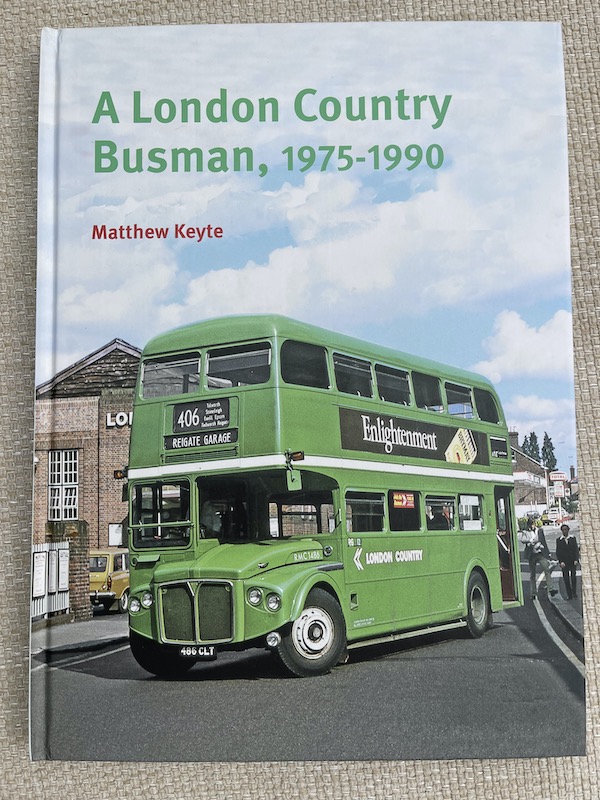
This new book by Matthew Keyte gives a fascinating insight into life working for London Country Bus Services (LCBS) and the privatised London Country Bus North West Ltd during a period that saw seismic change including converting routes to driver only operation, revitalising the Green Line network and deregulation and privatisation.
Matthew began his career as a Junior Management Trainee spending time learning the skills of scheduling among a range of different work streams before spending many years as a conductor and driver in London Country’s garages in the south (principally Reigate) as well as subsequently Hemel Hempstead moving to supervisory and junior management roles including in Amersham.

He left London Country Bus (North West) Ltd in 1990 aged 33 and continued his career in the bus industry at Metroline for 19 years, working as a driver, Service Controller and Schedules Manager then moved to Mullany’s Buses in Watford as Commercial Manager before returning to Metroline as Schedules Compiler until retirement in 2020.
But its the formative first 15 years of his career as “A London Country Busman” which is the subject of this book covering the years 1975 to 1990.
It’s a very readable personal account of Matthew’s experiences carrying out various roles helped by the diaries he kept detailing the conducting and driving duties depicting life on the road in the late 1970s and early 1980s.

His initial management training involved being one of the last trainee conductors with LCBS, as crew operation was rapidly drawing to a close in the mid 1970s. Working at both Godstone and Reigate garages Matthew recalls details of working with named drivers on a variety of routes with some wonderful anecdotes encapsulating crew operation of that era including a late night arrival back into garage 12 minutes ahead of schedule but unfortunately having been spotted by an off duty member of the Central London Green Line Control team leaving the station at Earlswood on his way home.
Matthew struggled with the Chartered Institute of Transport’s entrance exams particularly papers covering shipping – a familiar struggle I can also vouch for – and as it was a requirement to pass and become an Institute member in those days his management training was brought to an end, but he’d already got a taste of life on the road and opted to stay on as a conductor.
Matthew passed his PSV driving test at the fourth attempt in 1980 and drove a variety of routes including on the Green Line network with a particular liking for the long route 727. It was the first driver only operated route he drove in service on a duty that covered the Reigate to Crawley section, relieving drivers who’d arrived south from St Albans. He describes how what was known as the “Tango driver…. would try to make up time so as to handover on time northbound”, explaining how by knowing when to “put the proverbial foot down and by shaving stand time at Crawley from 10 minutes to one minute could often convert a 20-25 minute late takeover into an on time handover”.
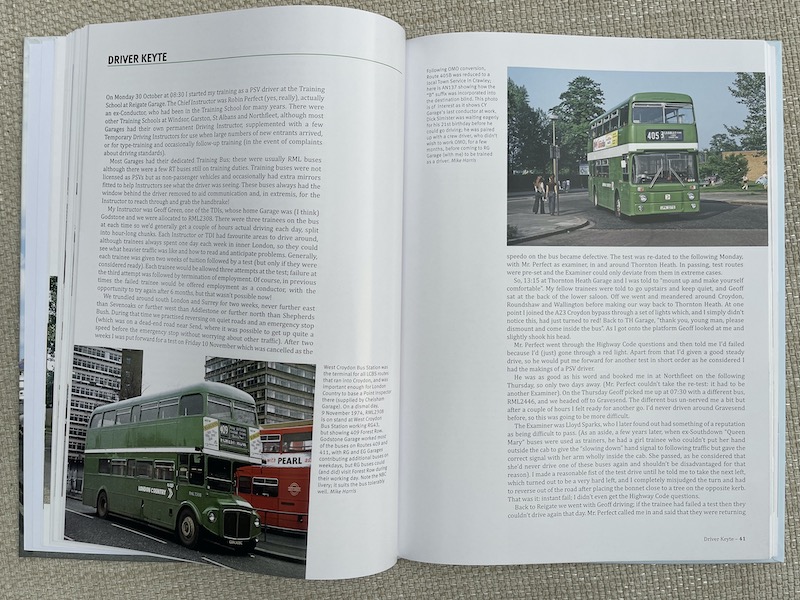
Work soon followed on Private Hires, National Express and Tours as London Country broaden its range of work with a young keen Matthew being an obvious candidate for such operations. He was often requested by hire clients for repeat business.
Matthew moved north to Hemel Hempstead in 1984 and quickly developed a preference for driving the longer distance routes from that garage rather than the tedious town routes. He describes some fascinating cultural differences there compared to Reigate including not only a very traditional male dominated approach (Hemel Hempstead was largely staffed by a group of ex London Transport drivers who’d moved to the New Town in the 1950/60s retaining their seniority and working practices) but also of concern, Matthew found the garage operated a “colour bar” with any black or Indian applicants illegally told there were no vacancies and to apply to neighbouring Garston or St Albans garages instead.
In 1985 he gained promotion to a Depot Inspector role at Amersham garage but big changes arrived the following year in 1986 in the form of deregulation and subsequently, privatisation.
Matthew’s skills were used in the Traffic Section of the newly established London Country Bus (North West) Ltd in 1986 to oversee fares and tickets as well as helping with drivers’ duty compilation. It’s interesting to read his account of what went on behind the scenes at this fledgling company including his work in publicity, dealing with on the road competition, gaining tenders for LRT work (pre TfL), introducing new Wayfarer ticket machines, writing manuals for drivers and then, in 1988, his take on the way the company was privatised.
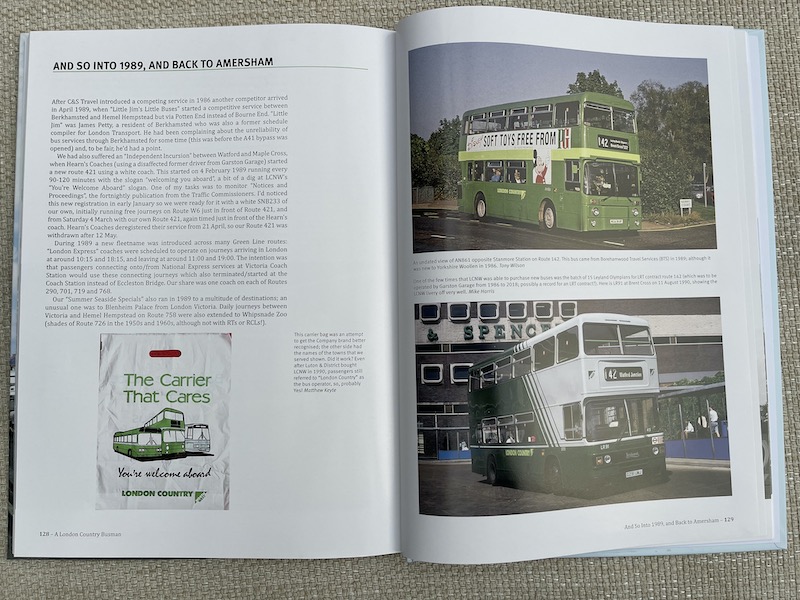
After what was a hectic three years for Matthew, a reorganisation saw him return to Amersham as Assistant Area Manager in 1989 which included responsibilities for outstations including High Wycombe, Chesham and Aston Clinton. The work schedule and responsibilities were punishing and with the company facing Public Inquiries by the Traffic Commissioners, rumours about its future ownership and general disillusionment Matthew decided enough was enough and in 1990 resigned and opted to become a driver with Metroline, subsequently leading to other roles as described earlier.
This isn’t a history of bus routes (although some details are given of routes based on Redhill and Hemel Hempstead (see below) which Matthew features in the book) and there are scant details of vehicles and the fleet but for me that makes the book even more readable as it concentrates on real life experiences of working for a bus company at a time of great change.

If you have an interest in the history of London Country and enjoy insights into what life was like at the operational sharp end as that company went through a turbulent period this is definitely the book for you. The hardback 144 pages come lavishly illustrated with wonderful photographs of the era from the magnificent collection of Mike Harris, as well as Tony Wilson, and at £30 it truly is a treasure trove of nostalgia and memories of a defining period now 35 to almost 50 years ago.
The book, published to its usual high standard by Capital Transport, costs £30 and is available from its online shop or the usual outlets. It’s a recommended buy from me.
Roger French
Blogging timetable: 06:00 TThS
Comments are welcome but please keep them relevant to the blog topic, avoid personal insults and add your name (or an identifier). Thank you.
 BusAndTrainUser
Many thanks for this review – I’ll get this book. Sad to hear about his increasing disillusion, but it will be interesting to find out the detail behind that: it rather matches my disillusion – as a passenger – with the company’s offering over the post LT period – cuts, unreliability, poor quality buses, obviously unhappy staff, even less co-ordination with rail, and a general feeling of managed decline rather than any attempt to match what the competition (the private car) was offering.
Rick Townend
LikeLike
Thanks for the excellent review and recommendation Roger this is now most definitely on my reading list over Christmas along with Buses Yearbook Cheers
LikeLike
Interesting to add that Matthew left London Country North West totally disillusioned with company in total turmoil whereas I joined Midland Red West as an accountancy trainee at a similar time to find a totally professional forward looking company being a founder member of Badgerline Holdings with the inspirational leaders of Ken Mills & Trevor Smallwood sadly it wasn’t too last as Trevor later fell in love with a charismatic businessman called Moir and created a business relationship if think everyone later regretted at Badgerline Holdings………..
LikeLike
It will certainly be on my reading list as I was at LCBS for a similar period, 1976 – 1988. Starting off on the 715 Green Line then an inspector at HG, going on to plain clothes inspector based at Reigate then going back to LCBS NE. Just as a by the way I was caught on the first London short 715 arriving 26 minutes early at Oxford Circus by squad inspector Kieth Motley. Not proud but there was a good coffee shop open early (Pontis) and we only had 10 minutes stand time.
LikeLike
Sorry, not Anonymous – Harry Hobson
LikeLike
Mine arrived on Friday very interesting read so far. recommended.
Glyn
LikeLike
It is a very good read about the operational aspects of LCBS and successor LCNW. However there are quite a few factual errors. Force example quoting twice the seating capacity of SNBs were 37 – they were 41. One photo caption if a TL reallocated from RG says they were replaced at RG by RSS. There are quite a few other examples.
Andrew Simmonds
LikeLike
When l was at LUL/TfL l worked with someone (Trevor Cox) who had started as a Driver at GY in 1969. He progressed to Driver-Operator and then Inspector, ending up at HA. He was ‘Tupeed’ from LT to LCBS, and LCBS to LCNE. When the latter was privatised and sold to the cowboys ‘enough was enough’ and he resigned and joined BR as a Guard! Kim Rennie
LikeLike
A very inglorious period for the once proud London Transport Country Bus and Coach department…and the worst years were prior to de-regulation. I recall the main job of Inspectors during the 70s was the posting of service cuts at main bus stops! A tie between unreliable vehicles and staff shortages. Little wonder the passengers melted away, a situation now seen all over the UK as highlighted with Whippet.
And the unofficial Colour bar also affected a few Central Bus garages as well, both in the operating department and the canteen. It is no good reaching for the smelling salts and feigning “shock and horror” at such events, because like Enid Blyton’s children stories, they were seen as acceptable at the time. Interestingly, and speaking of my days in the Underground staff office (1959-1962), we had to be very careful not to mix certain West Indian/Asian staff from different locations together, so it wasn’t just a one-way street.
Terence Uden
LikeLike
Interesting and sad to read about the colour bar, especially as the Bristol bus protests were flagged up in today’s “Songs of Praise” in connection with part of a new stained glass window at St Mary Redliffe church. I’m also reading Clive Myrie’s autobiography and he mentions Roy Hackett as one of his heroes. Here is the design – fortunately the window as shown in SoP has the bus in the corredc green! https://tinyurl.com/26mc3evd
Andrew Kleissner
LikeLiked by 1 person
Absolutely shocking to read about a colour bar at London County sometimes you are ashamed to be a White Brummie Baptised Practising Catholic (St Chads) however as far as I am aware this never happened at Birmingham City Transport & even today at its ultimate sucessor National Express West Midlands is proud of being so ethically diverse unless anyone knows differently.
LikeLiked by 1 person
I am fully aware of Bhikai Patel at West Bromwich Corporation which is frankly one of the most disgraceful periods of what we now call Sandwell history thankfully its largest based employer; Diamond Bus has proudly one the most most ethically diverse employee bases in England
LikeLike
I’ve not read any such alegations about BCT, but there absolutely were colour bars on the shop floors of many West Midlands’ manufacturing plans and for much of the better council housing. If you’ve not read it, Second City: Birmingham and the Forging of Modern Britain is an excellent look at all this.
LikeLike
Sadly, the West Midlands did have more than its fair share of racist flashpoints and, more shamefully, some were with the support of trades unions.
In 1953, Wolverhampton Corporation staff held industrial action demanding the introduction of a colour bar with a maximum quota of what we would now call, workers of colour. In 1967, there was also the terrible episode of Tarsem Singh Sandhu who was the Sikh conductor that was sent home as his turban was not considered uniform.
Sadly, such attitudes were exploited by such individuals as the Wolverhampton MP, Enoch Powell as well as controversy in the Smethwick constituency during the 1964 election.
Thankfully, as a nation, we have moved a lot further forward in the last 60 years.
LikeLike
I think it is for too easy to over simplify the era you are commenting on especially in the 1970s as I was growing up where themes we would abhor today were accepted as the norm. I grew up in a very very liberal family whose parents had fully embraced the swinging 60s what is pertinent looking back all the males in my family were massive admirers of Enoch Powell & all my uncles etc wished he was Prime Minister & like the Charltons hung on his every word. The following Powel had and popularity he had in The Black Country amongst the White majority then was akin to the 2019 sucess in election with the equally controversial Boris Johnson who swept everyone aside in the Black Country with the simple phase “Let’s Get Brexit Done. ” To simply dismiss Enoch Powell is akin to airbrushing history. We can’t change the past only learn the lessons of it for the future.
LikeLike
I wasn’t dismissing Enoch Powell. Quite the opposite as he encapsulated many abhorrent attitudes that were commonplace at that time. Thankfully, society has moved on to a great degree but still much to do. Even in 2010, the BNP garnered enough votes in one of the Wolverhampton constituencies to retain their deposit.
LikeLike
You are welcome to your own opinions about Enoch Powell & it is up to historians to decide his place in history but whilst you and others find his comments abhorrent I can assure you when I was growing up he was the most popular politican in the Black Country during this period as he was in my own family. It is plainly obvious to those who lived thru his era that his opinions very much reflected society in inner city working class communities at the time and as such history tells us not judge someone as abhorrent from era in another without historical context
LikeLike
Yes, Dickie – we know that racist views were much more prevalent in the past. That the Smethwick election result in 1964 was built on such views having a resonance in the local community.
However, those views weren’t right then (hence the effectiveness of the Bristol bus boycott) and they weren’t right in 1970s Hemel Hempstead and it was downright illegal by that point.
LikeLike
I work at go coach swanley
LikeLike
My mother was the very first female in Worcestershire to be a Company Secretary of a large manufacturing company while my father was a toolmaker in the Black Country so I am very aware of historic role of manufacturing across Birmingham & The Black Country whilst Second City is an interesting piece of reading my mum always said the company she was the main accountant was at which had multiple companies on sites across the Black Country always ensured when recruiting employees from the Empire as she would call it Skihs worked at one site those from India another & those from Pakistan at another because initially fights would break out constantly between them when working together. One thing that is never actually published anywhere in publications about the glory days of Midland Red my late Aunty was Head of Payroll at Midland House in Edgbaston for decades untill she retired from what had become Midland Red Engineering Limited when Central Works was closed down and she was adamant there was an unwritten policy that Protestants were always employees by The Birmingham & Midland Motor Omnibus Company Limited & Catholics by Birmingham City Transport interestingly.
LikeLike
What you say about your mum’s company rings true to me. My GF was in personnel at a large food manufacturing plant in London and organised their teams and shifts the same way. All with the co-opation of the unions and plant management. This was as late as the start of the 1990s. Ironically she was from Northern Ireland and had left partly to avoid all this.
LikeLike
I think the big turning point was the visit of Malcom X to Smethwick.
LikeLike
Following changes instigated by The Electoral Commission my Parliamentary Constituency at the next election will be Smethwick. I really do not need someone who hides cowardly behind the word “anonymous ” to lecture me on the history of my own parliamentary constituency.
LikeLike
Dickie – it’s lovely that you have that freedom. However, some people posting on here have senior roles in businesses that would prefer they didn’t. Rather than being disenfranchised, it is practicality rather than cowardice that makes some use pseudonyms, one such being greenline727. Therefore, continued employment to provide for ones’ family is a more pressing concern.
As for outrage on being lectured to… Of course, you’d not act in any form of high handed manner.
LikeLike
Having a pseudonym such as greenline727 is perfectly acceptable commenting as ‘Annoymous” reflects an act of cowdience which undermines any professional weight the comment my carry and your argument that comments posted may reflect one’s position in employment are quite simply laughable. As an employer myself any such matter as restriction on free speech or a disciplinary matter levied whilst commenting would quite simply end up at a tribunal which the employer would ultimately loose. Oh and my friends and foes call me RICH
LikeLike
Absolute rubbish, Dickie. Many of us are bound by terms and conditions of employment. Even where we aren’t specifically precluded, we are bound by considerations. Not all of us have the freedom of being self employed as you are.
LikeLike
I would check your terms and conditions are legal therefore under:
https://www.gov.uk/employment-contracts-and-conditions
I am not self employed I am an employed under a contract of employment.
LikeLike
The colour bar issue is part of the untold story of LT (“Hidden London”?) that you won’t read in the LTM’s “Sun a’shine. Rain a’fall” exhibition. On the bus side there was agitation by many staff when turbans were permitted, whilst on the Underground there was a so-called “banana boat strike”, the cause of which is self-explanatory. The book “Race & Labour in London Transport”(OUP 1975) is an eye-opening and fascinating read. Kim Rennie
LikeLike
I certainly shall not be buying this book. Historically, I have always regarded LCBS as a runt of the bus industry. Whether the Country Services ought to have come within the fold of the LTPB in 1933 ought to be a discussion in itself! In 1977 I needed to buy my first motorcycle for journeys between Hersham and Addlestone for work. LT Route 219 was reliable between Hersham and Weybridge with sound RF buses but the vehicle trash Addlestone Garage put out on their local routes was a disgrace to the bus industry and the services were unreliable. After I bought my first motorcycle, when passing Addlestone Garage each day to and from work the premises deserved my “middle finger”. Governments in 1933 and 1969 have a lot to answer for and to those stuck just outside the red bus area. This is and was political ineptitude of a depraved enormity. The history of two Zonal Boundaries still enrages me: Sparrow Farm Road (293) and Westerham Heights (410). As numerous Zonal Boundaries fell to LBL services I rejoiced every time, especially Worcester Park Road (406) which I regarded as the final LCBS “Gate Felled”. In the north: Route 350 between Harrow and Watford was a favourite, especially when Wetherspoon had an outlet at Carpenders Park. Dear little Arriva minibuses plying the A4008 are fond memories. Some of the Arriva minibuses on the 350 had “BUS” number plates too!
Alas no longer a Garston Garage.
LikeLike
I have just completed reading Matthew’s book from cover to cover – it is a really excellent read, whether you worked in public transport yourself, or whether you were just a passenger in the London Country years. One thing I particularly like is that the book is broken up into a number of chapters, some just a couple of pages and this encourages the reader to read just one more chapter before putting the book down. A well researched book which tells it as it was.
LikeLike
In view of comments above, it’s interesting that the LT Museum in Covent Garden has a current exhibition called “Legacies: London Transport’s Caribbean Workforce”.
Andrew Kleissner
LikeLike
Sounds like a must read for someone who Green Rovered all those Croydon-focused routes (though on the 409 I seem to recall that such tickets were not valid all the way to Forest Row, similarly with the 403 to Tonbridge beyond Hildenborough Church). The RLHs on the 410 were always a highlight, except when wanting to alight from a top-deck window seat when the bus was full…
The colour bar in Bristol was repugnant but not illegal (nor uncommon at the time), but by 1984 the Race Relations Act had been in force for 20 years, so the Hemel Hempstead one was also illegal – and (like Bristol) in a nationalised industry, too. That is truly disgraceful, and an indictment of LCBS and NBC management at the time. The former (at least) must have known, and the latter should have.
And (dare I say it) there’s an error on Mike Harris’s map – the 409 shown between Redhill and Reigate should be 410.
Mike M
LikeLike