Tuesday 3rd October 2023
Transport Focus has just published its interim report on this year’s ongoing research into bus passenger satisfaction while the report by the University of the West of England commissioned by the DfT into DRT schemes funded by the Rural Mobility Fund is also now available.
I’ve had a read of both to save you the bother and here’s a synopsis of what both reports contain.
First up: Your Bus Journey from Transport Focus,
Considering all the challenges faced by bus companies this year, not least unreliability caused by driver shortages, the headline figures from Transport Focus’s research are mildly comforting, not least that drivers themselves are rated as offering the highest satisfaction. This accords with my own travel experiences where I find the standard of service and attitude of drivers is probably the best I’ve known it.
From a sizeable sample of 14,000 passenger surveys Transport Focus have found 85% satisfied (with 60% of those “very satisfied”) and only 3% dissatisfied with the driver.
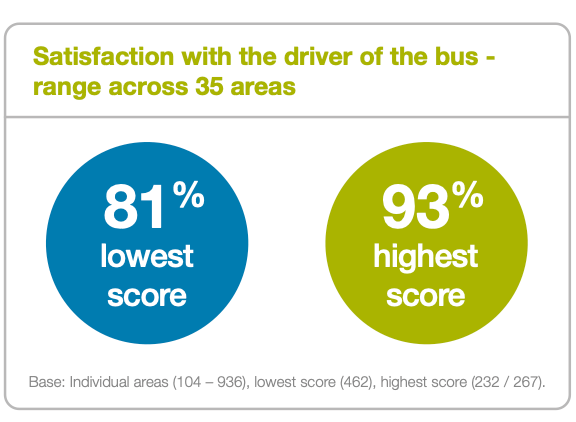
I reckon that’s a pretty good result considering all the pressures drivers face out on the road and, as other research shows, it’s the driver that plays a crucial role in creating a great journey. Even better, the range of satisfaction goes from a high of 93% (well done which ever company that was) to a low of only 81%.
Perhaps that’s a key reason why, taking all factors into account, overall satisfaction is at 80% satisfied (44% “very satisfied”) and just 7% dissatisfied. The satisfaction range was from 70% to 94%, the latter being particularly impressive.
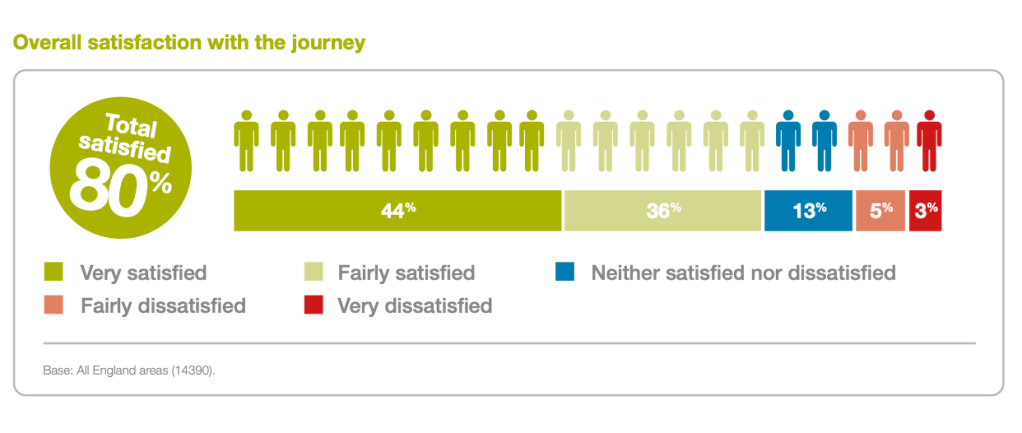
So what’s dragging the numbers down? It would seem “value for money” is once again the bête noire of the results which is somewhat ironic considering the widespread adoption of the Government funded £2 maximum fare since January.
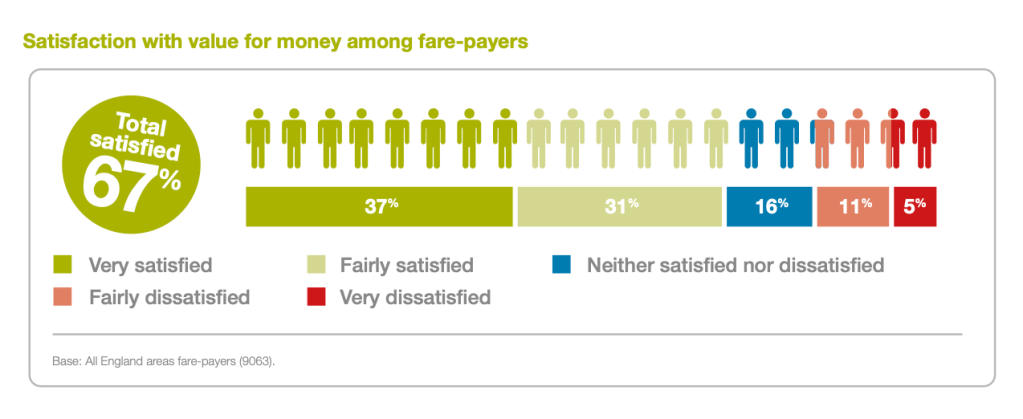
Only 67% of passengers are satisfied with value for money (just 37% “very satisfied”) and a fairly hefty 16% dissatisfied. Transport Focus put the anomaly of these results, despite the £2 fare, down to the fact around half of those surveyed used the bus at least five times a week for whom the £2 maximum per journey may not be so relevant as weekly tickets offer better value. It also points out these results are better than previous surveys for value for money and much better than achieved in the rail sector.
Interestingly younger passengers (16-25) are the least satisfied with value for money and one factor in that is the transition between child rate and adult fares. I’m a great believer in softening that transition by bespoke special deals with prices paid gradually increasing year by year and communicated personally through direct mail (emails) etc to each passenger. Something we attempted at Brighton & Hove with traditional mail outs even before email and social media was a thing.
Other highlights from the surveys are 77% satisfaction with the bus stop (worse in rural areas), 70% satisfaction with punctuality and 68% satisfied with waiting time at the bus stop. I reckon more publicity about the availability of bus tracking information online/smartphones could help with the latter result.
These are only interim results with more surveys continuing until the end of the year with the aim of reaching 35,000 and a final report published next Spring. It’s the first survey carried out by Transport Focus for four years due to the pandemic and a new approach has been adopted collecting passenger feedback in each area on a continuous basis throughout the year.
Now let’s turn to the second report. The one we’ve all been waiting for. An evaluation of DRT schemes funded by the DfT’s £20 million Rural Mobility Fund and introduced from 2020 with a few yet to hit the road, hence its interim nature.
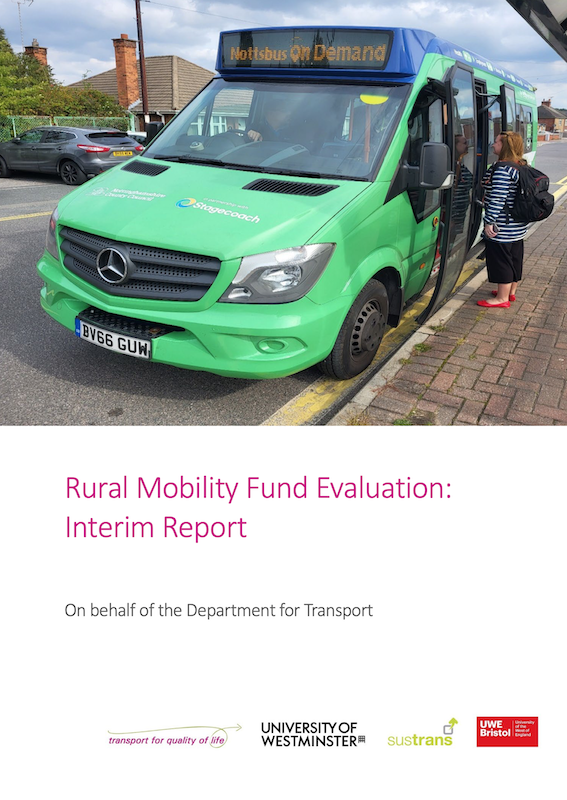
The characteristics of each of the 14 schemes across 12 local authority areas are explained in some detail highlighting, for example, type of area served (rural, suburban etc), population and geographic size, operator, number of vehicles and other information which will be all too familiar to regular readers of these blogs.
As well as data being provided by local authorities (albeit in some cases with gaps) the report covers details of round table discussions and interviews where experiences and lessons learnt about scheme specification, preparation, mobilisation and marketing were usefully shared and have been documented in the 95 page report compiled for the DfT by the University of the West of England with Nawathe Consulting Ltd.
There’s a wealth of data in the report and some fascinating findings. Headline results which define the effectiveness of the 14 DRT schemes and which come as no surprise based on my own extensive travel experiences, and as readers will know are……
Passengers
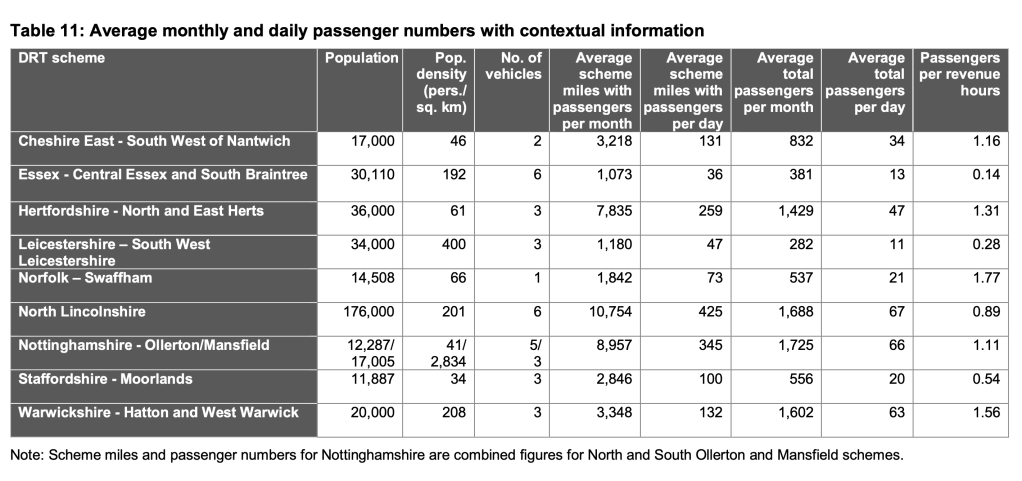
The number of passengers per “revenue hour” (ie when a scheme is available to the public) fall into a range across the schemes evaluated from 0.14 to 1.77. This is said to be a similar finding to a previous study of what are called “second generation DRT schemes” (ie ones using technology) published in 2019.
Average daily use varies from 11 to 67 passengers with higher numbers coming from larger schemes involving up to six vehicles.
Revenue
The average revenue per passenger (across paying and non-paying passengers) differs considerably between schemes with a low of £1.22 (including ‘introductory offers’) to a high of £2.92 for well-established schemes.
The scheme showing the highest revenue is HertsLynx, taking £25,000 in the six months between April and September 2022 using three vehicles. Lowest is Flexibus+ in Swaffham, Norfolk earning £3,922 over the same six month period with just one bus. Interestingly the average daily use of the Hertfordshire scheme was 47 passengers (16 passengers per bus) and 21 passengers using the Norfolk scheme but the latter includes a scheduled school journey at peak times.
Vehicle productivity
Vehicle utilisation rates (defined as when a passenger is on board) are in a range 33 to 86 miles per vehicle per day.
But it’s noteworthy the evaluation found distance travelled without passengers is “of a similar magnitude to distance travelled with passengers” and indeed some schemes (see table below) operate more miles each day without passengers than with.
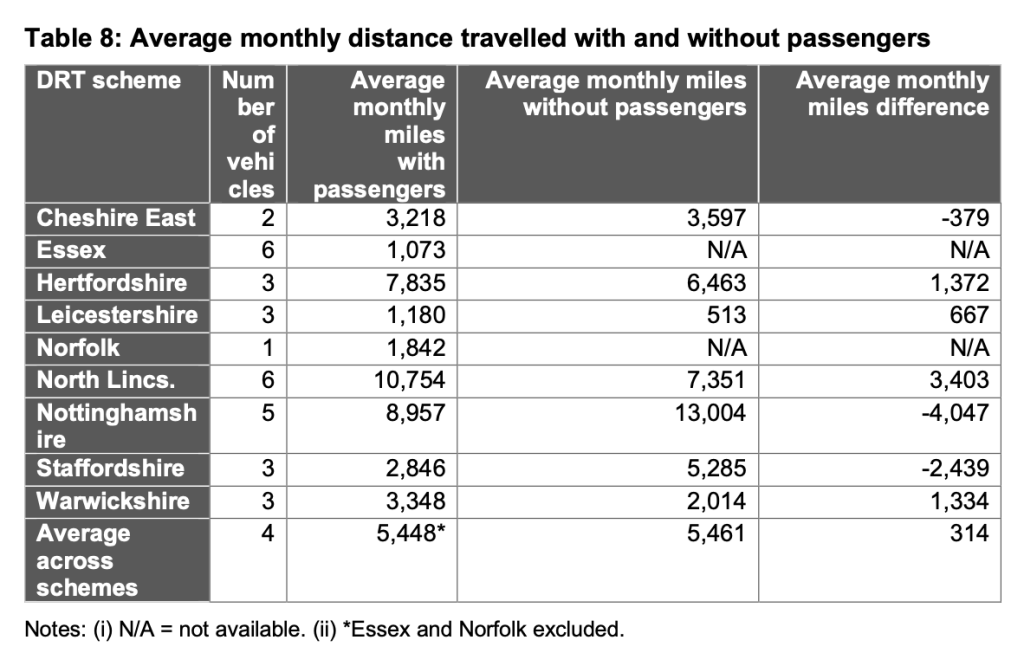
No information is provided about the costs of operating each scheme, only details of numbers of vehicles and miles operated.
Unfulfilled Demand
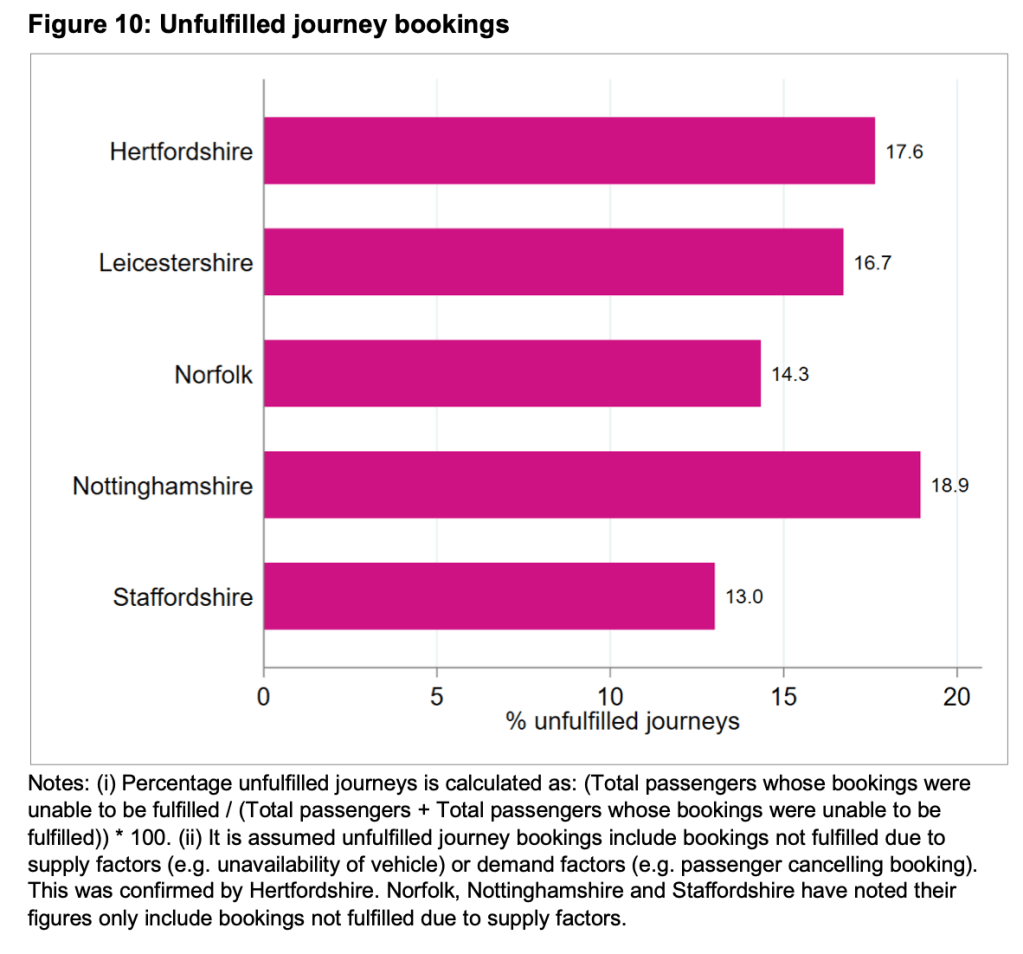
Another interesting statistic from the evaluation is a range of between 13.0% and 18.9% of unfulfilled journey bookings which, the report observes is “more likely when vehicles are heavily utilised” and cites Hertfordshire with unfulfilled journeys at 17.6% having the highest average distance per day with passengers at 86 miles. I had to smile at the term “heavily utilised”.
Comment
Whichever way you cut the data and try and dress it up as DRT “reaching parts of rural communities conventional buses just can’t reach” these results confirm what we (blog commentators and myself) have been saying on here for the last four years …. it’s an absolute hopeless cause and a scandalous waste of public money.
This report simply confirms similar results of the already quoted previous study in 2019 as well as my own anecdotal evidence from random journeys over the last four years that millions of public funding are being ploughed into these schemes including in Essex where six vehicles are carrying just 0.14 of a passenger per hour (that’s barely one passenger per vehicle across an operating day – certainly not two) yet the DfT continue funding ever more schemes (now, thanks to Bus Service Improvement Plan funding).
This, at the same time as local authorities – sometimes the same ones – are axing conventional rural bus routes for lack of funding which are carrying double, treble, quadruple and more passengers than ever the most shining example of DRT success has, or will ever achieve, just adds to the incongruity of it all.
I get all the idealistic endeavours and desire to fill gaps in public transport in deep rural areas and persuade motorists to try something different and give up their cars (is our motoring loving Prime Minister aware?) but frankly it’s a lost cause as confirmed by the results in this interim report.
And there’s that amazing statistic that despite spending all this money (£20 million) on DRT almost one in five passengers wanting to travel are being turned away as ‘unfulfilled journeys’.
I’ll leave you with this damning table of results….
Roger French
Blogging timetable: 06:00 TThS and a special DRT extra this Su on Surrey’s recently introduced five new schemes – spoiler alert – I was the only passenger on all five.
Comments are welcome but please keep them relevant to the blog topic and add your name (or an identifier). Thank you.
 BusAndTrainUser
Nice to see the satisfaction figures (Transport Focus) – I wonder if there was anywhere people could report their satisfaction (or not) with the level of services on offer (or not)?
– Rick Townend
LikeLike
Cynic that I am, I wonder how many surveys were actually returned. 88% positivity makes a good soundbite, but if it’s only of 100 people then it’s basically worthless.
I was at a railway station once when the equivalent surveys about train journeys were being handed out. Most people flat refused them, and of those who took them… Well, if you went outside the station they were lying on the ground where they’d been dropped. I doubt the return rate was as high as 5%, yet there’s plenty of back-slapping about the results.
As for value for money? Browsing social media, the amount of people who consider £1.75 for a London bus ticket to be “extortionate” is unreal. These are people who happily pay £3+ for a cup of coffee, but begrudge less than £2 for a journey. Until people get realistic about value for money, all the offers in the world won’t make any difference.
LikeLiked by 1 person
Asking people options is not a good way of really assessing satisfaction. Most bus users outside of the large towns and cities will be traveling for free as well. The fact that about 90% of bus travellers travel for free indicates a high level of dissatisfaction with fares
It also dos nothing to establish why over 90% of people do not use buses
LikeLike
14,000 so far as Roger says.
They haven’t published the response rates for the new survey yet, but they are public for the last wave:
– PTEs – 21%
– Unitary authorities – 26%
– Counties – 29%
– Operators – 32% (this is a slightly random selection of operators who paid more to have a bigger sample in their area rather than commission their own surveys)
– Stagecoach Scotland and NESTRANs – 40%
LikeLike
Yes, I have seen similar comments on social media here in the West Midlands, where people state that bus fares are ‘extortionate’. £2 for a single journey or £4.50 for a day ticket is hardly extortionate.
LikeLike
Transport Focus are careful only to ask those who get to make a trip. (It’s just like the Lottery Regulator asking just the winners whether they think their ticket purchase a good investment). Those for whom public transport doesn’t offer a viable itinerary, or who can’t afford it, aren’t on the bus or train to be asked.
LikeLiked by 1 person
Indeed – for that there is a whole separarate report called Motivations and
barriers to bus usage which was published in June 2023. It doesn’t mince it’s words “but half say nothing would encourage them to use buses more”.
LikeLiked by 1 person
Scandalous waste of public money as you say……suspected this all along.
LikeLike
What these DRT service should be able to show is when passengers want to travel and where they want to go to which would be very useful information for planning fixed routes. This assumes they actually keep a detailed log of all journeys
At the moment I cannot see any of these DRT schemes going beyond the currently available government funding. At a bit of a guess I would reckon it costs between £60K and a £100K per vehicle
Fares revenues will reduce it a bit but there are pretty negligible
I cannot see any LTA’s with pockets deep enough to keep these schemes going
LikeLike
From the reports that Roger has done, it is clear that DRT doesn’t do as it says on the tin. It is an expensive taxi. The sooner the local authority clowns start realising this the better.
LikeLike
Sobering stuff on DRT – but hardly a surprise: as Roger says, there has been plenty of evidence that DRT is only the right answer is if the question is “We have already decided that we are going to solve this sparse transport need with a bus. What sort of bus service is the least wasteful?”
Nobody seems to be confronting the issue that as non-car-users become fewer, there comes a point where even the smallest bus is too big. A good human broker might nudge users into some pairing-up, but most journeys are going to be one person (or travel-together group like a couple or family) being taken on their own. And that makes the answer a taxi service, even if you insist on delivering it with a minibus
LikeLike
You do us all a service, Roger, in analysing reports such as these. I’m afraid that my eyes usually gloss over reports from Transport Focus, worthy organisations that it is, because the summaries rarely expose actual failings (which you are so good at!).
The less than brilliant satisfaction at bus stops brings to mind two examples that I have seen.
In Huntingdon, I passed a bus stop (sadly unable to stop and photograph it) which comprised a pole without a timetable case. In place of the usual flag, a nice big real time display screen had the message ‘Please refer to timetables’. A daft instruction, as there was no timetable to refer to.
At two stops in Looe, Cornwall, timetables have displayed journeys on six days a week to Plymouth, despite the service having been withdrawn from those stops a month ago. Thankfully, a member of the public has obscured these timings, to save fellow travellers waiting for a bus that is never going to come. The humble bus stop is the gateway to operators’ services, yet it can feature low in their priorites at times.
Peter Murnaghan
LikeLike
“Roll-up…Roll-up…Roll-up, dozens of cheap minibuses for sale, hardly used, almost new and at a bargain fire-sale price”. A sound to be doubtless heard in the not too distant future….
Terence Uden
LikeLiked by 1 person
I hate to think how many times the original ‘Little & Often’ minibuses from Ashord Kent have been ‘repurposed’.
MotCO
LikeLiked by 1 person
Latest bus cuts this time in Wales
https://news-wew.firstbus.co.uk/news/cymru-network-october23
LikeLike
I don’t think ‘bus cuts in Wales’ is relevant to Roger’s (very interesting) blog topic……
LikeLiked by 1 person
An alternative approach, with vastly different outcomes:
SWITZERLAND https://ruralsharedmobility.eu/wp-content/uploads/2020/02/SMARTA-IP-Switzerland-v1-r1-AS.pdf
Peter Brown
LikeLiked by 1 person
I am not sure it is alterative., What appears to be different is the funding model
Unlike the UK Switzerland is a Federal state. It appears they fund their bus and rail service with funding at the state Level and Funding at the Regional Level
They also get a percentage of t a Heavy Vehicle road tax
The KEY thing is Switzerland is not looking for its Rail and Bus services to be commercially viable, It is only looking for the fares revenues and any other miscellaneous revenues to cover 50% of the cost. If we did that in the UK bus serves could be transformed
There would be other direct savings well such as reduced congestion,. reduced pollution and reduced number of road accidents
I in the UK it was said fares had to cover 70% of costs it would allow for a huge improvement in services
At present there is simply not enough money going into bus service so they are in a spiral of decline forcing people to have to use cars
LikeLike
Good points, my reason for posting the link was precisely to highlight what is possible once we stop limiting our thinking about being commercially viable. Public transport in Switzerland is seen as a public good, not everyone is expected to use it, but it’s there if you need it. Also looking at the outcomes (passenger usage) in the context of reduced carbon emissions, access to jobs, healthcare, education, recreation, the cost should be viewed as an investment, like spending on roads.
Peter Brown
LikeLiked by 1 person
HS2 extension officially axed. Replaced with Network North
Some of the projects’ listed below
Protection of the £12B to link Manchester and Liverpool
Midlands rail hub connecting 50 stations
A team network for Leeds
Electrification of the North Wales mainline
Extension of the Midlands Metro
LikeLiked by 1 person
Full derail’s here https://www.gov.uk/government/news/pm-redirects-hs2-funding-to-revolutionise-transport-across-the-north-and-midlands
LikeLike
As a society, we should be spending some money on something like DRT.
Attempting to get modal shift using DRT is clearly too expensive, but should fund DRT schemes to more address more limited “inclusiveness” and “social cohesion” goals, primarily serving passengers who cannot drive (for whatever reason). And analyse the outcome on that basis–“social miles” that enabled and enriched the person and their community.
There is a societal discussion to have about whether people who cannot drive should bear the impact of their choice of where they live (i.e. can’t drive? live in a town with scheduled bus service! But that is an urbanist answer.), However, that link of thinking is not enabling or equitable to some people who may have less of a choice and want some independence in their travel.
And maybe the population that lives rurally (by choice or by circumstance) should fund bus transport (mix of scheduled and DRT) by a monthly subscription (which then entitles a certain level of service), with the subscription subsidised for the poorest. Drivers fund their cars mostly upfront (expensively!) to enable independent travel, so why not non-drivers in rural settings?
And the whole conspiracy discussion of urban 15 minute neighbourhoods completely misses the reality than non-drivers in rural settings are already largely constrained into a 15 minute neighbourhood due to a lack of bus transport.
LikeLike
But DRT is targeted at people that do not drive. Thats probably one of its problem it limits the customer base
LikeLike
It’s called a taxi !!
Back in the day, some councils didn’t issue bus passes, but tokens which could be exchanged for taxi rides (National Transport Tokens).
Taxis accepted these tokens as cash; I believe there was also a discount on the taxi fare, although it’s 45 years ago now!!!
Buses accepted them as well …. I remember counting them with cash takings, and taking them to council offices to redeem them.
Ever so simple …. ever so effective …. and not an app in sight!!!!
greenline727
LikeLike
some council still give the option of taxi tokens
LikeLike
Transport Focus is an utter waste of time in the West Midlands. They are never visible to the travelling public, they don’t lobby for better buses just simply pander for a moment in the limelight whilst achieving nothing at all for passengers. How on earth they can possibly say they represent the bus user in the West Midlands is beyond me. Anyone wanting to have thier actual say on buses in the West Midlands is far better subscribing to Stu Johnsons West Midlands Bus Users forum rather than the aloof and utterly useless Transport Focus.
LikeLike
DRT is a bus, and buses are for people without access to their own transport, or those who don’t wish to add to congestion and a host of other reasons. But as this report and Rogers multiple trips on DRT operations around the country show DRT achieves nothing. It’s a glorified taxi and a very expensive one at that. It would be far cheaper, more environmentally friendly and more inclusive to allow taxis to provide a similar service. The difficulty is not then subsidising all of the taxi trips in that area.
Looking at the passenger use statistics it would be very difficult for a scheduled bus to avoid the number of passengers in a day that an average DRT bus carries, and with a bit of local knowledge and intelligent scheduling it would be easy to double or treble passenger numbers. Again on the rural buses Roger has travelled on double figure passenger loads are not uncommon.
DRT is a way of saying ‘we are doing something’ by County Councils but as there is never a definition of success they never fail, their end comes when the money runs out. But I fear this lunacy will continue now Rishi has found a new love of buses versus HS2. And however wasteful DRT is it pales into comparison with HS2 and it’s abysmal wasteful over engineered design
LikeLike
I wonder if there is a DRT middle ground, of a more of a “hail and ride” model within a basic timetable and route alignment, but can divert a bit “off route” or have flexible stops “en route”. This could also work within a taxi voucher scheme–get a discount for sharing/joining on a semi-scheduled route, to reduce costs/mileage of transport.
LikeLike
I think DRT has to be considered part of the entire network build Vs a complimentary or additional means.
LikeLike
Roger conveniently omits to mention that the RMF interim report is based only on data from the first SIX months of DRT operations – many services will not reach maturity till next year. Before jumping into negative conclusions, at least wait until the full report and whole dataset before judging.
When Roger visits a DRT and writes a blog, it is only a one person’s point of view and perception; a snapshot view only, that may not be representative for other passengers.
LikeLike