Tuesday 26th September 2023
It was back in 1986 the 56 year old system of bus route licensing and regulation outside London came to an end heralding in a new market led deregulated era of bus provision.

GM Buses was sold to the private sector eight years later.

The new deregulated system immediately attracted vocal critics, many in the PTEs who’d lost overall control of the network and were quick to highlight wasteful competition in some of the larger conurbations where newly privatised bus companies, along with opportunistic new entrants to the market, chased each other down main roads in a foolhardy competitive race to gain passengers while leaving less remunerative routes with reduced services.

Despite those initial skirmishes soon abating and becoming such a rarity over the last couple of decades the Competition and Markets Authority felt compelled to launch a full on Investigation into the “Local bus services market” in 2011, the clamour to return to some form of regulatory control has continued pretty much unabated for the last 37 years.

This call has ignored the increasing number of bus operators working effectively in partnership with local authorities which (aside from Covid) has successfully and consistently grown the market for bus travel in a range of towns and cities as well as seeing significant growth along many inter-urban corridors. This success has come about through a combination of entrepreneurial flair from experienced bus managers passionate about their work using high profile marketing promoting improvements in product delivery including frequencies, fare offers, new buses and excellent customer service alongside dedicated local authority officers and courageous politicians willing to introduce effective bus priority measures, attractive bus stop infrastructure along with parking controls and enforcement so bus passengers are favoured over motorists where doing so is for the overall public good.
The one ‘fly in the ointment,’ particularly in the last decade, has been the consistent reduction in those bus services funded by local authorities which meet social needs but would never be a commercial proposition whatever innovative ideas were conceived to stimulate the market (including DRT). Campaign for Better Transport research assessed (aside from Covid) 52% of local authority supported bus miles were cut between 2011/12 and 2019/20 compared to just 5% of commercially operated bus miles.

That 52% reduction in service provision was not due to the deregulated regime but simply reflected a lack of public funding.
When you see the scale of cuts in Government funding to local authorities during that period it’s no wonder time has been called on bus routes which few people use. Local authorities simply haven’t been able to justify the cost when statutory priorities such as social care and housing obviously take precedence.
Alongside this trend it didn’t help that some senior people in the bus industry exploited the new freedoms during the early deregulated era without taking account of wider social implications of providing, what our industry is regarded by most people as, a “public service”. They misguidedly prioritised short term gain for shareholders rather than long term interests of bus passengers. The importance of serving an overall market across a coherent network, particularly the need to run services at less profitable times of the day and week, was wrongly sacrificed in some high profile cases.
This got deregulation a bad name not least in Greater Manchester where industry observers in the mid 1990s to mid 2000s noted the conspicuously different approach adopted by First Bus towards bus provision in the north of the city and that in the south of the city served by Stagecoach.

It wasn’t deregulation that failed Greater Manchester. It was the attitude and approach adopted by senior executives at First Bus in the 1990s prioritising short term profitability, which ironically they never achieved.
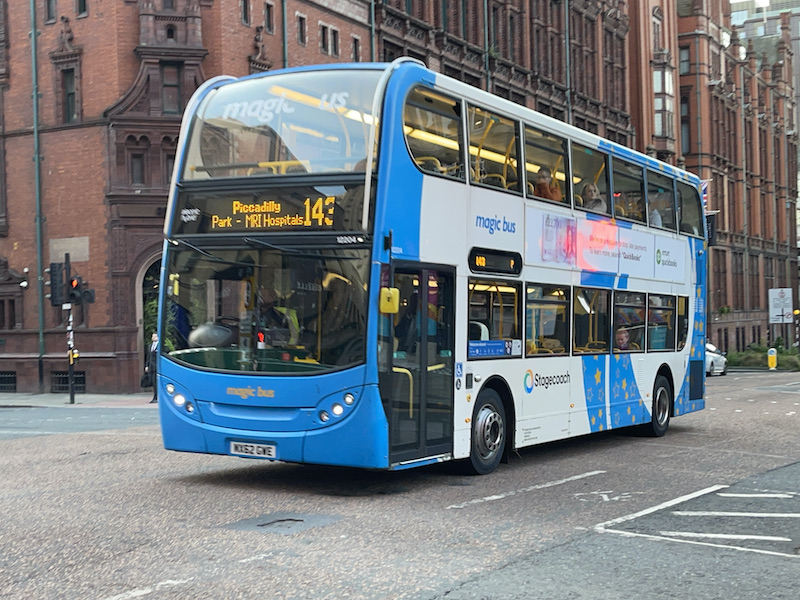
While in the south of the city, Stagecoach pursued a growth policy of lower fares (Magic Bus) and frequency enhancements, in the north we saw a ‘slash and burn’ raise fares and cut service approach.
Meanwhile the local authority and Transport for Greater Manchester prioritised resources into its tram network rather than delivering much needed comprehensive bus priorities to go with the nice new bus stations.

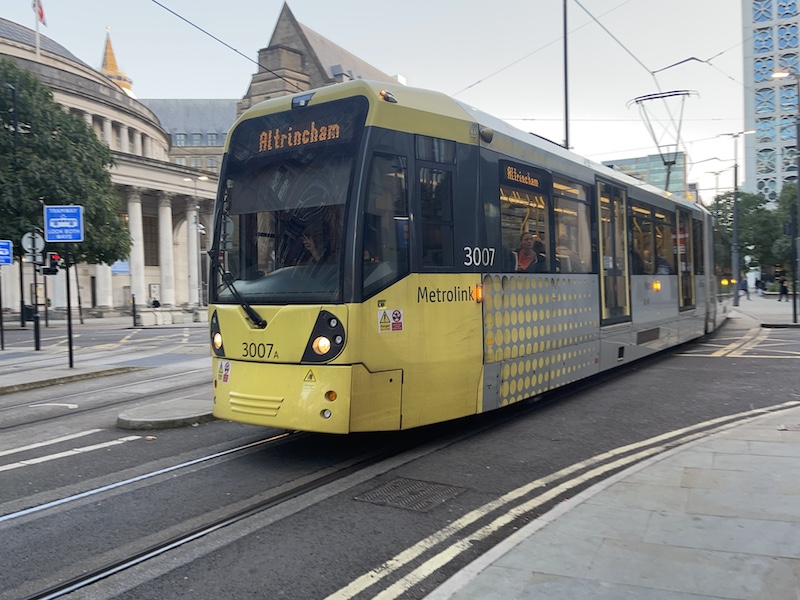
Indeed the establishment of the Metrolink tram in 1992 and its subsequent significant expansion over the last 30 years inevitably abstracted significant numbers of passengers from the conurbation’s bus network during that time. That reduction had nothing to do with deregulation.
But it comes as no surprise that on Sunday, Greater Manchester became the first Authority to “take back control” using powers under the Bus Services Act 2017 and introduce “London style” public control of service provision, fares and revenue with the private sector’s role diminished to one of being a contractor running pre-specified services after a competitive tendering process to obtain the work.

Before discussing the new era that’s begun this week and it’s likely prospects, I should conclude this snapshot assessment of the last 37 years by observing those critics of deregulation have always conveniently ignored the undeniable fact that by the 1960s and 1970s passengers were deserting buses at an alarming rate as car ownership inexorably grew alongside an extensive programme of road building and Government policies favouring motoring as an aspirational means of travel.
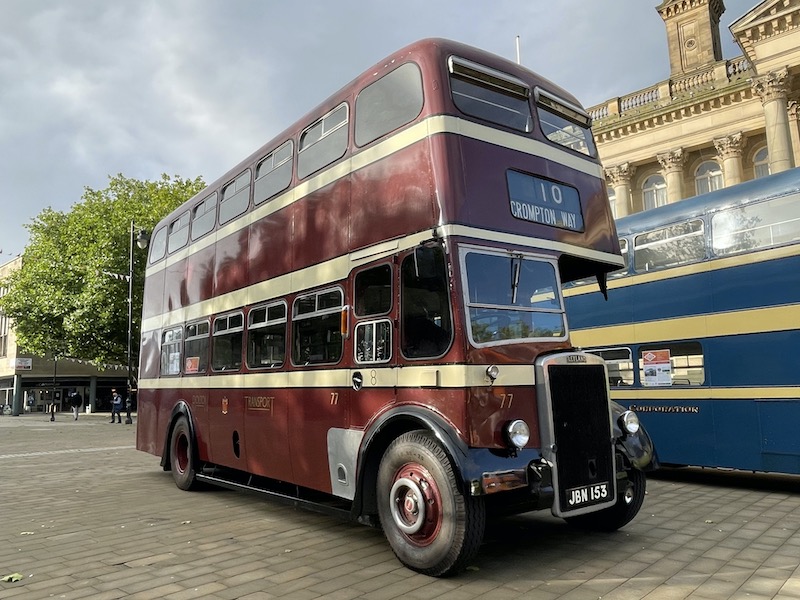
Other social trends including the growth in home entertainment (through television), reductions in the working week (six days to five) and the growth of out-of-town retail parks also played their part.
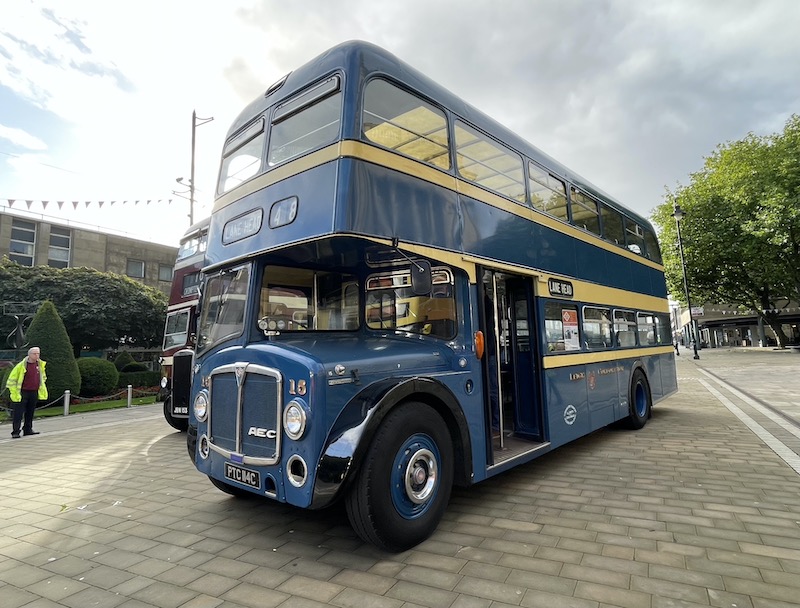
By the early 1980s the industry was characterised as being in an institutionalised spiral of decline with regular above inflation fares increases coupled with reductions in service levels needed to balance the books leading to further decreases in passenger numbers resulting in more fares increases and service reductions. These characteristics applied irrespective of who owned the bus company – whether it was one of the many municipals, the state run sector (National Bus Company or Scottish Bus Group) or the myriad of small independently owned bus companies all over the country in the private sector – yes, even in those regulated days there were private sector owned buses.
There is no doubt by 1986 the regulated licensed system of running buses had become completely unfit for purpose. Without change the industry was facing oblivion.
Rather than the regulated regime being the ‘golden era’ it had become a lame duck method of transport provision. I remember seriously wondering in the mid 1970s whether bus travel would see out my hoped for career in the industry for the next 40 years.

Against all that background, for better or for worse, here we are in 2023 on the cusp of another new era for bus operation. As Andy Burnham put it yesterday at the launch: “a new dawn for transport in Greater Manchester.”
And it’s interesting the nuance has changed from bringing back buses under public control to “under local control”. When I last looked earlier this month buses in Greater Manchester run by Diamond, Go North West, Stagecoach, Transdev Blazefield, Vision etc were very much “under local control”.
But that locally based entrepreneurial flair driven by a private sector discipline of being fleet-of-foot to adapt timetables, ticket prices and technology in a changing market, and be passionate about service quality and passengers is no longer relevant to bus provision in Manchester. Instead we have a large army of well meaning publicly employed officers accountable to an elected Mayor making all the decisions impacting bus provision and who in turn stands or falls by the democratic process at the ballot box.
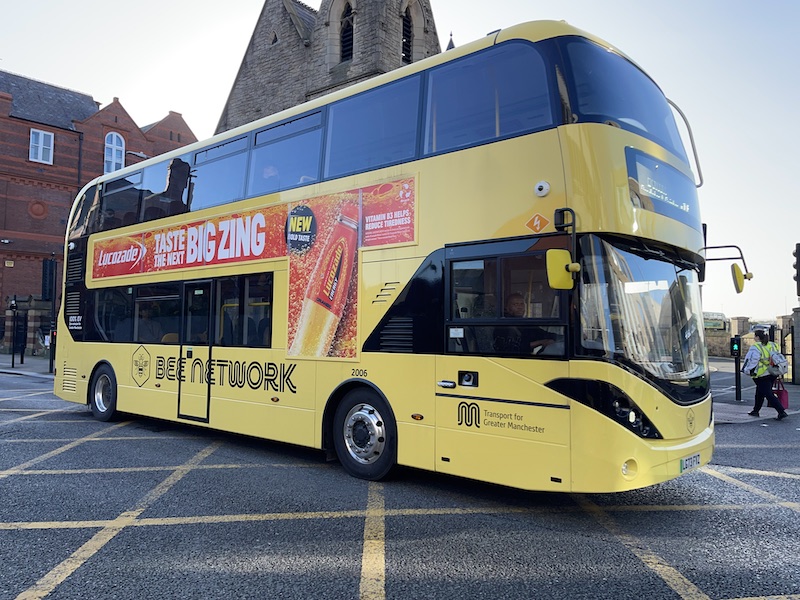
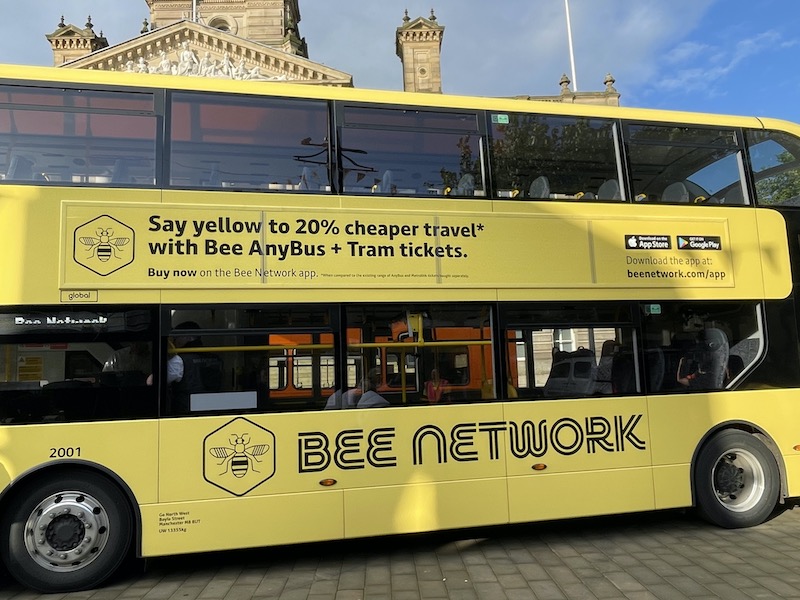
That all sounds highly appropriate for something, as said earlier, that is seen as a ‘public service’, and while passengers will increasingly notice all their buses are painted the same shade of pale yellow and there’ll be lots of hype about tickets being available on both buses and trams (as they had been prior to Sunday, of course), the main dynamic which has shifted this week is nothing to do with the colour of the bus or the type of ticket. It’s the fact the revenue risk of running a bus network comprising getting on for over 180 million passenger journeys per annum has passed from the private sector to the public sector.
Until Sunday it was down to Arriva, Diamond, First Bus, Go North West, Stagecoach and a myriad of smaller bus companies to manage that risk taking the hit in the bad weeks below budget, and banking the surplus in better weeks. Revenue is never static. It varies as much as the Greater Manchester weather does. In fact the weather can be a major factor determining whether revenue is up or down on last year. Economic conditions including buoyancy of retailing and employment, school attendances, medical appointments and many more reasons to travel can also all fluctuate and impact demand and hence revenue.
Not much else in the public sector, which local authorities are responsible for, sees revenue vary to such an extent. Council tax and funding from Government are pretty much fixed from one year to another or even longer. Those income streams don’t vary depending on whether it’s pouring with rain or one day saw particularly bad traffic congestion.
This new era is certainly going to be a novel experience for Transport for Greater Manchester (which until now has just had Metrolink revenue to worry about). It’s going to call for a whole new culture.

Bearing in mind the seismic changes in travel patterns post Covid (still around 80%) coupled with inflationary cost pressures, it’s no surprise there’s been a sea change in attitude towards the new regime from private sector bus companies. Whereas just in recent times Diamond and Stagecoach instigated costly legal proceedings against Transport for Greater Manchester’s plans, now they’re beating a path to the letter box to submit their tender prices and which, based on experience in the first couple of tranches, I’m guessing will see even keener prices for a hotly contested third tranche in the south of Manchester so they can get their desired market share and be part of the action.
Transport for Greater Manchester staff must be thinking they can’t believe their luck to have these private companies putting in ever keener prices to run the services it wants to be provided.
But for the bus companies it’s a win win, if they win. No longer needing to worry about revenue risk, their shareholder owners will be pleased to have a guaranteed income (assuming the margin has been priced in correctly) and nor do they need to worry so much about the challenge of running buses in a congested city like Manchester which for years has lacked decent bus priority on a comprehensive scale.
Sure, there are financial incentives and penalties if the quality of service suffers but as we’ve seen in London, bus companies are adept at dealing with that – either by the annoying “the destination of this bus has changed/this bus will terminate here” type actions or simply building more buses into the schedule and charging the Authority more for the pleasure of running a slower service (just as annoying to passengers).
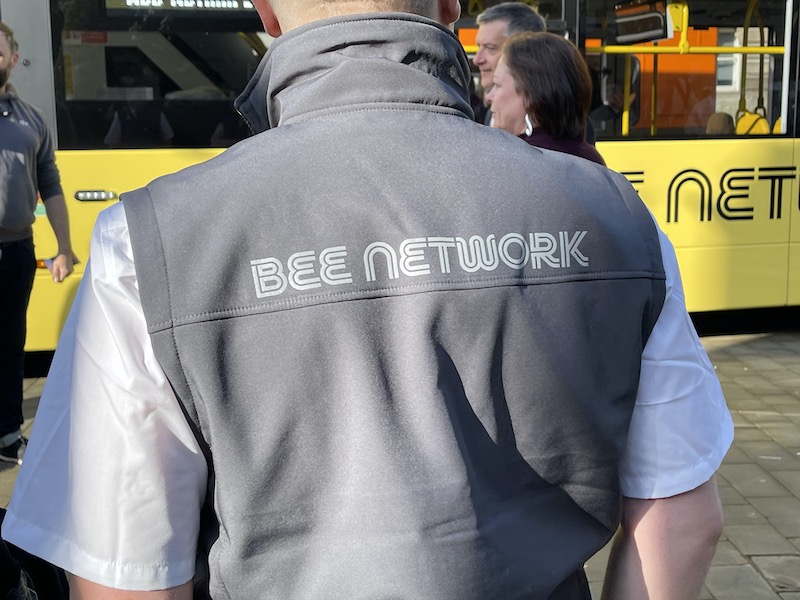
For staff who like to be loyal to their employer the new era brings in a another new dynamic. Unlike in London, where bus companies bid for one route at a time, the Greater Manchester model involves whole bus depots full of work being tendered and changing hands between bus companies as we’re already seeing with Bolton changing from Diamond to Go North West and Wigan from Stagecoach to Go North West yesterday with Queens Road soon to go from Go North West to Stagecoach. That must be very unsettling for staff with concerns over pay rates and pensions not least as staff at Bolton and Queens Road are, or shortly will be, on to their third employer in four years (First Bus selling out in 2019 following its offloading of Wigan in 2012).
Furthermore I dread to think how much time and energy has been devoted over the last few months by bus company managers firmly into mobilisation mode recruiting staff, getting their heads round all the requirements of operating from new bases and taking over buses from other operators (by the way, you’ll never find a fleet engineer praise a bus that he/she inherits from another depot, let alone another company).

Meanwhile staff at Transport for Greater Manchester have also devoted thousands of hours over many years to all the bureaucracy of setting up the new regime.

We’re talking well north of £100 million of costs so far and from the passengers perspective for what? A different colour bus and in due course perhaps a different name for a combined bus and tram ticket they could have purchased previously.

Even the timetable leaflets are the same unenticing boring funeralistic design. And the colourful maps you can see in the racks in Bolton bus station?
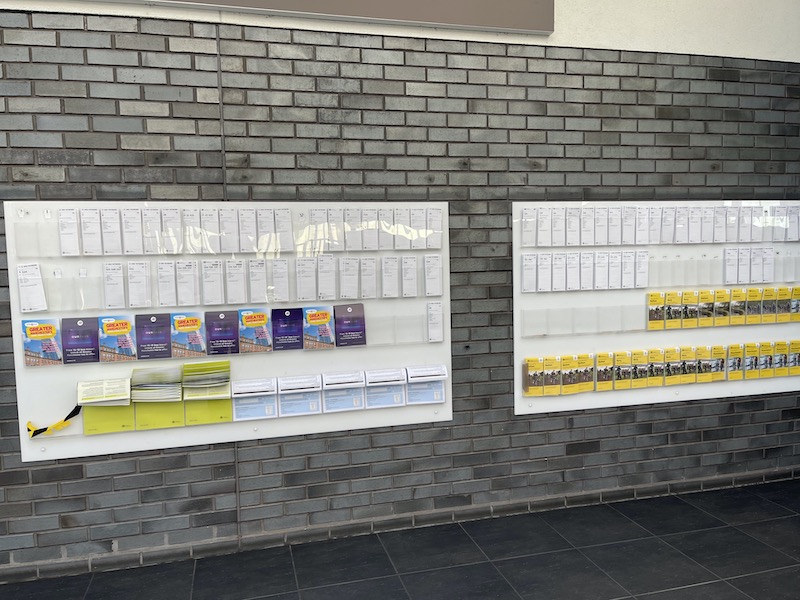
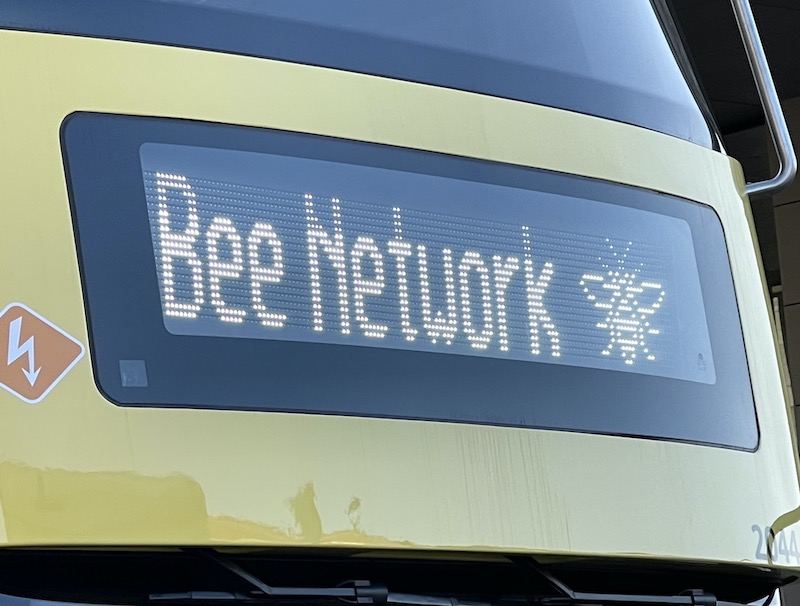
They’re showing cycle routes. There are no maps for the newly branded Bee Network of bus routes

Nor is there a Manchester city centre information point any longer with the Piccadilly Gardens outlet now a shop selling scooters. Still, at least that’s promoting “active travel” I suppose.

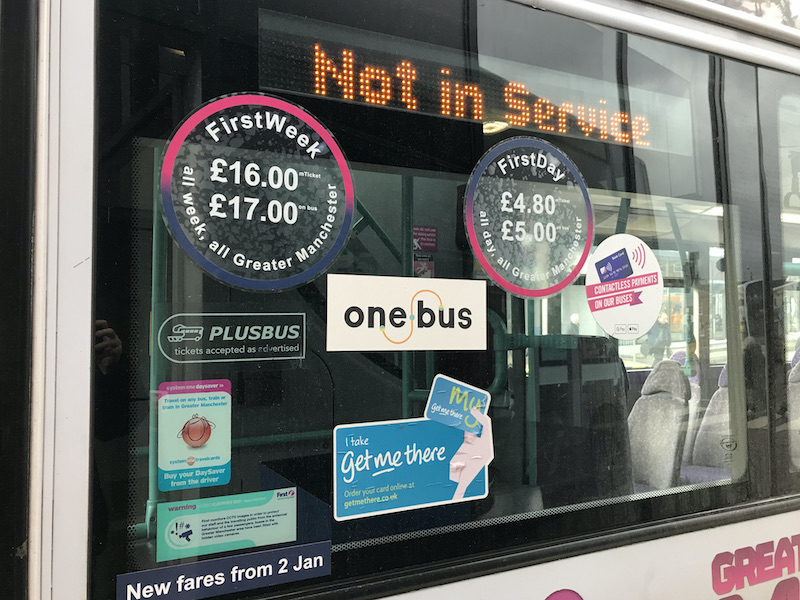
Just imagine if all that money, energy and work hours in setting this new regime up had been devoted to everyone working in partnership to radically improve customer service and introduce extensive bus priority measures across the conurbation with Go-Ahead, Diamond and Stagecoach combining their experience and skills to work collaboratively together on marketing campaigns to show a high profile ‘joined up’ network rather than the rather ineffectual “one-bus” brand that was latterly dreamt up a few years ago and was far too little and much too late.
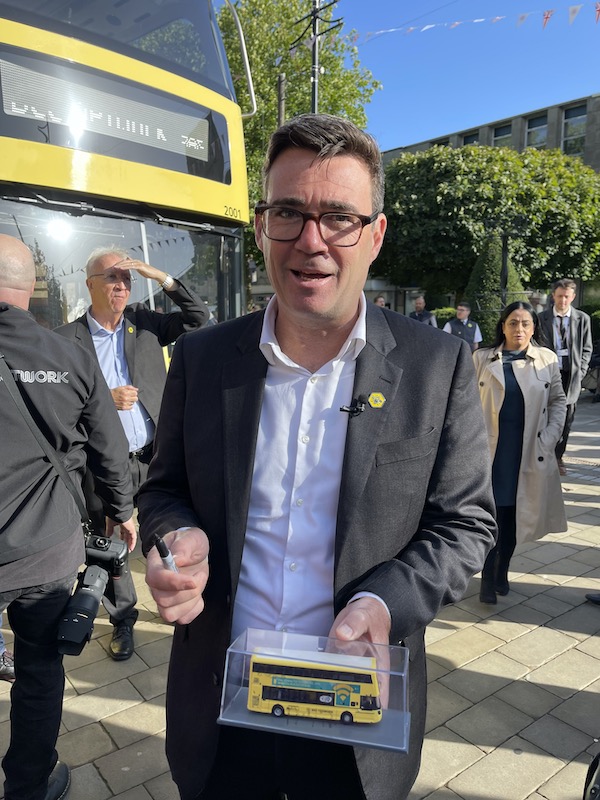
I had the pleasure of attending the grand official launch of the new Bee Network at Bolton Town Hall yesterday morning and Mayor Andy Burnham was once again on great form, as he was at the recent conference I chaired and blogged about.
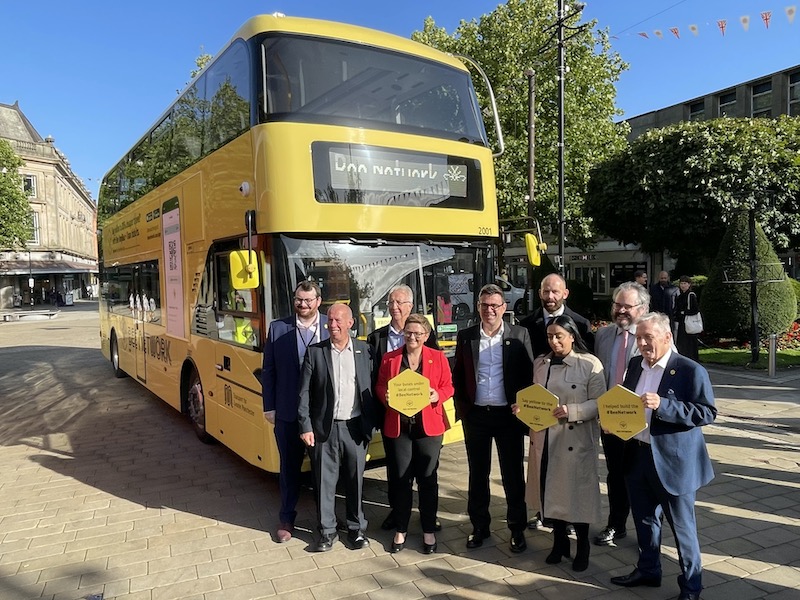
There was much back slapping and smiles all round with everyone delighted ‘control’ had been taken back.

As you can see from earlier photos, even Parliamentary Under Secretary of State for Transport Richard Holden was there and in buoyant mood (obviously pleased not to be talking about HS2).
Andy Burnham is definitely the one big asset for this new era, being a high profile politician showing passion for buses in a very public way. That is definitely a very welcome development and something buses (and passengers) need. You can count the number of high profile politicians prepared and happy to associate themselves with buses in the way Andy is on the fingers of half a hand.

I’m a great believer in strong high profile leadership from someone based locally who has high credibility and can talk up buses. I tried to do this in Brighton during my time there (ironically I had “local control of buses”) and it’s why I despair when the ‘big groups’ reorganise their businesses so managing directors run ever larger companies across unmanageable geographic areas becoming anonymous to the local population they purport to serve.
Another worrying trend among those same ‘big groups’ over the last few years is recruiting people from outside the passenger transport industry into senior roles. While there’s nothing wrong with having some outside input, the balance in some companies has gone too far and there’s a definite expertise gap further adding to the understandable disquiet among deregulation critics.
An excited Andy Burnham told the recent Public Transport North conference I chaired he sees Manchester heralding in a new “golden era” for buses in Britain with expectations Merseyside, West Yorkshire, South Yorkshire as well as Cambridgeshire and Peterborough Combined Authorities will follow down the same route. He’s probably right about the latter – Oliver Coppard, the Mayor of South Yorkshire was at yesterdays launch with his own personal media entourage, for example ….

… but I’m not sure about the former (ie a “golden era”)
Imagine if there’d been a high profile ‘Mr/Mrs/Ms Bus’ with vast experience of the industry leading truly customer orientated private sector bus companies, being constantly in the media and in tune with local communities in Greater Manchester for the past 20 or 30 years.
But that bus full of possibilities has long left the terminus. We are where we are. In the short term, passengers won’t see any changes to timetables but will enjoy continued subsidised cheaper fares and ticket prices. Andy reckons what he calls the “London style” model of cheap fares and frequencies will be enough to get motorists to switch to buses and thereby improve air quality without any need for controversial ULEZ style measures. He’s also very bullish about meeting the targeted 30% increase in bus use in Greater Manchester by 2030.
I wish Andy Burnham the best of luck and very much hope he succeeds.
A couple of words of advice to conclude: firstly, keep a close eye on that passenger revenue each day. Because the mega millions Government funding that has been showered down on Greater Manchester to enable all this to come to pass inevitably won’t last. It never does. As with the weather, showers come to an end. Ask Sadiq Khan.
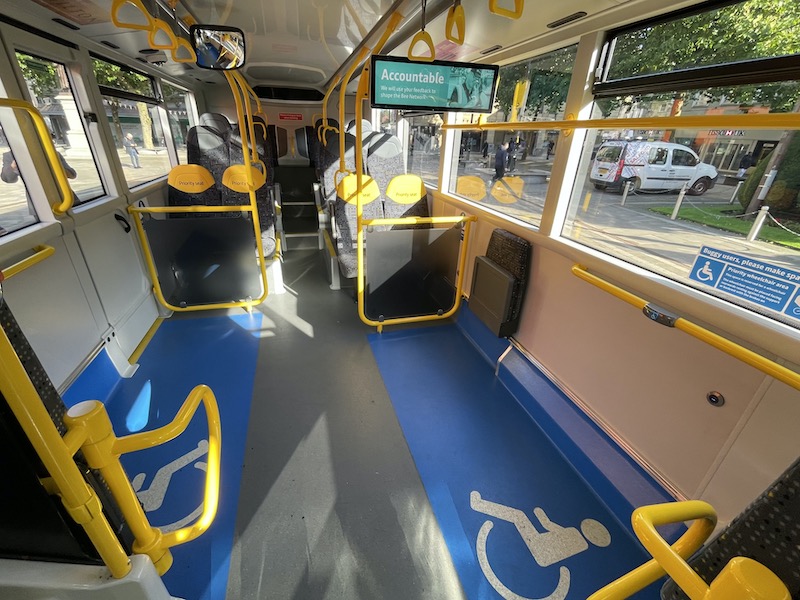
Secondly use the expertise in the bus companies to advise on such things as timetables, route developments, customer service and bus design. They have a wealth of knowledge and experience which mustn’t go to waste as mere contractors providing buses and drivers. For example, the lower deck interior layout on the 100 shiny new ADL electric double deck buses entering the Bee Network fleet isn’t very passenger friendly.

There are just 21 seats (including one tip-up) and whilst a large open area is great for (two) wheelchairs and buggies, it’s hopeless for those unsteady on their feet trying to access just four ordinary accessible “priority” seats (plus one tip-up) without a step. Whoever signed off on that design has not travelled extensively on buses and seen how passengers use them.
I reckon crunch time for the Bee Network (and any others back in ‘public control’ in other conurbations) will be around 2029 when initial tenders have been relet with bus companies seeking much greater margins at the same time as an incoming Conservative Government, following five years of Labour, will take one look at the subsidy bill and decide there must be another way to run buses……
Roger French
Blogging timetable 06:00 TThS
 BusAndTrainUser
Can’t disagree with a single word.
LikeLike
I believe bus de-regulation in 1986 was driven by Margaret Thatcher (no lover of buses), persuaded by Irvine Patnick (Sheffield Hallam Tory MP) who hated the South Yorkshire model of public transport which saw plenty of public sector innovation (including the first use of bendy buses in the UK) and bus fares frozen over many years of high inflation, with the costs met out of the local rates, which therefore went up every year. However, this meant high usage of buses, including by people who these days wouldn’t dream of leaving their car at home (or ‘managing’ with only one car per family) and traffic congestion in Sheffield was minimal. After 37 years it will be difficult to get back to that position, but Andy Burnham and others are surely right to try.
LikeLiked by 2 people
Whenever one of these articles is written, the defenders of the status qo say that it was working because in a handful of places (Reading, Brighton, Oxford) usage was going up. This is always credited to the skill of the bus managers and local authorities in these cities and seemingly ignores the fact that almost all of them had seen major population growth, often of low-car usage incomers like students.
The reality is that if you exclude London, English bus usage declined pretty well continuously over the ten years pre-pandemic (Passenger Journeys, millions, DfT Stats) at a time when the UK population was increasing and when usage of other public transport modes was rising.
2009/10 2,375
2010/11 2,349
2011/12 2,316
2012/13 2,256
2013/14 2,288
2014/15 2,263
2015/16 2,218
2016/17 2,199
2017/18 2,122
2018/19 2,107
Declines in some individual regions were even faster. The North East, West Midlands and Yorkshire lost a quarter of their passengers in ten years and none of these areas had enough abstraction by tram services to affect the trend.
I’m not sure the Manchester set-up will work, but the fact is that the current set-up was failing pretty comprehensively even before the pandemic, and things have got worse since then.
LikeLiked by 1 person
Utter rubbish in the year before Covid-19 bus use in the West Midlands Combined Authority actually rose by 18% in 2019-2020 on the previous year thanks to Andy Street CBE & TfWM, only for this to be decimated by the pandemic.
Whilst coming home on Diamond Bus in Brum last night from work with our lower fares and higher frequencies on our EP network I was following the live blog on the Manchester Evening News website whilst Andy Burnham was going around lording it up the reality for those using his new network was somewhat different the MEN roving reporter Ramu posted live “People have just got on but they’re not happy. I’ve been told that they’ve beenwaiting for 35 mins for a service thatusually runs every five mins.
This is s**t.” One commuter said & added “They should have stuck to Diamond Buses, they were reliable……….”
@MENnewsdesk @MyWiganUK
LikeLike
Here is the archive link for 2018 – 2019 from West Midlands Combined Authority before anyone shoots me down:
https://www.wmca.org.uk/news/millions-more-bus-journeys-in-the-west-midlands-following-investment-in-network/
LikeLike
DfT data is based on English standard regions so it includes a wider area than the former WMPTE area I assume you are talking about. But since you want to trade statistics, here’s the DfT data.
Passenger journeys on local bus services by metropolitan area and urban-rural status [note 1], region and country: Great Britain, annual from 2004/05
Table BUS01a
Department for Transport statistics
The figures in this table are National Statistics
Passenger Journeys, millions
Year West Midlands
2004/05 407
2005/06 403
2006/07 407
2007/08 412
2008/09 414
2009/10 399
2010/11 380
2011/12 364
2012/13 355
2013/14 361
2014/15 353
2015/16 341
2016/17 330
2017/18 321
2018/19 322
2019/20 302
LikeLike
That’s a pretty fair summary. I think it has to be admitted that this didn’t come from no-where, and the change appears to be very popular. So perhaps there needs to be some soul searching among the big groups (if they can be said to have souls …). I hope you are right about the ‘local control’, as that would appear to be the important factor, rather than ownership or the colour of buses, and it will be interesting to see how that operates from now on.
Are trains going to be included at some point in the ‘local control’? That’s a point where Manchester is still unlike London; for me it would be the crucial improvement to make a noticeable transfer of travel from car to bus/train/tram – simply because many more journeys will become possible or practicable.
Rick Townend
LikeLike
Yes. I believe the plan is for some rail services to be brought into public control (similar to London Overground) by the end of the decade
LikeLike
Clearly bus deregulation has not worked. Rural areas and areas with multiple competing operators have fared the worst, The general standard of the privatized bus companies gas been poor
Operating services as a single integrated network has many benefits for the passengers and there are a lot of potential cost savings but there are also risks
It is becoming clear that the Enhanced partnership route that most LTA’s went down are not working and further changes are needed
Another problem is finance most bus network at present are investment and are not a viable option for travel for most people. To change that needs investment and at present that investment is not there. Poor management and poor reliability of services is another major issue
The risk in Manchester is finance. I am not clear exactly how the service will be run there appear to be no arms length company
The tram network has normally made large losses, Whether as well cash has been set aside for replacing he trams could be another issue as they are very costly
Looking at their web site there appears to be quite a bit of mission creep with them keeping involved with walking and cycling and EV’s and also of integrating parts of the National Rail into the network
The risk is trying to do to much to quickly and not watching the budget
LikeLiked by 2 people
Service delivery on first two days has been utterly dismal. Buses missing, buses driven by folk who don’t know where they are going. When it did turn up, it was a shiny yellow 14 year old Scania from London which sounded as if it was on its last legs, very tatty inside.
Brave new world? Not on my local route. Burnham advancing his life long bid for Labour leadership, and not interested in the real passenger experience.
Roger completely agree with your comments re the lower floor layout of the new ADLs. Not fit for purpose.
LikeLike
With the mention of revenue risk is this the risk that the government had to take on during the pandemic to prevent the private companies going out of business and shareholders losing their investment, or is this the risk that governments have had to provide through Labour’s kick start or the current government’s BSIP to improve bus services, or is this the risk over last 40 years when a operator simply walked away from a service with say 56 days notice and it was left to local authorities to find the money to subsidise.
Also in terms of revenue risk, the big bus companies in the UK are too big to fail. If one of them did get into financial difficulty, the government would ultimately have to step in with money as too many communities would lose their public service.
LikeLike
I fear you are looking at the national bus industry through the rose tinted lens of your time at Brighton & Hove. Most of us don’t enjoy a company that has the flair, innovation and local control of Go-Ahead, trentbarton or Transdev, but instead have to suffer the turgid conservatism of First, Arriva or Stagecoach, where the first instinct is to cut, the second instinct is to cut, and the third instinct is to blame someone else. That’s why passenger numbers outside London and a small number of select places with strong local operators have continued to decline over the last 30 years.
As for private bus companies being able to be responsive … what we usually see is pointless tinkering. My local network is run by Arriva, and most routes have seen little change in route or frequency, but most routes see at least 2 timetable changes every year. What does it achieve? Nothing. The buses are no more reliable now than before, and every time the timetable changes by a few minutes here, a few minutes there, it causes disruption and confusion for passengers. And as for the abomination of First’s new policy of having timetables created by a random number generator, where buses run at irregular frequencies, and no two journeys throughout the day having the same running times between stops or the same headways – if this is what we have to look forward to from the private sector then I can’t wait to see more franchising rolled out across the country.
LikeLiked by 1 person
This whole “the private sector can change route patterns frequently to match demand” stuff has always seemed nonsensical to me. The kind of developments which cause material changes to traffic flows are generally known about years in advance (new housing developments, shopping and leisure facilities opening, changes to hospital locations).
Instead what we mostly get is endless tinkering with route patterns of the kind seen in the Arriva network in Hertfordshire, where the same set of services are sliced and diced every few months and route numbers either change or become a different service.
LikeLiked by 1 person
Interesting comments, and I do think that Roger is swayed by his experience of Go Ahead and some of the other firms you mention. However, I’d actually defend Stagecoach (under Souter) in that they have actually sought to grow and develop markets in their provincial operations. When you look at service provision in many opcos compared to how they were before Stagecoach, it is actually quite impressive but in the post Covid world and under new ownership, I have concerns about the extent of top down management and cost emphasis.
First is a mixed bag and the latest reorganisation is short-sighted and counterproductive. Some operations are doing ok whilst others are struggling.
It is Arriva that really drags the reputation of the big groups down (at the moment). A directionless, underinvested, bunch of unloved operations owned by a dithering DB. When you experience Go South Coast, you see what deregulation can bring, but equally, Arriva Cymru is a depressing example of what is can also realise!
BW2
LikeLiked by 1 person
GoAhead is a very mixed bag. It ha some excellent local business units but equally it has some very bad ones
LikeLiked by 1 person
Whilst clockface timetables may be a nice to have in most cases they are not practicable as running times will need to vary by time of day. There only way around that would be excessive running times off peak
Another issue is that routes are frequently interworked and or fitted around school hours
LikeLike
Clockface from dawn to dusk is unrealistic, sure, but from 0930 to 1500 you should be able to maintain a consistent pattern. Traffic patterns are not going to vary so significantly and so predictably from one day to the next that there is anything to be gained from trying to match the running time on each individual journey with the average traffic at that specific time of day. What you end up with is absolute nonsense like this: https://bustimes.org/services/5-strensall-acomb, where there is absolutely no pattern to it, just random numbers from start to finish. You might as well just roll a dice.
LikeLike
Selectively picking one year is not a true picture of what has actually happened so I will defend Phil Stubbington’s assertion. As shown in WMCA’s own figures in their BSIP application, you can see a steady decline in bus patronage – https://www.tfwm.org.uk/media/1xebdeu4/wmca-bsip-05-november-2021.pdf. In fact, they even state that
“Through the strong Bus Alliance, we were
beginning to achieve increases in bus patronage
to address the years of decline (falling by
2% year-on-year in the 10 years) before the
pandemic hit in 2019/20. Notwithstanding
these positive changes, we have seen changing
behaviour patterns (preferences to travel by car),
increasing cost of bus fares relative to motoring
costs, and declining service coverage (in part
because of declining bus speeds) impact bus
boardings.”
Those are the words from WMCA and TfWM, as endorsed by Andy Street. Is Richard suggesting that they have provided incorrect figures?
Onto a wider issue, this merely highlights one of the issues highlighted by Roger. The selective cherry picking of statistics. One of the justifications of the BSIP schemes was showing how patronage had declined since 1986 in the UK, without once highlighting that bus patronage had declined in the previous 30 years and at a much higher rate of decline. When you look at national figures, the decline in bus patronage had actually been reversed by the mid 2000s with the introduction of the twirly passes. Not so in Manchester but then again, as Roger has highlighted, it is really striking to see the correlation between bus patronage decline there and the phased openings of Metrolink. Correlation and causation are not necessarily linked but hard to argue otherwise in that case.
I do wish TfGM well and at least the model is more robust than the proposed Liverpool city one which just seems ideologically driven rather than anything else.
Also, in relation to revenue risk, Kickstart was usually with the revenue risk was often shared by operators and local authorities.
BW2
LikeLiked by 2 people
No DfT figures are collected by statistical analysis the figures used by WMCA are taken from the data from the ticket machines onboard. WMCA data is much more accurate than the DfT.
As I clearly stated bus patronage was declining in the Centro years but was again increasing under Transport for West Midlands from our own data.
The quote you are using is taken out of context from a multi modal report which was using analysis for the West Midlands Region.
My comments are wholly attributable to bus services operating within Birmingham, Sandwell, Walsall, Wolverhampton, Solihull & Coventry.
Stubingtons comments are based the West Midlands Region mine are purely on what actually matters the Metropolitan Area of West Midlands Combined Authority.
I have no interest in bus services not controlled by Transport for West Midlands.
LikeLike
No Richard – that is not true.
Firstly, you did NOT mention Centro. You made no distinction as to different eras – at all.
As stated earlier, the figures used by WMCA and TfGM figures clearly show a decline in bus patronage since 2010. They even say so themselves, declaring that it was a 2% year on year decline.
It is definitely IN CONTEXT – it’s WMCA’s BSIP application and relates purely to bus patronage.
LikeLike
Regardless of the causes bus passenger usage has declined and the normal response of the bus companies and councils is to further cut the services making them even less attractive then they are now
What must be even more concerning is they are now seeing their core market of schoolchildren and pensioners declining
If you cannot attract people who are largely travelling for free you know you have serious problems
LikeLike
If you are going to quote my dear friend Andy Street CBE at least get the comments and endorsements correct !
“In fact, we were one of the few places in the country where bus use was rising. In the 12 months up to December last year, the number of people catching the bus in the West Midlands rocketed by almost eight million.”
https://www.andystreet.org.uk/news/our-pioneering-bus-partnership-will-get-west-midlands-economy-moving
LikeLike
One needs to look at those figures carefully. I suspect much of it is just the recovery from Covid and not a long term upward trend in fact the last tram figures I showed a collapse in passenger numbers
LikeLike
Probably down to the recovery from Covid and not really an upward trend
LikeLike
As one of the authors of this report nowhere within contains any reference to contradict my comments that before Covid-19 in 2020 that bus usage in 2018- 2019 was again increasing within the WMCA.
Click to access wmca-bsip-05-november-2021.pdf
LikeLike
You will acknowledge that the TfWM/WMCA BSIP document is an official document. It is produced by them, and endorsed by Andy Street (but he is not quoted).
It shows, very clearly, that 2018/9 is just one year amongst an overall trend of decline from c.295m 2011 until 2020. Notably, 2013/4 was also a year that experienced an increase.
Therefore, there is nothing to contradict the statement that West Midlands bus patronage fell. In fact, TfWM and WMCA actually say so in their own words. They literally say it, and no amount of obfuscation gets away from the fact that Phil Stubbington is correct in stating that West Midlands bus patronage was at a lower level in 2019 (even after an increase) than it was in 2010 viz
“Through the strong Bus Alliance, we were
beginning to achieve increases in bus patronage
to address the years of decline (falling by
2% year-on-year in the 10 years) before the
pandemic hit in 2019/20. Notwithstanding
these positive changes, we have seen changing
behaviour patterns (preferences to travel by car),
increasing cost of bus fares relative to motoring
costs, and declining service coverage (in part
because of declining bus speeds) impact bus
boardings.”
Do you accept the fact that bus patronage fell in the ten years from 2010?
BW2
LikeLike
I stand fully behind my original comment that bus usership in West Midlands Combined Authority before the Covid-19 pandemic & had risen by 18% by 2020 from the Centro era following the introduction of Swift & the Low Fare Zones based on data from the platforms.
You can argue however you wish currently on some of the BCT trunks unlike The Black Country capacity is at 110% pre covid & consequently within the City there will be a frequency uplift in October on many services.
LikeLike
“I stand fully behind my original comment that bus usership in West Midlands Combined Authority before the Covid-19 pandemic & had risen by 18% by 2020 from the Centro era following the introduction of Swift & the Low Fare Zones based on data from the platforms.”
You challenged Phil Stubbington on his assertion that bus patronage had fallen in the West Midlands in the previous 10 years.
– TfWM stated that there had been a 2% YoY fall prior to 2018/9
– TfWM figures (as shown in the BSIP document) show a fall from c295m to 259m before the 2018 increase
Those are quoted figures in a document produced by a public body. Are they wrong?
BW2
LikeLike
What Stubbington has written is irrelevant I stand ,my original statement that it is rubbish to suggest usage of bus services was on the decline in the West Midlands Combined Authority when bus patronage increased by 18% before the Covid 19 pandemic.
LikeLike
Source you quoted
“Fare-busting initiatives and other incentives delivered through the West Midlands Bus Alliance mean passenger numbers were up to 267.1 million between March 2018 and March 2019, according to new government figures. This is up from 259.3 million during the previous 12 months.”
That’s a 3% increase on a single, solitary year. Before that, it had declined over the previous 8 years from 294.2 to 259.3, as per WMCA/TfWM’s own publications, and they use the same DoT figures that Malc M shared.
So irrespective of a single year in 2018/9 after the bus strategy, and another year in 2013/4, bus patronage in the West Midlands area has declined over the last 10 years. After that one year, they declined again but, in fairness, that was post Covid where we expect a decrease.
Those are the facts, backed up by the figures provided TfWM in their BSIP document, and used by them as taken from the DoT figures.
LikeLike
Disappointed that you should continually refer to ‘Greater Manchester’ as ‘Manchester’.
Terry Ough
LikeLike
Seven Greaters now added Terry.
LikeLike
Interesting that the cost of the bureaucracy in GM is quoted by Roger at around £100m. I wonder if they get free travel and spouse/partner passes like TfL ?
Also agree that the WM is often forgotten in the debate. After all low capped fares, frequent services and virtually no subsidy must be quite an achievement. Not forgetting a bus priority programme unlike in London where many bus lanes have been removed to make way for cycle lanes.
I do wish Manchester good luck but hope that they don’t go too far down the TfL bureaucracy route where it can take years to achieve changes in local route networks.
Perhaps the halcyon days in Manchester (south) were in the days of Stagecoach under Souter control. I am told he spent many hours in a McDonald’s counting passengers on the busy Oxford Road corridor. I wonder how many First and Arriva directors have done the same ?
LikeLiked by 2 people
I also remember the story that he travelled on Glenvale/Arriva vehicles from Gillmoss depot in readiness for the Stagecoach purchase with a firm eye on fare evasion etc
I actually think that West Midlands is the most progressive of the PTE areas (so Dickie Jones can smile at that) and they have focussed on areas such as red routes to ensure that traffic keeps moving. In Greater Manchester, the level of bus priority is pretty awful and piecemeal. Coming on the A6 from the north is ok but other routes are fairly haphazard and as for coming from the East…
Whilst there is much now promised in terms of bus lanes etc, you do wonder (like Roger) whether they were so busy with Metrolink that they just didn’t have the cash or incentive to sort that out.
LikeLiked by 1 person
What everyone appears to have forgotten is the other big change under the 1968 Transport Act where PTEs took over the true local services provided by local councils. In some places we entered a period where the ‘PTE knew best’ and made changes that were not always wanted by the public such as forcing integration with local rail.
There have been comments about the lack of bus priority schemes but the other major deterrent to non users is anti social behaviour and what plans do they have to tackle this.
LikeLike
A few things here. As a blind passenger, I totally agree with your
comments about bus layouts. While our legs work just fine and steps are
not a problem in most situations, on a moving bus, they definitely can
be a problem. While space is needed for wheelchairs, buggies and guide
dogs, so are clean, clear aisles, without poles butting into them, but
also poles themselves beside those aisles, and accessible seats with
them. For me, the ideal bus layout is one where there is a very gradual
slope up, eliminating the need for a step until right at the back. The
one thing I would take issue with here though is that it is the legal
duty of a company to maximise dividents for its shareholders. That means
that it is their legal duty to take as much money out of buses and put
it into the hands of their shareholders as possible. It is this, as much
as anything, that needsto change, to enable service minded companies to
run buses in a way that we all know is more sustainable long term. We
are just lucky that some companies justify long term gain well enough to
be as good as they are.
LikeLiked by 1 person
Most bus companies make very low profits. Without profits they would have no shareholders so the taxpayers would have to fund them. how much would you want council tax to increase to pay for the bus services ?
LikeLike
The introduction of the Bee Line sounds great for Manchester. Could they please sort London Buses out please. Rather than ask for more bus priority measures to enable the bus service to run TO TIME. London Buses revises the schedules to allow extra journey time.
In Harrow there is a bus that runs between Wembley Central & Harrow Bus Station (H17). Introduced to great fanfares some years ago. The great LB has altered the garage from Park Royal to Willesden Junction, yet none of the route serves an area within the North Circular Road. The buses and their crews get delayed in travelling between garage and joining the scheduled route at Wembley Central. The H17 bus does not seem to run to schedule, even being over 5 minutes early at a stop. The buses seem to have caught a reliability decease now -regularly breakdown.
I know that Andy Burnham likes the North of England but could one of his team please, please take over the running of Transport in London, that’s buses, trams, tubes, overground and British Rail services out into the far reaches of London. London does deserve better, much better then we have at the moment.
Allan Stewart
LikeLike
London nu services are tendered so the tender winner decides what garage to run a service from rather than TfL it does lead to long out of service runs and reliability issues
LikeLike
Building on the comments above from PhilStubington and BW2, DfT statistics are available by county/unitary/ITA from 2009/10 (table bus01e): https://assets.publishing.service.gov.uk/government/uploads/system/uploads/attachment_data/file/1132738/bus01.ods
I will compare 2009/10 with 2018/19, as that is the last full year before the pandemic.
Passenger journeys by bus in Greater Manchester:
2009/10 – 220.8 million
2018/19 – 189.2 million
Over those 9 years, 31.6 million fewer journeys, a decline of nearly 15%. Hardly a success in my opinion – and if Stagecoach were growing their market in south Manchester, that masks an even worse decline in other parts of Greater Manchester.
Is it all the fault of Metrolink, “abstracting” patronage from buses?
Passenger journeys on Manchester Metrolink:
2009/10 – 19.6 million
2018/19 – 43.7 million
That’s an increase of 24.1 million. Some of that may well have transferred by bus (and is that a bad thing?) but some will be former rail users (on the Oldham line). Some may be trips new to public transport (or it may not, the figures don’t show where the increase is coming from).
Turning to the comment by “rbjtasb4f994b035” about bus usage in the West Midlands (PTE/ITA area):
Passenger journeys by bus in West Midlands ITA:
2009/10 – 313.8 million
2018/19 – 262.8 million
A drop of 51 million (not far short of 20%)
It is true that Greater London also saw a decline over the same nine-year period, but nowhere near as sharp:
2009/10 – 2,238.2 million
2018/19 – 2,197.8 million
A drop of less than 2%, coming as it did after years of spectacular growth.
Although stats for individual county/unitary/ITA don’t appear to be available pre-2009/10, historic data for English Metropolitan areas (combined) is available, going back to deregulation and beyond. To compare the last full year before deregulation with the last full year before the pandemic:
Passenger journeys by bus in the English metropolitan counties (outside London):
1985/86 – 2,068 million
2018/19 – 908 million
A decline of 56%. Some of that will be due to other factors, or course (e.g. de-industrialisation), but if deregulation was meant to arrest the decline in bus usage, it clearly didn’t. Over the same period, Greater London bus usage rose by 91% (it actually doubled, then dropped back slightly).
Finally, to end on a positive note, there have been some areas where bus usage did rise between 2009/10 and 2018/19, one of which is of course Brighton & Hove:
Bristol (+52%)
Wokingham (+38%)
Reading (+36%)
West Berkshire (+32%)
Bath & North East Somerset (+30%)
South Gloucestershire (+28%)
North Somerset (+26%)
Poole (+26%)
Thurrock (+26%)
Brighton & Hove (+22%)
Cornwall (+16%)
Central Bedfordshire (+13%)
Luton (+12%)
Southampton (+10%)
West Sussex (+8%)
Milton Keynes (+6%)
Slough (+6%)
Bournemouth (+5%)
Portsmouth (+5%)
Hampshire (+3%)
Norfolk (+1%)
Torbay (+0.4%)
Growth in these 22, bucking the trend of decline on the other 68 counties/unitaries/ITAs
Malc M
LikeLiked by 1 person
Noticing that bus use in Bristol grew by 52% where First is the dominant operator. Comparing this with First in Manchester (a much bigger city than Bristol) where they lost passengers. I believe the big increase in bus use in Bristol occurred around the time where the city won government money to implement significant bus priorities on several corridors, and when First revised their fares downwards and adopted a single fare zone covering most of the city. Also this included the period when a certain manager joined from Reading Transport.
Peter Brown
LikeLike
The current plans for bus imprisonment in Bristol can be found here:
https://travelwest.info/projects/bristol-streets-transport-corridor-improvements/#improvements-for-bus-travel-1
Peter Brown
LikeLike
Imprisonment, Peter? Is that Suella’s next plan after the Bibby Stockholm? BW2
LikeLike
Hahaha sorry, stupid auto-correct!
LikeLike
To add some more colour to Malc’s analysis.
1) These numbers get much worse when you contextualise them with the population trends.
The total population of England was 51.8m in 2009, by 2019 it was 56.3m – an increase of just under 9%.
Greater Manchester’s population rose from 2.6m to 2.8 (+9%).
West Midlands (the former Met county not the Standard Region) rose from 2.6m to 2.9m (11%).
So the real decline adjusted for the population trend is roughly speaking 5% higher than these numbers (20% in Manchester and 25% in West Midlands).
2) Metrolink model shift is a can of worms, but there is TGfM survey data showing that 53% of journeys on Metrolink Phase 3 would have been undertaken by bus had Metrolink not been available.
That suggests that bus traffic loss caused by openings between 2009 and 2019 might be in the order of 12m bus trips per annum, or slightly over a third of the total decline.
LikeLike
Good work Malc M in picking out the respective figures.
A few observations, if I might…
Undoubtedly, the introduction of Metrolink will have persuaded some organic growth as well as attracting car users. However, it would be difficult to imagine that much of the patronage isn’t drawn by existing public transport users moving from bus to tram. No bad thing in itself, but always important to put such statements as declining bus patronage in GM in context.
As bus01a shows, there was an uptick in 2004-9 and I’d suggest that was down to the twirly pass introduction. Some operators embraced it and actually introduced services to exploit that market but otherwise, it was simply a government freebie.
However, the fact is that whilst deregulation did not arrest bus patronage decline, the picture before 1986 was awful. Based on DoT estimates, bus patronage fell by 17% from 6bn to 5bn between 1975 and 1980. By 1986, it was below 4.5bn journeys p.a. – down 25% in about 10 years (DoT actual figures).
As always, there are factors outside the bare statistics, with changes to lifestyle and personal wealth being key factors.
BW2
LikeLike
In response when referring to the artist formerly known as West Midlands ITA it has not be noted about the modal shift within streams of public transport in the West Midlands. Stubbingtons data fails to take into account the expansion of West Midlands Metro, the increase in service on the Snow Hill Rail Lines, the extensions to enhancements to the Cross City Lines, the enhancements to the Walsall line all of which are interchangeable thru multi modal ticketing on bus, metro and train leading to significant growth on West Midlands Rail. Few people would now take the bus from Solihull to Birmingham or Stourbridge, Cradley Heath & Rowley Regis to Birmingham or from Walsall to Birmingham creating a modal shift between all platforms. Compared with a decade ago few would use the 9, 37, 51, 137, 140 to name a few to travel into the City anymore compared to when many terminated in Bull Ring Bus Station for pre covid for any increase in bus patronage in the West Midlands Combined Authority; acknowledged by The Mayor at his recent Ask Andy events; has been quite remarkable and a testimony to the achievements of Andy Street CBE who has prioritised public transport from the moment of his election.
LikeLike
Is that a tacit admission that Phil Stubbington was correct in his assertion, backed up by the figures from TfWM and DoT, that bus travel in the West Midlands did decline over the previous 10 years?
A recognition that figures on patronage need to be viewed in the round; as in Greater Manchester, expansions of tram/train options can also impact bus patronage as well as attracting car drivers and generating organic growth.
The rest of that is ancient history and has no relevance in any case. The Bull Ring went in 2001, and not certain any of those routes used it by that time…grubby hell hole that it was.
BW2
LikeLike
NO I stand ,my original statement that it is rubbish to suggest usage of bus services was on the decline in the West Midlands Combined Authority when bus patronage increased by 18% before the Covid 19 pandemic
LikeLike
You can repeat all you like. So let me ask you again…
When TfWM stated that….
“Through the strong Bus Alliance, we were
beginning to achieve increases in bus patronage
to address the years of decline (falling by
2% year-on-year in the 10 years) before the
pandemic hit in 2019/20.”
….were they lying in stating that bus patronage had fallen 2% year on year for the 10 years previous to 2018/9?
LikeLike
NO I stand ,my original statement that it is rubbish to suggest usage of bus services was on the decline in the West Midlands Combined Authority when bus patronage increased by 18% before the Covid 19 pandemici
LikeLike
To help sort out some of the confusion, Richard, could you quote the actual figures for 2018-19 and 2019-20 (showing the 18% increase). Then would help people understand where the discrepancies arise.
NMcB
LikeLike
Unfortunately I cannot release into the public domain market sensitive information provided by operators due to GDPR which forms the data used internally however the figure has been used by The Mayor on Politics Midlands which may be available on the BBCiPlayer.
LikeLike
Midland Red West controlled the Bull Ring Bus Station on its closure and it provided facilities to passengers which are long lost today in Birmingham today. It comprised of 30 individual stands with individual seats for the comfort of passengers together with an Enquiry Office and Cafe. The facilities provided passengers with an interchange facility for services from across Worcestershire & The Black Country. It also housed overnight parking for Midland Red Wests Birmingham & Black Country vehicles. It is very much missed by passengers and quite amazingly it is still extant today as a memory of a much loved well used facility of Midland Red.
LikeLike
Much loved… Unlike others…
LikeLike
If “few people would take the bus between Walsall and Birmingham” why (a) the investment in Sprint (b) service enhancements by use of express services and (c) an increase in overall frequency.
If I were talking about trains then the answer is obvious. However, this is the A34 corridor aka 51 group of services.
LikeLike
The rail line between the center of Walsall & Birmingham City Centre runs via Besot while Sprint will use the A34 . There is no overlap between the two they run in two completely different directions to Brum. Sprint is there to enhance the service along the A34. The majority of passengers along the line of the Sprint route would not have direct access to the rail service therefore we are addressing two different secular markets in here.
LikeLike
I was quoting a statement made by a previous contributor who is using the Walsall corridor data to argue that he is right when all stats show that they are wrong!
LikeLike
I don’t have any figures to hand, but are those areas with growth in passenger numbers those where the ‘new’ universities are located? These are often over more than one campus, usually miles away – eg Uno in Herts, Unilnik in Southampton, so students (and lecturers) may be making additional cross- campus journeys.
MotCO
LikeLike
I think I must gave gone to the same virtual business school as you, Roger. I am also a firm believer of working your way up from the bottom so you have a sound knowledge of the business, rather than being parachuted in from a great height with no relevant experience.
Also, that local management, with ability to use ( or create your own) discretion, is key if your true interest is to provide a great service for passengers, rather than further your own career or generate profits for shareholders. Bizarrely, doing the former may do more for the latter two, but it may take longer.
MotCO
LikeLike
There is nothing wrong with being a graduate trainee at a bus company. I thoroughly enjoyed my accountancy training at Midland Red West whilst undertaking my five year sandwich degree in Accountancy. Graduates bring a dynamic to a company which enhance the management thinking by placing new a methodology within a company. I personally am not in favour in management not having an full professional academic education which is frankly essential at board level with today’s modern macroeconomics. How many people from the ground floor have spent a year studying SWOT analysis of Companies across the globe. There is a lot more to a bus company than driving a bus which incidentally MRW trained me to do as could all other members of management at the time.
LikeLike
Really good to see a more balanced appraisal of the Bee Network experiment. I agree with a lot of what is said. I firmly believe the last people you want running transport is anyone working for government or councils. For every Nottingham, there’s a Colchester, whose council messed them up completely and sold a debt-ridden hulk to Arriva.
I realise a lot of the country is in poor shape, but where I am now, where Yorkshire Coastliner and East Yorkshire are our local operators, they do a pretty good job. Yes, there could do with being more evening buses and Sunday ones on the whole, but imagine how much a small chunk of Burnham’s 100 mill could achieve by way of supporting services round here. With decent operators, (Transdev and Go Ahead – one of the best parts), they will only be worsened by council involvement. Just glad that North and East Yorkshire seem to not be on board with the experiment, and long may it remain so.
I remember the “Transport Supremo” episode of Yes Minister. Never a truer word…….
LikeLike
(That post about Coastliner/East Yorkshire was Delenn)
LikeLike
What an excellent, even-handed blog, Roger. I do wonder whether the rise of Brighton & Hove would have been so meteoric had Brighton Blue Buses sold out to one of the other ‘Big 4’ companies but that’s for another day….
Well, the best of luck to (Greater) Manchester! I think it will be closely watched. Ultimately, the industry has created the conditions in which franchising as an idea has gained traction so really it’s only got itself to blame – the examples of success in a deregulated world are just too few and far between.
I consider franchising potentially has two key benefits over the current situation; stability and accountability. Stability because all those seemingly innocuous service change tweaks (a few minutes here and there) actually cause more hardship in terms of missed connections etc than I think many operators realise, so at least routes can now be seen ‘in the round’, as it were. Accountability because outside of the bus company, no one never really knows how profitable a route is or not so we have to take the operators’ word for it if a route gets cancelled. Not so in a franchised environment where those responsible can be held to account.
Dan Tancock
LikeLike
Excellent analysis, thank you Roger. Every Mayor should read it.
No doubt West Yorkshire CA / Metro will waste millions on setting this up too, and expand themselves into an even bigger bloated bureaucracy. They can’t even get basic infrastructure like bus stops and real time right. As for promoting bus travel they are clueless, especially compared to Transdev (printed literature).
LikeLike
Absolutely bang on the money about some private operators not looking beyond the end of thier noses by not running loss making trips on profitable routes. They can’t complain when stakeholders look at taking things in to thier own hands.
Death by a thousand cuts and all that….
LikeLike
“bus managers passionate about their work using high profile marketing promoting improvements in product delivery including frequencies, fare offers, new buses and excellent customer service alongside dedicated local authority officers and courageous politicians willing to introduce effective bus priority measures, attractive bus stop infrastructure along with parking controls and enforcement so bus passengers are favoured over motorists where doing so is for the overall public good.”
Sadly on Merseyside Arriva and Stagecoach fail on the above as do the local councils.
Hardly any bus priority, no overnight tunnel buses or any overnight buses,very few X press buses they wander round on long routes instead of going direct, many almost vintage bone shaker buses still in service, with no heating or ventilation when it rains, we cant wait for them all to be taken over and we the public have some sort of acountability over the companies who fail us the passengers so much
LikeLike
Deregulation in 1986 certainly slowed passenger losses from the previous catastrophic falls since the late-60s. It was the desire to get rid of the loss-making National Bus Company that spurred the Thatcher Government to bring in the act. There were certain aspects far from perfect, but it at least let the newly privatised bus companies work out and operate as any normal company should. Some made a great success, some a hash and went out of business.
It was up to local authorities to plug the gaps and subsidise loss making services considered necessary in the public interest, something they had ALREADY been doing on a fast becoming out of £ control basis since the mid-1970s. Thus bus companies became much more efficient and cost-effective and those loss-making, now tendered services became both identified and cheaper to operate.
As some comments have noted, Stagecoach (under the Souters) made a much better job of Manchester than Arriva and First, and pre-Covid, there has been an element of competition re-starting as the two main groups made incursions into each other territory. Sadly, Covid changed it all, but to spend £100,000,000 to give Manchester council tax payers basically exactly the same service, but with buses in a unified colour seems a hefty price to pay. And I suspect the chickens will come home to roost later down the line as they did in London.
Now long forgotten, virtually one of the first privatisations the Thatcher government did was Coach deregulation in 1980, an undoubted and very successful act. The ridiculous and restrictive arrangements which had been in place for the previous fifty years were swept aside and we now have three main operators. Never mentioned or credited, yet the “pro” and “anti” bus deregulators never stop arguing their case. Interesting.
Terence Uden
LikeLike
Maybe in a few areas deregulation improved things but in general services got a lot worse
LikeLike
@Terence Uden – the decline in bus patronage had indeed been sharp during the late ’60s and through the ’70s. During the 1970s, bus journeys in Great Britain fell by nearly 30%.
And yet, by the time of deregulation, the rate of decline was slowing. Bus ridership stayed stable from 1982 until 1985/86, with modest increases in Greater London and in the English metropolitan counties (where ridership in 1985/86 was 4.4% higher than in 1982), counterbalancing small declines in the non-met counties (2%) and Scotland (3%), and a 10% decline in Wales (I wonder whether the miners’ strike may have been a factor in South Wales?)
Having stabilised from 1982 until 1985/86, the metropolitan counties resumed their pattern of decline from 1986/87. Within five years, ridership in the metropolitan counties had fallen by 25%.
Malc M
LikeLike
Any discussion about the changes in bus usage over periods of the last 20, 30 or 40 years (and more) needs to take into account factors such as the development of out-of-town shopping centres, more recently the growth of online shopping; the growth of car ownership and use; or the development of housing remote from places of employment and shopping centres. One could also add the growth in the use of in-home entertainment.
All of those factors tend to have a negative impact on the use of local public transport. One could of course point out that politicians have facilitated many of those developments (and continue to do so), but are initiatives such as the “Bee Network” in Manchester a genuine change of approach, or simply a very expensive sticking plaster?
LikeLike
Roger has provided a balanced account of events leading up to the Beeline launch, and I’m not sure how a childish squabble over passenger statistics in the West Midlands advances the discussion on wether Franchising (Nationalisation without compensation ) is the way forward.
Let’s remember that this crackpot way of bringing buses back under local political control was devised by Conservative chancellor George Osbourne to deprive private sector businesses of their undertakings, whilst in certain cases leaving them with substantial liabilities in the form of pensions.
All for short term political gain.
Sadly in the past few years the operators in Manchester had no interest in working together. Gary Nolan did a fantastic job of setting up the One Bus consortium but Stagecoach,Go Ahead and First had no intention of working together to stop the franchising scheme coming down the road. They were even unable to agree on an all operator bus ticket, the alleged lack of which was one of the Mayor’s few effective sticks with which to beat the bus operators.
As to the cost, it will never be known, all carefully hidden in various accounts within Tfgm and it’s various associated bodies. If Tfgm had bought Wigan,Bolton ,Oldham and Queens Road from First the bill would have been under £20m, and that would have included 4 freehold properties. The missed opportunity has been laid bare in Rotala’s recent accounts. Not TfGM’s fault , but George Osbourne’s as he could not be seen to ‘nationalise’ anything.
Let’s hope that Stagecoach and Go Ahead have built this years 16% driver pay rises into their bids.
I’m am unaware of the inflation mechanism built into the contract prices but it definitely won’t recognise a number like 16.
Richard Jones still thinks the sun shires out of the West Midlands, but it’s clear that the BSIP/EP strategy of low fares has been blown out of the water, 20% plus inflation since COVID has seen to that. The financial plight of Mobico means that as the U.K. is a non core market, and NXWM will have to be sold shortly to reduce their debt burden. Ditto presumably the coaches.
All of the PTA areas ( including the West Midlands) will go down the franchising route as it means more power and prestige for the Mayor, they are seen to be doing something, and the real cost will always be hidden.
LikeLike
How do you know West Midlands Combined Authority will go down the franchising route? Yes as Andy Street CBE has stated in our current review of bus services across the WMCA ” all cards are on the table” & a detailed review is underway by TfWM to review all options post May 2024 for the future of the bus network However why would you personally opt for franchising in Birmingham when the City has some of the lowest fares in Europe, highest frequencies 7 days a week 364 days a year & the majority of City Services are operated by Platinum buses all under 6 years of age & an integrated Bus & Metro Swiftcard. What benefits would franchising bring to Birmingham? I live 7 miles from the City Centre my first bus is 04:30 on weekdays , my last bus is 01:05. The all day fare is £4.50 while its £17 per week with 6 buses per hour to the City & every 20mins after 8pm & on Sundays, Bank Holidays & Boxing Day operated with 66 plate Platinum buses. Exactly what benefits do you perceive I would gain from franchising?
LikeLike
“Richard Jones still thinks the sun shires out of the West Midlands, but it’s clear that the BSIP/EP strategy of low fares has been blown out of the water, 20% plus inflation since COVID has seen to that. The financial plight of Mobico means that as the U.K. is a non core market, and NXWM will have to be sold shortly to reduce their debt burden. Ditto presumably the coaches.”
As an accountant why would a company for example West Midlands Travel Limited have 300 buses on order if its holding company was seeking to either divest or reduce its debt pile increasing its Fixed Asset base which WMT is doing would simply not be an option to its holding company.
In regard to fares there has been no fare increase on TfWM n day tickets since Mr Street was elected in 2017. Today they are still 10p cheaper
Operators own products have been withdrawn in lieu of our own TfWM all operator tickets and passes which are all still cheaper than 6 years ago & allow passengers the convenience of boarding the first bus that arrives.
Local Fare Zone all operator day tickets continue to be available on Swift at £4.
When all the above is taken into account one would reflect on what exactly has been blown out of the water?
LikeLike
This Company won’t Work because the Buses never turn up on time as they are always letting Passengers down or keeping them Stranded at Bury Interchange. They are giving away Freebies when they turn up at the Bus Stops in Ramsbottom in Bury
LikeLike
Andy Burnham needs to sort his act out because this will cost too much Money. His New Buses never turn up on time in Bury
LikeLike
I did have to smile at the idea of Diamond as a dynamic private operator. Down south on the Surrey/London border they’re the absolute pits in every area of their operation.
Unsurprisingly their buses often run around virtually empty. Tfl might not be especially dynamic but the contrast in passenger loadings is very clear to see.
Many comments above have already pointed out the vast difference in quality between operators. Perhaps the culture and leadership in any given organisation matter more than the ownership/contracting structure?
Surfblue
LikeLike
In fairness, there is some inconsistency in the Rotala offering across the UK with a true north/south divide.
The best operations have been in the North West. Preston Bus still has the bedrock of a robust municipal operation though it has evolved. DBNW was a bit ropey – a decline when SLT was taken on and the aking on Goodwins and then First in Bolton was not great. However, in fairness, they did get the Greater Manchester operations onto an even keel, so much so that they were nominated for UK Bus Awards even if they ultimately didn’t win the big prize. They’ve done very well out of the divestment of their Bolton operations now, and whilst they’ve not got any of the big tender packages in GM, they have had some success with the smaller elements.
However, the Surrey operations are the worst in the group by some distance. It might be a reflection of staff availability in the area? Or simply that compared to the level of change elsewhere in their business, it receives less management focus.
BW2
LikeLike
I dropped by Wigan and Bolton en route back from Edinburgh on Monday.
There were queues in Wigan bus station and no sign of 575 bus so I caught train to Bolton. The scene there was even worse, with a sea of souls trying to get home. The timetable for enhanced routes 36 and 37 to Manchester remains pure fiction so caught another train (another £5 of potential revenue to Greater Manchester’s buses thrown away due to poor performance).
It has been interesting to read the many theories behind loss of passenger numbers, not one sighting poor performance.
My day started on reliable municipal buses (Lothian),
gave up on unreliable franchised buses (GM),
caught late running private sector (Stagecoach) from Nuneaton (inadequate layover)
Walked home.
New National Express electric buses provide no incentive to travel as service is unmemorable 40 minute headway and its quicker to walk due to public realm pedestrianisation of city centre.
Travel by bus in the West Midlands, the travel option of last resort. My late father gave up on unreliable buses to work in Coventry and bought a motorbike that was in 1970!
One of fundamental reasons people give up on the bus industry as a mode of transport is that it acts as logistics organisations rather than treating bus users as true customers incentivising them to expect the same high standards wherever they travel.
Will the bus be the 21st century barge, purely used for leisure, after all there will always be a need for Edinburgh tour buses!
John Nicholas
LikeLike
I’ve caught the 575 Bolton-Wigan a few times recently [before the new set up] & it’s always unreliable, often has buses running in pairs, this a 20 minute service, last time i was on it the Arriva 575 was running 20 minutes late with another Arriva 575 just a couple of minutes behind, so i ended up catching the one behind, as the one in front would be full.
The 575 was not helped that Arriva interworked the 575 with, the 362 Wigan-Chorley
SM
LikeLike
Note 3 of NXWM’s latest accounts appear to suggest that NXWM has been guaranteed £55.1m to keep fares down until November 2024. Other operators ‘guarantee’ runs out in October 2023 so again it appears that NXWM have a special arrangement. As to the 300 electric buses on order that suggests an investment of £160m as the buses don’t appear to have been ordered as part of the ZEBRA electric bus grant scheme. And such a large investment would have to be funded by debt. Regarding Mobico their last set of results caused a collapse in the share price due to the overall trading position and level of debt. Analysts suggested that a reduction in overall debt was essential.
Wether franchising in the West Midlands would bring benefits is a moot point, the same arguments were used in Manchester. But Birmingham politicians are basically Labour, only the Mayor is Conservative, and they will relish the prospect of ‘local control’ regardless of the Mayor’s wishes.
Reading the relevant WMCA papers over the past year has revealed increasing frustration of NXWM by the combined authority.
LikeLike
Outside of Birmingham the WMCA have agreed funding arrangements for all services to continue on exisiting frequencies until the end of 2024 especially in the Black Country were user levels have failed to return to pre covid levels. As for Birmingham Labour councilors and politicians they have currently very little power to influence the WMCA given the Conservative Government has now taken direct control of the council. Transport for West Midlands gained sweeping new powers in the Spring following the latest devolution deal including assuming the work of Traffic Commissioner’s & the bonfire of the tickets. It is now for operators such as West Midlands Travel Limited & Diamond Bus Limited to work with Transport for West Midlands in this new era.
LikeLike
So, despite all your attempts to big-up private enterprise (no vested interest there) it generally doesn’t work because of public sector cutbacks imposed by central government, and private sector greed …..
LikeLike
Not certain what Roger’s vested interest is? He’s retired and drawing on a couple of well-earned pensions, I shouldn’t wonder.
LikeLike
Point of information. A contributor above says that the GM operators “were even unable to agree on an all operator bus ticket”. This is incorrect, there has always been such a ticket in the SystemOne range, the AnyBus Day Saver with day, weekly, monthly and, at one time, annual versions. These of course cost more than single operator tickets and were probably not as well publicised as they should have been. The 1 and 7 Day Bee Bus tickets are simply a rebranding of these. Similarly the AnyBus and Tram ticket has always been available, it is not new as the publicity seems to imply. This was effectively a 4 zone Metrolink ticket, what they have done is introduce 1, 2 and 3 Metrolink Zone versions of this ticket; only people purchasing the 1 zone version will get the much bandied about 20% fare reduction (see photo of the side of the electric bus above, I think this what the small print that nobody will read is saying!). As the change relates to Metrolink usage , it actually has nothing to do with Bus Franchising and could have been done before. Andy Burnham in his sales talk has studiously ignored the existence of such tickets, e.g. when he did a stunt travelling from Middleton to Media City on single tickets.
One unanswered question concerns the fact that for historical reasons (some going back to SELNEC) the SystemOne Tickets are currently valid in some areas outside the GM area, notably New Mills/Hayfield/Glossop in Derbyshire. Will this continue?
A. Henthorn Stott
LikeLike
The System One tickets are valid outside the TFgm area because when they were set up SELNEC ran the routes to Glossop, between Glossop and New Mills and Stockport (the 361/2/3 group) and to Wilmslow. So I assume it was thought logical to offer these tickets throughout the Selnec operating area as they were the predominant (only?) operator covering those areas. And now all that is set in stone even though it may be illogical
LikeLike
Regarding the abstraction of bus passengers to new and expanding tram networks in Manchester and West Midlands etc. This could be partly to the deregulated bus industry consisting of numerous companies each operating within their respective silos.
Experience in France is that bus use increased where trams were introduced as the bus networks were repurchased to act as tram feeders, thus spreading the catchment of the tram stops. The only UK example similar to this to my knowledge was the Tyne & Wear Metro, until Thatcher destroyed that model and gave people the choice of multi coloured buses.
When the original Nottingham tram consortium lost the contract as part of the network expansion, Nottingham City Transport (part of that consortium and now acting in its silo) introduced the Yellow Line service in direct competition to the tram they previously operated.
Peter Brown
LikeLike
Tyne & Wear Metro illustrates things well.
They invested in the metro, as the centrepiece of a modern, integrated public transport system for Tyne & Wear (OK, the metro stuck to Tyneside, not reaching the Wear until 2002). In 1985/86, the last full year before bus deregulation, Tyne & Wear Metro carried nearly 60 million passengers. In 1987/88, the first full year after bus deregulation, metro ridership had fallen by nearly a quarter, to just under 45 million. Of course, there were a couple of other factors – the decline of heavy industry on Tyneside, and the opening of the Metrocentre enabling shoppers to jump into their cars and drive to a big gleaming shopping centre just off the A1, rather than travelling into Newcastle. But, bus operators seized the opportunity to reintroduce buses into Newcastle, taking custom away from the metro which had been invested in so heavily only a few years beforehand.
Fast forward to 2018/19, the last year before the pandemic. The metro had been extended to Newcastle Airport, and to Sunderland and on to South Hylton. And yet, passenger numbers on that expanded network were down to a bit over 36 million, nearly 40% down on the figures for 1985/86 when the network was smaller.
1985/86: 59.1 million passengers, 55 route kms = 1.07 million passengers/km
2018/19: 36.4 million passengers, 77 route kms = 0.47 million passengers/km
So, while the commercial bus network takes passengers away from the metro, the metro (with higher fixed costs) then doesn’t cover its costs. Nexus annual accounts for 2018/19 show the metro requiring a subsidy of £25million – money which might otherwise have been spent on supporting useful but not profitable bus services – because the bus services are competing against it rather than complementing it. In my view, that’s just crazy!
Malc M
LikeLike
If it’s true that WMCA have agreed a network subsidy for all services to remain on their current frequencies until the end of 2024 then I would have thought that would be illegal under competition law in that one operator (NXWM) would be receiving a substantial amount of public money with out any competing tender or value for money evaluation. And it would be continuing the problem that the West Midlands has had from 1986 of an overly dominant single operator. Now I accept that with the bonfire of bus tickets NXWM has had to concede it’s monopoly stranglehold on the Travelcard.
But NXWM has been able to eradicate most of the competition over the years with the Travelcard, and so going forward routes that require subsidy should be put out to tender as has been the case in the past, otherwise that de facto monopoly will continue
LikeLike
It is beyond any reasonable doubt that bus passenger numbers have been in long term decline. There will of course be blips in the numbers from year to year
There has as well been a long term decline in standards with infrastructure left to decline and bus stations closed
There is a lack of roadside timetable and route information. Bus stops and shelters are poorly maintained if at all . Information on service is typically poor and changes to services are rarely properly notified and reliability of services remains unacceptable low and nothing is done to improve the situation
There is no common ownership of bus stops and shelters. They my belong to a local bus company or county council or district council or parish council. Basically it is a mess and the Enhanced partnerships have not changed this
LikeLike
One of the strange failures of NX has been its totally inability to get rid of Diamond Bus bearing in mind all other competitors have come & gone. Despite the stranglehold of the West Midlands Travelcard most forget they began operations on the 16 on 27th October 1986 & shortly later on what is now the 4H (217) & continue today on the 4H & on the 16 7 days a week almost 37 years later…………
LikeLike
Latest round of DSIP funding. whether all the money materializes might be another thing and how much of it the LTA’s waste could be another issue. In the grand scale of things the funding is not great and One DRT scheme could use up a lot of an LTA’s funding
You can take a look and see if your area has come up lucky and got some funding
https://www.gov.uk/government/publications/bus-service-improvement-plans-local-transport-authority-allocations/bus-service-improvement-plans-local-transport-authority-final-allocations
LikeLike
I thank god every day I live in London. I have four bus routes nearby which run every 10 minutes on Sunday evening. More frequently other times. Two of those run 24/7. I have another local hail and ride bus which connects me to the big shopping centre at one end and lots of green space on the other. That runs every 20 minutes on Sunday evening until midnight. Deregulation outside London has created a complete shambles. It isn’t just the steady decline it’s the constant chopping and changing and obvious disregard for the real people who have to use these “services”. Roger in all fairness points out how the shareholder value model of capitalism prioritises nobody BUT the shareholder. But it was always going to be that way. Other European cities were suffering problems of decline in the 70’s but decided common sense should prevail over ideology and the verkehrsverbund model was born in Hamburg. Would Manchester, Birmingham and the rest rather have the public transport of Hamburg, Amsterdam, Vienna, Lyon, Prague or Milan or what they have now? Finally in the lead up to deregulation we had two shining lights in Sheffield and Newcastle. If their model hadn’t been destroyed in the name of ideological purity maybe we could have been spared the utter nonsense of the last forty years.
LikeLike
I would humbly suggest that the main reason you have such services in London is simply because of the geography of London. It has three times the population of Greater Manchester and, probably more importantly, 2.5 times the population density. This means can never have a ‘London-style’ bus service in GM, whatever Andy Burnham might say. Although note that some main routes, eg the 192, are as frequent and run almost 24 hours.
LikeLike
No it really isn’t down to geography. Many cities of far smaller size and very similar to Manchester and other U.K. conurbations have excellent ‘London style’ public transport systems by which I mean they are integrated, frequent and generally cheaper. One example I would give is Freiburg which is relatively small but has frequent tram services many of which run all night at weekends.
LikeLike
I thank God every day I live in Birmingham with our public transport network & use it 7 days a week. Our all operator bus tickets start at £4.00 or £55 for the month. My main bus service to the City Centre begins at 04:30 & continues to 01:05 364 days a year except Christmas Day. I can also walk to my local railway station which has 4 direct trains to Moor St with an onward service to Marylebone; on non strike days; together with connections to West Midlands Metro to West Bromwich & Wolverhampton so why on earth would someone in Brum want a network like Hamburg, Amsterdam, Vienna, Lyon, Prague or Milan ?
LikeLike
Public transport in Brum and Manchester is frankly an embarrassment compared to Hamburg, Vienna, Prague etc. which are all cities of roughly the same size as each other. Proper integration of heavy rail, light rail and buses. Proper all night services. Wayfinding, ticketing. If you don’t want to go look at the maps. And Hamburg is now covered by the €49 a month ticket. Vienna has its €1 a day ticket.
LikeLike
Go and have a look, then you will know why it’s better.
LikeLike
Before you criticise Birmingham it would be helpful if you actually got your facts right:
In Vienna according to Wien the following apply to buses :
Single ticket: € 2.40
24-hour Vienna ticket: € 8.00
48-hour Vienna ticket: € 14.10
72-hour Vienna ticket: € 17.10
Vienna weekly ticket (valid from Monday to Monday at 9.00 am): € 17.10. It would appear Birmingham has cheaper Single Tickets & Weekly tickets available also to use before 09:00 on our bus network. Perhaps if you actually used Birminghams bus network daily a dose of reality would detract from your fantasy travels around Vienna!
I
LikeLike
In addition the Deutchland Ticket at 49 Euros is a marketing ticket financed by the Federal State of Germany. I would personally welcome a similar one in England may I suggest you lobby your MP with a suggestion for one being introduced here. I am sure Transport for West Midlands would welcome acceptance of a similar state government funded ticket here in Birmingham.
LikeLike
The €49 Deutschland ticket started a few months ago. Here is a link to a recent (1 Oct) report on the current financing situation of the ticket:-
https://www.zeit.de/mobilitaet/2023-10/deutscher-staedtetag-ende-deutschlandticket?utm_referrer=https%3A%2F%2Fwww.google.com%2F
The first two sentences of the report read:-
“Without financial guarantees from the federal and state governments, the Deutschlandticket is on the brink of extinction,” says Helmut Dedy. The 1.5 billion euros planned by the federal government are too little.
Possibly a good idea to be careful what one wishes for!
Nigel Frampton
LikeLike
I used the post covid €9 euro ticket last year. The €49 ticket is a good compromise. No one believed it could run without significant state aid but that is what states are for especially given the unpaid externalities cars and fossil fuels impose on society. I’d be surprised if a German government with a large Green component gave up on it.
LikeLike
The Wien annual ticket for €365 is still available. It is a beautiful city similar in size to the West Midlands conurbation ( maybe a little smaller) but with a far, far better public transport system. You really should visit.
LikeLike
Pre Covid-19 I have visited Vienna , as a fluent German speaker I found the place to be vastly overpriced with poor quality bars with a very unfriendlily population. In my own opinion it is very overated and trades very much on its past glories. Without any government subsidy the annual pass in Birmingham is 762euros and allows unlimited travel 364 days a year from Litchfield & Cannock in Staffordshire to Leamington Spa & Bedworth in Warwickshire 40 miles apart & each side of the West Midlands Combined Authority
LikeLike
Prior to 1969, Manchester and its surrounding towns were linked by joint services operated by their various municipal corporations, whose fleets carried individual livery and branding with which their residents associated and were a matter of civic pride. These undertakings were relatively-efficient and carried none of the financial “fat” associated with the public sector today. Was it really worth going through the hassle and expense of replacing them, first with the PTE, then deregulation/privatisation and, now, the new hybrid as represented by Burnham’s ridiculously-branded Bee network? If something ain’t broke, why fix it?
LikeLike
Well said. Coincidentally I read an article today about the perilous state of local government today which began:
“In most of Britain’s towns there are buildings hinting of a more prosperous past. Vast stone public libraries, swimming baths, and theatres; all encircling the grand town halls that once controlled them. Many are long shut, converted, or owned by someone else. But the symbolism remains – local government used to do stuff.”
Municipal transport was omitted under the “stuff”, perhaps the author was too young? Anyway local government built council housing estates and served them with quality public transport services. Think of the major municipal tram systems such as Glasgow, Edinburgh, Liverpool, Sheffield, etc. Think of the major municipal bus and trolleybus networks, the sense of civic pride, services for the benefit of the local population not remote shareholders.
Peter Brown
LikeLike
Given how rail is now with contractors paid a fixed fee to (theoretically) deliver a specified service / timetable time will tell how this pans out.
While it could not happen overnight looking ahead will TfGM not renew each contract but bring it in house? Only then can the priority swing from profit / shareholder dividends to providing the best possible public service from the combination of farebox income and subsidy/support.
Regarding the new ADL electric double deck buses are the raised seats required to create space for batteries to maximise the number of hours of operation each day? A conventional bus can run from the first to the last service which could be 20 hours with at most a quick ‘pit-stop’ to refuel. If pure electric bus can only run say 5 hours then a charge a much larger fleet is needed.
LikeLike
How about
Monthly Vienna all modes ticket 51 Euros
Monthly West Midlands all mode ticket £118 by direct debit
Is Vienna or the West Midlands cheaper?
LikeLiked by 1 person
It will be interesting to see how things pan out. To be honest, I have always been in favour of deregulation. Apart from the uncertainly of securing constant revenue streams, at least it gave the opportunity of market innovation without constraints. Having grown up in the era of the National Bus Company, I still think that the deregulated environment was more preferable with management decisions being made at a local level rather than at a central level with one policy applies to all.
LikeLike
I think it is very hard to make a common sense argument for deregulation and after forty years there is zero evidence that it improves bus services. Hand in hand with deregulation of course was the belief in commercial viability as a key goal. That’s proved elusive as well. All to often that meant deconstructing valuable networks making the same mistake Beeching did with the railways. We need a new way of thinking that recognises all taxpayers chip in to maintain an enormous network of roads whether they drive or not and car drivers are not made to pay for the externalities they cause especially congestion and pollution but also the consequences of road accidents. Your argument about innovation is important but I see plenty of that in European public transport systems. The key there is transparency of the democratic process.
LikeLike