Saturday 9th September 2023

It’s the only former National Bus Company to still be owned by its original management buy-out team.
It’s the pioneering and original trend setter of a whole host of marketing ideas in the bus industry that have stood the test of time and been much copied elsewhere including individual route branding and a tap-on tap-off smartcard.
It’s renowned for providing a quality bus service which people aspire to use and not being afraid to operate as a commercial enterprise.

It is of course trentbarton so named after the bus company formerly known as Trent purchased the long standing independent Barton Transport in 1989 and then merged the two operations.
Although they are still owners of parent company the Wellglade Group, it’s been many years since the hugely respected Brian King and Ian Morgan were controlling day to day operations at the helm of trentbarton. Until February this year that was overseen by managing director Jeff Counsell but following his retirement his worthy successor is Tom Morgan.

I’ve long admired the way trentbarton has trail blazed quality bus provision. To do this consistently over the decades takes a lot of hard work and dedication. Many years ago you could always bank on trentbarton being worthy award winners at various industry events but for a long time now the team has chosen to plough on with its highly regarded policies and practices rather than constantly seeking industry adulation and peer recognition.
There’s something to be said for that approach. It’s the ultimate example of just getting on with the job with attention to detail rather than needing an annual massage of the corporate ego.
I know from my own travel experiences post Covid in what’s called “trentbartonland”, the “really good bus company” (as it’s also called), like everywhere else, has struggled to maintain its usual high standards due to driver shortages but it was one of the first to fess up to this in public and regularly publish a list of journey cancellations on social media so passengers were aware of the situation.
The absence of those regular bulletins of late indicates the worst of that period is now over and reliability is much improved.
I should also add I’m not a dewy-eyed fan of everything trentbarton does; for example the company resolutely refuses to operate double deck buses which I have a personal preference for especially on long journeys with scenery to enjoy but I accept it’s just a personal thing and trentbarton has always said its single deck only policy is based on customer research of passengers’ preferences.
I also wasn’t a great lover of the company’s current website design which I initially found awkward to navigate especially on a smartphone with confusing menu headings but as I’ve been delving into it more in researching for this blog, I’ve grown to like it.
And there’s so much else to like about the company and its operations, those minor issues pale into insignificance.
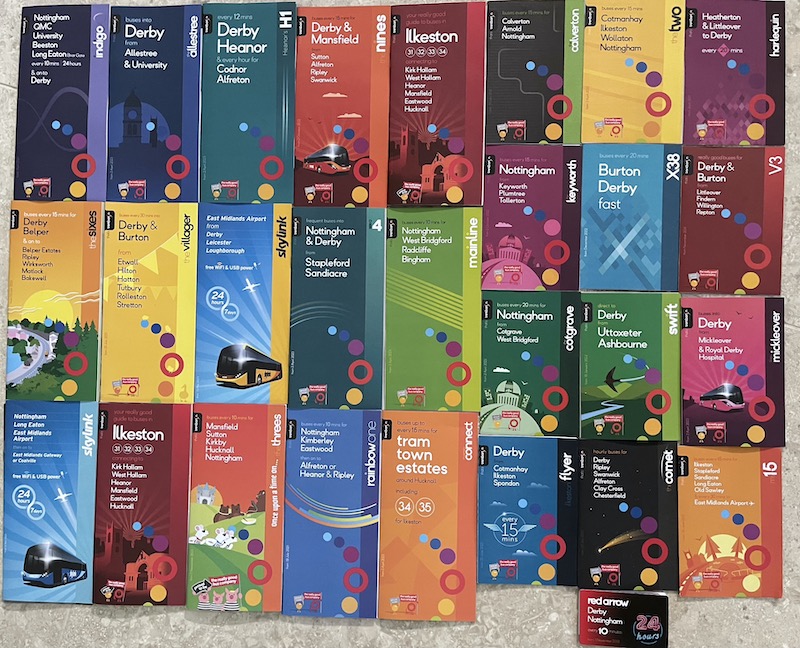
For example, there’s a plentiful supplies of colourful timetable leaflets all in keeping with each route’s brand.
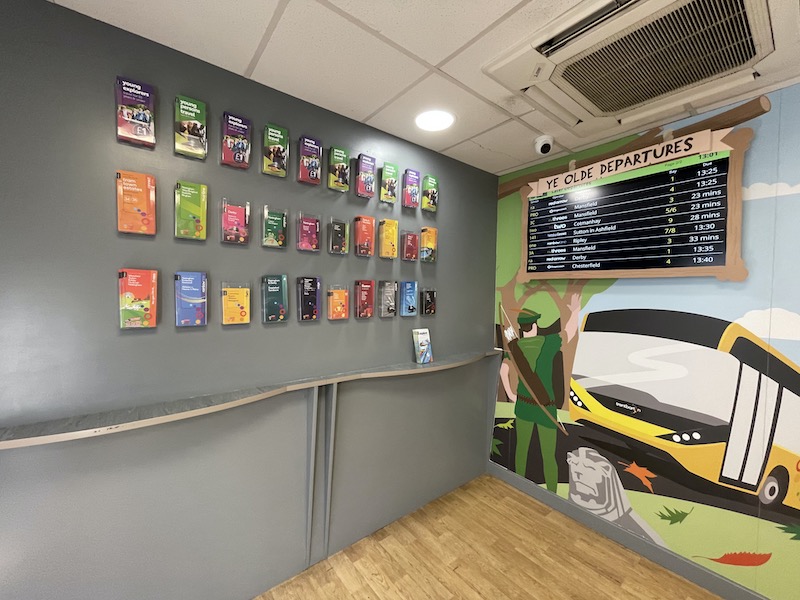
These are readily available at Travel Shops the company operates in Nottingham’s Victoria bus station, Derby bus station and in Sutton.
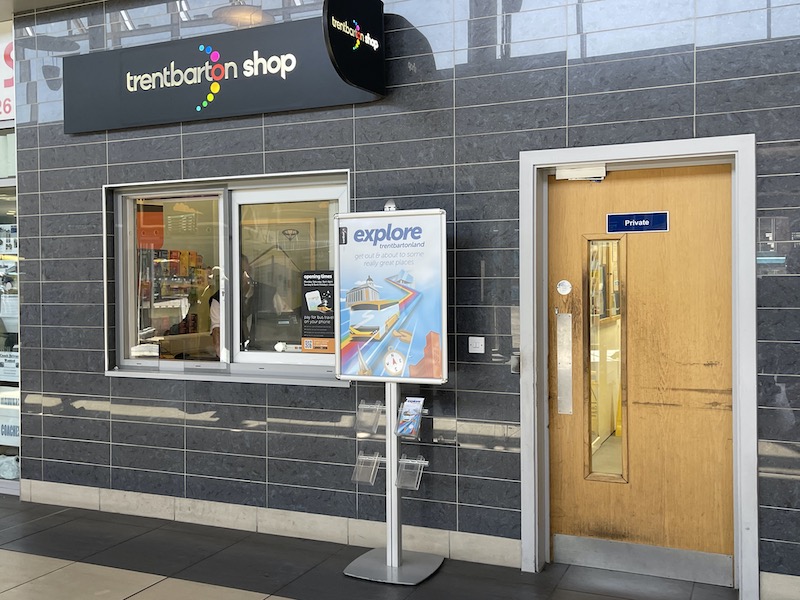
In Derby bus station there’s a window where a trentbarton member of staff provides information and leaflets while the larger adjacent Information office which is marked as Arriva, but I doubt is still looked after by them,…
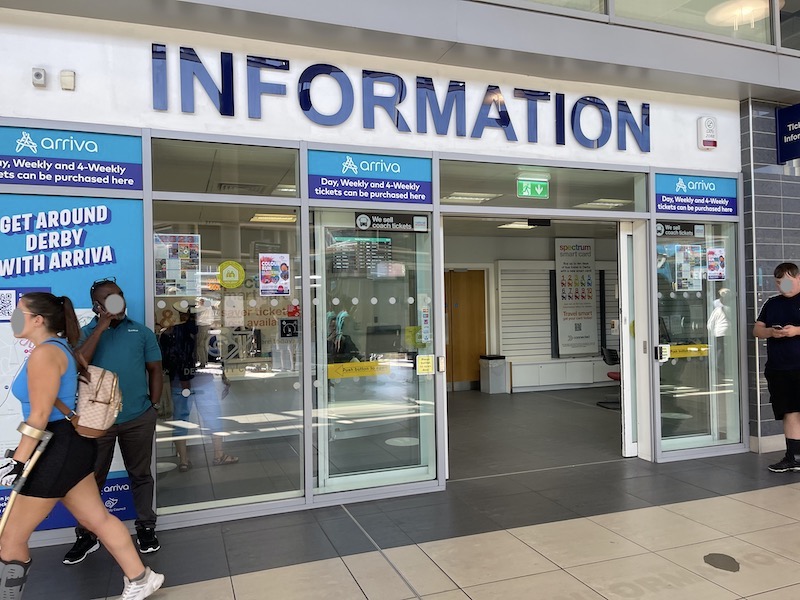
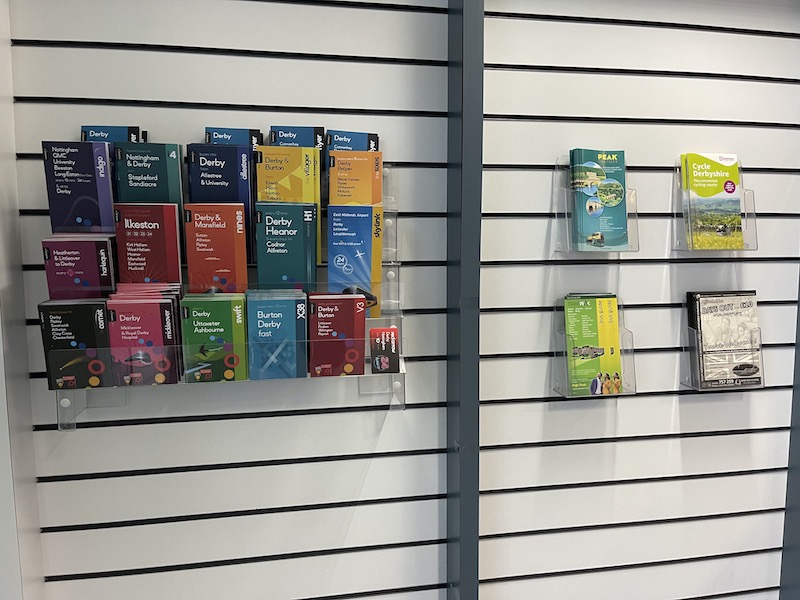
… contains a supply of leaflets for all bus services … except Arriva’s.
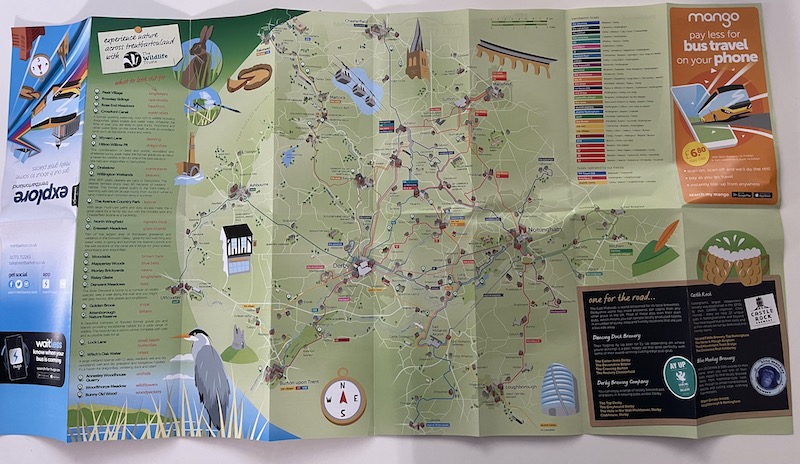
A brochure I picked up in Nottingham when I visited on Tuesday called Explore had some great suggestions for destinations to travel to on the company’s bus network.
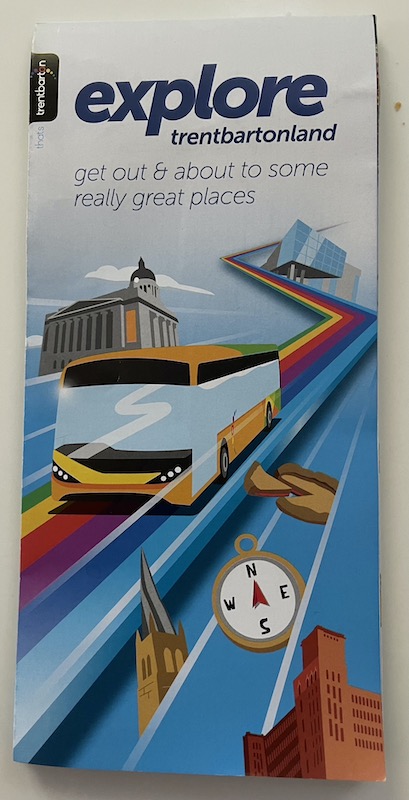
This includes a colourful map depicting the routes.
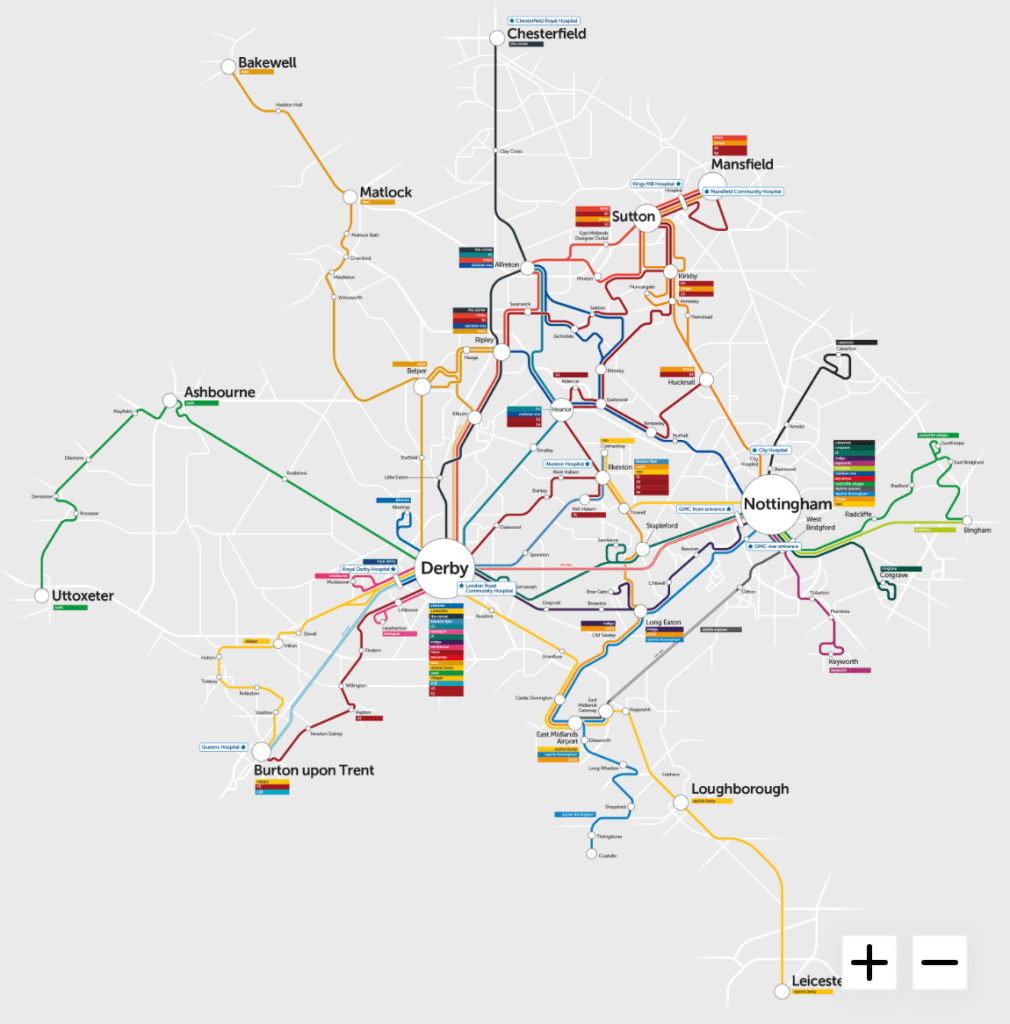
There’s also a network map online which shows the extent of the company’s operations stretching across Derbyshire and Nottinghamshire with cross border forays to Staffordshire and Leicestershire.
It also offers maps showing how networks radiate from the ten main towns where you can find trentbarton’s bus routes. For example here’s the map for Derby.
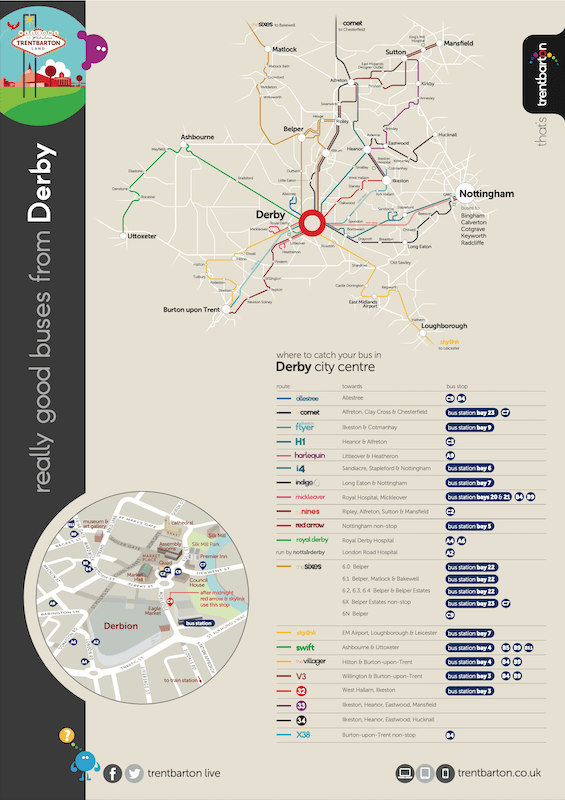
There are also maps based on city centres, hospitals, the universities and East Midlands Airport.
Although the company mostly uses brand names rather than traditional route numbers for some routes it uses a number with sub-numbers rather than letters to distinguish route variations.
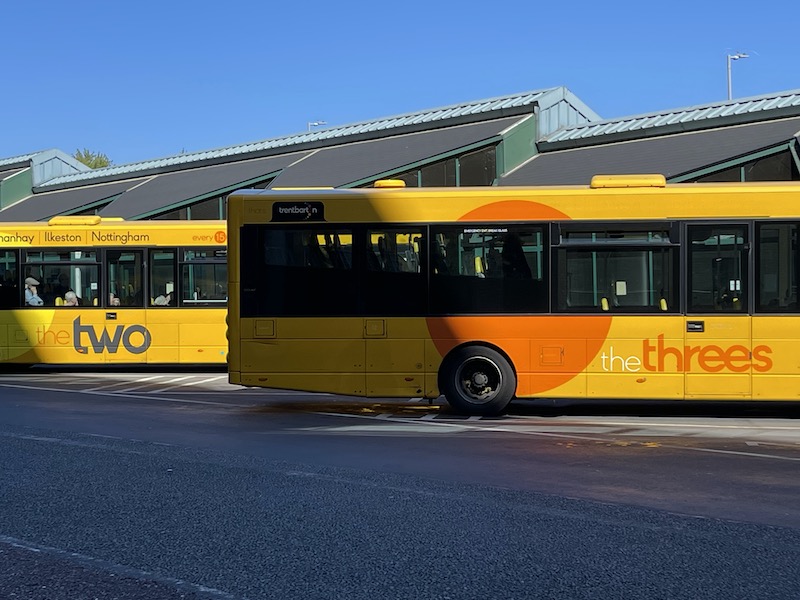
For example the two, threes, sixes and nines.
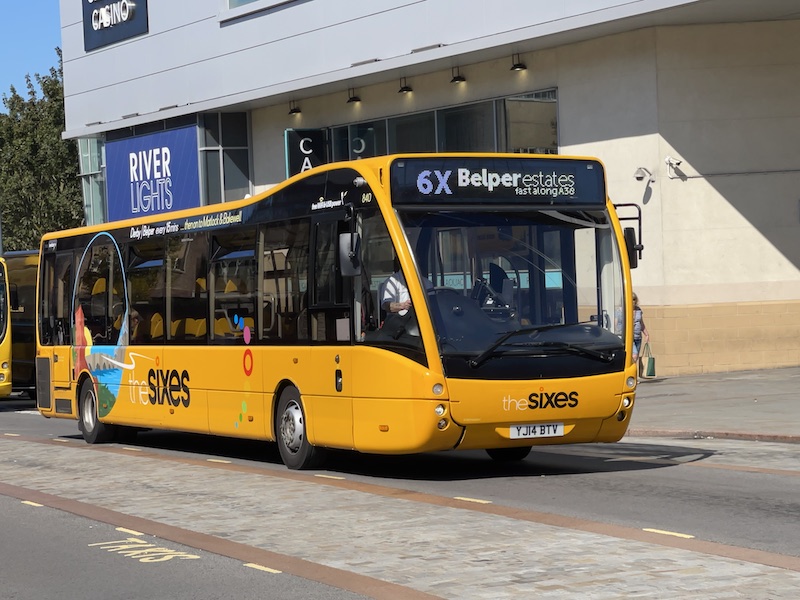
The sixes provide a combined 15 minute frequency between Derby and Belper made up of the 6.1 hourly onward to Bakewell, 6.2 and 6.3 half hourly to Ripley and 6.4 hourly to Belper. There’s also an hourly 6X between Derby and Belper via a slightly different route. Just to add to the mix evening journeys on the 6.2 and 6.3 are referred to as 6E and late night/early morning weekend journeys are 6N.

I understand the logic of it all but I do wonder if potential passengers understand it enough?
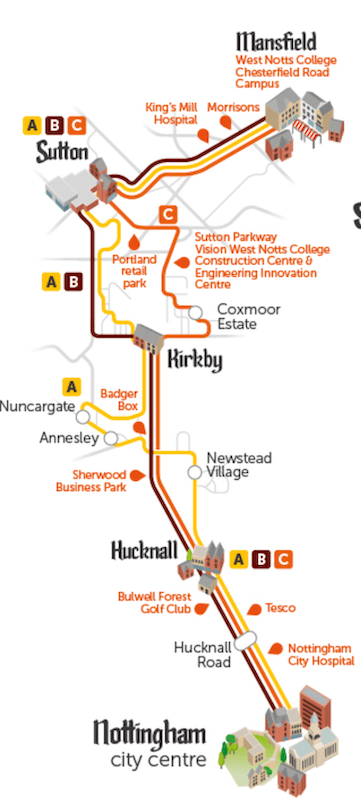
The nines similarly have 9.1 and 9.3 route variations between Derby and Mansfield while the threes use an A B or C in the timetable and map and on destination blinds to distinguish between the options for the routes between Nottingham and Mansfield.
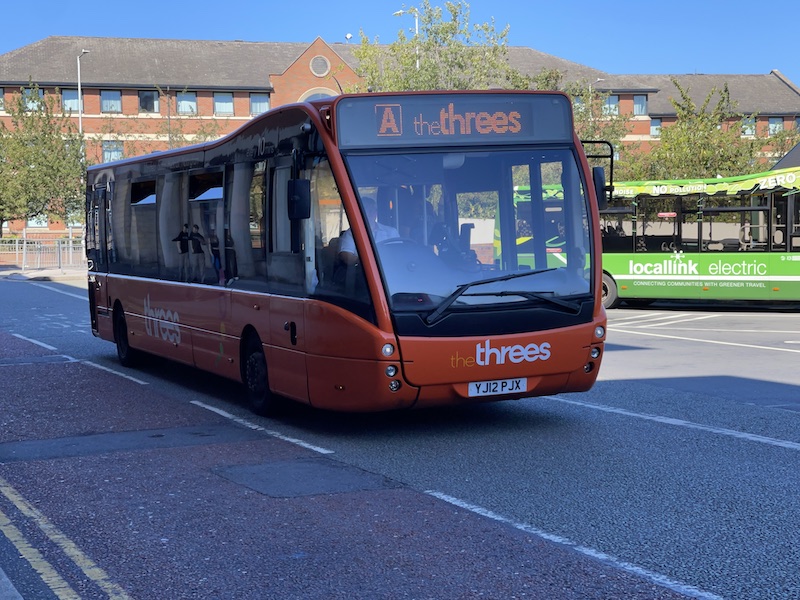
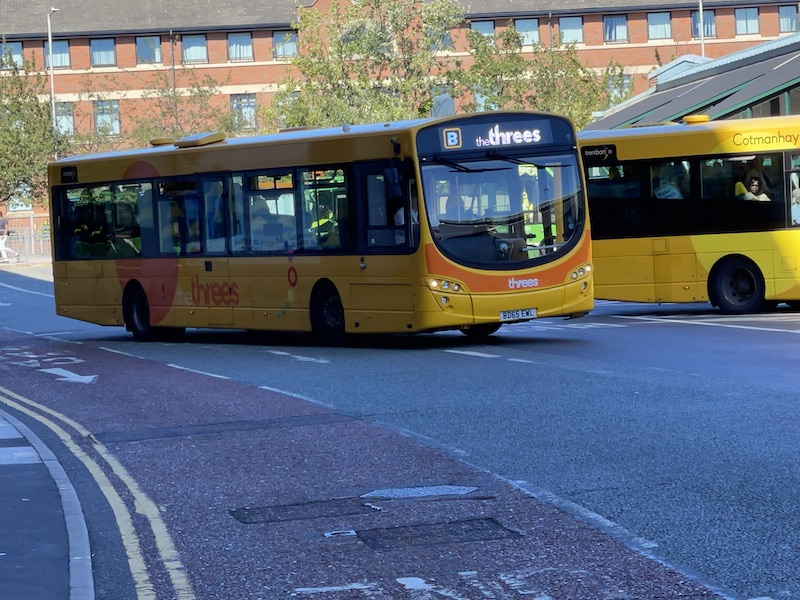
There also seemed to be two variations of livery for the threes – one yellow based and one orange.
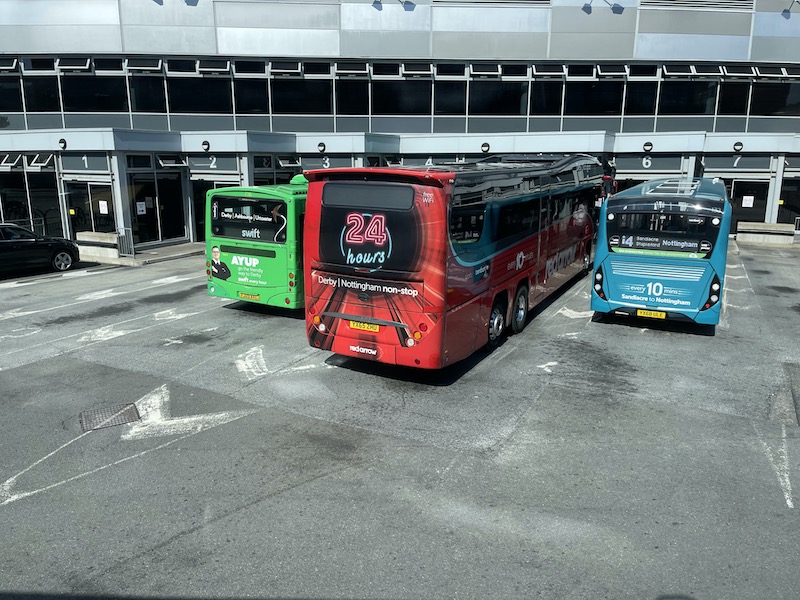
The company’s flagship route must be the high profile Red Arrow branded non-stop service between Derby and Nottingham which runs 24/7 with a very attractive 10 minute daytime frequency and every 20 minutes on Sundays.
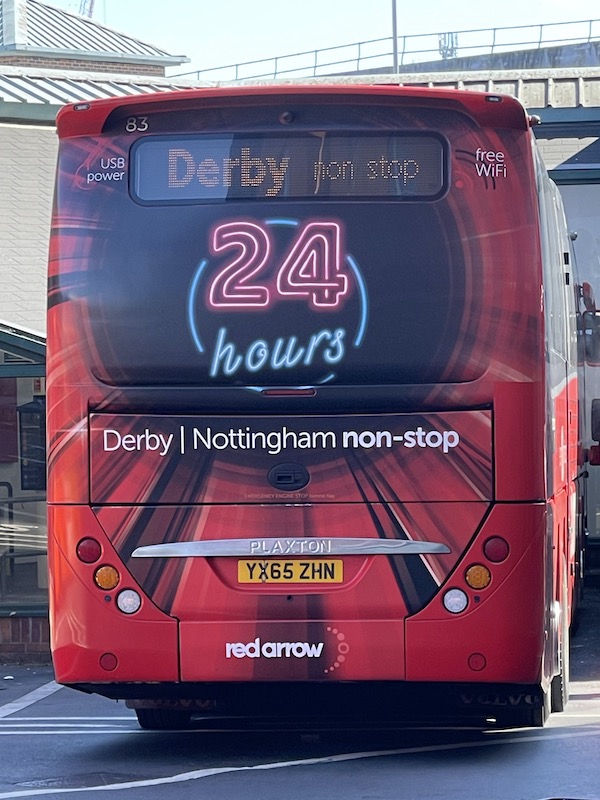
At one time some journeys were extended beyond Derby to Chesterfield but that section of route is now in the hands of the hourly ‘comet’ branded route.
Other 24/7 routes include the indigo route between Nottingham and Derby via Beeston and Long Eaton and the two Skylink branded services between Derby as well as Nottingham and East Midlands Airport.
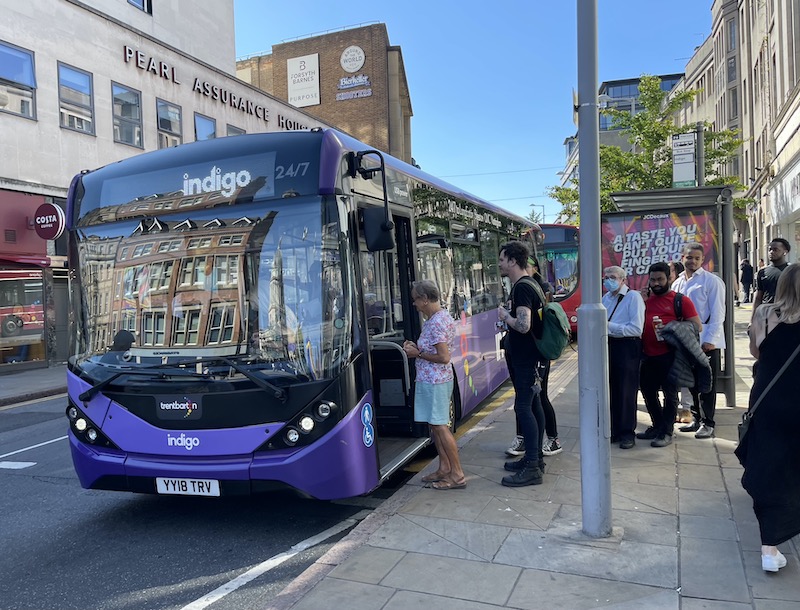
Frequencies across the trentbarton network are very attractive and I am sure are in tune with the market each route is serving.
Ten minute frequencies can be found on the company’s pioneering branded route – rainbow one from Nottingham as far as Eastwood where the route splits to either Alfreton (two an hour) or Heanor (four an hour) and Ripley (two of the four an hour from Heanor) but using the same brand.
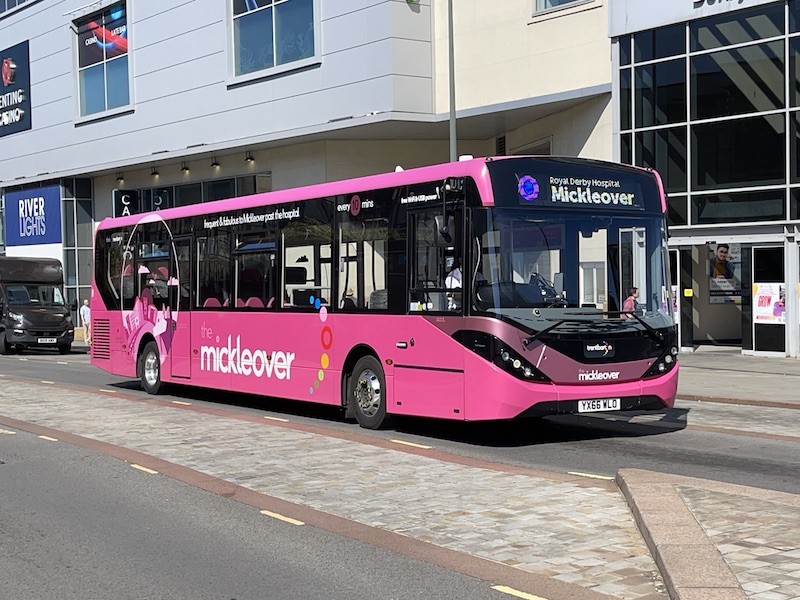
The relatively local route in Derby to Mickleover runs every 10 minutes with alternate journey encircling the residential area denoted by a green or blue dot on the timetable and on the bus destination blind and the mainline branded route between Nottingham and Bingham runs a simple end to end ten minutes timetable. The H1 between Derby and Heanor uniquely runs every 12 minutes, with one journey an hour extended to Alfreton.
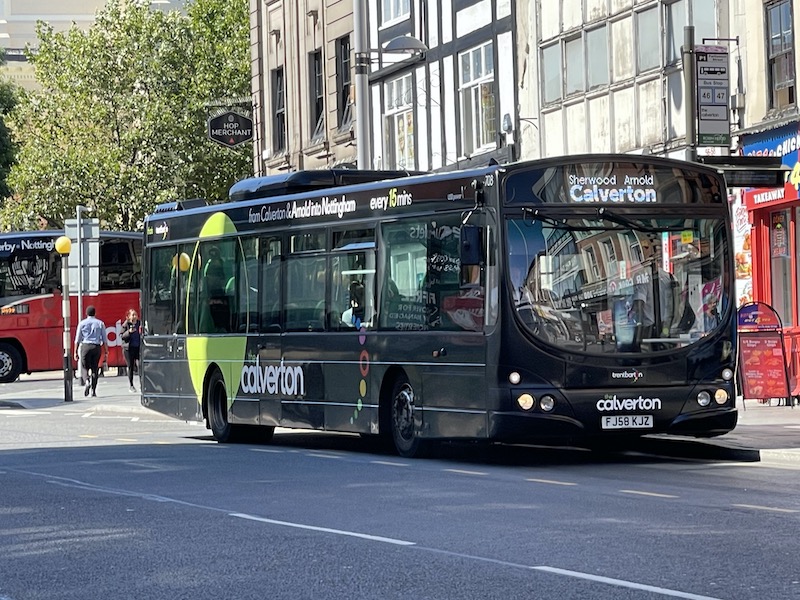
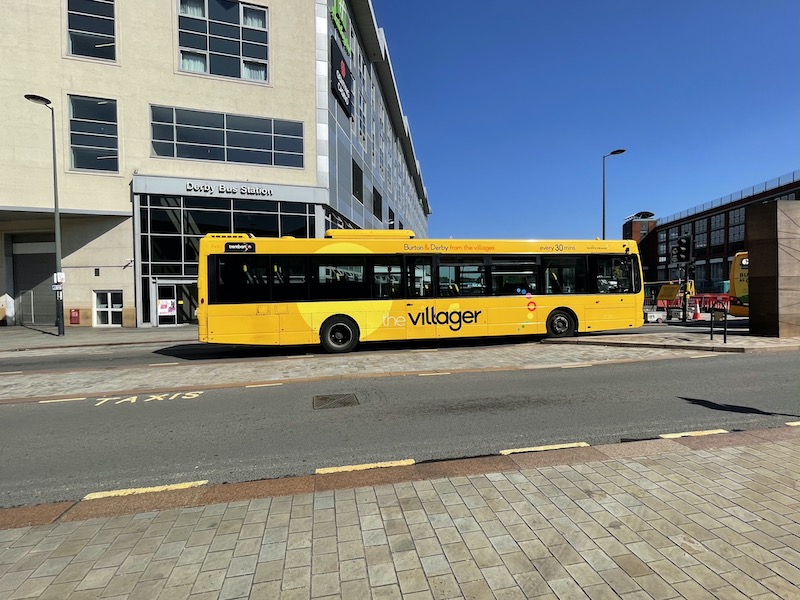
After that most other routes operate a 15 minute frequency with a 20 minute offering on the Derby to Heatherton ‘harlequin’, the Nottingham to Cotgrave and West Bridgford and the jointly operated non-stop route X38 between Derby and Burton. Two other routes between Derby and Burton branded as ‘the villager’ and V3 run every 30 minutes and hourly respectively.
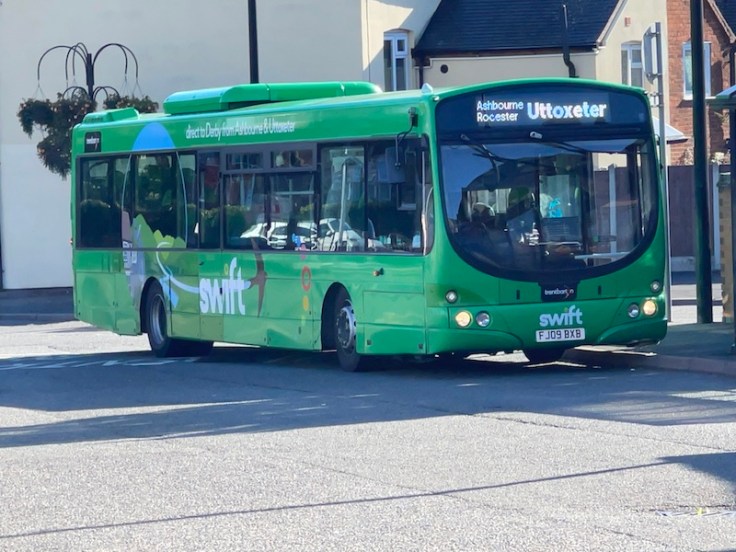
There are a small number of other routes on hourly frequencies including ‘swift’ between Derby, Uttoxeter and Ashbourne .
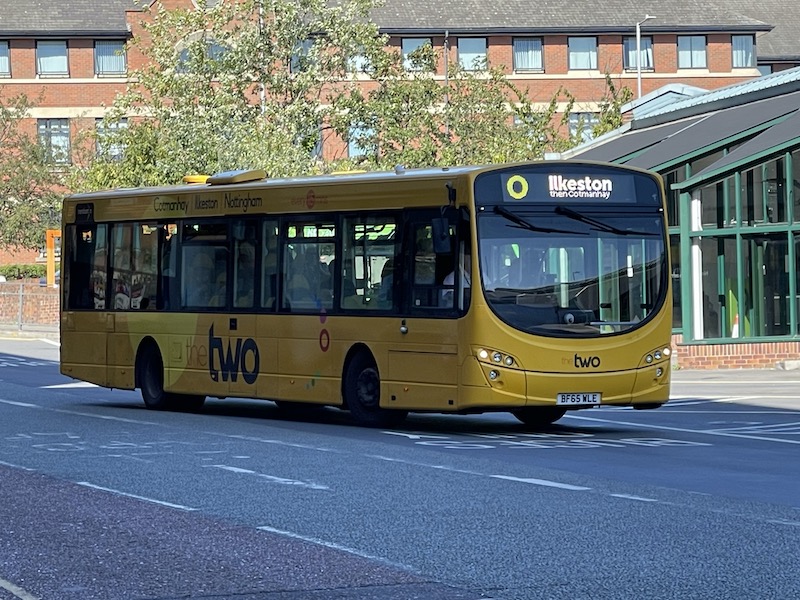
Finally in this snapshot summary there’s a network of four routes numbered 31, 32, 33 and 34 based on Ilkeston which provide hourly connections to Kirk Hallam, West Hallam and Derby, Sutton and Mansfield and Hucknall.
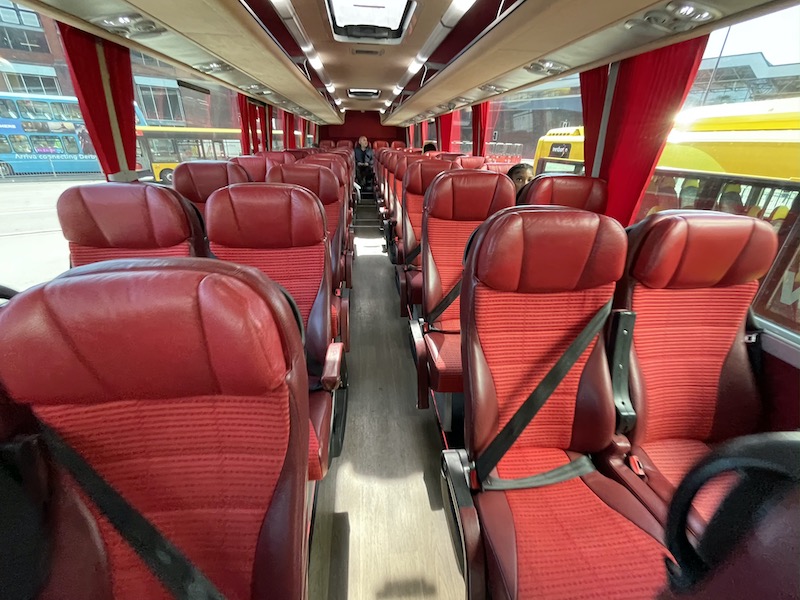
The exclusively single deck roughly 250 strong fleet comprises Optare Solos and Versas (the favoured purchase up to 2009), Volvo Wright Eclipses (purchases between 2008 and 2015) and ADL Enviro200s (purchased up to 2020 and with around 100 now being the largest bus type in the fleet). There are also nine eight year old Volvo B11RT Plaxton Elites for the Red Arrow service.
The fleet is housed in bus garages in Derby, Langley Mill, Belper, Nottingham and Sutton in Ashfield.
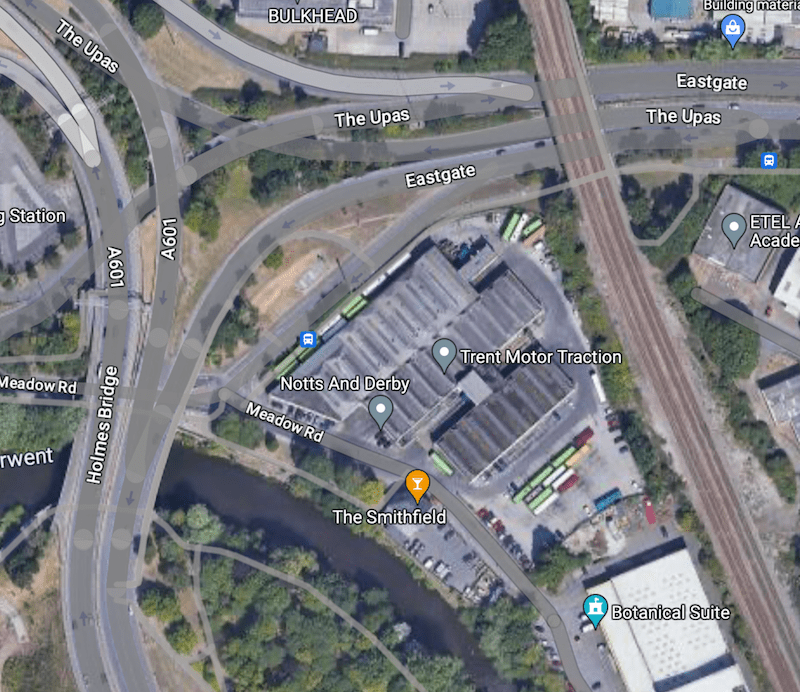
The large Derby site is the original Trent bus garage – as Google maps reminds us (below) – but also houses a large fleet of buses (including double decks) operated by sister Welglade Group owned business, Notts & Derby.
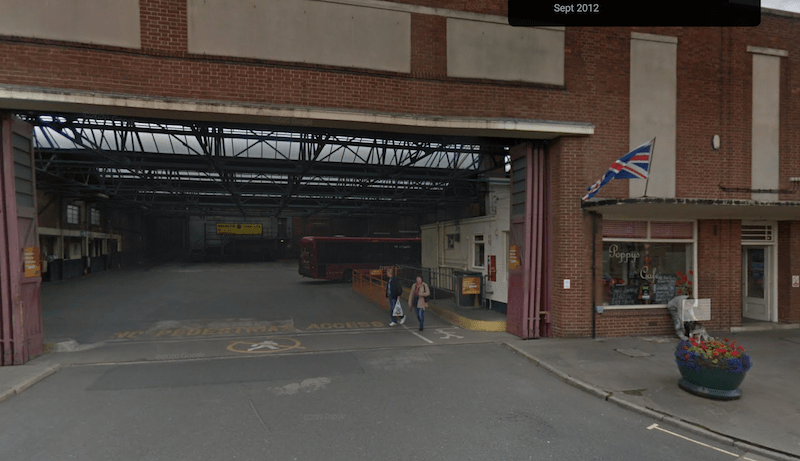
The garage in Belper famously doubles up as a bus station during the day.
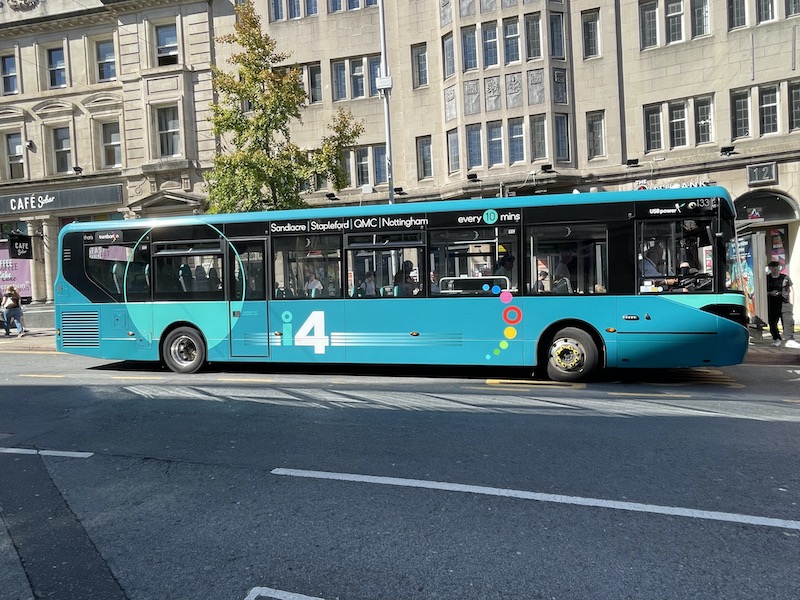
Over the years I’ve had many enjoyable journeys across trentbarton’s network and, the Covid inspired driver shortages era aside, have come away impressed with the quality service provided. I travelled between Derby and Nottingham again on Tuesday taking the prestigious Red Arrow for the eastbound journey and the i4 for the westbound.
Both vehicles were well presented with a lunch time journey on the former carrying nine passengers …
… with 16 leaving Nottingham on the i4 and about the same number boarding during the journey across to Derby with the 10 minute frequency as far as Stapleford definitely the busier section of route compared to the 20 minute frequency from there into Derby.
On the way into Derby there was a driver changeover alongside the bus garage which took about four minutes to enact which being only the same amount of time from the bus station was a frustrating interlude and interestingly one passenger alighted while the chat between the drivers continued. There would have been a time when such an arrangement causing inconvenience for passengers would have been unthinkable, and it did make we wonder whether the driver shortage challenge has led to a perhaps temporary lessening of the high standards trentbarton has always stood for.
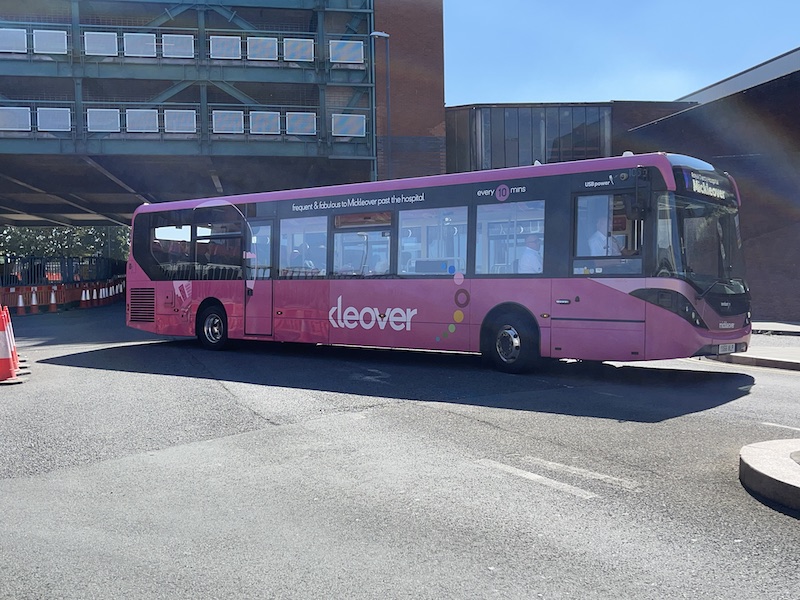
Two other minor not-quite-getting-attention-to-detail-right observations I spotted on Tuesday were a missing vinyl on a mickleover branded bus in Derby…
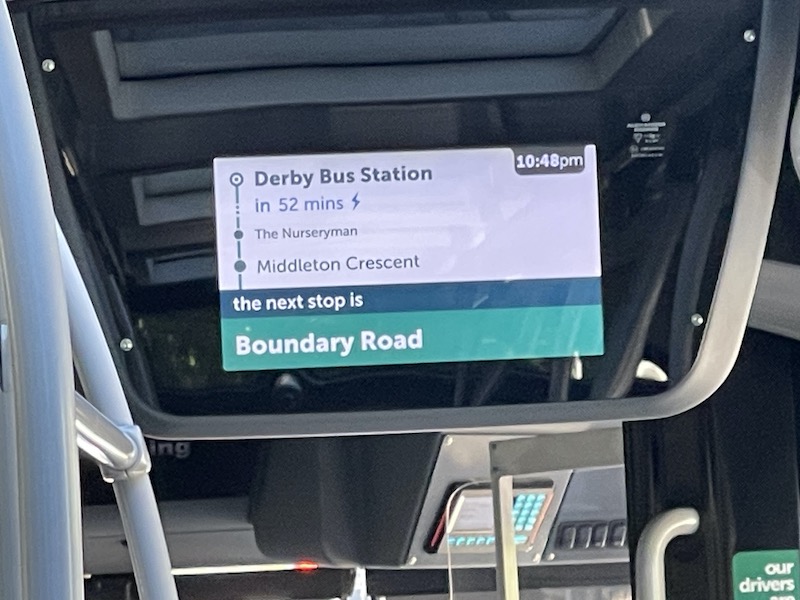
… and the clock on the next stop display showing a widely incorrect time on my i4 journey.
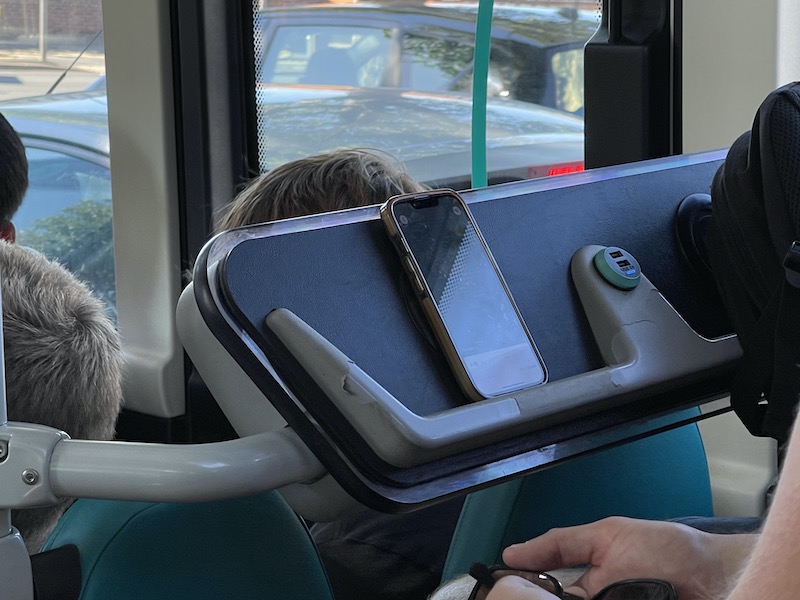
However, I did like the ledge to put your smartphone while it charges using wire-free on the first pair of raised seats towards the rear of the bus …
… and the three roof windows really do make the bus feel light inside.
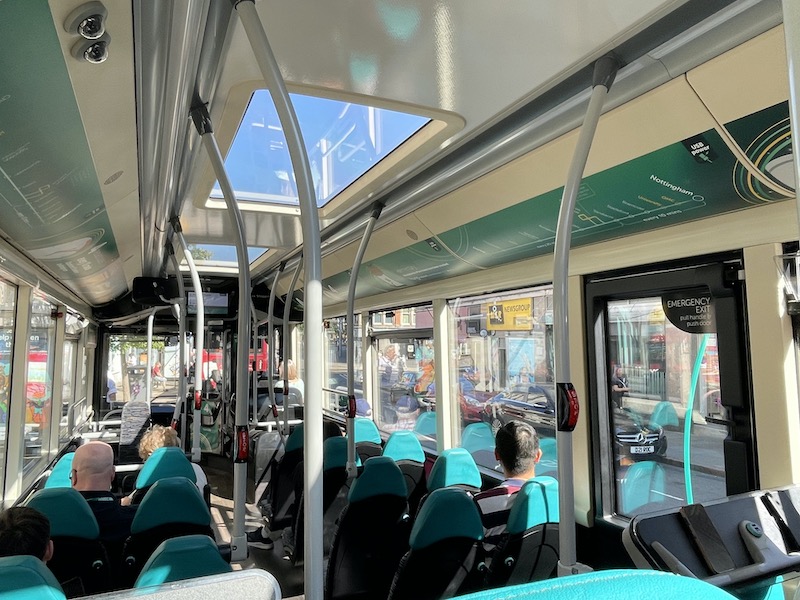
And the cove panels are always brilliant and well presented.
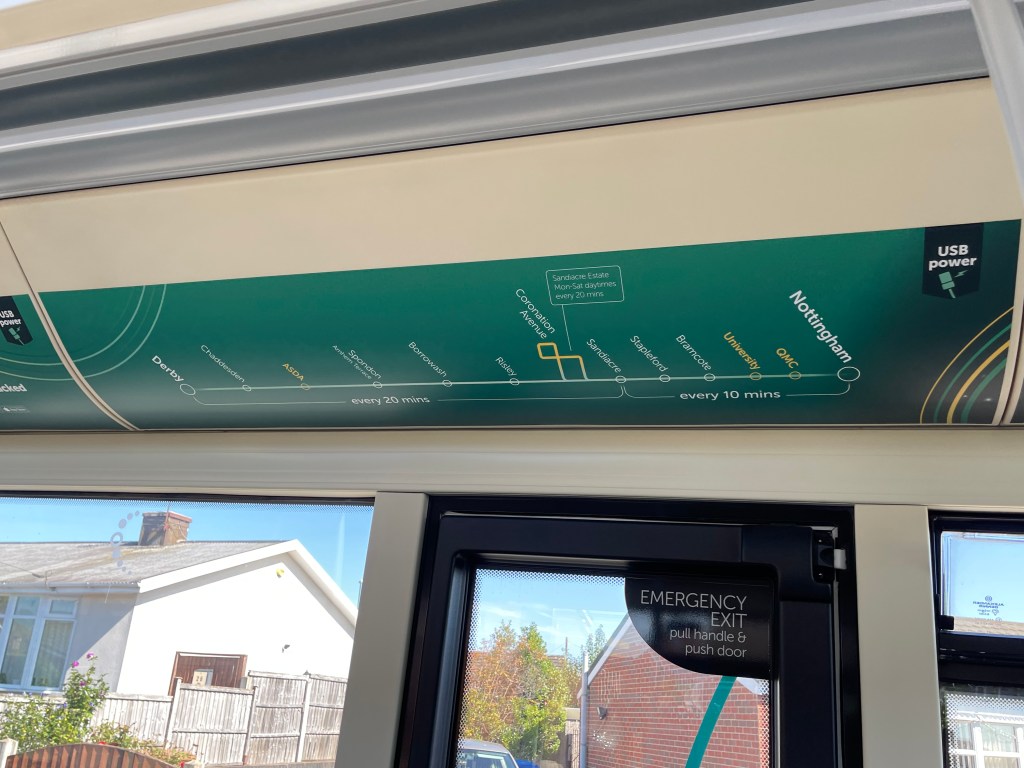
As are the clever promotional messages at bus stops.
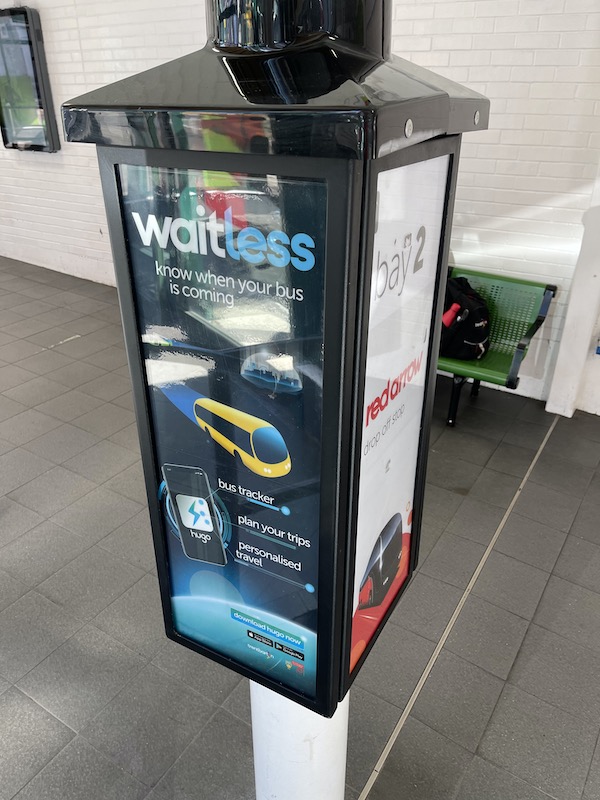
I paid the £6 single fare for the journey over to Nottingham on the Red Arrow as local authorities have excluded this route from the concessionary pass scheme but I reckon that is a good value price especially as an after 09:00 day ticket across the network (a zigzag ticket) costs £7.60 (making a Red Arrow return ticket that price) with attractive deals also for two or up to five people travelling together (£13 and £17 respectively)
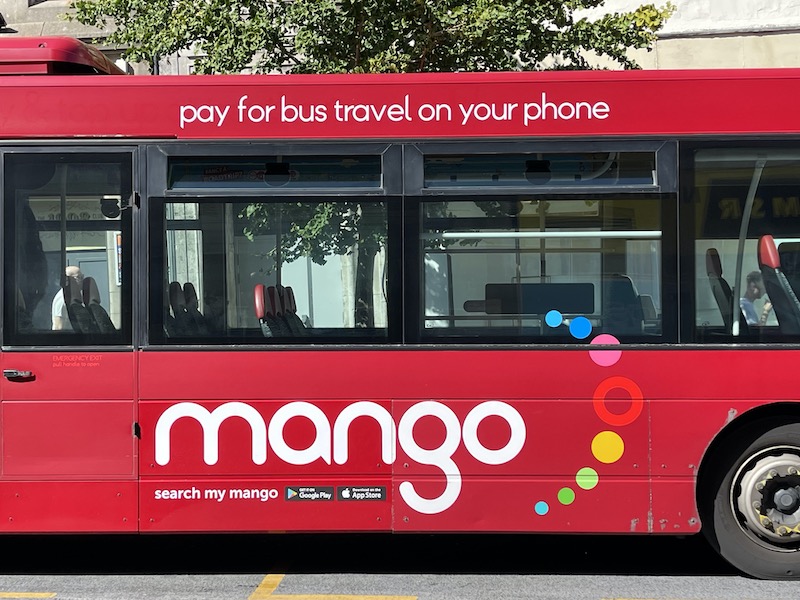
In addition to zigzag, trentbarton’s ticket range includes its long standing mango brand which has now morphed from a smartcard to a smartphone app and offers 10% off adult prices as well as daily (peak and off-peak), seven day, and 28 day caps. As in many bus companies, this involves passengers tapping in when boarding and out when alighting but I noticed that there aren’t readers for the latter so passengers were using the ticket machine by the driver which did slow the alighting process down a little.
Credit has to be added to the mango app from which fares paid are deducted (Oyster style) and passengers can also pay for tickets using contactless or cash.
In the Nottingham area there’s a range of zonal tickets under the Saver brand with weekly, four weekly and annual versions across three geographic areas centred on Nottingham which increase in size by three permutations. The ticket is also available for travel across all trentbarton’s services including routes operated by sister Welglade Group owned company, Kinch Bus and for an annual ticket costs £1,350.
Two more great attributes from trentbarton are firstly the ease to make contact with the company.
There’s no hiding behind Traveline or making it hard to phone the company – I made a call to the contact number and was delighted there were none of the usual press 1, 2, 3 etc for a range of menu options where you often end up in a loop getting nowhere, and the call was answered within three minutes with a very helpful and knowledgable member of staff.
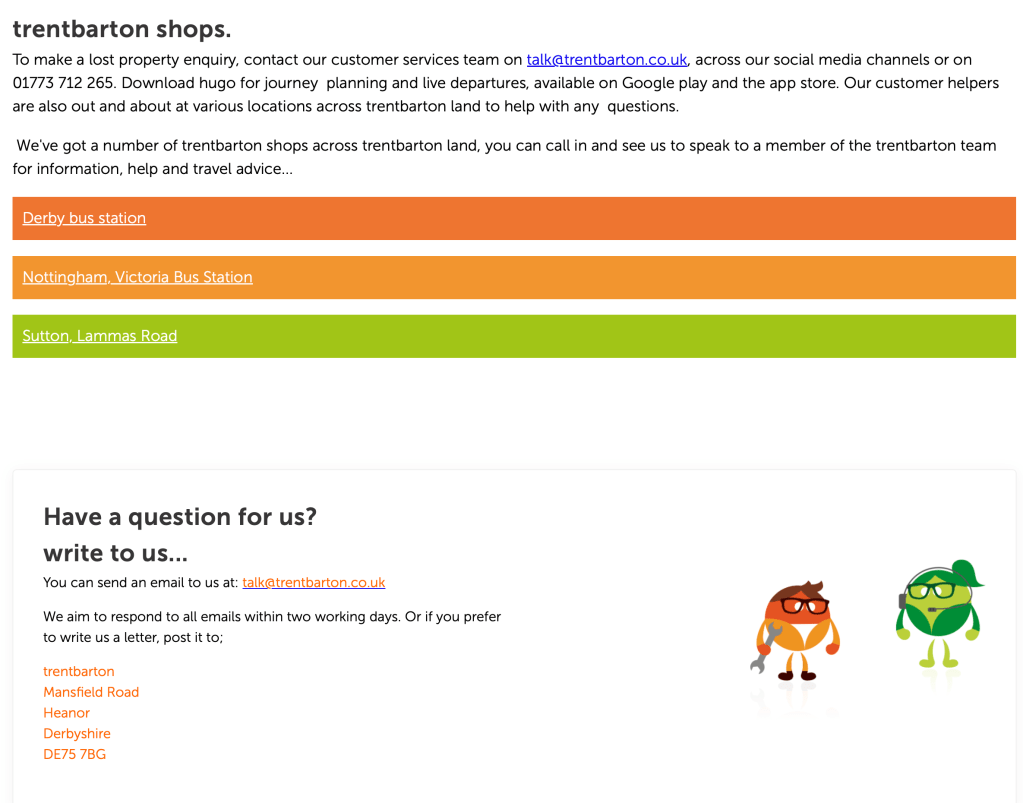
There’s an email address to use without the faff of filling in an online form so loved by the big Groups (and often then ignored) and the company is active on social media. And, as you can see from the above image, there’s even a postal address to use if you want to write a letter.
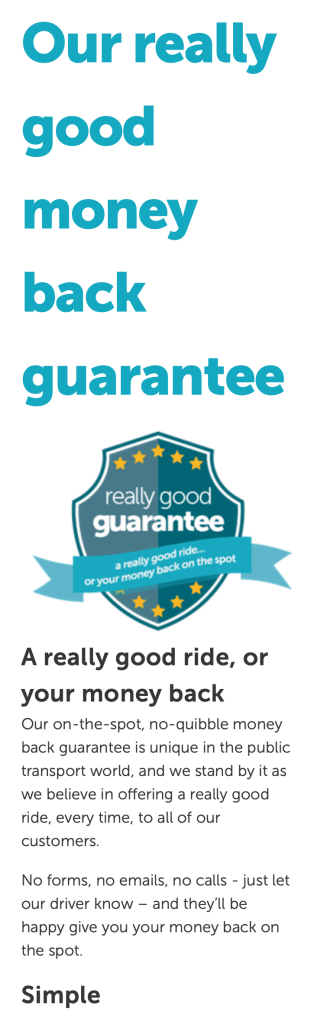
The second very long standing initiative is of course the company’s unique on-the-spot no-quibble money back guarantee where drivers will give you your fare back without any challenge if asked. I meant to try it out arriving into Nottingham on my Red Arrow journey but I enjoyed the journey so much I completely forgot.
That’s trentbarton for you.
They really are the “really good bus company”.
Roger French
Previous AtoZ blogs: Avanti West Coast, Blackpool Transport, Chiltern Railways, Delaine Buses, Ensignbus, Faresaver, Grand Central, Hull Trains, Ipswich Buses, JMB Travel, Kirkby Lonsdale Coach Hire, Lynx, Isle of Man Transport Part 1, Part 2, Part 3, Part 4, Part 5, Part 6, Part 7, Nottingham City Transport, (London) Overground, Preston Bus, Reading Buses, Southern Vectis.
Blogging timetable 06:00 TThS
Advance warning: The BusAndTrainUser.com website will be undergoing a design makeover on tomorrow (Sunday) afternoon meaning normal access and display of content may be interrupted.


I’ve never been a fan of branding where is no consistency in the names between the route brands and the livery style chops and changes. GoAhead NE was always the worst example of this (especially since many of the liveries were a mess), but TrentBarton isn’t great either. Also as Roger points out, the route numbering system is a mess (even within individual route groups, nevermind across the network); pick a format and stick to it.
It’s all very well having a network ticket, but it’s making life difficult for the customer when they must work out that’s valid on a Red Arrow, a Villager and an i4 before deciding whether to buy it. Then there is a bus painted with the words Mango, how am I supposed to know if that’s the route name or a ticket name? And apparently, I have to work out if I need a Saver, a Zigzag or Mango. Life is WAY too short for this nonsense.
Reading Transport isn’t perfect, but at least all the “town” routes have a consistent numbering format, the liveries clearly form a family and the route names are all colours (I’m going to pretend that Lion 4/X4 isn’t a thing for the purposes of this argument).
LikeLiked by 2 people
Lion 4/X4 is most definitely a thing! It was the brand adopted by Reading Buses after it took over First Beeline’s route 90 (Reading-Bracknell) back in 2015. It was in in fact the second “big cat” brand, Reading Buses having created “the leopard 3” the previous year when it took over from Thames Travel on the 144 (Reading-Arborfield-Wokingham). However you are right about the liveries forming as the leopard and lion liveries have the same layout as the other brands.
There was a third “big cat”, “tiger 7”, this was Reading Buses short-lived tenure of the Reading-Fleet section of what had formerly been a Stagecoach South through service to Aldershot. This commenced in April 2018 but has not survived a downturn in passenger numbers since Covid, although a different route does operate a service as far as Riseley.
LikeLiked by 1 person
GoAhead don’t seem to want you to contact them
Please only call our Customer Services number if you have an urgent query/complaint. We are incredibly busy at the moment and are unable to get to a large number of calls.
If you have used services@hedingham.co.uk to contract us, please be advised that this email address is no longer being monitored, and as such all communication needs to be logged by the below link
Direct messages are not enabled on our social media sites so please get in touch with us either using the form on the right
LikeLiked by 2 people
Roger should try Hedingham who are a complete mess with constant cancellations.
Heard this week they are servicing a school contract from Clacton depot in Bury St Edmunds. Must be a record for dead mileage.
LikeLike
They seem to be going for a record number of cancellations today
Is there any rail urelements going on as they usually abandon the commercial service so they can run them
https://www.hedinghamandchambers.co.uk/service-updates
LikeLike
A very fair assessment of a generally good company, including “warts and all”.
I am no fan of route branding, but their scheduling does at least mean the correctly branded vehicles work where they are meant too. This of course is because during the changeover years, they rather “cherry-picked” those services considered profitable (no problem with that, they are not a charity!) and didn’t waste too much time trying to achieve a network which included much local authority support.
The worst aspect is their continued reluctance to operate double-deck vehicles. Quite why their passengers prefer (do they?) to travel in sometimes over-crowded single-decks when neighbouring Operators are happily using modern and extremely comfortable double-decks is odd. When “Pronto” was shared with Stagecoach, I would always let a Trentbarton go in favour of a Stagecoach offering.
And why oh why did it take so many years for them to produce a half-decent map? I was astonished to find one shortly before Covid, and I think reasonable updates have occurred since. But at least a casual passenger can see at last where their day ticket may take them.
Terence Uden
LikeLiked by 1 person
Yes, my memory of them from the 90s was never knowing where they actually operated in Nottinghamshire due to the lack of a map (Derbyshire being well covered by the County Council)
It is difficult to get the right balance of how to market frequent corridors with offshoots at the end – you want the core to know it’s a good service but the offshoots whilst essential make it more complicated. Online resources don’t help things as individual routes are normally considered to be discreet.
LikeLike
Roger,
A negative point for the TrentBarton website is that you cannot download a single timetable pdf for each route, for example for the Rainbow One, you need to select which bit of the route you want and then within in each section, there is a separate PDF for journeys “To Nottingham” and for journeys “From Nottingham” for Monday to Fridays, Saturdays, and Sundays. That makes a total of 12 separate PDF files for the Rainbow One route alone.
Also, the formatting and look of the PDF files are very basic. How is that the likes of Go North East can have nice looking pdf timetable files which are in the same format as their printed material and can be printed out on 2 or 4 pages of A4 paper, whereas TrentBarton’s are a completely different style, and each pdf is 2 or 3 pages so to printout the whole Rainbow One service alone it would be about 24 pages. However, at least TrentBarton does produce timetable leaflets which are widely available.
Another niggle is that they don’t follow the English language and have capital letters for names or words at the beginning of sentences i.e., trentbarton rather than TrentBarton.
Therefore, I would call then “the not quite really good bus company” but they are a lot better than most.
Ian Hardy
LikeLiked by 3 people
I think the bus company is really good despite them using the 12 hour timetable when almost everyone else uses the 24. I also think using 1A, `1B etc is better than 1.1 and 1.2
However, arriving in Nottingham I found I just had to look at the buses until I saw one going to where I was going and then find the same colour bus stop and I was on my way!
For many of the services you hardfly need a timetalbe or app but both are there when you do need them. Other bus companies please copy!
LikeLike
Previous comment Ray Wiles, anonimity unintended
LikeLike
The ‘other’ travel office at Derby Bus Station, despite having the Arriva stuff on its windows, is operated by Derby City Council.
LikeLike
trentbarton isn’t quite what it was. They have dropped the online list of service cancellations – apparently you have to check journey planners or live times(if working) whether your bus is running and information is only available one hour before cancellation. So people without internet can’t do it and you can’t plan a day out – even hourly routes like the Comet suffer from frequent, now unannounced, cancellations.
Rogers observation on the clock time onboard vehicle – it is unusual to find a clock showing the correct time now – often 4 or more hours out – that would never have happened years ago with them, the quality aspect has slid downhill.
They also dropped the Mango card, it is now app only. My nearest town is a virtual mobile phone black hole – I can get no phone signal except in the middle of the precinct car park – the live times display at the stop rarely works due to the poor signal, and people paying by bank card or trentbarton app are often turned away due to no signal! I now pay by cash so no longer get a 10% Mango discount (25% when it started).
The majority of drivers are an asset to the company, friendly, helpful and it is a shame that the company seems to be let down at the management level these days.
Mitch in Notts, on the trentbarton Rainbow one route.
LikeLike
My knowledge about tb is largely second hand, from family in the East Midlands. Their view is that tb were good (but expensive ), but lost their way around 2010 and stated to believe their own publicity while dropping their quality. Before COVID there had been improvement although reliability is still a massive issue.
Gareth Cheeseman
LikeLike
I agree with your family.
All the individually-named branding is wonderful until you notice that quite a lot of their customers talk about getting “the purple bus” or “the yellow bus” on routes without numbers or “the sixty-one” rather than the (painfully trendy) six-point-one. And I’ve never forgotten the discussion I overheard between older two women waiting for what TB call “indigo” as to whether or not the bus they wanted was the 5 (the old Barton route number) or the 247 (“the purple buses have 247 on the side” – actually 24/7). Branding’s great if it works with the customers rather than trying to impose on them, and TB’s tends to impose.
Too often they use unbranded buses so you’re looking down the road at a red bus trying to see if the screens change from “the threes” to the “B” you need rather than just displaying “3b” like any other operator would.
And I’ve never forgotten being refused sale of two scratch off “zig-zag plus” day tickets (in the days when Kinch didn’t sell them on-bus) by Nottingham’s office unless they were pre-dated “because the boss says they might be used fraudulently”. The manager giving that instruction was too cowardly to come out of his office to justify that to his customer, of course.
It’s difficult to think they’re as “really good” as they claim.
LikeLike
A pretty fair assessment I would say. I moved to Derby 20 years ago and have always been on the Allestree but use the network regularly. I think the “really good bus company” moniker was deserved back then, but TB have slipped over the last 10 years whilst others have caught up, and in some cases overtaken them. The “not so bad bus company” would be more apt now.
LikeLike
I like that TrentBarton is still owned by the original management buy out team, compared to all the others who cashed out. I also like the route branding having a house style so that it presents as a cohesive whole rather than a random mess such as Go North East. I like how the company is obviously interested in running a quality operation with attention to detail and customer service (travel shops that are open, leaflets, money back if things go wrong).
Not so keen on some of the route names e.g “The Allestree”. I’m sure there was a “Black Cat” at some point which was just silly.
Overall one of the better bus companies.
Peter Brown
LikeLiked by 1 person
Wasn’t the “Black Cat” the route previously operated by Felix of Ilkeston?
Nigel Frampton
LikeLike
The Black Cat was a shared route, formerly 120. Felix’s logo was a black cat, hence the route name
LikeLike
Yes, the 120 was jointly operated. Felix’s logo was a black cat, hence the route name.
LikeLike
“I like how the company is obviously interested in running a quality operation with attention to detail and customer service”
They certainly shout that they are, yes.
When you actually try getting that customer service because their attention to detail has proven to be lacking, my experience is that they’re incredibly defensive and far to quick to try to blame the customer for their failings.
A typical experience was being one of a dozen people using tap-on, tap-off when TB decided to have a vehicle swap en-route and the drivers told us all that we didn’t need to tap-off the first bus and tap-on to the second “because it’s the same journey number”. I’m sure they believed what they told us, but I got two incomplete journeys and it was quite clear that TB’s “customer service” felt that I was lying about what the drivers had said.
I don’t travel with TB a huge amount but when I do, I find them to be neither better nor worse than Stagecoach or Centrebus. They’re certainly not the “really good bus company” they’ve long claimed to be.
LikeLike
Both Nottingham and Derby were trolleybus towns, which for various reasons never linked their systems into one unit. Time to revisit the idea, using in-motion-charging and bus priority where necessary – not all the bells and bows that sank the Leeds proposal. The UK can’t keep on putting this off forever.
LikeLike
A note on the yellow ‘threes’ vehicles. These were cascaded from the two which has a lower frequency post covid (though I personally think they should increase it again), to cover for a shortage of buses for the threes. This should be rectified once the new Enviros have been delivered.
Adrian Johnson
LikeLike
The new Enviro MMC is horrible from a passenger perspective the buses are uncomfortable and the seats unusuable above the wheel arches at the rear the back seats are uncomfortable and the luggage pens tiny , these vehicles are not a patch on the previous Volvo wright buses and the company has seriously let down it’s passenger base by developing a reputation of cancelling services and not turning up . In hucknall where I lived the services hardly ever could be reliable and now with all this investment it’s too little too late I have moved onto using the tram
LikeLike
I can honestly say I have NEVER had a good experience with Trent. To me like Southern Vects it’s one of the companies that enthusiasts who never use buses love but those of us who do hate. Each time I have been in the East Midlands either the Trent bus hasn’t turned up or having checked the fare in advance the ususally rude and obnoxious drivers know better whilst the vehicles themselves are usually absolutely filthy full of litter etc. The same armchair enthusiasts who never use Diamond Bus West Midlands constantly riddicual Rotala PLC. Those of use Diamond each day know better but constantly have how wonderful Trent , Southern Vects etc are. If armchair Bus Enthusiasts got out of thier cars & actually used the bus companies they gush over they may have different thoughts. I am no lover of the Labour Party but its London Mayor has his polices spot on with the ULEZ & abolishing the Travelcards on TfL but conversely so then again here in Brum we have a pro Bus & Tram Conservative Mayor. Just to put the record straight The Commonwealth Games were NOT responsible for the financal chaos at Birmingham City Council this is just media rubbish 75% of the funding actually came from the West Midlands Combined Authority via a direct grant from Central Government. Birmingham City Council contributed a minority amount of 25% to the games whilst the only purpose built complex The Aquatic Centre is funded by Sandwell MBC & has now sucessfully replaced three time expired swimming pools in the borough.
LikeLike
I’m with you. But you know as well as I do that the trentbarton fan club will be screaming you down soon.
Most of them will never have been on a trentbarton bus, of course.
LikeLike
It’s a bit off topic but to reply to the comments about Hedingham telling people not to phone them, I understand that it is because some office staff have been made redundant so there is nobody left to answer the phones.
It’s particularly contentious because it’s the time of year when there are loads of queries about school bus times.
It has to be said that Go-Ahead’s purchases of the East Anglia operators a decade ago has been pretty disastrous. Perhaps a subject for RF to investigate?
Nigel Turner
LikeLike
I caught Hedingham fleet number 274, a couple of weekends ago, on a journey from Walton to Clacton. Externally, the vehicle was well presented, in the latest version of fleet livery, and a proper job had been done on removing the centre exit door, from its original life as a TfL bus.
Its internal condition was quite a different story though. It had many cove panel vinyls, on both sides of the vehicle. These were about:
* Joining the Metropolitan Police Service.
* Becoming a bus driver with Go-Ahead London.
* Multiple types of advice on various transport topics, usually etiquette related, from TfL.
Not a single item to do with Hedingham, its products or services or destinations in the area which might encourage further bus services. All incredibly apathetic I thought. Bizarre really, when the company is so short of driving staff, not even to have a recruitment advert.
It is rather sad if true that some office staff have been made redundant because it will simply become harder promote the company’s presence and deliver locally. When you look at the average age profile of vehicles running out of Clacton depot, I think that tells you all you need to know about the viability of such a large company being involved in the area. It certainly tarnishes Go-Ahead’s image…
N.P. Beasley.
LikeLike
The last published accounts show Konect Bus made a lose of £874M ( they also cover chambers & Heddingham trading names)
They were due to publish their latest accounts in June of this year but have extended the accounting period to December
LikeLike
£874M seems quite a substantial loss to have made with just 61 buses (according to Wikipedia). Are you sure that you don’t mean £874,000?
LikeLike
Ambassador Travel hasn’t changed hands since the company was sold by the NBC .
LikeLike
I have to confess that I’ve never been on a bus in trentbartonland but what has always seemed evident to the outsider was their desire to rip up the rule book and try something different. Some of those initiatives have paid dividends and even the relatively high frequencies that still exist are probably a testament to the success of that thinking, even if not everyone liked everything that was done. It also seems to be the case that the glory days are now being seen in the rear-view mirror as far as quality is concerned. They are clearly not immune to the post-Covid ridership declines, the staff shortages and cost increases that have beset so many operators. I’m left feeling that if tb are struggling, something very radical has to happen in the wider industry. Without wanting to get into politics, given their lead in the polls and the need for change, it’ll be interesting to read what Labour’s manifesto will propose.
LikeLike
As one who strongly dislikes the ‘lower case only’ practice, I feel pleased that TrentBarton maintain the convention of using capital letters on their destination displays.
Petras409
LikeLike
I’m with Roger and a few others here with regards to double decks… I certainly won’t be having any days out in TB land with only a single deck fleet, yuk!
I totally get not running infrequent rural routes with deckers just for the sake of it, but In general, Why on Earth would you run single decks on services as frequent as every 10mins while you’re short of drivers, when you could use higher capacity double deckers every 12 or 15 seating more passengers in comfort, saving staff and hardly increasing the average waiting time? Are there that many low bridges in Derby and Nottingham??
40 years on from the minibus revolution experiment are there more deckers or bread vans on the stands of the uk’s bus stations??? !!
(Mackay)
LikeLike
Reducing frequency and substitution of deckers may make sense if a staff shortage is permanent. But:
1. It is now well proven the decreases in frequency over time lose custom
2. Many passengers – especially the elderly and less mobile – won’t go upstairs anyway
3. Double decks cost circa up to 50 % more to buy (circa £100k extra)
4. They cost more to run – fuel consumption up to double that of a single deck depending on make)size etc. Maintenance costs higher. Tree damage/top deck screens/vandalism can also be issues.
5. They typically have fewer accessible seats – ie those in the low floor section.
So the rationale for double decks isn’t as easy compelling as it sounds and can rarely be justified when only a few peak journeys have high standing loads.
And as a passenger, I enjoy them more too! But running a business, if a single deck will suffice, it’s a no- brainer! There are always odd exceptions like really scenic or coastal routes etc – but these aren’t the norm!
LikeLike
Yet on multi-operator roads where Wellglade (because it’s group-wide, not just trentbarton) refuse to run double-deckers, other operators happily run them when appropriate and clearly consider them value for money.
Where Wellglade are concerned the refusal to run double-deckers isn’t about money. It’s their standard behaviour when they’ve decided to do something: they’ll keep doing it even if it clearly not the right thing for the business, and they’ll refuse to review it until they’re hurting.
LikeLike
Other Wellglade fleets run deckers, indeed Notts & Derby has recently received brand new ones. I much prefer to sit upstairs as single-decks can get crowded very quickly. GMN tried to move to a single-deck fleet in the mid-90s but subsequently had the good sense to change its mind.
LikeLike
It’s an interesting contrast with Morebus where the single deckers on M1/M2 are about to be replaced (one-to-one as far as I can tell) with double deckers.
LikeLike
We know from Roger’s excellent ‘compendium of jointly operated bus routes’ that trentbarton’s X38 service is one of just eight commercially ran jointly operated routes but I wonder where it would place in an age ranking of the eight given the X38 is just eighteen months short of its joint running 30th birthday (ref link https://uktransport.fandom.com/wiki/Derby_Corporation_/_City_Transport_and_Trent_Motor_Traction_jointly_operated_routes )
LikeLike
A belated response as I was out all day yesterday.
I’ve lived in Mickleover since the first branded buses on the route, K registered Optare Deltas. I agree with Anon at 1120 today, that trentbarton are not as ahead of the pack as they were 10 years ago.
The buying policy has alternated between lightweight vehicles that don’t last (Optare Excels and Tempos) and Wright-bodied Scanias and Volvos that are solid but are heavy on fuel. Mickleover had the first batch of E200’s, which are now the fleet standard. I find them perfectly adequate for longer runs, but not as nice as the Volvos. Though the fixed glazed roof on later batches of E200’s produces complaints in the current weather.
Mickleover had 8 buses/hour from 2000 until Covid, since the end of restrictions it’s been 6/hour, which is enough for current loadings, though the timetable wasn’t changed to reflect this until Sept 2022. Random gaps, endemic in early 2022 due to driver shortage, are now rare and usually due to the lack of serviceable buses.
The latter was shown yesterday. On my way to the railway station, I caught a Solo rather than a branded E200. At 8.50, the departing 6.1 was a branded Versa, but incoming 6.2 a Solo. The departing Red Arrow was a Mango-liveried Versa, though a coach came in. A Mango-liveried Volvo was waiting to be the 9.05 “Comet”. Roger did well to get a coach on the Red Arrow, a friend who uses it 3 (varying) days/week reckons that there are 5 (out of 9) out most days, with Versas and Volvos filling in if spare, and at least one gap in the timetable.
Price-conscious OAPs baulk at £6 single or £7.60 off-peak return on the Red Arrow, especially as Derby – Nottingham by train is £6.05 anytime day return with a railcard. A Zig-zag valid before 9.00 is a “please don’t ask for change” £11.10. I now meet friends from Nottingham somewhere in the middle where we can all use our ENCS cards.
Wellglade’s low-cost subsidiary, Notts and Derby, mainly runs school services with second-hand double-deckers, but gets both older buses and marginally-profitable routes cascaded from trentbarton, the latter recently including the Royal Hospital service in Derby, now running at a lower frequency with bigger buses than trentbarton with Solos.
A couple of minor points:
“Villager” started out as a brand for three hourly routes, V1, V2 and V3. New housing has created a busy half-hourly V1, now just Villager, with Volvos, while the V3 is still hourly and only justifies a Solo.
Driver changeovers in Derby usually take place in the bus station, and i4 is mostly worked from Nottingham, so the long chat may partly have been sorting out why it was happening at Derby garage.
Jim Froggatt
LikeLike
I don’t know the area well, but did travel on the Mickleover when it had Excels and was being heavily touted as the best thing since sliced bread. To me it was just a good bus service, as they all should be.
The route numbering and branding I have always found totally confusing – presumably the opposite result to that intended! Very few get route branding right. Amongst the few who have are Reading and Nottingham. They didn’t try to be clever with route numbers either.
The simpler things are the more easily they are understood and the better they work.
17A
LikeLike
Fun in Wales next week when the default speed limit changes to 20mph with very few exceptions. iy remains to be seen the impact it will have on bus services in wales
LikeLike
First Cymru are saying it won’t, whilst Newport Bus and Cardiff Bus are saying it will and have introduced revised timetables. Wales is slowly, literally, becoming something North Korea would be proud of.
LikeLike
I find it difficult to see how it cannot affect the schedules . At 20mph there is not much scope to recover any lost time
Looking at the map s very few roads are exempt. The Motorway is as is the A48 but not much more
The major bus corridor from Newport to Blackwood seems to be included
Another thing is there appears to be no exemption for the Emergency services UNLESS they are on blue lights
LikeLike
You have to credit Rich – irrespective of the subject to hand, he will crowbar in some references to Birmingham, West Midlands, Rotala etc though the relevance of Commonwealth Games and Sandwell’s swimming baths escapes me. So I’ll ignore all that.
Dealing with the subject of the blog, it is clear that Roger is generally positive about TrentBarton, and was very effusive about Southern Vectis. Roger is no armchair enthusiast – I’d wager he’s much more knowledgeable than most current industry managers with 40 or so years of experience working at the coal face. However, I think there are some valid areas to be highlighted that act as a counterpoint.
My recent experiences of TrentBarton (yes, I’ve travelled on them in the last year) showed them to be better than most operators in terms of publicity and marketing etc. My personal experience, in terms of service reliability was also fine, and no issues with surly staff – seemed cheerier than the Arriva Derby drivers.
Every journey operated and BUT I know that this is atypical. They are struggling with cancellations from staff shortages and serviceable vehicles; it’s evident every day. The age profile of the fleet is suffering, and the RedArrow coaches are definitely showing the strain from the constant hammer meted out in terms of availability. As good as the marketing is, operators will live or die by service reliability.
As for the question of double deckers, it does seem odd that where driver resource is limited that they haven’t sought some newish secondhand stuff to assist in widening headways, maintaining vehicle capacity and reduce driver resources. We know their long held view that many of the passengers (i.e. elderly pass holders) don’t appreciate steps to get to a seat and that service enhancements have been preferable to accommodate passenger volumes. That may have sufficed in 2018 but perhaps they need to review that given the circumstances now.
Thanks for the blog, Roger – Kind regards, BW2
LikeLike
The new layout looks good – except that with the posting times no longer shown it is less easy to see which are the latest comments!
And the Swift route runs Derby to Uttoxeter via Ashbourne, as shown on the front of FJ09 BXB.
Ian McNeil
LikeLike
The problem is that you now can’t skip straight to the comments without scrolling through the whole blog, or seeing if new comments have been added by looking at the running total. In my view there was nothing wrong with the blog before, and it has now been ‘improved worse’
17A
LikeLike
I quite agree with the above comment regarding the removal of the “comments shortcut”. Moreover, as a visually-impaired person I find the new font and size less comfortable to read. It would be helpful to know the reason(s) for this change of layout
LikeLike
I quite agree with the above comment regarding the removal of the “comments shortcut”. Moreover, as a visually-impaired person I find the new font and size less comfortable to read. It would be helpful to know the reason(s) for this change of layout
LikeLike
I suspect there is a setting that can be changed to show the time. Probably could do with as slightly larger font size as well
It would be nice if the order of the post could be changed i.e, it shows the most recent post first
LikeLike
Yes I think the new blog style is unfortunately a backward step!
LikeLike
I think if it shows the time of the posts. I suspect there my be setting to do that and increased the font size slightly and have it display the last post first it would be ok
LikeLike
Rural focus for ZEBRA 2 funding
More government funding for zero-emission buses has been announced, with bids now open for DfT’s Zero Emission Bus Regional Areas (ZEBRA) 2 scheme. A particular focus for the scheme will be on helping with the investment in these vehicles and related equipment for rural areas.
ZEBRA 2 is to make £129m available to help local transport authorities introduce hundreds more zero-emission buses. In an effort to make sure more parts of England benefit from green technology, particularly remote areas where building the infrastructure needed for the buses is more expensive, the government has prioritised the first £25m for rural communities.
ZEBRA 2 is now open for bids from all local authorities in England (outside London), with applications to be prioritised from those that did not receive funding in the previous funding rounds.
Not sure it will help in the real rural areas as even with government funding is will still be unfordable for many operators who are barely making a profit ss it is. A further problem is the value of old non low emission buses is collapsing
LikeLike
I admire Trent Barton’s branding, although it would be good if they remained consistent with their suffixes for each route series. For example, Rainbow One, Threes and Sixies should all be 1A, 3A, 6A OR 1.1, 3.1, 6.1 etc. Certain other routes should also be identified by an alphanumeric system for ease of identification, such as S1, S2, S3 etc for Skylink.
LikeLike
I have used Trent Barton over the years due to rellies in Mansfield. I think they’re quite good. Roger didn’t mention the £2 max fare which is a real boon and the only good thing we’ve had from government in the last 13 years. TB do accept it but still seem to sell their now overpriced cards. The East Midlands would be much better if there was an integrated, planned public transport network using the best of Notts Bus, TB and Stagecoach. Deregulation hasn’t and indeed never worked.
LikeLike
It is quite puzzling to sort out what Mango, i4, mickleover are, and without a standard livery, I can’t tell what buses should the ticket valid on from the view if an just ordinary passenger.
LikeLike
I live at the Bingham end of the Mainline Trent Barton route. As you report the quality of service is exemplary. Some years ago the Trent Bridge test match finished earlier than expected. This delayed the Mainline buses. Everyone waiting at Friar Lane stop in Nottingham was given a free ride. This is just one example of this splendid bus company. Attached to this email are the responses of various friends from Somerset and Leicestershire.
Geoff Smith.
LikeLike
Just back from riding buses and trains in Italy, and briefly Slovenia. What a contrast – their trains are superb and buses more comfortable, eg Mercedes Intouros in Slovenia run by Arriva in fact.
PLenty of Arriva buses in Brescia and Trieste/Udine too. Their standard bus is the Iveco Crossway, built in Czech Republic, much more comfortable than the Enviro 200s of Stagecoach I have to use in Fleet.. One snag for interurban travel is the lack of posted timetables almost anywhere. Another is that all buses in Italy seem to need cash, not cards, yet cards are the norm for everything else.
Incidentally we bitterly miss our splendid “suspended” Tiger route 7 to Reading. Two trains with their high steps and gap are no replacement, especially for my wife. Reading Buses please note
Malcolm Chase, Editor, http://www.busesworldwide.org
LikeLike