
Tuesday 18th July 2023

Go-Ahead Group’s Metrobus is the latest bus company to roll out a small fleet of hydrogen powered buses. It follows First Bus in Aberdeen, National Express West Midlands, Metroline in London and Translink in Belfast introducing small fleets of Wrightbus StreetDeck Hydroliner double decks and Merseytravel introducing ADL buses powered by hydrogen operated by Arriva and Stagecoach.
This latest delivery to Metrobus comprises 20 Wrightbus GB Kite Hydroliner single decks with a further 34 buses on order as part of a funding deal with Surrey County Council which when in service will make for a substantial fleet, said to be Europe’s largest fleet of hydrogen buses.

The 20 GB Kite Hyrdoliners have been part funded by the UK Government and (because it dates back some time ago when the order was submitted) the European Union JIVE scheme (Joint Initiative for Hydrogen Vehicles) with some further funding chipped in by Gatwick Airport.
However, one of the current drawbacks of hydrogen operation is the very limited supply of Green Hydrogen. This is affecting all the above mentioned fleets, and indeed at Metrobus only around five of the new fleet are in service on any one day while the current fuelling arrangements at the company’s Crawley bus garage are from a temporary installation with the permanent facility awaiting official authorisation and approval.
The hydrogen supplied by a company called Air Products – which has been involved “in more than 13 million hydrogen vehicle fills across the world and has extensive experience over the last 60 years in delivering reliable end-to-end hydrogen solutions” – is stored at Crawley bus garage in liquid form before being converted to the gas which is held in tanks on the roofs of the buses. It’s envisaged liquid hydrogen will be delivered to the garage once a week, rather like the supply of diesel.
Hydrogen operation comes with the need for modification to garage infrastructure to ensure safety factors are taken care of and it is said the operational costs are higher than a diesel bus, whereas a battery electric vehicle offers lower operation costs. Hydrogen buses are also around twice the capital cost of a diesel bus whereas an electric bus is slightly less at 1.8 times. But, on the positive side the range is around 200-220 miles (Metrobus quote even higher figures – see below) and it takes 6-10 minutes to fuel whereas an electric bus has a range of only 130-170 miles with a battery charge taking three to six hours. These aren’t my figures, they’re ones explained during my recent visit to Translink in Belfast a company trialling both types of ‘green’ powered buses.
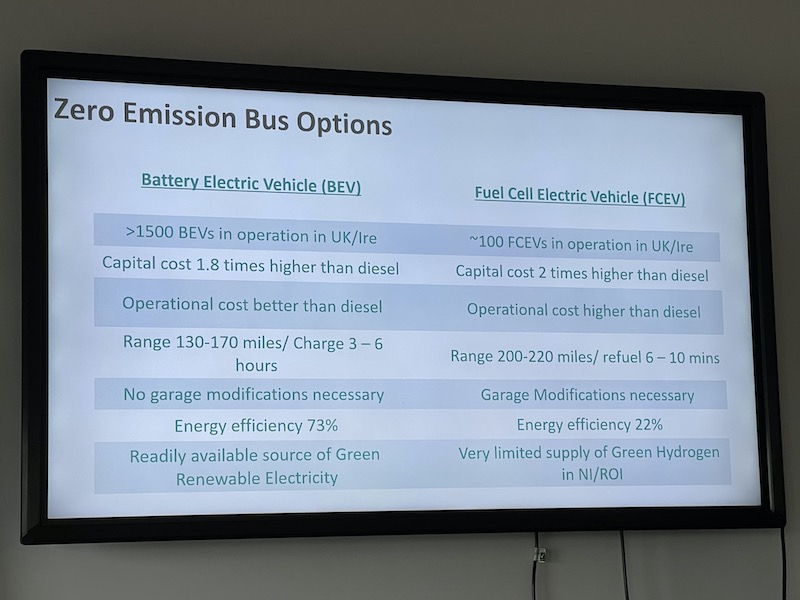
The Translink team concluded energy efficiency of a battery electric vehicle is 73% whereas a fuel cell vehicle is only 22%. However, the great unknown with batteries is how long they’re going to last, and what environmentally friendly arrangements will be in place for the disposal of life expired batteries.
Anyway, all that aside, it was interesting to take a ride on some of Metrobus’s new fleet last week and see how the buses perform on the road for passengers.

They’re operating on the company’s high profile Fastway branded route 10 between Crawley’s Bewbush residential area, the town centre, Manor Royal industrial area and Gatwick Airport’s South and North terminals.
It’s a very busy route running round the clock with a half hourly night service, peak hour 7-8 minute frequency, every 10 minutes off peak and 20 minutes evenings and early mornings. Vehicles are reported “to have been put on the most intensive running cards we have at this depot, going out at 03:00 and coming back at 01:00 in the morning”. It’s said the range is between 300 and 400 miles, with vehicles coming back on that running with 19% hydrogen left in the tank.

End to end journey time on route 10 is 30-40 minutes depending on the time of day/night and Monday to Friday daytime sees up to ten buses on the road. I took a round trip on the route and the company’s website clearly shows which buses are hydrogen powered (there were five in operation the day I travelled) and which are ordinary diesel buses making it easy to take a few rides on the former but the ever helpful Tom Bowell was on duty in Crawley’s travel shop when I called in and he was able to guide me too (thanks Tom).
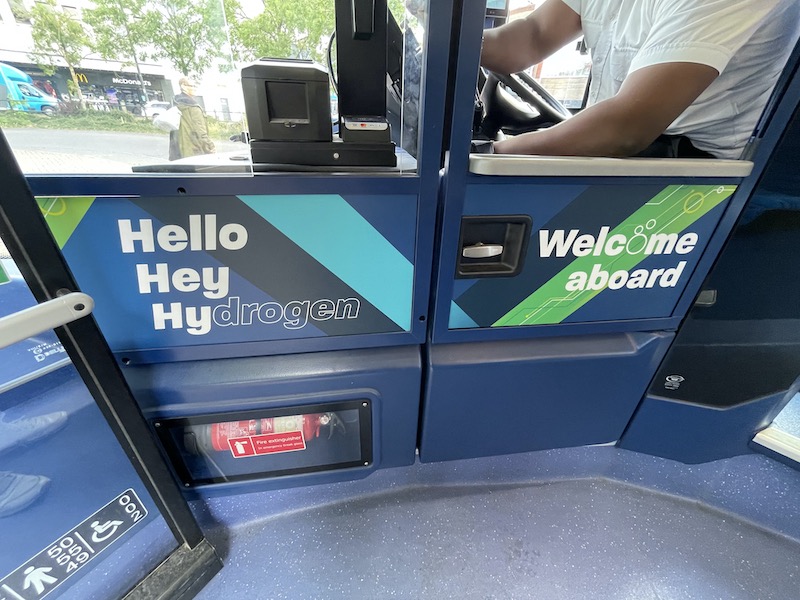
You definitely notice you’re on a hydrogen powered bus. You can’t miss the welcome posters as well as noticing the smoothness of ride on board. There weren’t any annoying rattles either although one of the buses I travelled on had a distinct squelching type sound from time to time which I couldn’t put my finger on what it was.

The buses have centre doors and are nicely kitted out inside with a good balance of accessible seats, wheelchair and buggy areas and rear section.
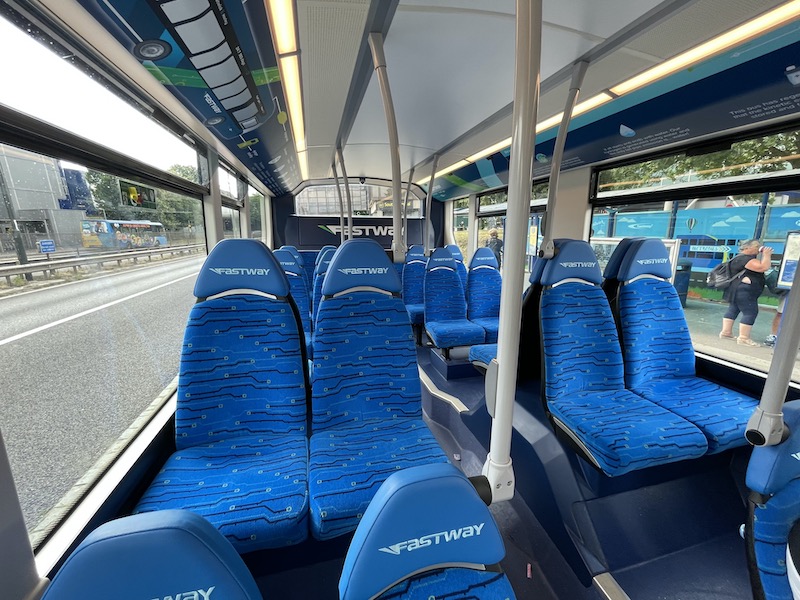
The buses have 35 ‘ordinary seats’ in a smart moquette and Fastway logos in the headrests as well as five tip-ups which can make way for two wheelchairs.
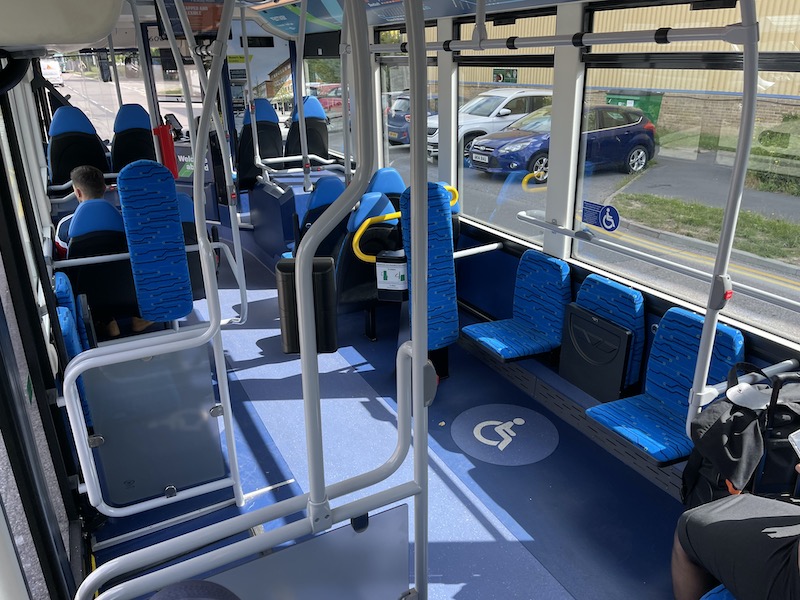
Most noticeable to me, but I’m not sure to many other passengers, were all the explanatory notices on the cove panels.

These explained all about the bus being hydrogen powered and how it works.


It’s good to see the environmental credentials of the bus being explained in easy to understand language but it is difficult to read much on cove panels and I wonder whether a leaflet explaining it all might also be helpful for passengers to pick up if they’re interested.

Whether ‘green propulsion’ buses per se increase passengers rather than the other features of bus operation to be found in Crawley is a moot point.

I’m thinking of features such as attractive service frequencies and timetable span across the day, evening and night; good value fares and ticket offers; easy to find information at bus stops…

… as well as printed timetables and online together with network and route maps and the all important bus priority measures…

… which thanks to investment by West Sussex County Council some years ago establishing the Fastway network are now an established feature of the town and have transformed bus provision.
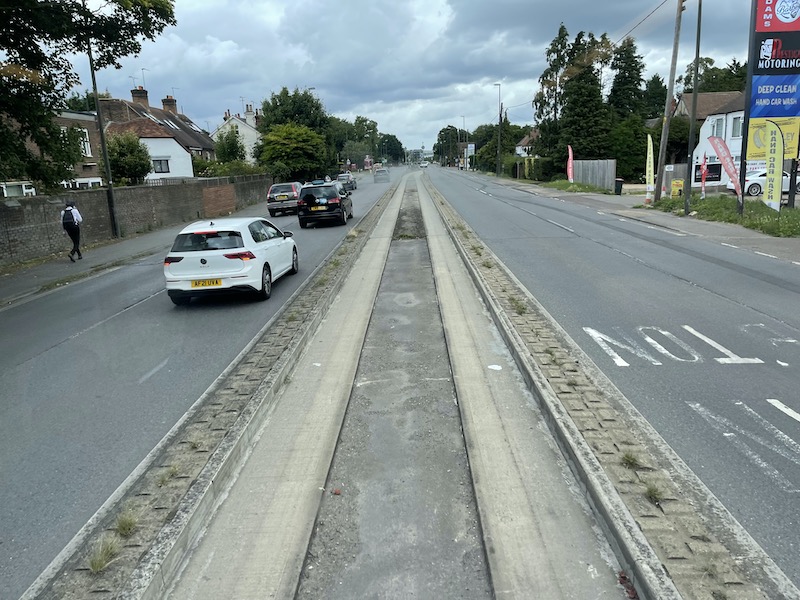

At one time it was a lacklustre operation which Arriva gave up on.
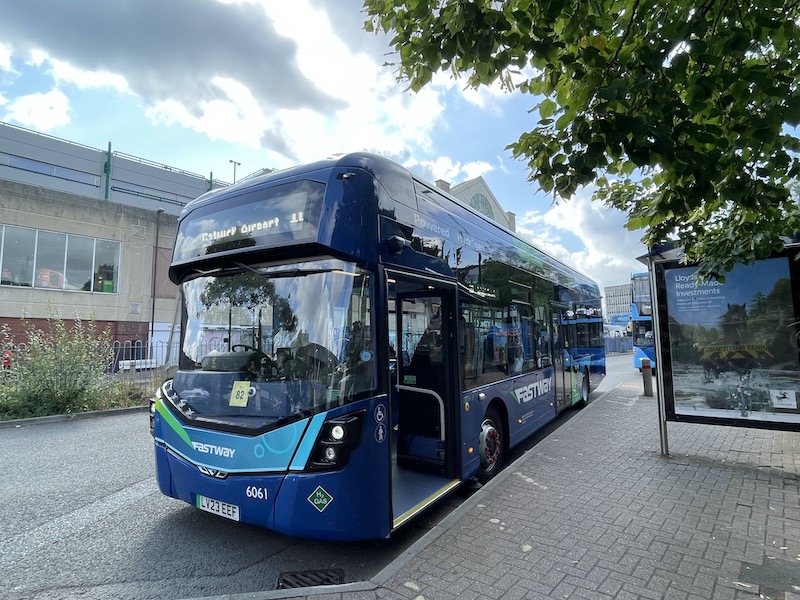
Now it’s an award winning network conveying an excellent image in a town where buses play a key role, so investing in green propulsion and being at the vanguard of trialling hydrogen is something that’s very positive to see. I hope the trial works out and becomes a resounding success.

Roger French
Blogging timetable: 06:00 TThS with DRT Su specials.
 BusAndTrainUser
Strictly, the hydrogen buses on Merseyside belong to Merseytravel, and Arriva and Stagecoach operate them on their behalf.
LikeLike
And the Merseytravel buses are ADL, not Wright
LikeLike
Good points, thanks. Have updated the wording.
LikeLike
Hydrogen fuel cells normally have an efficiency of at least 60% . Wright quote a range of up to 650 miles but the range probably depends on the model and usually the manufactures quoted ranges are o the optimistic side. Probably there is scope for further development with hydrogen buses and the cost of the fuel should fall as demand for hydrogen vehicles increases. Currently it i quite a small market
One thing that is being developed is ways of using excess Wind Turbine capacity. Currently the answer is to pay to have the turbines turned off. About 30% to 50% of the turbines capacity is effectively wasted
There are three methods at present of storing excess capacity
a) Batteries
b) Hydrogen
c) Compressed air
Compressed air at present has been limited, It is mainly used by specialised mining vehicles where you do not want anything potentially explosive or that emits fumes
There have been a few trials to run vehicles on compressed air but they have not been very successful
There are pilots that will use compresses air to power the turbines in a power station. There is one trial not yet started in Manchester
Using excess Wind turbine capacity to produce hydrogen looks to be more capacity. It can then be used as a fuel for vehicles or for power stations
Hydrogen looks to be the most promising for lorries. Batteries simply do not have the capacity or range at present., They are also very bulky and heavy
Construction vehicles etc are also problematic for batteries. JCB has produced a number of hydrogen products for the construction market.
LikeLike
A funding deal with Surrey CC?
LikeLike
Apparently Surrey County Council has committed £16m towards this scheme as part of their investment to accelerate the roll out of zero emission buses. Brilliant initiative by Surrey and Metrobus.
LikeLiked by 1 person
Obviously a very positive step forward, and indeed both hydrogen and electric buses do give a much superior ride. But since Crawley’s services turned from lacklustre Arriva to gold-plated Metrobus, in part because of the insatiable appetite for air travel, local buses have become extremely crowded for most of the day. But it is disappointing that they remain single-deck for no obvious reasons than supposed slower loading and unloading for double decks. With dual doors, as Brighton has discovered, and passengers mainly only travelling to/from Gatwick or Crawley town centre, the extra time factor balanced against a much more comfortable journey would be negligible.
LikeLiked by 1 person
I last travelled on Crawley Fast way many years ago. My enduring memory of the kerb guided busway sections was the ‘less than smooth’ ride over the drain covers. To allow rainwater to drain away, these are naturally lower than the rest of the road, but it gave an undulating ‘clonk clonk’ to the ride.
Has the highway authority found a solution to this problem, that might offer a smoother ride for passengers?
LikeLiked by 1 person
In reply to Petras, regrettably, a common fault with most bus lanes in urban streets and not just on Crawley fast track.
LikeLike
Agreed Terence, but the problem is magnified on a kerb guided busway as the bus wheels are necessarily close to the kerb and the driver won’t naturally have the freedom to avoid them. At least with a conventional bus lane there is a bit of leeway.
LikeLiked by 1 person
All roads will have drains and the covers should be flush with the road service so there should be little noise from going over them at normal road speeds and other than with guided buses the bus expect when coming into bus stop will be away from hr drain covers
Either there is something wrong with the drain overs are you are very sensitive to noise
LikeLike
Bob, it’s not the noise that is was bothersome. It was the repeated drop down, first by the front wheel, then by the back wheels. A very un-relaxing ride, sadly.
LikeLike
There Green claim is not as Green as they try to make out. To produce desalinated sea water you need enormous amounts of energy which is the main reason it is not very widely uses as it is very costly
LikeLike
Hydrogen ‘the only option’ for Metrobus Fastway ZE
Hydrogen fuel cell-electric remains the most realistic zero-emission technology for usage cases requiring very high mileage and utilisation capabilities. That is the verdict from the Go-Ahead Group after its Metrobus subsidiary launched 20 Wrightbus GB Kite Hydroliner single-deckers on 29 June.
They say they need a 300 mile range and do not have the time to recharge EV’s
They hydrogen is stored at the garage in liquified form. 18 bus parking places have been lost to allow for the hydrogen storage and fuelling. The facility installed though can cope with up to a 100 buses
Metrolines view is hydrogen is needed for intensive urban and long distance bus services as currently EV’s do not have the range and the battery technology is not advancing much
They are seeing the cost of hydrogen fall and expect the cost of hydrogen buses to fall as well as volumes increase
There have certainly been reports of areas where EV’s have been deployed having to go back during the day for a recharge which is an expensive and slow business
It is looking as if Hydrogen will play a much bigger part in the bus network unless battery technology improved
EV’s seem to be working in London but they usually have long lay over times and due to traffic congestion do not run up much milage and most run close to there garage which is often not the case outside of London
LikeLike
Trolleybus v battery electric bus pros and cons. Food for thought.
LikeLiked by 1 person
re could b some sense in having overhead lines in the central section. Other possibilities being a Pantagraph system with the return path being through the road
LikeLike
The real contribution buses could make towards greening our land would be through massive modal shift from car to public transport. That really ought to be possible in urban areas where the vast majority of people live. Then it wouldn’t matter if they were still fossil fuel powered. As it is hydrogen seems problematic. I think it’s deemed highly inefficient for train operations.
LikeLiked by 1 person