
Thursday 13th July 2023

Along with some bus industry colleagues I recently paid a visit to Belfast hosted by the team at Translink which included a look at three interesting public transport developments in the city.
Translink employs 4,000 staff making it one of Northern Ireland’s largest employers. It runs 1,400 buses and trains across Northern Ireland carrying 300,000 passenger journeys per day. There are 80 bus and rail stations across its network and it also has responsibility for 300 miles of rail track and a £3 billion railway asset.
Park & Ride is big business across the Province with 30 rail based sites and 33 bus based sites offering a total of just over 10,000 spaces. Pre-covid these sites had 83% occupancy but utilisation is currently running at 62% with rail recovering better than bus at 79% and bus at 51%.

The three projects we heard about during our visit were: the move to net zero, Glider and the new Belfast Transport Hub – a new combined bus and rail station being built in central Belfast.
Net zero

Translink’s target is to achieve a 50% reduction in emissions by 2030, net zero by 2040 or sooner and be ‘climate positive’ by 2050 or sooner.
Following a pilot in December 2020, which saw three hydrogen buses introduced in Belfast, 80 electric and 20 hydrogen buses went live in March 2022.

The next phase this summer sees a fleet of 38 Wrightbus StreetDeck Electroliners (10 double deck and 28 single deck) electric buses on the Foyle Metro network and another 100 electric buses for Ulsterbus and Metro in Belfast are planned for Summer 2024.
Glider
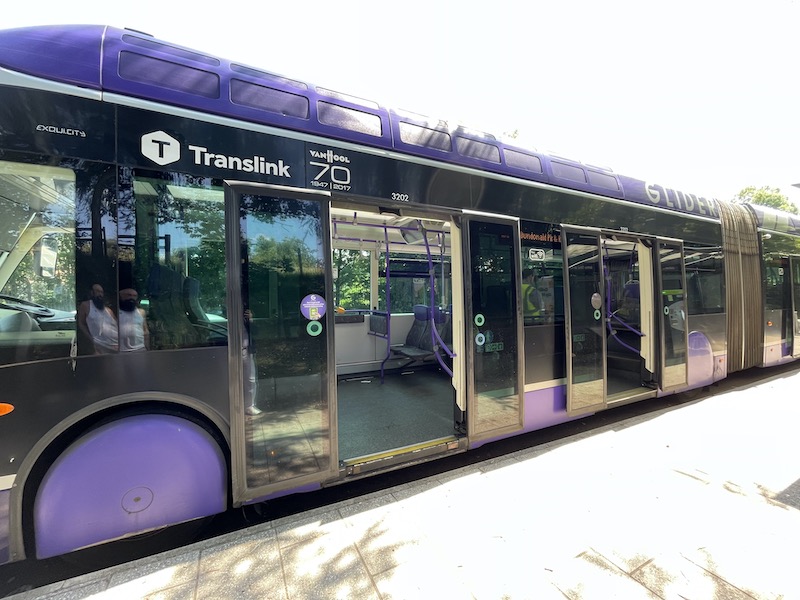
Phase one of the flagship Glider project saw a fleet of VanHool articulated buses connect east and west Belfast via the city centre begin running on a high profile bus priority protected route numbered G1 in September 2018 together with a shorter G2 route between the city centre and Titanic Quarter. These routes are now firmly bedded in with passengers well used to the arrangements for off-board ticketing and the attractiveness of a 7-8 minute frequency.

The vehicles have unashamedly been made as ‘tram like’ as possible with bus stops effectively ‘tram stop’ like too and located further apart than traditional bus stops.
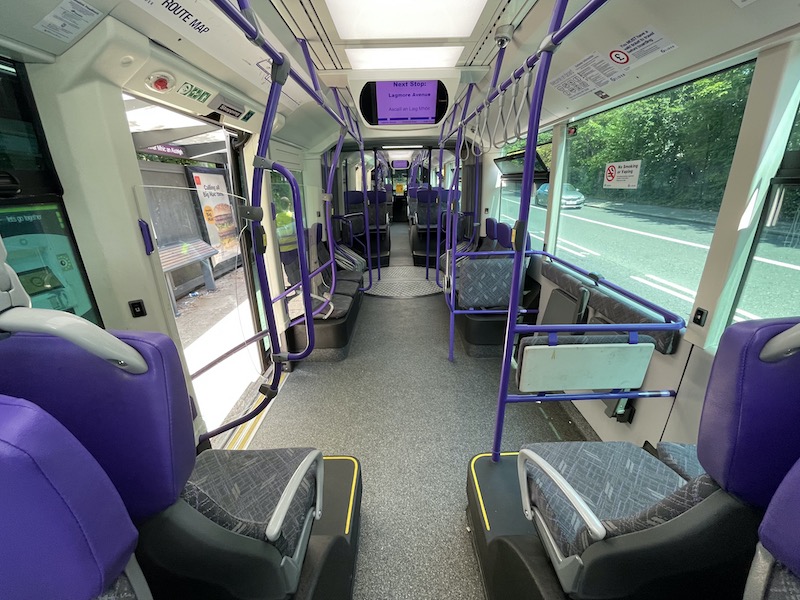
Carrying capacity is 105 passengers with 42 seats and space for wheelchairs as well as buggies and shopping trolleys.

Results from Glider so far have been impressive with growth of 35% in passenger numbers. Park & Ride usage at the site at the eastern end of the route has grown by 75% and there’s been an 8% modal shift from car to public transport along the corridor.

To cater for this new requirement a new bus garage with 141 parking bays and a workshop was built and opened in Belfast, north of the city centre on a former industrial site.
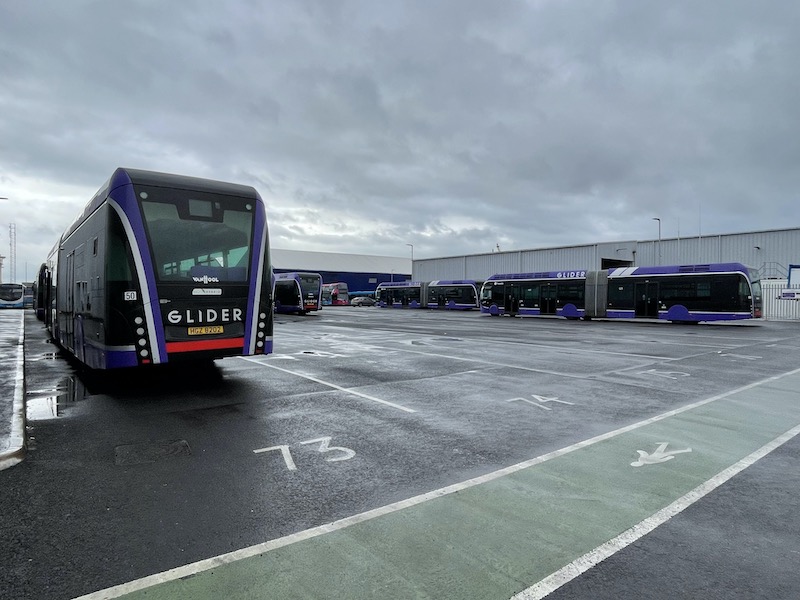
It’s a very extensive and impressive facility …
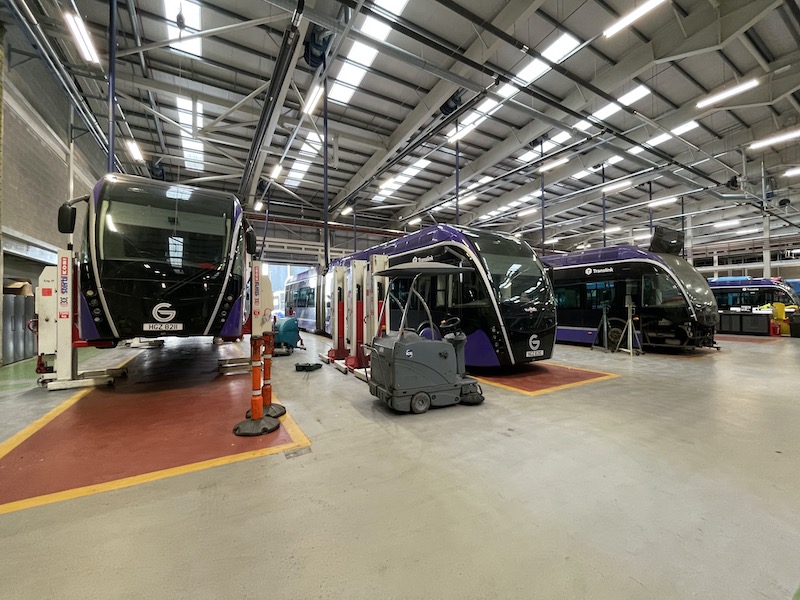
… which looks after the maintenance of vehicles from across Northern Ireland as well as those involved on the rail infrastructure side of the operation.
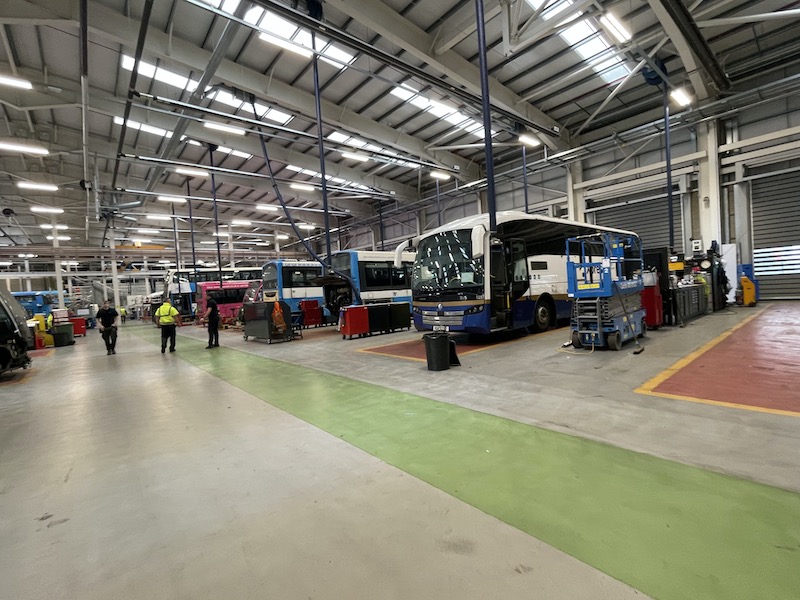
The site has also been kitted out with charging facilities for the electric powered buses based there …

… as well as a hydrogen fuelling facility.
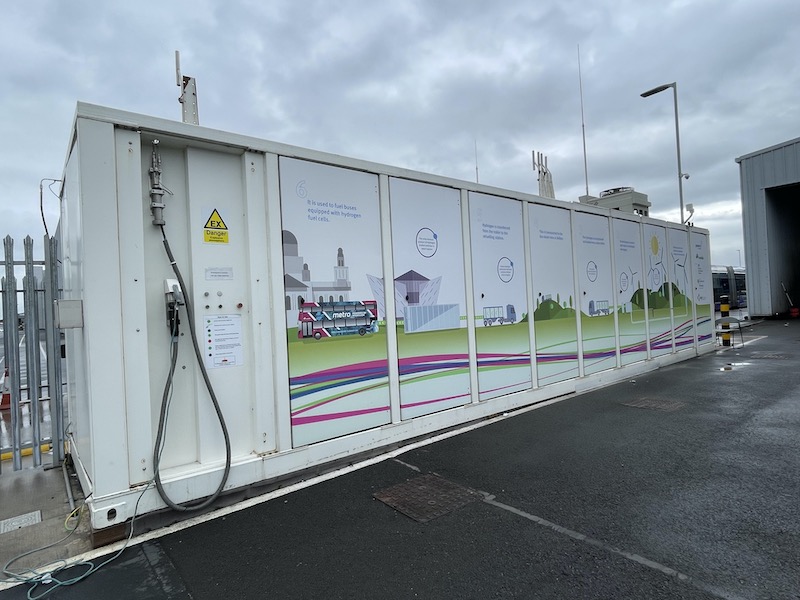

Were it not for the continuing political impasse in Northern Ireland’s Assembly, routes G1 and G2 would have been joined by more routes operating on a north-south corridor through the city. Plans are still awaiting approval.
Belfast Transport Hub – Belfast Central Station

This huge £175 million project began in 2020 with enabling works and the early construction of a Busway Bridge to enable access to the site once completed in 2025 or more likely 2026.
It will see the replacement of both the Europa bus and coach terminal and Great Victoria Street railway station – one of Belfast’s two main rail termini – both being incorporated on to the newly merged site located adjacent to Great Victoria Street station seen on the left in the photograph below.

The number of stands for buses (16 to 26) and platforms for trains (4 to 8) increase significantly and there’ll be 300 cycle spaces. The Belfast to Dublin Enterprise railway will also use the new station.
The work involved in building the all new Belfast Central Station is hugely complex, not least on the rail side with re-alignment and renewal of all the rail tracks to enter the new site as well as the eight new platforms capable of accommodating a range of 6 and 9 car sets as well as signalling and telecommunications.
There’ll be an integrated bus and rail concourse and, wait for it, a combined ticket office (yes, I know, a ticket office) where passengers will be able to buy either a bus, a coach or train ticket or all three.
We were able to take a look at how construction was progressing from a viewing platform overlooking the site.
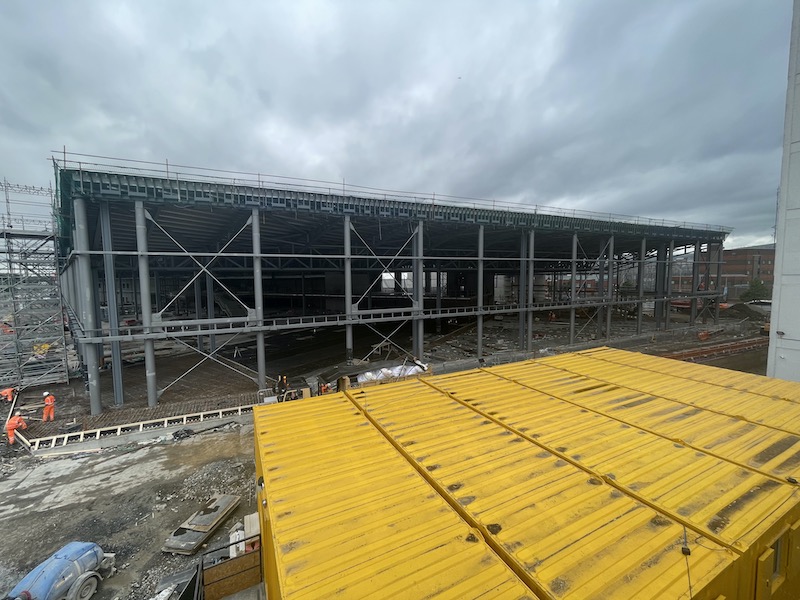
There’s still much to be done but you can see the structure taking shape.

But to give you a better idea of how it will look here’s a model of the finished project (above and below).

Roger French
Blogging timetable: 06:00 TThS and, currently, Su DRT extras.
 BusAndTrainUser
It seems, without number crunching, cheaper to build stations in NI than on the mainland. Can anyone crunch some numbers? £175m for Belfast seems very good value when compared with costs for a basic platform facility in England.
LikeLike
I really do not understand why building new stations in England is so slow and expensive
Platforms are normally made of prefabricated concrete section s that just need to be lifted into place
Footbridges could be of a modular design so they can be simply assembled in section again a few days at most
Usually just a bus shelter on platform
Running in a power supply might cost several thousand
Signs, lighting , camera and ticked machines say no more than £50K
Fencing etc perhaps another £50K
The biggest cost will probably be the lifts if it needs them
Should be able to build a station in 3 months in most cases but it seems to typically take 3 years
LikeLike
This report is most encouraging. It shows what can be achieved under a system where political posturing is less important than actually trying to improve public transport.
One issue though is that the bus station is designed as drive in reverse off, while the operator is buying artics (admittedly for a cross city service).
LikeLike
It does tend to indicate that the franchise approach works better than the free for all we have in most of England
NI has nearly all its but and rail under a single organisation as does London
Where we have no single organisation responsible for the service we tend to end up with poor and unstable services which drives passengers away
The EP’s in England are supposed to address those issues but there is no sign of that happening
LikeLike
Northern Ireland’s public transport system isn’t operated on the franchise model, it’s largely run by state-owned NI Railways and Ulsterbus/Citybus under the umbrella Northern Ireland Transport Holding Company (NITHC). It answers to the Stormont Government (or would if the Assembly were actually sitting) so local politicians have a direct say in public transport matters but day-to-day operations are in the hands of bus & train company management.
LikeLike
What is a “ticket office” of which you speak? Sounds like they may be a great idea across the whole rail network.
LikeLike
Having tickets offices at most stations no longer makes sense
The rail fares need simplifying and rail tickets sold in other retail shops such as travel agents and Post Offices
At major stations the ticket office could become a ticket office/ information desk for rail and bus and in some location tourist information as well
LikeLike
“Having tickets offices at most stations no longer makes sense”
So you keep asserting. Considering you’ve previously complained about bus operators closing their ticket offices, you seem rather hypocritical.
“rail tickets sold in other retail shops such as travel agents and Post Offices”
Very few rail stations have travel agents or post offices anywhere near them, and both of those are dying breeds in their own right.
I get the impression that you have an irrational dislike of rail ticket offices; who knows why?
LikeLike
Reopening the Lisburn to Antrim line with a station for Belfast International Airport and the other recommendations of the all island rail review should be the next developments.
LikeLike
Very interesting: so, 8 buses an hour plus more comfortable waiting facilities with big clear signs has given 35% more passengers. Is there anything really stopping passenger-friendly, enterprising and innovative bus companies from doing that on mainland Britain?
Re the ticket office – certainly encouraging, but I note that it will sell you a bus OR coach OR rail ticket. Any hope of that developing into a ‘Ticket-for-where-you-to-go-to-by-any-combination-of-means?
Thanks for another encouraging blog
LikeLike
The widespread use and retention of ticket offices in Northern Ireland, particularly at bus stations, is possibly due to a number of historical factors.
Firstly, most provincial Ulsterbus depots and adjoining bus stations were located on the site of former railway stations e.g. Dungiven and Newcastle (County Down) or in the former goods yards of still open rail stations, such as Antrim or Ballymena. The concept of buying a train ticket from a ticket office transferred to the replacement bus services.
There is still a very high weekend commuter travel, particularly students in/out of Belfast – in Sundays, out Fridays. During the troubles, when all transactions were in cash, it made security sense to deal with cash in more secure offices rather than drivers carrying relatively large amounts through remote locations and the prospect of armed hold-ups. The latter did occur but any cash, if taken, would have been minimal.
LikeLike
Yes – the passenger waiting facilities e.g. bus shelters are a local authority responsibility. Also, Glider benefits from lots of bus priority; again an LA responsibility and not down to the bus company.
Where you see the best bus patronage in the U.K., it’s where operators invest in new fleet and innovative services supported by enthusiastic public bodies – see Brighton, Nottingham etc
LikeLike
While it is great to have integrated facilities, if I’ve interpreted the plans correctly, the new Grand Central station is in fact around 300m further away than the currently centrally-situated facilities. That’s somewhere between 3 to 4 minutes’ further walk for everyone to access either buses or trains.
LikeLike
Very impressed with the Glider BRT, and looking forward to the new route opening. This is what BRT should look like, streamlined articulated buses, lots of bus lanes, proper stop infrastructure, passengers respond accordingly.
LikeLike
To think that there is an ex-London Mayor and ex-PM who would most likely have vetoed the articulated Glider if he could.
LikeLike