
Sunday 2nd July 2023
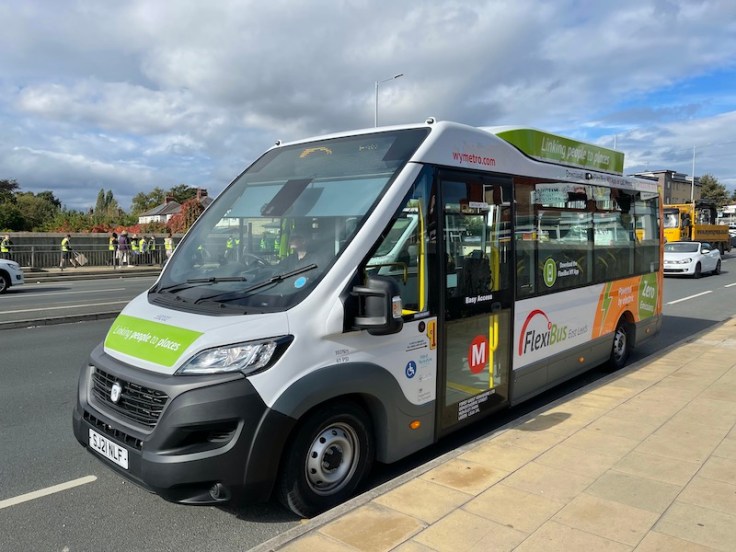
And another one bites the dust.
Introduced in September 2021 for “an initial period of three years” the East Leeds FlexiBus scheme was “the first trial of digital DRT within West Yorkshire” to be “used to evaluate the impact, effectiveness and commercial viability of the DRT service for the wider roll out of the service model in West Yorkshire”.
Funding for the service came from various sources including the DfT’s Better Bus Fund (£753,000), developer funding (£225,000), Leeds Public Transport Investment Programme (£1,160,000), the Local Transport Plan (£491,000) and a Fair Revenue Fund (£177,000) whatever one of those is.
Seven electric Orion E accessible minibuses were purchased by West Yorkshire Combined Authority at a cost of £1,543,432 and a three year contract was awarded to First Bus to operate the service for £1,499,265.

I gave the new service a try out back in October 2021.
Now, after just 21 months operation the plug is being pulled early on the three year trial as passenger numbers continue to be resolutely below the business case assumption and costs escalate above the allocated funding. A report before the Combined Authority’s Transport Committee meeting this Friday (7th July) recommends members approve an “early termination of the trial”.
Coming at the same time as North Yorkshire pulls the plug on its YorBus DRT “pilot” scheme based on Bedale, the Novus Flex DRT scheme operated by Vectare about to change to a fixed timetable in Leicestershire and Transport for Wales reverting another of its Fflecsi bus schemes back to an off-peak fixed timetable in Blaneau Gwent this latest DRT failure, having wasted vast amounts of public funding, will come as no surprise to readers of these blogs.
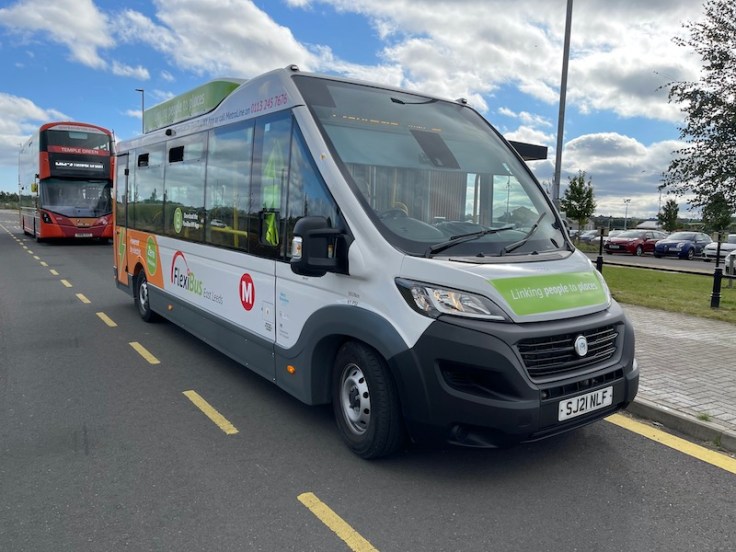
The East Leeds Flexibus report makes for grim reading. The service is being used by 242 passengers per week making 627 journeys. It’s a six days a week service so that’s just 40 passengers a day making 104 trips across six operational buses over 12 hours a day. You don’t even get to one passenger per bus per hour in that calculation.
In fact you get 0.55555556 passengers making 0.8 journeys per bus per hour. And this, after 21 months.
The report states “at the current monthly cost of the service this works out at £16.03 per passenger trip on average”. It goes on to explain the “recovery rate from fares revenue” was set as low as 15% in the Full Business Case but the service “is recovering only 12% of operating costs from fares revenue”.
It comes as no surprise to read passengers shunned the expected facility of using FlexiBus to connect with other bus and rail services “despite through ticketing arrangements with bus services”. “Only 2% of booked trips connected to Cross Gates Rail station” (I was one of them) “and there have been zero trips to connect with Park & Ride sites” – which isn’t strictly true as I did on my visit.

A survey in March 2022 revealed that 59% of passengers had previously walked or used public transport to make the journey on FlexiBus and only 9% had previously used a car.

But there’s worse. There’ve been “mechanical and technical issues” with the vehicles which has “impacted on service delivery” and even more alarming the “operating range of the EV vehicles is significantly less than the 100 mile range quoted in the vehicle specification and has necessitated vehicles returning to the depot for charging during the middle of the day”.
There’s more. “The scheduling algorithm had limited success in combing customer journey requests (trip aggregation) to maximise vehicle utilisation” leading to an average peak utilisation of 1.8 passengers. Shortcomings in the software and app necessitated higher manual intervention from the AccessBus team with “additional staff resource to be deployed”.
All this has understandably led to an impending financial crisis with two other factors at play. The developer’s £225,000 funding, assumed in the Business Case, is no longer available as the envisaged new housing has yet to appear and operating contractor First Bus has “indicated the fixed price submitted for the service underestimated the supervision resource element of their original bid together with higher vehicle parts and maintenance costs …. significant inflationary increases in the cost of labour, energy and vehicle parts on a contract with no provision for year-on-year inflation adjustment”.
You might be thinking, more fool First for entering into a three year contract with no inflationary uplift but that aside, the report says the company has said it is “seeking a significant increase in the base annual costs of the service” leading to the killer, nail in coffin, line: “which would result in an average cost per passenger trip of approximately £40.00.”
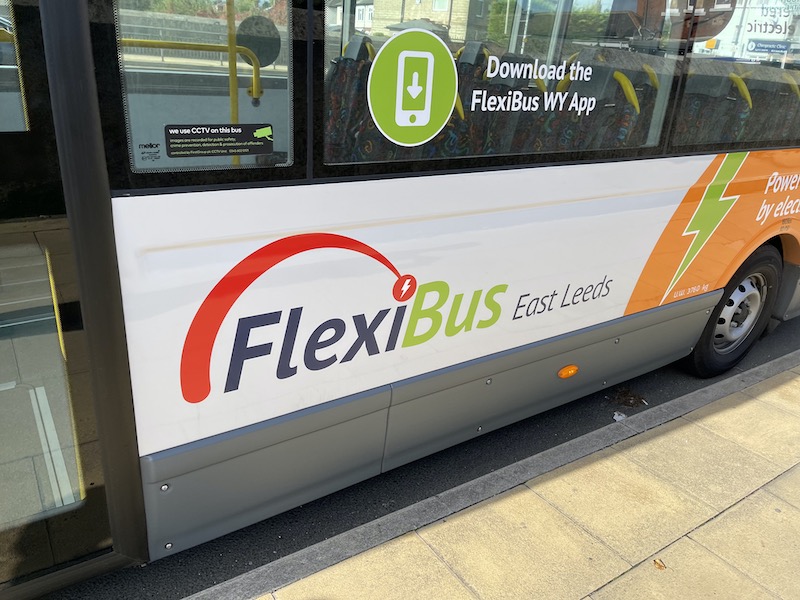
It’s no surprise therefore the Committee is being asked to agree the early termination of the service.
The report also recommends next steps should be for a “full lessons learned from this service” to “inform a further report to Transport Committee on the strategy for future DRT operations”.
A sharing of “lessons learned” with the DfT and other foolhardy local authorities seemingly content to waste millions of public money on these doomed to fail trials can’t come soon enough as I see another’s just begun in Worcestershire with one more due to start in Shropshire in a few weeks.

Roger French
Blogging timetable: 06:00 TThS with the occasional unscheduled Su extra – including today.
 BusAndTrainUser
I work in the area covered by the East Leeds DRT. I only rarely saw any of the vehicles carrying more than one passenger. The whole thing was an utter waste of money and resources. It’s much more relevant though that First continues to make heavy cuts to its services in Leeds, particularly in the early mornings and evenings. Trunk services like the 1 have been cut to hourly service, with other services (the 27 and 64 are examples) either cut totally or now requiring passengers to change buses in less salubrious parts of the city with no guaranteed connection. How on earth First gets away with it is beyond me. Leeds only has a bus service (no trams) and First is on a steady course of regular cuts to services, which when they do run are increasingly unreliable. Leeds should be prime bus operating territory. Metro (WYPTE) seems to have no motivation or power to do anything about it. The Mayor of West Yorkshire makes grand talk of future tram systems (which have been talked about for decades) but does nothing about the steady decline in the bus service. The East Leeds DRT was only ever an expensive distraction from these much more significant problems.
LikeLike
“Leeds should be prime bus operating territory.”
If an urban trunk route can only justify an hourly service, then it’s unfortunately no longer prime bus operating territory regardless of who operates the buses.
Looking at the timetable, it’s only early Saturday morning and late Saturday evening that the 1 is hourly; the rest of the time (combined with the 1b) it’s quarter-hourly weekday daytime and half-hourly evenings and Sundays. And it has all-night service. Presumably the Saturday morning service isn’t needed because most potential users are still in bed after staying out Friday night and the late Saturday evening service isn’t being used because they’re all back in the clubs until the early hours of Sunday.
Operators should be able to flex the frequencies they offer according to passenger usage, not be forced into running buses around empty just so they make a nice timetable on paper. Doing things that look good on paper are, after all, why that DRT debacle existed!
LikeLike
Yet another example of how the government have been criminally irresponsible with public money, funneling huge sums into private equity on the pretext of schemes that were never remotely plausible as long-term prospects.
LikeLike
Not Labour run Leeds City Council then? They are the incompetents who made the business case for it.
LikeLike
It was the West Yorkshire Combined Authority, not Leeds City Council.
I’m not sure what WYCA’s political make-up is nor why it should be relevant when the government policy of requiring local authorities to bid for funding applies to all local authorities regardless of whether they’re Conservative, Labour, Lib-Dem or some other control.
What we should be complaining about is the government insisting that local authorities bid for DRT funding or get no money at all for public transport.
Indeed, we should be questioning why national government keeps insisting that local authorities waste time and money putting together new bids for funding competitions each year instead of working with those local authorities to maximise the benefit of every pound of the limited available funding.
LikeLiked by 2 people
Councils of every colour up and down the country have been told that the only way that they will get funding for buses is if it’s in the form of DRT. Budgets have been stripped to the bone and beyond, and they are desperate for any grant that will allow them to muddle on for a bit longer without having to axe services completely and leave residents without any form of public transport.
LikeLike
I’ve only ever used a DRT once, and that was in Germany, where there was no alternative. Although I had a fairly relaxed schedule, I spent the previous day fretting that I could book it correctly, and having got there the whole trip was overlaid with further anxiety about getting back. And this for a relatively experienced public transport user.
To me, the biggest issue is a declining scale of confidence in the service provision, particularly for new users. Rail or tram with fixed infrastructure and published timetables allows one to travel with a degree of certainty (operational reliability permitting). Fixed route buses come next – with stops, map and timetable the next best thing. But with DRT there is nothing to indicate the service to a potential user unless they are in the know, nor any timetable commitment to get them to a given point at the right time, around which a trip can be designed.
(And no, I’ve never used an Uber either!)
LikeLiked by 1 person
And still DRT schemes are being rolled out!
Money that could be used to keep marginal services afloat while, say, a new development along the route is at least part complete so increasing the number of potential passengers is wasted on schemes that are little more than a very expensive taxi services.
What I have written will be all to familiar to any regular, even occasional, reader of this blog but hopefully, just hopefully, someone with influence will read this and (especially) the list of DRT failures above and realise that they are throwing good money after bad and consider alternatives. After all, I gather that you can teach rats not to keep making the same mistake over and over again, so we must hope …
LikeLiked by 2 people
Data on DRT is scant but most of these schemes fail by the end of their trial period. It begs the question as to why they keep rolling out DRT schemes when all the data suggests at least an 80% failure rate
Essex Country council have been merging their DRT routes and what remains is under review and may be axed
The concept of DRT feeding into so called transport hubs seems to be growing. There is less data on this but what there is indicated it does not work
Why did they buy buses for a trial? It would make more sense to lease or hire them. Now they have to find something else to do with these buses or sell them
Was there a break clause in the contracts or will they incur early termination costs ?
The range pf EV vehicles is always overstated. It can probably be achieved under ideal conditions but not actual conditions. Charging times as well are usually understated.
There are a lot of variables that affect the range of EV’s. Temperature is the biggest, In winter he range will be a lot less. Batteries age as well and will typically hold about 1% less charge a year
They appear to have spent almost £3M on this trial. That’s a lot of money to waste
Passengers per trip of less than 2 seems to be fairly typical for DRT plus lots of time parked up waiting
The High Wycombe scheme from data they have given appear to be successful but I am not convinced it is early days and I would not have thought that area would be good DRT territory
LikeLike
Not at all surprised, a waste of money. Thought it wouldn’t last this long.
LikeLike
“Potential” £40 a ride sees plug pulled on East Leeds DRT
LikeLike
In the light of another expensive DRT scheme failing, I just idly wonder if any authority has tried a scheme offering to reimburse local taxi firms for them to provide, within a fixed area and between, say 7am-7pm Mon-Sat, journeys to be made for the £2 bus fare, and also accept senior citizen passes?
The infrastructure is already in place with no need to buy or rent extra vehicles. Neither app nor algorithm required – just ring a simple number, which will probably be known anyway. If successful, it might even provide employment as taxi drivers for more people.
It would at least be interesting to see how the maths work-out.
LikeLiked by 2 people
The problem I can see is it becomes a taxi fare subsidy scheme with costs roaring out of control
LikeLiked by 1 person
Following upon the closure of YorBus, I note that they point out that two community bus services will still operate. I am not familiar with those but I have used some in East Sussex, they seem to be pretty well used and I found the service excellent. Maybe offer more support to them? After all, the staff will be part of the community they serve and may actually know when locals want to travel and where they want to go. They may actually be more responsive to the needs of particular passengers; if one is not on the return bus, hang around for five minutes in case they have been delayed, rather than driving off because the computer says so.
Oh, I forgot, photo-ops less likely to figure prominently in the local media come election time. Still, the passengers might not need to be told to smile!!
LikeLike
99% of DRT schemes seem to be a waste of money and/or fail before the ‘pilot’ finishes. Is it not time for the National Audit Office to step in and do a Value for Money report, to help ensure other local authorities do not fall into the same trap?
LikeLike
Thanks Roger. I will pass this blog on to the 3 Leeds City Councillors for the area who take an interest in buses. It will inform them from an unbiased knowledgeable spectator .
LikeLike
Local authorities and transport companies in recent years seem to have adopted Demand Responsive Transport as the panacea panacea to doing something (anything) about public transport provision in the desperate hope it achieves something, but usually nothing. Unfortunately the answers to achieving greater public transport use are often far more difficult to deliver and more costly though deliver far better results. As ever with many things in life DRT is a wasteful tick box exercise. Politicians, planners and public transport providers ought to know better by now.
LikeLike
If DRT was a rail based product it would be a fine example of a “gadgetbahn”.
Do we not need to revisit high frequency fixed route (with hail & ride) minibuses for urban areas that are away from the main trunk routes? Exeter’s urban services were in decline prior to conversion to minibuses and then the passengers came back when they had a turn up and go service.
LikeLike
What I find strange about these DRT schemes is apparently the money for them is ring fenced and can’t be used to finance normal timetabled routes but DRT schemes replace existing easy to understand timetabled routes.All so strange that they keep throwing money into them when they obviously don’t work.
LikeLiked by 1 person
The government has an agenda, which is to funnel as much public money into private hands as they can. These DRT schemes are often backed by financial investment bodies, and that is why the government is keen to give as much of our money away to them as they can. It is all about helping Big Money to make big profits, and not at all about providing a viable transport system.
LikeLiked by 2 people
What is so annoying is that, at least in my neck of the woods, the companies that are losing out are the small independents, the very companies that can put in a competitive bid for a tendered route, whose drivers know the routes and the regulars, who provide a service. Instead, as you write, tech companies and, frequently, larger bus companies (with the money to invest and are able to shrug their shoulders if all goes wrong – they will be able to move the vehicles to the next DRT that comes down the track) are taking over. The danger is that we will end up with monopolies where the companies decide what services to run, where and what type of service they will be. I thought we were told that was a bad thing?
LikeLike
Very interesting if depressing … I revisited your original blog, which was equally interesting, especially taken together with your encouraging recent blog about bus services in Nottingham. Perhaps some of the money saved by cancelling this project early could be spent on a day-out for Leeds councillors on Nottingham buses!
In almost every town or city it is difficult to make journeys other than to the centre by bus, and – by trial and, in most cases, error – DRT has demonstrably failed to solve this. It’s not just enabling supermarket shopping for all, but includes evening visits to friends, making occasional (but significant in total) journeys to speciallist shops etc. away from the centre, and access to the bus network for residents in back-streets or in estates built for car-owners who would now like to use buses and trains. So, general connectivity is paramount, and good interchange points are essential with big, clear information and quick, easy walks between stops on the radial and peripheral routes.
I’m not certain that anyone has tried what seems to me obvious: a network of peripheral (circular, semi-circular, hexagonal, spiral, whatever) routes with frequencies the same as the radial routes (just make them all 8 per hour, using smaller buses where the usage is lower). Before this suggestion is drowned in a chorus of ‘it’ll never be commercially viable’, the evaluation of whether this would work would have to be on ‘revenue gain for the whole network’, not just the ticket-sales for each route. Ideally other values (social inclusivity, reduction of traffic congestion and air quality etc.) would also be in the equation, plus – if there is also an increase in the now better-accessible interurban/intercity rail, bus and coach services – some recognition of that. I know this would make demands on the accountants, but – tough! it must be possible. After all, there is presumably some way of estimating the value of the Park & Ride services mentioned in your original blog: I’m sure they don’t cover their costs, especially if you include repaying the investment in the quality facilities you described.
LikeLike
Rick . . . it’s an interesting concept, and given an ideal world, with limitless pump-priming finance and a suitable road layout . . . it would be worth trialling; perhaps Milton Keynes, where the road grid network might suit?
I’ll just comment that passengers will only wish to travel for a purpose . . . be it shopping, entertainment, VFR (visiting friends and relations), commuting or whatever . . . if there is no reason to travel, then any “super” bus service will fail. Whether we like it or not, “society” is becoming more home-based; on-line shopping, working from home, satellite entertainment . . . this all reduces the overall passenger base.
Perhaps a better way forward would be to subsidise taxis? After all, a taxi is the ultimate “go-anywhere” form of public transport!!
LikeLike
Bus services fail at present because gthey dont run when most people need them and do not go where most people need to go and they are far to infreqent and dont run in the evenings or on Sundays
LikeLike
I have also wondered about radial and orbital networks. The goal should be to generate trips from anywhere to anywhere with a maximum of say two changes of bus. Start your trip on a radial, transfer at the first orbital you cross, then finally onto the radial that serves your destination. Short and properly thought out way finding required at all interchange points.
I found this film interesting on how Barcelona changed its bus network into a grid, snd wonder in the UK context a radial/orbital network design could achieve similar objectives.
LikeLike
“The goal should be to generate trips from anywhere to anywhere with a maximum of say two changes of bus.”
Have you asked passengers what they think about that idea?
I think you’ll find that the vast majority of passengers don’t want to make changes, they don’t trust changes, they worry about transfer failures (missing buses because of one leg running late, one leg being cancelled and so on) and all they want is to get on a bus which takes them where they’re going.
Yeah, Barcelona has gone for the grid system, but Barca has a top-down network imposed on it by the city planners, not one which necessarily pays attention to what its customers actually want.
I’d be interested in seeing the passenger numbers for Barca’s bus network although given the ticketing system in use I doubt they actually know the journeys actually being made apart from on the Metro.
LikeLike
If a service is frequent and reliable, passengers are far more willing to change, because they know they won’t be waiting too long. That’s how the Underground and most metro systems work, a lot of journeys do involve a change but because people know they won’t be left waiting around for ages it isn’t a problem.
LikeLike
“If a service is frequent and reliable, passengers are far more willing to change”
The problem there is that people expect higher frequencies with buses than they will accept on railways, possibly because information provision is usually better on railways, and more importantly they take a very long time to be convinced that services are reliable enough to trust connecting journeys.
Remember that we, the passenger transport industry, are fighting to get people away from the comfort and convenience of their cars. Insisting that people change vehicles for our own convenience is not helpful in that respect.
LikeLike
As the film explained, Barcelona had a bus network that took everyone to the city centre. Given that the city is polycentric (has multiple activity centres) this didn’t cater for trips between these centres. The grid system does. People are always saying passengers don’t like changing bus. No they don’t if the network is fragmented, infrequent, and only sees itself as a bunch of direct routes into town. No rail system (tram or metro) operates in this way, they are networks designed to cater for journey involving a change of line at some point. The Barcelona film showed the importance of designing the bus transfer points by moving bus stops closer to road junctions where routes bisect each other, and innovative wayfinding signage directing passengers to their desired stop.
LikeLike
York did have ambitions for a frequent orbital service linking the Park & Ride sites and key destinations around the ring road and the periphery of the city, but it never got off the ground. There have been a lot more orbital routes over the years, albeit usually running only hourly, but one by one they have fizzled out and all that remains is the 20 running from Clifton Moor to Monks Cross via Haxby, with some journeys extended to Heworth. It’s hard to know if any of the lapsed routes would have been more successful if they had been more frequent, but it seems unlikely that they would have been abandoned if there was untapped potential. Any such routes outside the largest of conurbations are always likely to require subsidy funding to keep them going.
LikeLike
An hourly service is never going to be very attractive. THey need to be at abcolute minimum every half hour and preferably every 20 minutes
LikeLike
I would say that orbital routes need to be as frequent as the radials that they connect with. Failure to do so adds weight to the argument that people don’t like changing buses.
Perhaps DfT money would be better spent on trialling a proper radial/orbital network, with several orbitals not just one, instead of wasting it on more DRTs.
LikeLike
“Perhaps DfT money would be better spent on trialling a proper radial/orbital network, with several orbitals not just one, instead of wasting it on more DRTs.”
I absolutely agree with this suggestion. What we need is a properly funded trial, lasting more than the few months of most UK trials, to see if such a network would be successful or what changes would have to be made to make it successful in the UK environment.
I’d also like to see a city-network-wide free-at-the-point-of-use trial somewhere in the UK, because being a cynic I suspect that even free buses will fail to get a significant proportion of car users out of their tin cans and I’d like to know what excuses they all come up with if fares aren’t an issue and service levels are as good as they’re realistically ever going to get.
LikeLike
Np one voted for or wants a combined authority whose only purpose seems to be wasting taxpayers cash, I have a beef with West Yorkshires combined authority and the useless Mayor, (nobody wants either), on their accountability to us the payees on how they seem to splash out vast sums of money without any comeback when these things fail, and are able to keep coming up with more expensive crackpot schemes, it is bad enough that this authority can over-ride elected councils to build more and more anti-car road changes, bike lanes that nobody uses, low traffic neighbourhoods, which affect the emergency services mostly and anything else to force motorists into buses and bikes, not going to happen Tracy. The sooner this madness and these self important bureaucrats are abolished and the drain on public finances stops, the happier we’ll all be.
LikeLike
Do you feel better for that rant?
LikeLiked by 1 person
I reckoned, when the DRT scheme in Watford started, that the £4m budget (over 4 years) would pay for a doubling of the town service frequencies for two years, assuming no increase in revenue.
If the revenue doubled as well, then year 3 would only require a small extra financial contribution.
I accept that this particular DRT started in July 2020; so not auspicious timing, but AFAIK the financials are appalling …. unsurprisingly the Borough Council are silent on the matter.
I’ve never seen any minibus with more that 1 passenger on board …. most of the time they are empty.
Surely the results from around the country have provided enough information …. or does the DfT simply issue the funds and not care afterwards??
Such a waste …..
LikeLike
Thank you for your comprehensive coverage of DRT schemes. I think the simple rule is that if a DRT service is carrying less than four passengers, you might as well run it with a taxi 🚖 at much lower cost. Small buses running about with no or one passenger is a waste of public money. (It’s never a waste of private money because such a service would be completely unviable.). Much easier not to have to book and just turn out for a fixed route timetabled service, otherwise known as a bus.
LikeLiked by 1 person
How an earth can they continue to deploy DRT services. There have been a considerable number of DRT services most of which have failed.
There is no way that there can be any sensible business case for them.
Most get so few passengers the money runs out before the trial period expires
On the data available DRT services typically achieve less than 2 passengers an hour So any business case should only assume in the region of 2 passengers an hour
LikeLike
Paul Kirby says he is going to pass the blog onto three Leeds City Councillors. Could he also copy it into the DfT…….you never know, Someone might just wake up to this continuing scandalous waste of public money.
Forget the politics, the only reason DRT is being allowed to flourish the way it has, is the total lack of understanding of how basic bus services actually work and what passengers actually want. Those at the helm have probably never used buses in their life, and nor the “Consultants” who draw a fat fee for selling these “New Clothes to the Emperor”.
LikeLike
The approach that worked was to have local routes feeding into a central bus station where you can connect to inter urban routes and possibly rail but councils are doing away with bus stations deciding they are redundant
Strangely they have decided transport bus i.e a bus stop on the edge of town is the answer. The theory being DRT feeds into these hubs but you are likely to have only one low frequency scheduled service from that hub. The chances it will connect with DRT is low and it will probably not go where you want to
What might work is a circular service around a town that connects with other
radial routes from the central hub in the town. It could also connect with DRT
Most current bus service are based on town centre Market town routes but these places are far less important than they used to be and mot places people now want to travel to are either unserved or have very limited services that are of little use to anyone
It needs decent frequencies to work though. At least every 20 minutes. The other big problem is road planning is so poor designing a workable circular route might be near impossible
LikeLike
I personally think it’s really thoughtless and callous to have posted this. Not a single thought was given to the drivers or those that might lose their jobs if this service goes down. If the service had been confirmed cancelled by metro and first then yes go ahead, but at the moment this blog has done nothing but cause panic and unrest among the drivers and employees. Journalists have a responsibility to check their facts and their sources and consider those involved. You could have atleast waited till it was officially decided or confirmed by metro so the employees didn’t need to hear about it from some jobsworth who doesn’t care abut the families involved. Think before you post.
LikeLike
The drivers will have some idea of the situation, They will know that they are waiting around for the next booking, not occasionally but regularly. They will know if fewer drivers are rostered now than when the scheme started. They will know the problems experienced with the batteries. They will knew about the situation regarding developer funding.
Does that mean that I (and Roger, for that matter) have no sympathy for the drivers; of course not, I don’t know what the situation is regarding drivers in Leeds but round here (south east) they are in very short supply, journeys are being cancelled. As they are almost certainly reliable, dependable, customer friendly drivers, it will almost certainly mean that First don’t have to be so active on the recruitment front in the near future.
There was a story from late last year that stated how well it was doing, how the numbers were well up. Was this irresponsible, because the facts are probably accurate but from a low base.
I understand your concern for the drivers, but I suspect they are all too aware of the situation.
LikeLike
Actually no they didn’t know. Today they have gone into work not knowing if they have jobs because they have had to hear from customers that their position is being scrapped, before they heard anything from their bosses. Obviously the situation hadn’t been good for a while but thats different from being told by a blog that you’re going to be out of a job.
LikeLiked by 1 person
I’m surprised and very sorry to hear that. I would be interested in knowing whether First were aware of the situation (because they would hopefully have been aware of the contents of the report to be discussed this Friday).
Hopefully, for the reasons I gave before, First can reassure them that their jobs are safe.
LikeLike
Don’t blame this messenger for a failure to communicate by those with responsibility to have done so.
Details were published online in the public domain last week on WYCA’s website:
Click to access Item%206%20-%20East%20Leeds%20Flexibus%20Trial%20Review.pdf
LikeLike
It’s interesting to note that one form of DRT does work, in the USA, and makes a profit without direct government intervention: Shared van shuttles. (The level of government intervention is in the regulation of taxicab prices, which sets a priceing peg for the shared van shuttle services). Services like Uber/Lyft have disrupted this business due to bypassing of taxicab fare regulations and venture capital subsidy of fares (in early years).
Shared van services typically are prebooked 12-24 hours in advance, and usually start or terminate at a transit hub (airport) but don’t have to. Given the desired dropoff time and location, the shuttle service will quote a fee and a pickup time (which usually has generous slack and often results in a very early arrival). But that fits the definition of DRT. The services will also take bookings as a full vehicle charter at a discount for larger groups.
The benefit to the customer is usually a significant discount on taxicab prices, fixed price quotes (no variable prices from Uber) and an element of timing certainty.
Of course the cost of a shared van shuttle is a much higher cost per mile than a bus (which is often not a viable alternative) and certainly beyond funding and subsidy model of public service attempts at DRT.
DRT is a viable business, but only with the right customer base and financial model.
LikeLike
Shared van shuttles are common in Central America and we went on two one internally in Guatemala from Guatemala City to Antigua (a city in Guatemala and not to be confused with the island of the same name!) and from Antigua, Guatemala to El Zonte,El Salvador.These are well maintained vehicles and mainly used by tourists and wealthy locals.They are sort of a hybrid of a bus and taxi.I assume that they only run on demand and not to a set timetable.I was reading that New York City has similar shuttles called Dollar Vans although they now cost $2 as the price has gone up since the naming.Apparently they cover routes that the NYC transport authority no longer cover but don’t partake a through ticketing and NYC transport passes.
LikeLike
@kevan I think the NYC “dollar vans” run semi scheduled routes (on a walk up basis from well known stops, a bit like the historical stagecoaches in the UK) so aren’t fully “DRT” in context of this article. SImilar services available in the larger cities in South Africa, Phillipines etc., wherever there is an unmet transit need and a lack of overbearing regulation.
NYC also has shared van shuttle services which are full DRT (but not for regular public transit because of the fares), most major US cities do have shared van shuttles and there are some “national” brands.
LikeLike
I am a driver for DRT , we have heard Nothing from our manager or Metro stating the service is ending or even when it could end , customers do treat our busses like a taxi , the booking app allows the customer to choose which bus they want and tells them the timescale of the journey, its a no brainer to know if your journey home takes 10 mins they choose a 10 min booking knowing they have bus alone , we have told them it needed changing to remove options, a customer should only select a booking and the app should choose which bus needs filling thats in area , the busses are not fit for purpose they are glorified ice cream vans , battery’s drain , lights wipers heating air con all are factors that drain battery’s, but all are needed , the last 12 months the busses have broken down and due to warranty our engineers was not allowed to fix leaving busses out service for days for a fix the could have been done in depot , East Leeds flexibus that had a cut off point to streets in east Leeds was a bad move , I had numerous people asking me why they couldn’t use bus as it said ‘out of area ‘ on app but they came from east Leeds, yet our busses drove from A to B right past their houses ! Cheers metro anyway thanks for the heads up the service is coming to a end , nice to read this article and not be approached first 👍 anyway it was a pleasure to serve my regulars for the last 18 months
LikeLike